
 แผ่นงาน
Figurative Language in Poetry
คำถามทั้งหมด: 20
Figurative language is
not meant to be taken literally or seriously
meant to be taken literally or seriously
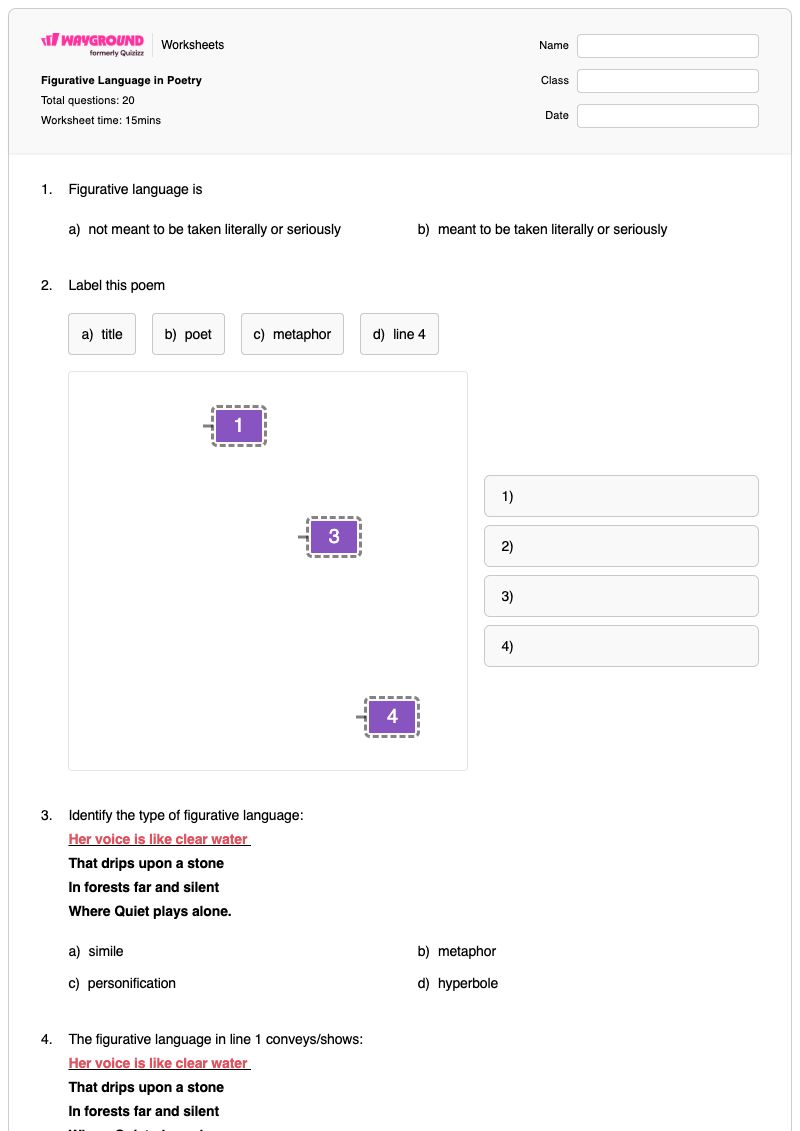
Label this poem
Identify the type of figurative language:
Her voice is like clear water
That drips upon a stone
In forests far and silent
Where Quiet plays alone.
simile
metaphor
personification
hyperbole
The figurative language in line 1 conveys/shows:
Her voice is like clear water
That drips upon a stone
In forests far and silent
Where Quiet plays alone.
appreciation
anger
disgust
loneliness
Personification is:
an over exaggeration
giving human/living qualities to something that is non-living/non-human
a comparison between two unlike things using like or as
A type of literal language meant to be taken as it is
Label the poem.
The poet compares the fog to:
The fog comes
on little cat feet.
It sits looking
over harbor and city
on silent haunches
and then moves on.
a quiet, sneaking cat
a loud, aggressive cat
a city at night
a slow boat
The figurative language and imagery convey which mood:
The fog comes
on little cat feet.
It sits looking
over harbor and city
on silent haunches
and then moves on.
peaceful
terror
anxious
wonder
This poem is an example of:
I’m bigger than the entire earth
More powerful than the sea
Though a million, billion have tried
Not one could ever stop me.
I control each person with my hand
and hold up fleets of ships.
I can make them bend to my will
with one word from my lips.
I’m the greatest power in the world
in this entire nation.
No one should ever try to stop
a child’s imagination.
personification
hyperbole
oxymoron
simile
What is being EXAGGERATED in this poem?
I’m bigger than the entire earth
More powerful than the sea
Though a million, billion have tried
Not one could ever stop me.
I control each person with my hand
and hold up fleets of ships.
I can make them bend to my will
with one word from my lips.
I’m the greatest power in the world
in this entire nation.
No one should ever try to stop
a child’s imagination.
a person's strength
a child's voice
the size of a fleet of ships
a child's imagination
What is the poet trying to convey in the last lines?
I’m the greatest power in the world
in this entire nation.
No one should ever try to stop
a child’s imagination.
a child's imagination should be feared
a child's imagination should be respected
The underlined is an example of:
I know a place where the sun is like gold,
And the cherry blooms burst with snow,
And down underneath is the loveliest nook,
Where the four-leaf clovers grow.
hyperbole
simile
personification
Alliteration
Where do four-leaf clovers grow?
I know a place where the sun is like gold,
And the cherry blooms burst with snow,
And down underneath is the loveliest nook,
Where the four-leaf clovers grow.
gold is mined
it is bright and private
cherries are ripe and delcious
Which lines contain RHYME?
I know a place where the sun is like gold,
And the cherry blooms burst with snow,
And down underneath is the loveliest nook,
Where the four-leaf clovers grow.
lines 1 and 3
lines 2 and 4
no rhyme
What does the FOURTH leaf of the clover represent?
One leaf is for hope, and one is for faith,
And one is for love, you know,
And God put another in for luck—
If you search, you will find where they grow.
faith
hope
love
luck
What do you need to do to find where the four-leaf clovers grow?
But you must have hope, and you must have faith,
You must love and be strong—and so—
If you work, if you wait, you will find the place
Where the four-leaf clovers grow.
exercise regularly to become strong
be hard working and patient
Research the best locations
Pray for luck
What does the metaphor in line TWO mean?
I know a place where the sun is like gold,
And the cherry blooms burst with snow,
And down underneath is the loveliest nook,
Where the four-leaf clovers grow.
snow is covering the trees
four leaf clovers are exploding on the trees
the white flowers on the tree look like snow
What MOST impresses the speaker about the rose?
Did you hear about the rose that grew from a crack in the
concrete?
Proving nature's law is wrong
it learned to walk with out having feet.
Funny it seems,
but by keeping its dreams,
it learned to breathe fresh air.
long live the rose
that grew from concrete
when no one else ever cared.
it grew in an unlikely place
It had no feet
It learned to walk
It breathed fresh air
HOW did the rose grow from concrete?
Did you hear about the rose that grew from a crack in the
concrete?
Proving nature's law is wrong
it learned to walk with out having feet.
Funny it seems,
but by keeping its dreams,
it learned to breathe fresh air.
long live the rose
that grew from concrete
when no one else ever cared.
it was lucky
it didn't give up
It learned to walk
someone cared for it
What is the speaker's ATTITUDE towards the rose?
Did you hear about the rose that grew from a crack in the
concrete?
Proving nature's law is wrong
it learned to walk with out having feet.
Funny it seems,
but by keeping its dreams,
it learned to breathe fresh air.
long live the rose
that grew from concrete
when no one else ever cared.
impressed
sorrow
humorous
loving
แป้นคำตอบFigurative Language in Poetry
คำถามทั้งหมด: 20
not meant to be taken literally or seriously
simile
appreciation
giving human/living qualities to something that is non-living/non-human
a quiet, sneaking cat
peaceful
hyperbole
a child's imagination
a child's imagination should be respected
simile
it is bright and private
lines 2 and 4
luck
be hard working and patient
the white flowers on the tree look like snow
it grew in an unlikely place
it didn't give up
impressed