

Wayground
L 3.3: Wind - Printable ศาสตร์ Worksheets ระดับ 7 - Wayground

L 3.3: Wind

Susan McDowell

สร้างโดย Susan McDowell

20 คำถาม

7th ระดับชั้น

ศาสตร์

อัปเดตแล้ว พ.ค. 2568

L 3.3: ลม เป็นแบบฝึกหัดวิทยาศาสตร์สำหรับนักเรียนชั้น ม.1 ที่ศึกษาว่าความร้อนจากแสงอาทิตย์ที่ไม่สม่ำเสมอส่งผลให้เกิดความแตกต่างของอุณหภูมิและความดันในชั้นบรรยากาศได้อย่างไร นักเรียนจะต้องตอบคำถาม 20 ข้อ—6 ข้อเป็นแบบเลือกตอบ และ 14 ข้อเป็นแบบเลือกตอบ—เพื่อระบุแถบความดันสูงและต่ำตามละติจูด เชื่อมโยงอากาศที่เย็นลงหรือร้อนขึ้นกับเซลล์การพาความร้อน และแยกแยะรูปแบบลมต่างๆ เช่น ลมค้า ลมตะวันออกขั้วโลก และลมละติจูดม้า แบบฝึกหัดนี้ยังตรวจสอบความเข้าใจของนักเรียนเกี่ยวกับระบบลมในท้องถิ่น โดยถามให้พวกเขาระบุว่าลมทะเล ลมบก ลมหุบเขา และลมภูเขาเกิดขึ้นเมื่อใดและมีต้นกำเนิดมาจากที่ใด ข้อสอบแบบถูกหรือผิดจะกล่าวถึงความสัมพันธ์ระหว่างดวงอาทิตย์ ลม กระแสน้ำบนพื้นผิว และการเคลื่อนที่ของชั้นบรรยากาศ ในขณะที่คำถามอื่นๆ จะเสริมสร้างคำศัพท์สำคัญและรูปแบบตามละติจูด แบบฝึกหัดที่พิมพ์ได้ฟรีนี้ออกแบบมาสำหรับการสอน การทบทวน หรือการประเมินผลวิทยาศาสตร์ชั้น ม.1 และมีเฉลยคำตอบที่สมบูรณ์เพื่อการตรวจสอบที่มีประสิทธิภาพ

การตั้งค่าแผ่นงาน

ขนาดตัวอักษร

S
M
L
XL
Waygroundแผ่นงาน

L 3.3: Wind

คำถามทั้งหมด: 20

ชื่อ
ระดับ
วันที่
1.
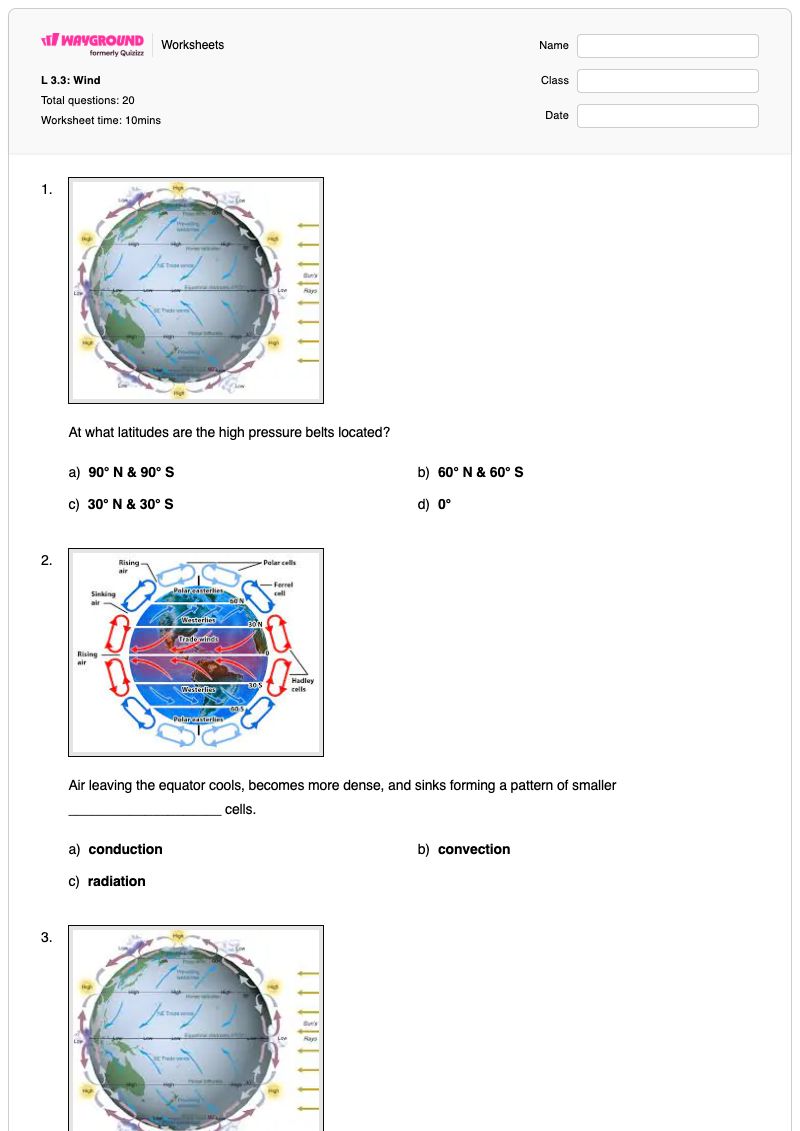
At what latitudes are the high pressure belts located?

At what latitudes are the high pressure belts located?

a)

90° N & 90° S

b)

60° N & 60° S

c)

30° N & 30° S

d)

0°

2.
Air leaving the equator cools, becomes more dense, and sinks forming a pattern of smaller ____________________ cells.

Air leaving the equator cools, becomes more dense, and sinks forming a pattern of smaller ____________________ cells.

a)

conduction

b)

convection

c)

radiation

3.
At what latitudes are low pressure belts located?

At what latitudes are low pressure belts located?

a)

0°

b)

30° N & 30° S

c)

60° N & 60° S

d)

90° N & 90° S

4.
Air leaving the poles warms, becomes less dense, and rises forming smaller convection cells and creating areas of…

Air leaving the poles warms, becomes less dense, and rises forming smaller convection cells and creating areas of ____________ pressure.

a)

high

b)

low

5.
Air leaving the equator cools, becomes more dense, and sinks forming a pattern of smaller convection cells. This forms areas…

Air leaving the equator cools, becomes more dense, and sinks forming a pattern of smaller convection cells. This forms areas of ________________ pressure.

a)

high

b)

low

6.
T / F: The sun heats the atmosphere unevenly and creates differences in temperature above Earth’s surface.

T / F: The sun heats the atmosphere unevenly and creates differences in temperature above Earth’s surface.

a)

true

b)

false

7.
The jet stream causes the deflection of moving objects from a straight path, which is caused by the Earth revolving around…

The jet stream causes the deflection of moving objects from a straight path, which is caused by the Earth revolving around the sun.

a)

true

b)

false

8.
Winds and surface currents are caused by the sun .

Winds and surface currents are caused by the sun.

a)

true

b)

false

9.
Check all statements that apply to sea breezes.

Check all statements that apply to sea breezes.

a)

occurs during the day

b)

occurs during the night

c)

originates over water

d)

originates over land

10.
Check all statements that apply to land breezes.

Check all statements that apply to land breezes.

a)

occurs during the day

b)

occurs during the night

c)

originates over water

d)

originates over land

11.
Check all statements that apply to valley breezes.

Check all statements that apply to valley breezes.

a)

occurs during the day

b)

occurs during the night

c)

originates over valley

d)

originates over mountain top

12.
Check all statements that apply to mountain breezes.

Check all statements that apply to mountain breezes.

a)

occurs during the day

b)

occurs during the night

c)

originates over valley

d)

originates over mountain top

13.
Zone of weak, variable winds, calm areas; located at 30° N and 30°S

Zone of weak, variable winds, calm areas; located at 30° N and 30°S

a)

trade winds

b)

polar easterlies

c)

horse latitudes

14.
Winds that blow between 30° latitude and the equator in both hemispheres

Winds that blow between 30° latitude and the equator in both hemispheres

a)

westerlies

b)

doldrums

c)

trade winds

15.
Winds that blow between the poles and 60° latitude in both hemispheres

Winds that blow between the poles and 60° latitude in both hemispheres

a)

jet stream

b)

polar easterlies

c)

horse latitudes

16.
Winds that blow between the 30° and 60° latitude in both hemispheres

Winds that blow between the 30° and 60° latitude in both hemispheres

a)

westerlies

b)

global winds

c)

doldrums

17.
Very little wind due to warm, less dense air and low pressure; calm area at equator

Very little wind due to warm, less dense air and low pressure; calm area at equator

a)

local winds

b)

trade winds

c)

doldrums

18.
Narrow belts of high speed winds that blow from west to east; subtropical and polar

Narrow belts of high speed winds that blow from west to east; subtropical and polar

a)

jet stream

b)

polar easterlies

c)

westerlies

19.
Winds that blow from any direction over short distances

Winds that blow from any direction over short distances

a)

global winds

b)

local winds

c)

doldrums

20.

Winds are caused by the uneven heating of the earth due to varying specific heats.

a)

true

b)

false

Waygroundแป้นคำตอบ

L 3.3: Wind

คำถามทั้งหมด: 20

1.
a)

90° N & 90° S

, c)

30° N & 30° S

2.
b)

convection

3.
a)

0°

, c)

60° N & 60° S

4.
b)

low

5.
a)

high

6.
a)

true

7.
b)

false

8.
a)

true

9.
a)

occurs during the day

, c)

originates over water

10.
b)

occurs during the night

, d)

originates over land

11.
a)

occurs during the day

, c)

originates over valley

12.
b)

occurs during the night

, d)

originates over mountain top

13.
c)

horse latitudes

14.
c)

trade winds

15.
b)

polar easterlies

16.
a)

westerlies

17.
c)

doldrums

18.
a)

jet stream

19.
b)

local winds

20.
a)

true

คำถามที่พบบ่อย

แบบฝึกหัด L 3.3: ลม ครอบคลุมเนื้อหาอะไรบ้าง?

แบบฝึกหัดวิทยาศาสตร์สำหรับนักเรียนชั้น ม.1 นี้ ประกอบด้วยคำถามแบบเลือกตอบและเลือกคำตอบหลายข้อจำนวน 20 ข้อ เพื่อประเมินเกี่ยวกับแถบความดัน เซลล์การพาความร้อน และรูปแบบลม นักเรียนจะได้ระบุละติจูดความดันสูงและต่ำ เชื่อมโยงการอุ่นขึ้นหรือเย็นลงของอากาศกับการเปลี่ยนแปลงความดัน แยกแยะลมค้า ลมตะวันออกขั้วโลก และละติจูดม้า และจำแนกประเภทของลมทะเล ลมบก ลมหุบเขา และลมภูเขาตามช่วงเวลาและแหล่งกำเนิด

ฉันจะใช้แบบฝึกหัดเรื่องลมนี้ในการสอนเรื่องแถบความดันและลมท้องถิ่นได้อย่างไร?

เริ่มแบบฝึกหัดโดยให้นักเรียนลากเส้นตามรอยความร้อนจากแสงอาทิตย์ที่ไม่สม่ำเสมอ ซึ่งทำให้อากาศร้อน เย็นลง ลอยตัว หรือจมลง จากนั้นใช้ป้ายละติจูดเพื่อคาดการณ์เขตความดันอากาศ ก่อนที่จะตอบคำถามที่เกี่ยวข้อง หลังจากนั้น ให้นักเรียนเปรียบเทียบสภาพอากาศในเวลากลางวันและกลางคืนสำหรับลมทะเลกับลมบก และลมหุบเขากับลมภูเขา โดยอธิบายว่าแหล่งกำเนิดของลมแต่ละชนิดสอดคล้องกับช่วงเวลาอย่างไร

ฉันควรระวังข้อผิดพลาดอะไรบ้างเมื่อนักเรียนทำแบบฝึกหัดเรื่องลมนี้?

ระวังนักเรียนที่เลือกคำตอบเพียงข้อเดียวในข้อสอบแบบเลือกตอบ โดยเฉพาะอย่างยิ่งเมื่อต้องระบุเขตความกดอากาศสูงสองเขตหรือเขตความกดอากาศต่ำสองเขต นักเรียนอาจสลับรูปแบบกลางวันกลางคืนหรือแหล่งกำเนิดของลมทะเล ลมบก ลมหุบเขา และลมภูเขา สับสนระหว่างลมค้ากับลมตะวันออกขั้วโลก หรือยอมรับข้อความที่ผิดในแบบฝึกหัดที่เชื่อมโยงการเบี่ยงเบนของวัตถุเคลื่อนที่กับการโคจรของโลกรอบดวงอาทิตย์

ฉันจะมอบหมายและให้คะแนนแบบฝึกหัด L 3.3: ลม ได้อย่างไร?

แบบฝึกหัดนี้มีให้ดาวน์โหลดเป็นไฟล์ PDF สำหรับพิมพ์ และเป็นแบบทดสอบดิจิทัลบน Wayground โดยมีเฉลยคำตอบครบถ้วนสำหรับตรวจสอบคำตอบทั้ง 20 ข้อ สำหรับการส่งงานแบบพิมพ์ คุณสามารถตรวจงานของนักเรียนได้โดยการสแกนด้วยแอป Wayground for Teachers

ฉันจะปรับแบบฝึกหัดเรื่องลมนี้ให้เหมาะสมกับนักเรียนของฉันได้อย่างไร?

ในส่วนการตั้งค่าขั้นสูงของแบบฝึกหัด คุณสามารถปรับระยะห่างระหว่างตัวอักษรหรือขนาดตัวอักษรเพื่อให้ตัวเลือกเกี่ยวกับละติจูด ความดัน และรูปแบบลมอ่านง่ายขึ้น นอกจากนี้ คุณยังสามารถใช้แบบอักษรที่เหมาะสำหรับผู้ที่มีภาวะดิสเล็กเซีย หรือแปลแบบฝึกหัดเป็นภาษาอื่นโดยยังคงรูปแบบคำถามแบบเลือกหลายตัวเลือกและเลือกหลายข้อเอาไว้ได้

ฉันจะหาแบบฝึกหัดแบบนี้เพิ่มเติมได้ที่ไหนบน Wayground?

Wayground นำเสนอชุดแบบฝึกหัดและโจทย์ฝึกหัดฟรีที่ครอบคลุมทุกวิชา พร้อมไฟล์ PDF และเฉลยคำตอบ เพื่อช่วยให้นักเรียนเชี่ยวชาญทักษะและแนวคิดที่สำคัญ ดูแหล่งข้อมูลเพิ่มเติมได้ที่ https://wayground.com/en-us/worksheets