

Wayground
Water Cycle Quiz - Printable ศาสตร์ Worksheets ระดับ 6 - Wayground

Water Cycle Quiz

Jamaura Williams

By Jamaura Williams

12 คำถาม

6th - 6th ระดับชั้น

ศาสตร์

153 เล่น

อัปเดตแล้ว ก.ย. 2568

แบบทดสอบวัฏจักรน้ำเป็นแบบฝึกหัดวิทยาศาสตร์สำหรับนักเรียนชั้นประถมศึกษาปีที่ 6 ที่สามารถพิมพ์ได้ฟรี ซึ่งช่วยเสริมสร้างความเข้าใจเกี่ยวกับวิธีการเคลื่อนที่ของน้ำผ่านวัฏจักรน้ำของโลก แบบฝึกหัดนี้ประกอบด้วยคำถาม 12 ข้อ—11 ข้อเป็นแบบเลือกตอบ และ 1 ข้อเป็นแบบเลือกตอบหลายตัวเลือก—นักเรียนจะได้ระบุการระเหย การควบแน่น การตกตะลึก การคายน้ำ การไหลบ่าของน้ำ น้ำใต้ดิน และชั้นหินอุ้มน้ำ เชื่อมโยงการเปลี่ยนแปลงสถานะกับอุณหภูมิ และตีความแผนภาพ แผนภูมิ และแบบจำลองอ่างเก็บน้ำของวัฏจักรน้ำ แบบฝึกหัดนี้ยังให้นักเรียนนำแบบจำลองไปประยุกต์ใช้กับสภาพการณ์ในโลกแห่งความเป็นจริง รวมถึงการตัดไม้ทำลายป่า การละลายของหิมะตามฤดูกาล ปริมาณน้ำฝนที่มากเกินไป ความเค็มของมหาสมุทร และการกระจายตัวของน้ำจืด คำถามเหล่านี้ช่วยให้นักเรียนคิดวิเคราะห์ว่าการเปลี่ยนแปลงของอุณหภูมิ พืชพรรณ ปริมาณน้ำฝน และปริมาณน้ำในอ่างเก็บน้ำ ส่งผลต่อการเคลื่อนที่และความพร้อมใช้งานของน้ำอย่างไร แบบฝึกหัดนี้เหมาะสำหรับการเรียนการสอน การทบทวน หรือการประเมินผลวิทยาศาสตร์ชั้นประถมศึกษาปีที่ 6 และมีเฉลยคำตอบครบถ้วนเพื่อการตรวจสอบที่มีประสิทธิภาพ

การตั้งค่าแผ่นงาน

ขนาดตัวอักษร

S
M
L
XL
Waygroundแผ่นงาน

Water Cycle Quiz

คำถามทั้งหมด: 12

ชื่อ
ระดับ
วันที่
1.
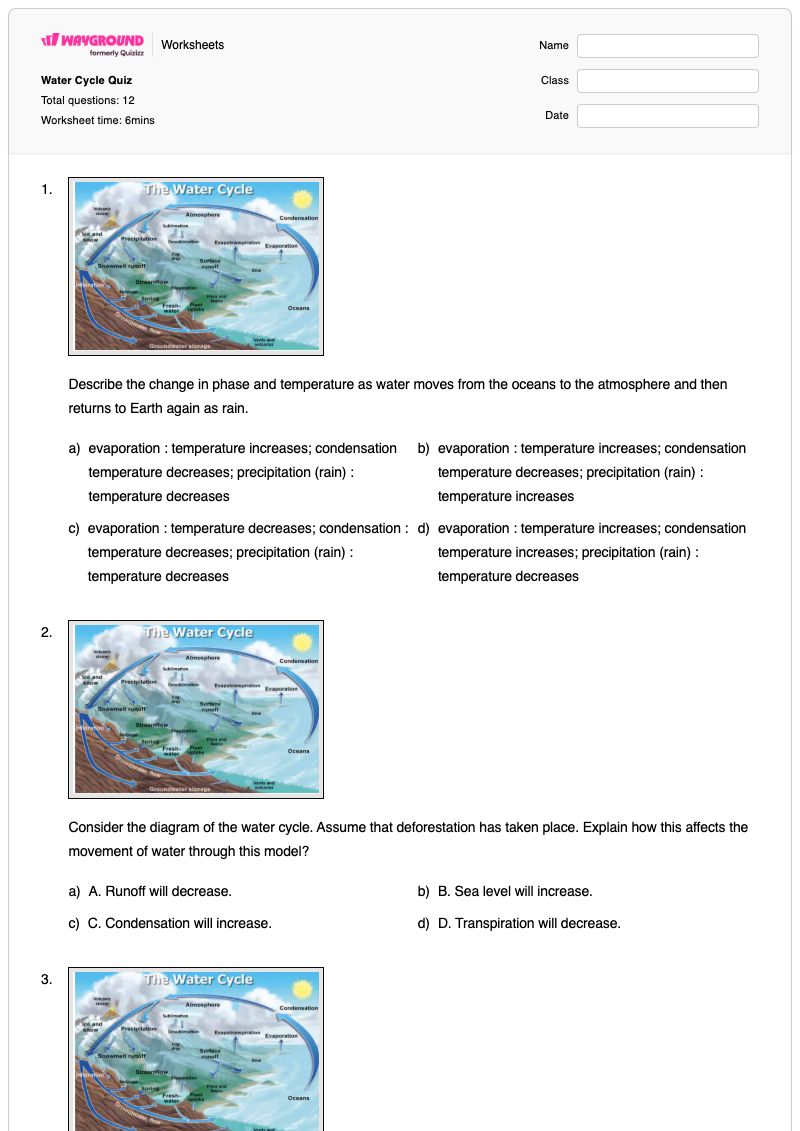
Describe the change in phase and temperature as water moves from the oceans to the atmosphere and then returns to Earth…

Describe the change in phase and temperature as water moves from the oceans to the atmosphere and then returns to Earth again as rain.

a)

evaporation : temperature increases; condensation temperature decreases; precipitation (rain) : temperature decreases

b)

evaporation : temperature increases; condensation temperature decreases; precipitation (rain) : temperature increases

c)

evaporation : temperature decreases; condensation : temperature decreases; precipitation (rain) : temperature decreases

d)

evaporation : temperature increases; condensation temperature increases; precipitation (rain) : temperature decreases

2.
Consider the diagram of the water cycle. Assume that deforestation has taken place. Explain how this affects the movement of…

Consider the diagram of the water cycle. Assume that deforestation has taken place. Explain how this affects the movement of water through this model?

a)

A. Runoff will decrease.

b)

B. Sea level will increase.

c)

C. Condensation will increase.

d)

D. Transpiration will decrease.

3.
Describe the role of temperature change in cloud formation.

Describe the role of temperature change in cloud formation.

a)

A. As water on Earth cools down, it condenses in the air and forms clouds.

b)

B. As water on Earth cools down, it evaporates into the atmosphere and forms clouds.

c)

C. Water on Earth heats up and evaporates into the atmosphere, then cools and condenses to form clouds.

d)

D. Water on Earth heats up and evaporates into the atmosphere. Water vapor continues to heat up forms clouds.

4.
Consider the diagram of the water cycle. Assume we have a very cold winter with lots of snow. The mountain top is piled high…

Consider the diagram of the water cycle. Assume we have a very cold winter with lots of snow. The mountain top is piled high with snow. Then it is spring. How will this impact the water cycle model?

a)

A. Runoff will decrease.

b)

B. Ground water will increase.

c)

C. Precipitation will increase.

d)

D. Transpiration will decrease.

5.

The Great Salt Lake in Utah has a saline content that can be up to ten times greater than the ocean. It is fed by three freshwater tributaries. What causes it to have such a high concentration of salt?

a)

A. Salt water from the Pacific Ocean flows back into the lake, where it becomes more concentrated.

b)

B. The ground underlying the Great Lake is composed mostly of salt, which is leached into the lake.

c)

C. The tributaries carry small amounts of salt into the lake that becomes concentrated when water evaporates.

d)

D. Plants the refine salt on the shores of the lake deposit waste that causes it to have a high salt concentration.

6.
The chart illustrates the distribution of Earth's Water. Which statement below is supported by the chart?

The chart illustrates the distribution of Earth's Water. Which statement below is supported by the chart?

a)

A. Most ground water is fresh water.

b)

B. 2% of the Earth's fresh water flows in rivers.

c)

C. 87% of the fresh water on Earth is found in lakes.

d)

D. About 2/3 of the fresh water on Earth is frozen.

7.
The oceans cover about 70 percent of the Earth's surface. Ocean water contains salts and we say that ocean water has a…

The oceans cover about 70 percent of the Earth's surface. Ocean water contains salts and we say that ocean water has a certain salinity. You are very familiar with the a salt: NaCL, but there are other salts in the oceans. Scientists estimate that if the oceans could be removed and spread evenly over the Earth's land surface it would form a layer more than 500 feet thick, about the height of a 40-story office building (NOAA). Scientists also believe that the amount of salt in the Earth's oceans remains pretty constant. Salt water-freshwater. Where did the salt in the oceans come from?

Salts dissolve in water. Look at the image of the water cycle. Hypothesize as to the original source of the salts in the oceans on Earth.

a)

A. Water collecting on Earth chemically erodes the continental crust.

b)

B. Elements found within the Earth, dissolved in water, enter the water cycle, and return to the oceans.

c)

C. Elements in the atmosphere fall back to Earth when combined with water in some form of precipitation.

d)

D. Evaporation leaves behind salts that eventually combine with the water that covers the oceanic plates.

8.
A student is proposing a model for the hydrologic/water cycle. The teacher asks that the student refine the model in order…

A student is proposing a model for the hydrologic/water cycle. The teacher asks that the student refine the model in order to more accurately reflects the amount of water in each of the types of reservoirs. Which revisions should be made in order to move accurately reflects the amount of water in each reservoir? Select three that apply?

a)

A. More water should be shown as frozen ice.

b)

B. More water should be represented as groundwater.

c)

C. The majority of the water should be shown in the ocean.

d)

D. The majority of the water should be shown in the atmosphere.

e)

E. The majority of the water should be shown in lakes and rivers.

9.
The image is a model showing the processes of the water cycle. Water uptake to the atmosphere occurs through the processes…

The image is a model showing the processes of the water cycle. Water uptake to the atmosphere occurs through the processes of evaporation and transpiration from plants where it condenses to form clouds. Clouds release the water through precipitation. During an extreme rainy season, what can we expect to happen to the surface ground water stored in ponds and lakes?

a)

A. Animals drink more water, so water levels decrease.

b)

B. Water levels will increase because there is more precipitation.

c)

C. Water levels will increase because there is more evaporation and transpiration.

d)

D. Water levels will decrease because there is more evaporation and transpiration.

10.
Clouds begin to form in the atmosphere when ___________ causes ______________ of the water on Earth.

Clouds begin to form in the atmosphere when ___________ causes ______________ of the water on Earth.

a)

A. The sun; evaporation

b)

B. Altitude; condensation

c)

C. A temperature drop; evaporation

d)

D. The prevailing wind; convection currents

11.
Precipitation moves down into the soil and becomes groundwater. Groundwater that travels into the saturated soil zone…

Precipitation moves down into the soil and becomes groundwater. Groundwater that travels into the saturated soil zone becomes part of:

a)

A. An aquifer

b)

B. The Oceans

c)

C. Precipitation

d)

D. Surface run-off

12.
The diagram shows the water cycle. At point D, condensation is occurring. How is water changing?

The diagram shows the water cycle. At point D, condensation is occurring. How is water changing?

a)

A. Water vapor (gas) is becoming liquid.

b)

B. Water is being stored in the atmosphere.

c)

C. Liquid water in the atmosphere is becoming a gas.

d)

D. Liquid water from the earth's surface is becoming water vapor (gas).

Waygroundแป้นคำตอบ

Water Cycle Quiz

คำถามทั้งหมด: 12

1.
a)

evaporation : temperature increases; condensation temperature decreases; precipitation (rain) : temperature decreases

2.
d)

D. Transpiration will decrease.

3.
c)

C. Water on Earth heats up and evaporates into the atmosphere, then cools and condenses to form clouds.

4.
b)

B. Ground water will increase.

5.
c)

C. The tributaries carry small amounts of salt into the lake that becomes concentrated when water evaporates.

6.
d)

D. About 2/3 of the fresh water on Earth is frozen.

7.
b)

B. Elements found within the Earth, dissolved in water, enter the water cycle, and return to the oceans.

8.
a)

A. More water should be shown as frozen ice.

, b)

B. More water should be represented as groundwater.

, c)

C. The majority of the water should be shown in the ocean.

9.
b)

B. Water levels will increase because there is more precipitation.

10.
a)

A. The sun; evaporation

11.
a)

A. An aquifer

12.
a)

A. Water vapor (gas) is becoming liquid.

คำถามที่พบบ่อย

แบบทดสอบวัฏจักรน้ำครอบคลุมเนื้อหาอะไรบ้าง และช่วยให้นักเรียนเรียนรู้เกี่ยวกับวัฏจักรน้ำได้อย่างไร?

แบบฝึกหัดวิทยาศาสตร์สำหรับนักเรียนชั้นประถมศึกษาปีที่ 6 นี้ ประกอบด้วยคำถามแบบเลือกตอบ 11 ข้อ และคำถามแบบเลือกคำตอบ 1 ข้อ เพื่อประเมินว่านักเรียนสามารถติดตามวัฏจักรของน้ำได้อย่างไร ตั้งแต่การระเหย การควบแน่น การตกตะลึก การคายน้ำ การไหลบ่าของน้ำ น้ำใต้ดิน และชั้นหินอุ้มน้ำ นอกจากนี้ นักเรียนยังต้องตีความแผนภาพ แผนภูมิ และแบบจำลองอ่างเก็บน้ำ จากนั้นจึงนำวัฏจักรดังกล่าวไปประยุกต์ใช้กับการตัดไม้ทำลายป่า การละลายของหิมะ ฝนตกหนัก ความเค็มของมหาสมุทร และการกระจายตัวของน้ำจืด

ฉันจะใช้แบบฝึกหัดนี้ในการสอนเรื่องกระบวนการวัฏจักรน้ำและอ่างเก็บน้ำได้อย่างไร?

เริ่มแบบฝึกหัดโดยให้นักเรียนลากเส้นตามหยดน้ำจากมหาสมุทรสู่ชั้นบรรยากาศและกลับสู่พื้นโลก พร้อมระบุการเปลี่ยนแปลงสถานะและการเปลี่ยนแปลงอุณหภูมิในแต่ละขั้นตอน จากนั้นใช้แผนภาพและคำถามสถานการณ์จำลองเพื่ออภิปรายว่าการตัดไม้ทำลายป่า การละลายของหิมะในฤดูใบไม้ผลิ และปริมาณน้ำฝนที่มากเกินไป ส่งผลต่อการคายน้ำ น้ำใต้ดิน และปริมาณน้ำผิวดินอย่างไร ทบทวนคำถามเกี่ยวกับอ่างเก็บน้ำแบบเลือกตอบหลายข้อร่วมกันในชั้นเรียน เพื่อให้นักเรียนเปรียบเทียบปริมาณน้ำในมหาสมุทร น้ำแข็ง และน้ำใต้ดิน

ฉันควรระวังข้อผิดพลาดอะไรบ้างเมื่อนักเรียนทำแบบทดสอบเกี่ยวกับวัฏจักรของน้ำนี้?

นักเรียนอาจสับสนระหว่างการระเหยและการควบแน่น หรือระบุว่าการควบแน่นคือน้ำเหลวกลายเป็นแก๊ส แทนที่จะเป็นไอน้ำกลายเป็นของเหลว นอกจากนี้ พวกเขาอาจสับสนระหว่างการคายน้ำกับการไหลบ่าของน้ำเมื่อพิจารณาถึงการตัดไม้ทำลายป่า มองข้ามน้ำใต้ดินที่ไหลเข้าสู่ชั้นหินอุ้มน้ำ หรือสันนิษฐานว่าน้ำจืดส่วนใหญ่ถูกเก็บไว้ในทะเลสาบและแม่น้ำ แทนที่จะเป็นน้ำแข็ง ในข้อสอบแบบเลือกตอบหลายข้อ ให้ตรวจสอบว่านักเรียนเลือกแบบจำลองอ่างเก็บน้ำที่ถูกต้องทั้งสามแบบ แทนที่จะเลือกเฉพาะอ่างเก็บน้ำที่ใหญ่ที่สุดเท่านั้น

ฉันจะมอบหมายและให้คะแนนแบบทดสอบวัฏจักรน้ำได้อย่างไร?

แบบทดสอบวัฏจักรน้ำมีให้เลือกทั้งในรูปแบบไฟล์ PDF ที่สามารถพิมพ์ได้ และแบบทดสอบดิจิทัลบน Wayground โดยมีเฉลยคำตอบครบถ้วน คุณสามารถตรวจงานของนักเรียนที่พิมพ์ออกมาได้โดยการสแกนด้วยแอป Wayground for Teachers รูปแบบที่สามารถพิมพ์ได้ยังช่วยให้โรงเรียนมีทางเลือกในการลดเวลาการใช้หน้าจออีกด้วย

ฉันจะปรับแบบฝึกหัดเรื่องวัฏจักรน้ำนี้ให้เหมาะสมกับนักเรียนของฉันได้อย่างไร?

ใช้การตั้งค่าขั้นสูงของแบบฝึกหัดเพื่อปรับระยะห่างระหว่างตัวอักษรและขนาดตัวอักษรบริเวณคำถามที่มีแผนภาพ แผนภูมิข้อมูล และข้อความสถานการณ์ที่ยาวขึ้น นอกจากนี้ คุณยังสามารถเปิดใช้งานแบบอักษรที่เหมาะสำหรับผู้ที่มีภาวะดิสเล็กเซีย หรือแปลแบบฝึกหัดเป็นภาษาอื่น เพื่อช่วยให้นักเรียนเข้าถึงคำถามเกี่ยวกับการเปลี่ยนแปลงสถานะ อ่างเก็บน้ำ และผลกระทบต่อสิ่งแวดล้อมในรูปแบบที่เหมาะสมกับความต้องการของพวกเขา

ฉันจะหาแบบฝึกหัดฟรีแบบนี้เพิ่มเติมได้ที่ไหนบน Wayground?

Wayground นำเสนอชุดแบบฝึกหัดและโจทย์ฝึกหัดฟรีที่ครอบคลุมทุกวิชา พร้อมไฟล์ PDF และเฉลยคำตอบ เพื่อช่วยให้นักเรียนเชี่ยวชาญทักษะและแนวคิดที่สำคัญ ดูแหล่งข้อมูลเพิ่มเติมได้ที่ https://wayground.com/en-us/worksheets