
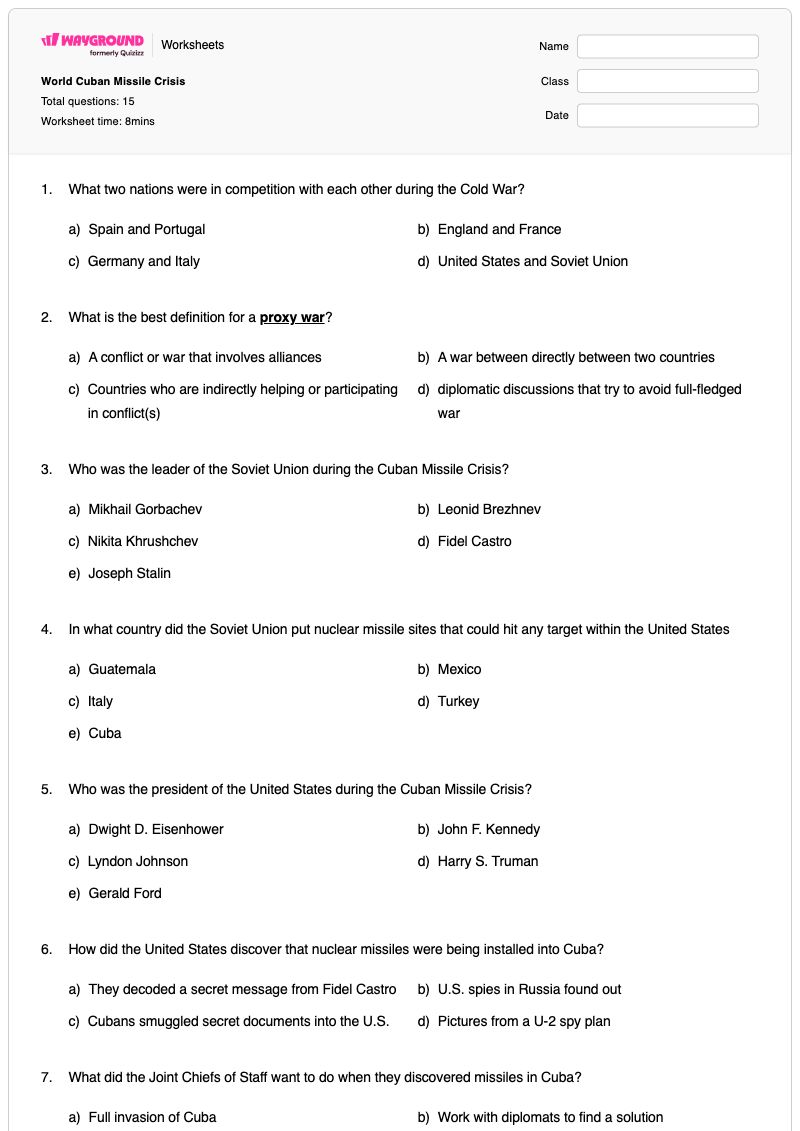

What two nations were in competition with each other during the Cold War?
a)
Spain and Portugal
b)
England and France
c)
Germany and Italy
d)
United States and Soviet Union
2.
What is the best definition for a proxy war?
a)
A conflict or war that involves alliances
b)
A war between directly between two countries
c)
Countries who are indirectly helping or participating in conflict(s)
d)
diplomatic discussions that try to avoid full-fledged war
3.
Who was the leader of the Soviet Union during the Cuban Missile Crisis?
a)
Mikhail Gorbachev
b)
Leonid Brezhnev
c)
Nikita Khrushchev
d)
Fidel Castro
e)
Joseph Stalin
4.
In what country did the Soviet Union put nuclear missile sites that could hit any target within the United States
a)
Guatemala
b)
Mexico
c)
Italy
d)
Turkey
e)
Cuba
5.
Who was the president of the United States during the Cuban Missile Crisis?
a)
Dwight D. Eisenhower
b)
John F. Kennedy
c)
Lyndon Johnson
d)
Harry S. Truman
e)
Gerald Ford
6.
How did the United States discover that nuclear missiles were being installed into Cuba?
a)
They decoded a secret message from Fidel Castro
b)
U.S. spies in Russia found out
c)
Cubans smuggled secret documents into the U.S.
d)
Pictures from a U-2 spy plan
7.
What did the Joint Chiefs of Staff want to do when they discovered missiles in Cuba?
a)
Full invasion of Cuba
b)
Work with diplomats to find a solution
c)
Attack the Soviet Union with nuclear weapons
d)
Bomb North Korea and invade across the 38th parallel
8.
What event took place prior to the Cuban Missile Crisis that led to Cuba asking for help from the Soviet Union?
a)
Vietnam War
b)
Berlin Wall
c)
Bay of Pigs
d)
Korean War
9.
What did the U.S. do once they discovered the missiles in Cuba?
a)
Attacked Cuba
b)
formed a blockade (quarantine) against new weapons entering Cuba
c)
Asked the United Nations for help
d)
Started negotiations with Fidel Castro
e)
Offered to pay to have the missiles removed
10.
What did the U.S. agree to do in order to get the Soviet Union to remove their missiles from Cuba?
a)
Remove their "Jupiter" missiles from Berlin
b)
Remove their "Jupiter" missiles from Turkey
c)
Remove their "Jupiter" missiles from Iran
d)
None of the these
11.
Which leader was NOT involved in the negotiations for the Cuban Missile Crisis?
a)
Castro
b)
Khrushchev
c)
Kennedy
12.
True or False: The Cuban Missile Crisis was a diplomatic victory for the United States and the Kennedy administration?
a)
True
b)
False
c)
Don't pick this one
13.
Why didn't Kennedy want to attack Cuba once the missiles were discovered?
a)
fear of war
b)
fear of communism in the US
c)
fear of putting European allies in danger
d)
fear of losing re-election
14.
A system where the government owns the factories and other natural resources AND controls the production of goods is known as _____________________.
a)
isolationism
b)
independence
c)
communism
d)
democracy
15.
In 1949 the United States and European countries worked together to form an alliance for protection against Communist aggression called N.A.T.O. What does N.A.T.O stand for?
a)
National Alliance Traffic Organization
b)
North Atlantic Treaty Organization
c)
North American Traffic Organization
d)
National Airlift Traffic Organization
แป้นคำตอบ
World Cuban Missile Crisis
คำถามทั้งหมด: 15
1.
d) United States and Soviet Union
2.
c)
Countries who are indirectly helping or participating in conflict(s)
3.
c)
Nikita Khrushchev
4.
e)
Cuba
5.
b)
John F. Kennedy
6.
d)
Pictures from a U-2 spy plan
7.
a)
Full invasion of Cuba
8.
c)
Bay of Pigs
9.
b)
formed a blockade (quarantine) against new weapons entering Cuba