

Wayground
Homophones & Transitions - Printable อีแอลเอ Worksheets ระดับ 6 - Wayground

Homophones & Transitions

Paige Wilson

สร้างโดย Paige Wilson

20 คำถาม

6th ระดับชั้น

อีแอลเอ

อัปเดตแล้ว พ.ค. 2568

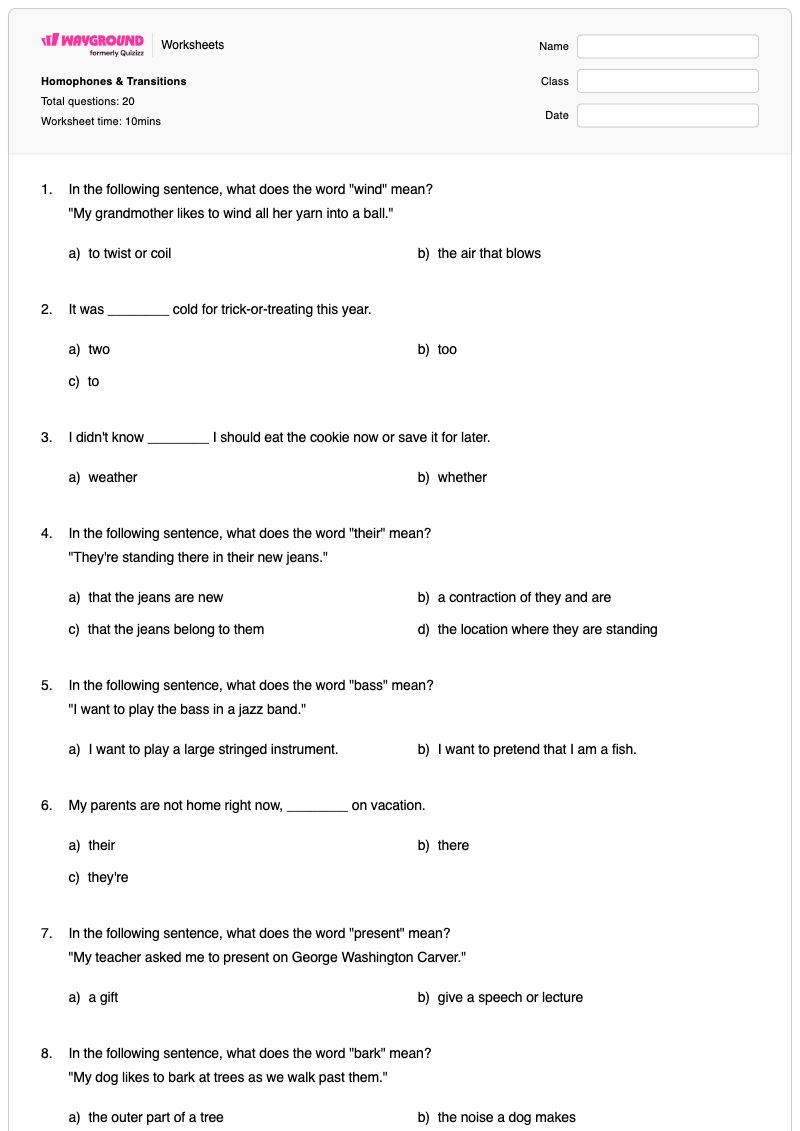
แบบฝึกหัดเรื่องคำพ้องเสียงและคำเชื่อม (Homophones & Transitions) เป็นแบบฝึกหัดภาษาอังกฤษสำหรับนักเรียนชั้นประถมศึกษาปีที่ 6 ประกอบด้วยคำถามแบบเลือกตอบ 20 ข้อ ที่พัฒนาทักษะทางภาษาที่เกี่ยวข้องกันสองอย่าง นักเรียนจะใช้บริบทของประโยคเพื่อแยกแยะคำที่มักสับสนกัน เช่น two, too และ to; their, there และ they’re; และ weather และ whether นอกจากนี้ นักเรียนยังต้องพิจารณาความหมายของคำที่มีหลายความหมาย เช่น wind, bass, present และ bark จากการใช้คำแต่ละคำ แบบฝึกหัดนี้ยังให้นักเรียนเลือกคำเชื่อมที่แสดงลำดับเหตุการณ์ ความแตกต่าง ความเฉพาะเจาะจง เหตุการณ์ที่เกิดขึ้นพร้อมกัน หรือเหตุและผล แบบฝึกหัดที่พิมพ์ได้ฟรีนี้มีประโยชน์สำหรับการฝึกฝนด้วยตนเอง การทบทวน หรือการประเมินภาษาเฉพาะด้าน มีเฉลยคำตอบครบถ้วนเพื่อให้ครูสามารถตรวจสอบคำตอบของนักเรียนได้อย่างมีประสิทธิภาพและแก้ไขข้อผิดพลาดทั้งในการใช้คำและการเลือกคำเชื่อม

การตั้งค่าแผ่นงาน

ขนาดตัวอักษร

S
M
L
XL
Waygroundแผ่นงาน

Homophones & Transitions

คำถามทั้งหมด: 20

ชื่อ
ระดับ
วันที่
1.

In the following sentence, what does the word "wind" mean?

"My grandmother likes to wind all her yarn into a ball."

a)

to twist or coil

b)

the air that blows

2.

It was ________ cold for trick-or-treating this year.

a)

two

b)

too

c)

to

3.

I didn't know ________ I should eat the cookie now or save it for later.

a)

weather

b)

whether

4.

In the following sentence, what does the word "their" mean?

"They're standing there in their new jeans."

a)

that the jeans are new

b)

a contraction of they and are

c)

that the jeans belong to them

d)

the location where they are standing

5.

In the following sentence, what does the word "bass" mean?

"I want to play the bass in a jazz band."

a)

I want to play a large stringed instrument.

b)

I want to pretend that I am a fish.

6.

My parents are not home right now, ________ on vacation.

a)

their

b)

there

c)

they're

7.

In the following sentence, what does the word "present" mean?

"My teacher asked me to present on George Washington Carver."

a)

a gift

b)

give a speech or lecture

8.

In the following sentence, what does the word "bark" mean?

"My dog likes to bark at trees as we walk past them."

a)

the outer part of a tree

b)

the noise a dog makes

9.

I need ________ apples and some bananas ________, so I should go ________ the store.

a)

two / to / too

b)

to / too / two

c)

too / two/ to

d)

two / too / to

10.

Look over ________! I see a flock of butterflies flapping ________ wings. I think ________ migrating south.

a)

their / they're / there

b)

they're / their / there

c)

there / their / they're

d)

there / they're / their

11.

I was just getting over the flu. ________, I went in to school to take the SAT.

a)

Then

b)

Nevertheless

c)

First

d)

Immediately

12.

Jesse is an animal lover. ________, he adores penguins and pandas.

a)

Simultaneously

b)

Equally important

c)

Specifically

d)

Despite

13.

At 1 p.m. Charlotte was eating lunch. ________, Joseph was just waking up after sleeping in.

a)

Simultaneously

b)

Then

c)

So

d)

Consequently

14.

Peter won the scholarship to his dream school. ________, he was able to attend for free.

a)

Meanwhile

b)

Nonetheless

c)

Second

d)

Consequently

15.

Mr. Lopez gave an exam second period. ________ he graded it during third period.

a)

Similarly

b)

Truly

c)

Then

d)

Finally

16.

I could really go for some Chinese food for dinner. ________, pizza would be great, too.

a)

On the other hand

b)

Moreover

c)

So

d)

In sum

17.

________ his intense stage fright, Brian's act in the talent show was by far the most popular.

a)

Beyond

b)

Indeed

c)

Despite

d)

For instance

18.

________ fencing, Teddy had many other skills as well, like computer programming.

a)

First

b)

Of course

c)

Beyond

d)

Finally

19.

________, Jean painted her room. Then, she bought a new dresser.

a)

Specifically

b)

First

c)

Truly

d)

So

20.

Giselle is a talented student. ________, she was the valedictorian her senior year.

a)

Indeed

b)

Immediately

c)

On the whole

d)

Then

Waygroundแป้นคำตอบ

Homophones & Transitions

คำถามทั้งหมด: 20

1.
a)

to twist or coil

2.
b)

too

3.
b)

whether

4.
c)

that the jeans belong to them

5.
a)

I want to play a large stringed instrument.

6.
c)

they're

7.
b)

give a speech or lecture

8.
b)

the noise a dog makes

9.
d)

two / too / to

10.
c)

there / their / they're

11.
b)

Nevertheless

12.
c)

Specifically

13.
a)

Simultaneously

14.
d)

Consequently

15.
c)

Then

16.
a)

On the other hand

17.
c)

Despite

18.
c)

Beyond

19.
b)

First

20.
a)

Indeed

คำถามที่พบบ่อย

แบบฝึกหัดเรื่องคำพ้องเสียงและการเปลี่ยนคำครอบคลุมเนื้อหาอะไรบ้าง?

แบบฝึกหัดภาษาอังกฤษสำหรับนักเรียนชั้นประถมศึกษาปีที่ 6 นี้ ประกอบด้วยคำถามแบบเลือกตอบ 20 ข้อ เพื่อฝึกฝนการแยกแยะคำพ้องเสียงและคำที่มักสับสนในบริบทของประโยค การตีความคำที่มีหลายความหมาย เช่น “wind” และ “present” และการเลือกคำเชื่อมที่แสดงความสัมพันธ์ เช่น ความแตกต่าง ลำดับ ความเฉพาะเจาะจง ความพร้อมกัน และผลที่ตามมา นักเรียนจะได้พัฒนาทักษะการใช้คำและการเชื่อมโยงประโยคอย่างแม่นยำโดยการเลือกคำตอบที่เหมาะสมกับประโยคแต่ละประโยค

ฉันจะใช้แบบฝึกหัดนี้สอนเรื่องคำพ้องเสียงและคำเชื่อมได้อย่างไร?

เริ่มแนะนำแบบฝึกหัดการเลือกคำ โดยให้นักเรียนอธิบายว่าคำรอบข้างกำหนดอย่างไรว่าประโยคนั้นต้องการ “their,” “there,” หรือ “they’re” จากนั้นสาธิตการใช้เหตุผลเดียวกันกับคำที่ขึ้นอยู่กับบริบท เช่น “bark” หรือ “bass” หลังจากทบทวนตัวอย่างเหล่านั้นแล้ว ให้ถามนักเรียนว่าความสัมพันธ์ระหว่างสองความคิดเป็นอย่างไร ก่อนที่จะเลือกคำเชื่อม เช่น “Nevertheless,” “Specifically,” “Simultaneously,” หรือ “Consequently”

ฉันควรสังเกตข้อผิดพลาดอะไรบ้างเมื่อนักเรียนทำแบบฝึกหัดนี้เสร็จ?

นักเรียนอาจเลือกคำพ้องเสียงโดยพิจารณาจากเสียงเพียงอย่างเดียว เช่น สับสนระหว่าง “to,” “too,” และ “two” หรือใช้ “there” ในประโยคที่ต้องการคำแสดงความเป็นเจ้าของ “their” หรือคำย่อ “they’re” นอกจากนี้ พวกเขายังอาจเลือกความหมายที่คุ้นเคยโดยไม่ดูประโยคทั้งหมด เช่น เข้าใจ “present” ว่าเป็นของขวัญแทนที่จะเป็นคำกริยาที่หมายถึงการกล่าวสุนทรพจน์ ในส่วนของคำเชื่อมประโยค ให้สังเกตการเลือกที่ไม่สอดคล้องกับความสัมพันธ์ เช่น การใช้คำที่แสดงลำดับเหตุการณ์ในประโยคที่แสดงความแตกต่างหรือผลที่ตามมา

ฉันจะมอบหมายและให้คะแนนแบบฝึกหัดเรื่องคำพ้องเสียงและคำเชื่อมนี้ได้อย่างไร?

คุณสามารถมอบหมายแบบฝึกหัดนี้เป็นไฟล์ PDF ที่พิมพ์ได้ หรือเป็นแบบทดสอบดิจิทัลบน Wayground แบบฝึกหัดนี้มีเฉลยคำตอบครบถ้วนสำหรับตรวจสอบคำตอบแบบเลือกตอบ 20 ข้อ และสามารถตรวจงานส่งของนักเรียนได้โดยการสแกนงานของนักเรียนด้วยแอป Wayground for Teachers รูปแบบที่พิมพ์ได้ยังช่วยให้โรงเรียนมีทางเลือกในการลดเวลาการใช้หน้าจออีกด้วย

ฉันจะปรับแบบฝึกหัดนี้ให้เหมาะสมกับนักเรียนของฉันได้อย่างไร?

ใช้การตั้งค่าขั้นสูงของแบบฝึกหัดเพื่อปรับระยะห่างระหว่างตัวอักษรและขนาดตัวอักษรสำหรับแบบฝึกหัดเติมประโยคและแบบฝึกหัดความหมายตามบริบท เพื่อช่วยให้นักเรียนอ่านแต่ละตัวเลือกได้อย่างชัดเจน นอกจากนี้ คุณยังสามารถเปิดใช้งานแบบอักษรที่เหมาะสำหรับผู้ที่มีภาวะดิสเล็กเซีย หรือแปลแบบฝึกหัดเป็นภาษาอื่นเมื่อการแปลนั้นช่วยให้เข้าถึงตัวอย่างคำพ้องเสียงและคำถามเชื่อมโยงได้ง่ายขึ้น

ฉันจะหาแบบฝึกหัดแบบนี้เพิ่มเติมได้ที่ไหนบน Wayground?

Wayground นำเสนอชุดแบบฝึกหัดและโจทย์ฝึกหัดฟรีที่ครอบคลุมหลากหลายวิชา พร้อมไฟล์ PDF และเฉลยคำตอบ เพื่อช่วยให้นักเรียนเชี่ยวชาญทักษะและแนวคิดที่สำคัญ ดูแหล่งข้อมูลเพิ่มเติมได้ที่ https://wayground.com/en-us/worksheets