

Wayground
Chapter 11 The Rise of Christianity and Rome Review - Printable สังคมศึกษา Worksheets ระดับ 6 - Wayground

Chapter 11 The Rise of Christianity and Rome Review

Rhonda Marcum

สร้างโดย Rhonda Marcum

25 คำถาม

6th ระดับชั้น

สังคมศึกษา

อัปเดตแล้ว ก.ย. 2569

แบบฝึกหัดบทที่ 11 การกำเนิดของศาสนาคริสต์และกรุงโรม เป็นแบบฝึกหัดวิชาสังคมศึกษาสำหรับนักเรียนชั้นประถมศึกษาปีที่ 6 ประกอบด้วยคำถามทบทวน 25 ข้อ: 24 ข้อเป็นแบบเลือกตอบ และ 1 ข้อเป็นแบบเลือกตอบหลายข้อ แบบฝึกหัดนี้ตรวจสอบความเข้าใจของนักเรียนเกี่ยวกับประวัติศาสตร์และความเชื่อของชาวยิวในจักรวรรดิโรมัน รวมถึงอิสราเอลและคานาอัน โมเสสและการอพยพ เอกเทวนิยม การพลัดถิ่นของชาวยิว และความหมายของการถูกขับไล่ แบบฝึกหัดนี้ยังทบทวนการกำเนิดของศาสนาคริสต์โดยให้นักเรียนระบุถึงพระเยซูคริสต์ ความเชื่อพื้นฐานของศาสนาคริสต์ คัมภีร์ไบเบิล ความหมายของพระเมสสิยาห์ และบทบาทของเซาโล/เปาโลในการเผยแพร่ศาสนา นักเรียนจะต้องแยกแยะคำศัพท์ทางประวัติศาสตร์ บุคคล คัมภีร์ศักดิ์สิทธิ์ และระบบความเชื่อที่เกี่ยวข้อง ในขณะที่เลือกคำตอบที่ถูกต้องหนึ่งข้อหรือหลายข้อ แบบฝึกหัดที่พิมพ์ได้ฟรีนี้มีเฉลยคำตอบครบถ้วนสำหรับการทบทวนอย่างมีประสิทธิภาพ การฝึกฝนด้วยตนเอง หรือการตรวจสอบท้ายบทในชั้นเรียนสังคมศึกษาชั้นประถมศึกษาปีที่ 6

การตั้งค่าแผ่นงาน

ขนาดตัวอักษร

S
M
L
XL
Waygroundแผ่นงาน

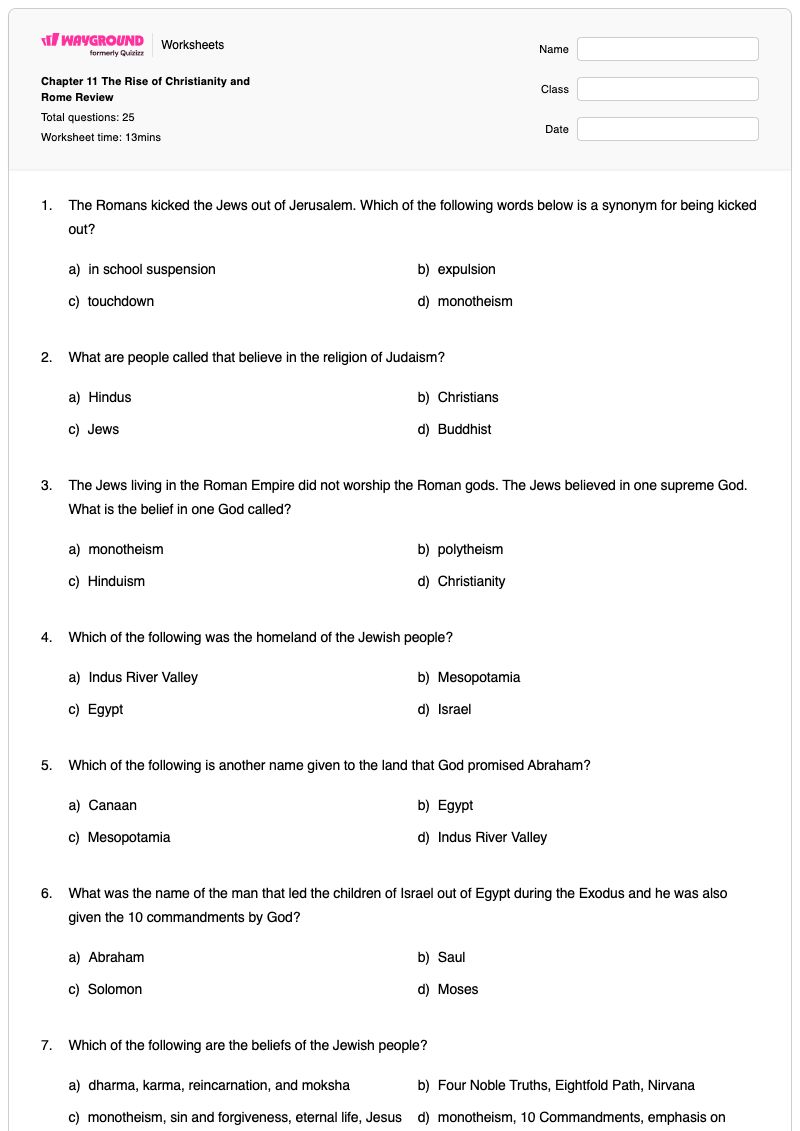
Chapter 11 The Rise of Christianity and Rome Review

คำถามทั้งหมด: 25

ชื่อ
ระดับ
วันที่
1.

The Romans kicked the Jews out of Jerusalem. Which of the following words below is a synonym for being kicked out?

a)

in school suspension

b)

expulsion

c)

touchdown

d)

monotheism

2.

What are people called that believe in the religion of Judaism?

a)

Hindus

b)

Christians

c)

Jews

d)

Buddhist

3.

The Jews living in the Roman Empire did not worship the Roman gods. The Jews believed in one supreme God. What is the belief in one God called?

a)

monotheism

b)

polytheism

c)

Hinduism

d)

Christianity

4.

Which of the following was the homeland of the Jewish people?

a)

Indus River Valley

b)

Mesopotamia

c)

Egypt

d)

Israel

5.

Which of the following is another name given to the land that God promised Abraham?

a)

Canaan

b)

Egypt

c)

Mesopotamia

d)

Indus River Valley

6.

What was the name of the man that led the children of Israel out of Egypt during the Exodus and he was also given the 10 commandments by God?

a)

Abraham

b)

Saul

c)

Solomon

d)

Moses

7.

Which of the following are the beliefs of the Jewish people?

a)

dharma, karma, reincarnation, and moksha

b)

Four Noble Truths, Eightfold Path, Nirvana

c)

monotheism, sin and forgiveness, eternal life, Jesus as the Messiah

d)

monotheism, 10 Commandments, emphasis on individual worth and personal responsibility

8.

The Jewish people rebelled against the Roman empire. As a result of these rebellions the Roman kicked the Jews out of their homeland. What did this expulsion become known as?

a)

Exodus

b)

Jewish diaspora

c)

Babylonian Captivity

d)

Peloponnesian War

9.

During the time of the Roman empire a man was born that is going to be the founder of the largest religion in the world. What is his name?

a)

Siddhartha Gautama

b)

Augustus Caesar

c)

Moses

d)

Jesus Christ

10.

What is the largest religion in the world today?

a)

Hinduism

b)

Buddhism

c)

Christianity

d)

Judaism

11.

Christians believe in one God. Which of the following religions are also monotheistic?

a)

Jews

b)

Hindus

c)

Buddhists

d)

Romans

12.

What is the sacred book of Christians

a)

Tanakh

b)

Vedas

c)

Tripitaka

d)

Holy Bible

13.

Which of the following are the basic beliefs of Christianity?

a)

monotheism, sin and forgiveness, eternal life, Jesus as the Messiah

b)

dharma, karma, reincarnation, and moksha

c)

Four Noble Truths, Eightfold Path, Nirvana

d)

10 Commandments, emphasis on individual worth and personal responsibility

14.

Christians believe Jesus is the Messiah. Which of the following is the definition of Messiah?

a)

The promised deliverer of the Jewish nation

b)

The Enlightened One

c)

The leader of the Exodus

d)

The emperor of Rome

15.

Which of the following men tried to stop the spread of Christianity and then became a Christian and started many Christian churches. He also wrote 13 books in the New Testament of the Christian Bible.

a)

Solomon

b)

David

c)

Moses

d)

Saul/Paul

16.

Which statement is true about the Roman Senate?

a)

The Seante had very little power in the Roman Republic

b)

The Senate was created to give the Plebeians Veto Power in the Roman Republic

c)

The Senators worked as equals to the members of the Assembly and the Judges in the Roman Republic

d)

The Senators advised the consuls, took care of the money and kept their seat for life

17.

How did the Roman Republic use the System of Checks and Balances in their government system?

a)

Consuls and Tribunes could veto each other

b)

Each branch has to write a check, or pay money, to the other branches to keep a balanced account

c)

Those ideas ensured that every citizen had equal rights

d)

Those ideas ensured that every citizen obeyed the laws

18.

How did the government under the leadership of Caesar Augustus compare to the Roman Republic?

a)

The Roman Republic divided up the authority among many brances, whereas Caesar Augustus had complete authority

b)

Caesar Augustus divided up the authority among the branches, whereas the Roman Republic placed complete authority over one person

c)

Caesar Augustus ruled as Dictator for Life, but kept the branches balanced with equal authority to him

d)

The Roman Republic ruled eastern half of the empire and Caesar Augustus ruled the western half of the empire

19.

Select all of the following beliefs that Romans had about their gods. Select two (2) answers

a)

The Romans were polytheistic

b)

The Romans believed their deities had human like qualities and were important in everyday life

c)

They were monotheistic

d)

They did not believe in any gods

20.

Why did Emperor Diocletian divide the Roman Empire into the West and the East?

a)

So Diocletian could rule two empires instead of one

b)

to help rule the lare empire more efficiently

c)

to develop a larger trade route with Egypt

d)

to spread Christianity and Buddhism around the Empire

21.

What was the name of the emperor that moved the capital city of the Roman Empire?

a)

Diocletian

b)

Nero

c)

Caligula

d)

Constantine

22.

What was the name of the new capital of the Roman Empire?

a)

Rome

b)

Smyrna

c)

Constantinople

d)

Alexandria

23.

Who was the Chinese emperor that united China?

a)

Shi Hungdi

b)

Confucius

c)

Hammurabi

d)

Siddhartha Gautama

24.

Which philosophy was used to unify China?

a)

Confucianism

b)

Legalism

c)

Daoism

d)

Buddhism

25.

What were the political and cultural problems prevalent at the time of Confucius?

a)

China was going through a Golden Age

b)

China was getting rich through the sale of silk

c)

China was going through a period of 200 years of civil war known as the Warring States Period

d)

They became a democracy

Waygroundแป้นคำตอบ

Chapter 11 The Rise of Christianity and Rome Review

คำถามทั้งหมด: 25

1.
b)

expulsion

2.
c)

Jews

3.
a)

monotheism

4.
d)

Israel

5.
a)

Canaan

6.
d)

Moses

7.
d)

monotheism, 10 Commandments, emphasis on individual worth and personal responsibility

8.
b)

Jewish diaspora

9.
d)

Jesus Christ

10.
c)

Christianity

11.
a)

Jews

12.
d)

Holy Bible

13.
a)

monotheism, sin and forgiveness, eternal life, Jesus as the Messiah

14.
a)

The promised deliverer of the Jewish nation

15.
d)

Saul/Paul

16.
d)

The Senators advised the consuls, took care of the money and kept their seat for life

17.
a)

Consuls and Tribunes could veto each other

18.
a)

The Roman Republic divided up the authority among many brances, whereas Caesar Augustus had complete authority

19.
a)

The Romans were polytheistic

, b)

The Romans believed their deities had human like qualities and were important in everyday life

20.
b)

to help rule the lare empire more efficiently

21.
d)

Constantine

22.
c)

Constantinople

23.
a)

Shi Hungdi

24.
b)

Legalism

25.
c)

China was going through a period of 200 years of civil war known as the Warring States Period

คำถามที่พบบ่อย

แบบฝึกหัดทบทวนบทที่ 11 การกำเนิดของศาสนาคริสต์และกรุงโรม ครอบคลุมเนื้อหาอะไรบ้าง?

แบบฝึกหัดวิชาสังคมศึกษา ชั้นประถมศึกษาปีที่ 6 นี้ ทบทวนประวัติศาสตร์และความเชื่อของชาวยิวในจักรวรรดิโรมันและการกำเนิดของศาสนาคริสต์ ผ่านคำถามแบบเลือกตอบ 24 ข้อ และคำถามแบบเลือกคำตอบ 1 ข้อ นักเรียนจะได้ระบุคำศัพท์ต่างๆ เช่น การขับไล่ เอกเทวนิยม และการพลัดถิ่นของชาวยิว เชื่อมโยงบุคคลสำคัญ เช่น โมเสส พระเยซูคริสต์ และเซาโล/เปาโล กับบทบาทของพวกเขา และแยกแยะความเชื่อ ข้อความ และแนวคิดหลักของศาสนาคริสต์และศาสนายิว

ฉันจะใช้แบบฝึกหัดนี้ในการสอนเรื่องการกำเนิดของศาสนาคริสต์และกรุงโรมได้อย่างไร?

หลังจากแนะนำเกี่ยวกับดินแดนของชาวยิว การอพยพ การขับไล่ในยุคโรมัน และการพัฒนาของศาสนาคริสต์แล้ว ให้ใช้แบบทดสอบแบบเลือกตอบ ให้นักเรียนอธิบายว่าเหตุใดคำตอบที่เลือกแต่ละข้อจึงเหมาะสม เช่น เอกเทวนิยมแตกต่างจากพหุเทวนิยมอย่างไร หรือเหตุใดเซาโล/เปาโลจึงเกี่ยวข้องกับการเผยแพร่ศาสนาคริสต์ จากนั้นใช้แบบทดสอบแบบเลือกตอบเพื่อตรวจสอบว่าพวกเขาสามารถระบุความเชื่อที่ถูกต้องหลายๆ ข้อพร้อมกันได้หรือไม่

ฉันควรระวังข้อผิดพลาดอะไรบ้างเมื่อนักเรียนทำแบบฝึกหัดทบทวนเรื่องศาสนาคริสต์และกรุงโรมเสร็จแล้ว?

นักเรียนอาจสับสนระหว่างการไล่ออกกับคำที่ไม่เกี่ยวข้อง เช่น การพักการเรียน หรือเลือกนับถือหลายเทพเมื่อคำถามถามถึงความเชื่อในพระเจ้าองค์เดียว ระวังความสับสนระหว่างโมเสส พระเยซูคริสต์ และซาอูล/เปาโล รวมถึงความสับสนระหว่างคัมภีร์ไบเบิลและทานาค และระหว่างความเชื่อของชาวยิวกับความเชื่อของศาสนาอื่นๆ ที่ระบุไว้ ในข้อสอบแบบเลือกหลายข้อ นักเรียนสามารถเลือกความเชื่อที่ถูกต้องได้เพียงข้อเดียว แทนที่จะประเมินทุกตัวเลือก

ฉันจะมอบหมายและให้คะแนนแบบฝึกหัดทบทวนบทที่ 11 นี้ได้อย่างไร?

แบบฝึกหัดนี้มีให้เลือกทั้งในรูปแบบไฟล์ PDF ที่สามารถพิมพ์ได้ และแบบทดสอบดิจิทัลบน Wayground โดยมีเฉลยคำตอบครบถ้วนสำหรับทั้ง 25 ข้อ คุณสามารถตรวจงานของนักเรียนที่ส่งมาในรูปแบบไฟล์พิมพ์ได้โดยการสแกนงานด้วยแอป Wayground for Teachers หรือมอบหมายแบบฝึกหัดเวอร์ชันดิจิทัลให้ทำและตรวจสอบทางออนไลน์ก็ได้

ฉันจะปรับแบบฝึกหัดเรื่องศาสนาคริสต์และกรุงโรมนี้ให้เหมาะสมกับนักเรียนของฉันได้อย่างไร?

ใช้การตั้งค่าขั้นสูงของแบบฝึกหัดเพื่อปรับระยะห่างระหว่างตัวอักษร หรือเลือกขนาดตัวอักษรที่ใหญ่ขึ้น เพื่อให้ตัวเลือกแบบปรนัยอ่านง่ายขึ้น นอกจากนี้ คุณยังสามารถใช้แบบอักษรที่เหมาะสำหรับผู้ที่มีภาวะดิสเล็กเซีย หรือแปลแบบฝึกหัดเป็นภาษาอื่น เพื่อช่วยให้นักเรียนเข้าถึงคำศัพท์ทางประวัติศาสตร์ ชื่อ และคำอธิบายความเชื่อในแบบฝึกหัดได้ง่ายขึ้น

ฉันจะหาแบบฝึกหัดฟรีแบบนี้เพิ่มเติมได้ที่ไหนบน Wayground?

Wayground นำเสนอชุดแบบฝึกหัดและโจทย์ฝึกหัดฟรีที่ครอบคลุมหลากหลายวิชา พร้อมไฟล์ PDF และเฉลยคำตอบ เพื่อช่วยให้นักเรียนเชี่ยวชาญทักษะและแนวคิดที่สำคัญ ดูแหล่งข้อมูลเพิ่มเติมได้ที่ https://wayground.com/en-us/worksheets