

Wayground
Lewis - Matter (TEKS 4.6) Test HMH - Printable ศาสตร์ Worksheets ระดับ 4 - Wayground

Lewis - Matter (TEKS 4.6) Test HMH

Molly Jamison

By Molly Jamison

11 คำถาม

4th - 4th ระดับชั้น

ศาสตร์

อัปเดตแล้ว ต.ค. 2569

แบบทดสอบ Lewis - Matter (TEKS 4.6) HMH เป็นแบบฝึกหัดวิทยาศาสตร์สำหรับนักเรียนชั้นประถมศึกษาปีที่ 4 ที่ประเมินความสามารถของนักเรียนในการระบุและเปรียบเทียบสสาร สารผสม สารละลาย และสถานะของสสาร แบบฝึกหัดประกอบด้วย 11 ข้อ โดยนักเรียนจะต้องตอบคำถามแบบเลือกตอบ 6 ข้อ ทำแบบฝึกหัดจับคู่ 4 ข้อ และเลือกคำตอบที่ถูกต้อง 2 ข้อในคำถามแบบเลือกตอบ คำถามใช้หลักฐานการวัด แบบจำลอง และการทดลองในโลกแห่งความเป็นจริงเพื่อตรวจสอบมวล การอนุรักษ์สสาร คุณสมบัติทางกายภาพ และการเปลี่ยนแปลงต่างๆ เช่น การเกิดสนิม นักเรียนจะต้องคำนวณและเปรียบเทียบมวล อธิบายว่าทำไมมวลของสารผสมจึงคงที่ จำแนกตัวอย่างตามสถานะของสสาร ระบุสารผสมที่เกี่ยวข้องกับสารละลาย และเชื่อมโยงการสังเกตกับหลักฐาน แบบฝึกหัดนี้ยังขอให้นักเรียนเลือกวิธีการแยกส่วนประกอบของสารผสม และจับคู่เครื่องมือที่เหมาะสมสำหรับการวัดและเปรียบเทียบวัสดุ เป็นแบบฝึกหัดที่พิมพ์ได้ฟรีพร้อมเฉลยคำตอบครบถ้วน เหมาะสำหรับการทบทวน การประเมิน หรือการฝึกฝนด้วยตนเองในวิชาวิทยาศาสตร์ชั้นประถมศึกษาปีที่ 4

การตั้งค่าแผ่นงาน

ขนาดตัวอักษร

S
M
L
XL
Waygroundแผ่นงาน

Lewis - Matter (TEKS 4.6) Test HMH

คำถามทั้งหมด: 11

ชื่อ
ระดับ
วันที่
1.

Mixtures can be identified and compared. What do ALL mixtures have in common?

a)

They are a combination of substances that give off a gas.

b)

They are any type of matter that can change its shape or color.

c)

They are any type of matter that evaporates when heat is added.

d)

They are a combination of two or more substances that keep their identities.

2.

Lara uses a balance to measure the mass of some snap-together blocks. The mass of a red block is 2 g, a blue block is 5 g, and a yellow block is 10 g. She then makes a toy building using THREE of each type of block. If she measures the mass of the building, what would it MOST LIKELY be?

a)

44 g

b)

45 g

c)

46 g

d)

51 g

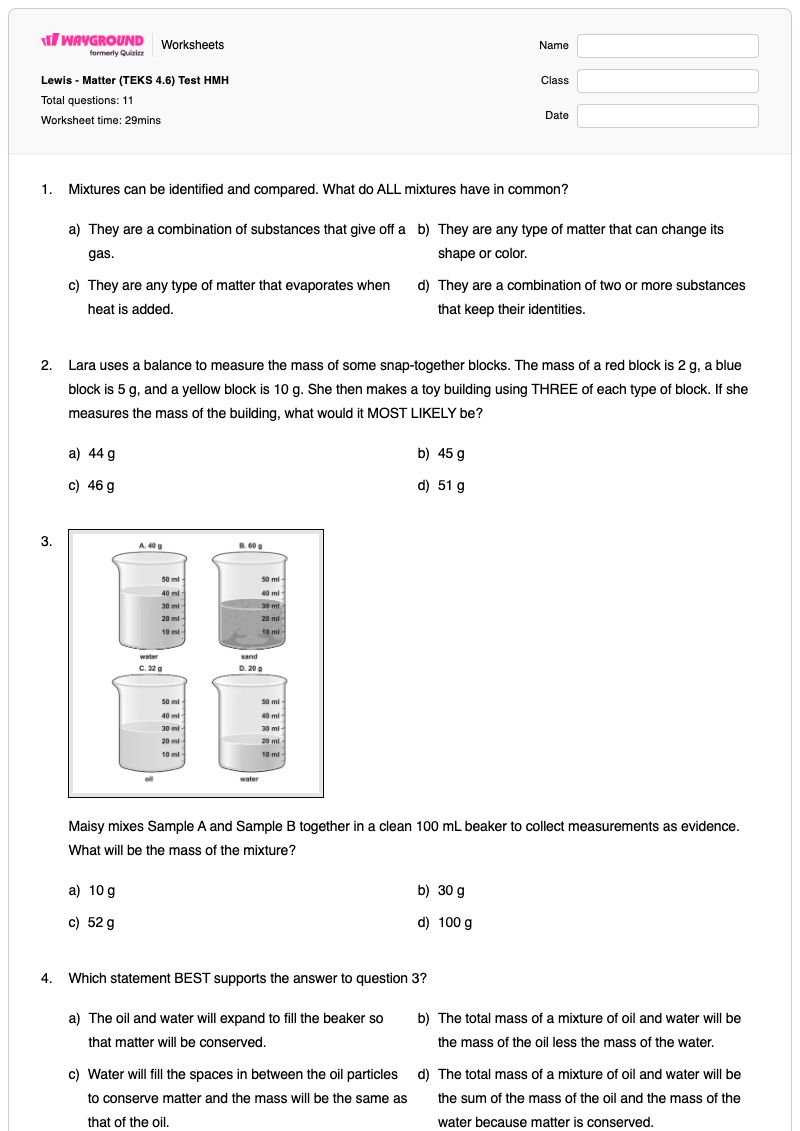
3.
Maisy mixes Sample A and Sample B together in a clean 100 mL beaker to collect measurements as evidence. What will be the…

Maisy mixes Sample A and Sample B together in a clean 100 mL beaker to collect measurements as evidence. What will be the mass of the mixture?

a)

10 g

b)

30 g

c)

52 g

d)

100 g

4.

Which statement BEST supports the answer to question 3?

a)

The oil and water will expand to fill the beaker so that matter will be conserved.

b)

The total mass of a mixture of oil and water will be the mass of the oil less the mass of the water.

c)

Water will fill the spaces in between the oil particles to conserve matter and the mass will be the same as that of the oil.

d)

The total mass of a mixture of oil and water will be the sum of the mass of the oil and the mass of the water because matter is conserved.

5.
Natalia is investigating properties of water. She uses a thermometer to measure four samples of matter. She lists the…

Natalia is investigating properties of water. She uses a thermometer to measure four samples of matter. She lists the results in the table below. Which sample is solid, which is liquid, and which is a gas?

Sample 1

Liquid

Sample 2

Solid

Sample 3

Gas

6.
Chantilly measured 50 grams of dish soap and 100 grams of water into two jars. Then she poured 50 grams of soap into a jar…

Chantilly measured 50 grams of dish soap and 100 grams of water into two jars. Then she poured 50 grams of soap into a jar with 100 grams of water, closed the jar, and shook it up, making bubbles. She measured the mixture of soapy water. Chantilly drew this model to show her classmates what she observed.

Which statements about Chantilly’s model are evidence that matter was conserved? Pick TWO correct answers.

a)

A. The model shows that dish soap weighs more than water.

b)

B. The model shows that the bubbles weigh more than the water.

c)

C. The model shows that shaking the mixture does not change its mass.

d)

D. The model shows that mass of the soap and water is equal to the mass of the mixture.

7.

Kelsey and Mickey wondered what would happen to different metals if they were put out in the rain. They chose two pieces of metal: one was shiny and one was dull and black. Each piece weighed 283 grams. Every three days the girls would pour 28 grams of water over each piece of metal. After five weeks, they noticed that the black metal was covered in orange-colored powder. The shiny silver piece was not. They weighed both pieces of metal at the end of five weeks. After they scraped the orange powder off, the black piece of metal weighed only 241 grams.What happened to the piece of black metal, and why did it weigh less after the experiment?

a)

The black metal was iron. When iron is exposed to water, rust forms. The girls learned in class about conservation of mass. They knew that the extra weight had to be somewhere. Kelsey suggested that Mickey weigh the rust. It weighed 42 grams.

b)

The black metal was aluminum. When aluminum is exposed to air, it forms a protective layer that weighs less.

c)

The black metal was copper. When copper is exposed to water, it dissolves partially, reducing its weight.

d)

The black metal was lead. When lead is exposed to water, it reacts and forms a lighter compound.

8.
Rama has two mixtures. Mixture A is salt and water, and Mixture B is oil and water. What can Rama do to separate the parts…

Rama has two mixtures. Mixture A is salt and water, and Mixture B is oil and water. What can Rama do to separate the parts of each mixture so they can be investigated AND how are Rama’s two mixtures different from one another?

a)

Use a paper filter.

b)

Boil and use evaporation.

c)

Freeze it and the salt and oil will separate.

d)

Weigh it.

9.

Emerald is making mixtures and she wants to compare them and classify the mixtures that are solutions. How can these mixtures be classified? Write the letter of each answer in the correct box. Not all answers will be used.

Mud

Not a solution

Salt water

Solid and liquid solution

Vinegar and water

Liquid and liquid solution

10.

Junior walks into the kitchen. How can he classify the states of matter that he sees in his kitchen?

Junior walks into the kitchen. How can he classify the states of matter that he sees in his kitchen?

Solid

Junior walks into the kitchen. How can he classify the states of matter that he sees in his kitchen?

Gas

Junior walks into the kitchen. How can he classify the states of matter that he sees in his kitchen?

Liquid

11.

Carlos is making mixtures of liquids and solids in the lab. How can he use tools to measure and compare the mixtures?

Carlos is making mixtures of liquids and solids in the lab. How can he use tools to measure and compare the mixtures?

measuring the mass of solid objects

Carlos is making mixtures of liquids and solids in the lab. How can he use tools to measure and compare the mixtures?

examining an object upclose

Carlos is making mixtures of liquids and solids in the lab. How can he use tools to measure and compare the mixtures?

measuring the volume of a liquid

Waygroundแป้นคำตอบ

Lewis - Matter (TEKS 4.6) Test HMH

คำถามทั้งหมด: 11

1.
d)

They are a combination of two or more substances that keep their identities.

2.
d)

51 g

3.
d)

100 g

4.
d)

The total mass of a mixture of oil and water will be the sum of the mass of the oil and the mass of the water because matter is conserved.

5.

Sample 1

 - 

Liquid

, 

Sample 2

 - 

Solid

, 

Sample 3

 - 

Gas

6.
c)

C. The model shows that shaking the mixture does not change its mass.

, d)

D. The model shows that mass of the soap and water is equal to the mass of the mixture.

7.
a)

The black metal was iron. When iron is exposed to water, rust forms. The girls learned in class about conservation of mass. They knew that the extra weight had to be somewhere. Kelsey suggested that Mickey weigh the rust. It weighed 42 grams.

8.
b)

Boil and use evaporation.

9.

Mud

 - 

Not a solution

, 

Salt water

 - 

Solid and liquid solution

, 

Vinegar and water

 - 

Liquid and liquid solution

10.

 - 

Solid

, 

 - 

Gas

, 

 - 

Liquid

11.

 - 

measuring the mass of solid objects

, 

 - 

examining an object upclose

, 

 - 

measuring the volume of a liquid

คำถามที่พบบ่อย

แบบฝึกหัดเรื่องสสารสำหรับนักเรียนชั้นประถมศึกษาปีที่ 4 นี้ครอบคลุมหัวข้ออะไรบ้าง?

แบบฝึกหัดนี้ครอบคลุมหัวข้อต่างๆ เช่น การระบุสารผสม การเปรียบเทียบคุณสมบัติของสสาร การจำแนกสถานะของสสาร การจำแนกสารละลาย และการอธิบายหลักการอนุรักษ์มวล แบบฝึกหัดประกอบด้วย 11 ข้อ โดยใช้รูปแบบการเลือกคำตอบที่ถูกต้อง การจับคู่ และการเลือกหลายข้อ เพื่อให้นักเรียนคำนวณมวล ตีความหลักฐานจากการทดลอง จำแนกตัวอย่าง และเลือกวิธีการแยกส่วนประกอบของสารผสม

ฉันจะใช้แบบฝึกหัดนี้สอนเรื่องสารผสมและการอนุรักษ์มวลได้อย่างไร?

เริ่มด้วยการสาธิตวิธีการบวกมวลของวัสดุที่แยกจากกัน เช่น บล็อกที่ต่อกันได้ ก่อนที่จะอธิบายว่าทำไมการรวมสารจึงไม่ทำให้มวลของสารหายไป จากนั้นใช้สิ่งของสำหรับการทดลองเรื่องน้ำมันกับน้ำและน้ำสบู่เพื่อให้นักเรียนยกหลักฐานสนับสนุนการอนุรักษ์มวล จบด้วยแบบฝึกหัดการจับคู่การจำแนกประเภทและการวัด เพื่อให้นักเรียนนำแนวคิดไปประยุกต์ใช้กับสถานะของสสาร สารละลาย และเครื่องมือในห้องปฏิบัติการ

ฉันควรระวังข้อผิดพลาดอะไรบ้างเมื่อนักเรียนทำแบบฝึกหัดเรื่องนี้?

นักเรียนอาจคูณหรือบวกมวลของบล็อกผิดพลาด แทนที่จะใช้บล็อกสีละสามก้อน หรือเลือกปริมาตรของภาชนะเป็นมวลของส่วนผสม ในข้อสอบแบบเลือกหลายข้อ ให้ระวังนักเรียนที่เลือกข้อความเกี่ยวกับน้ำหนักสัมพัทธ์ แทนที่จะเลือกหลักฐานที่แสดงว่าการเขย่าไม่ทำให้มวลเปลี่ยนแปลง และมวลเดิมเท่ากับมวลของส่วนผสม นักเรียนอาจสับสนระหว่างการเปลี่ยนแปลงที่สังเกตได้ของวัสดุ เช่น การเกิดสนิม กับการหายไปของสสาร

ฉันจะมอบหมายและให้คะแนนแบบฝึกหัดเรื่องนี้อย่างไร?

คุณสามารถมอบหมายแบบฝึกหัดนี้เป็นไฟล์ PDF ที่พิมพ์ได้ หรือเป็นแบบทดสอบดิจิทัลบน Wayground ก็ได้ แบบฝึกหัดนี้มีเฉลยคำตอบครบถ้วนสำหรับคำถามแบบเลือกตอบ 6 ข้อ คำถามแบบจับคู่ 4 ข้อ และคำถามแบบเลือกคำตอบเดียว 1 ข้อ สำหรับการส่งงานแบบพิมพ์ได้ ให้สแกนงานของนักเรียนด้วยแอป Wayground for Teachers เพื่อตรวจให้คะแนน

ฉันจะปรับแบบฝึกหัดเรื่องนี้ให้เหมาะสมกับนักเรียนของฉันได้อย่างไร?

ใช้การตั้งค่าขั้นสูงของแบบฝึกหัดเพื่อปรับระยะห่างระหว่างตัวอักษรหรือเพิ่มขนาดตัวอักษรสำหรับตารางการวัด คำถามจับคู่ และคำถามการสำรวจที่ยาวขึ้น นอกจากนี้ คุณยังสามารถใช้แบบอักษรที่เหมาะสำหรับผู้ที่มีภาวะดิสเล็กเซีย หรือแปลแบบฝึกหัดเป็นภาษาอื่น เพื่อช่วยให้นักเรียนเข้าถึงแบบฝึกหัดเกี่ยวกับมวล สารผสม และสถานะของสสารได้ง่ายขึ้น โดยยังคงรูปแบบคำถามไว้เหมือนเดิม

ฉันจะหาแบบฝึกหัดแบบนี้เพิ่มเติมได้ที่ไหนบน Wayground?

Wayground นำเสนอชุดแบบฝึกหัดและโจทย์ฝึกหัดฟรีที่ครอบคลุมทุกวิชา พร้อมไฟล์ PDF และเฉลยคำตอบ เพื่อสนับสนุนทักษะและแนวคิดที่สำคัญ ดูแหล่งข้อมูลเพิ่มเติมได้ที่ https://wayground.com/en-us/worksheets