

Wayground
Citizenship - Printable สังคมศึกษา Worksheets 7th ระดับชั้น - Wayground

Citizenship

Civics Goddess

สร้างโดย Civics Goddess

21 คำถาม

7th ระดับชั้น

สังคมศึกษา

อัปเดตแล้ว พ.ค. 2568

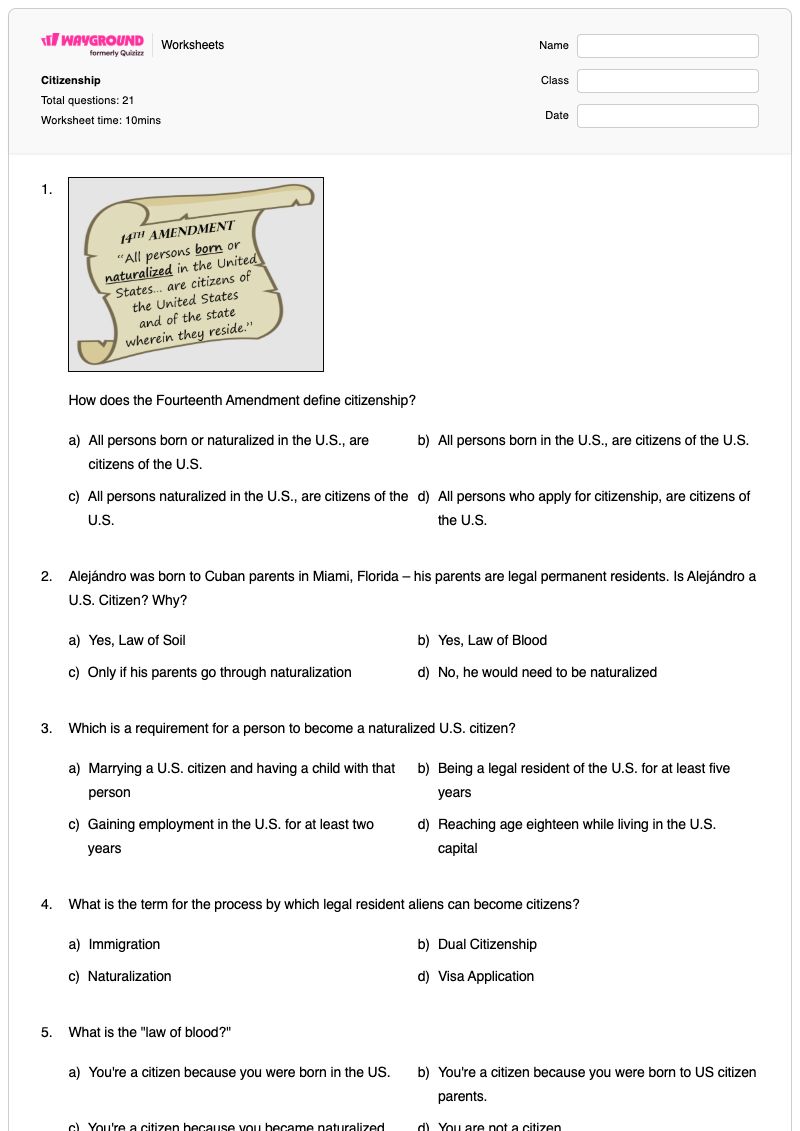
แบบฝึกหัดวิชาสังคมศึกษา ชั้น ม.1 นี้ ช่วยพัฒนาความเข้าใจของนักเรียนเกี่ยวกับสัญชาติอเมริกัน ผ่านคำถามแบบเลือกตอบ 21 ข้อ นักเรียนจะได้ประยุกต์ใช้คำจำกัดความของสัญชาติตามบทแก้ไขเพิ่มเติมที่ 14 แยกแยะความแตกต่างระหว่างกฎหมายแผ่นดินกับกฎหมายสายเลือด ระบุการแปลงสัญชาติเป็นเส้นทางสู่การเป็นพลเมือง และตระหนักถึงขั้นตอนและข้อกำหนดต่างๆ เช่น การอยู่อาศัยอย่างถูกกฎหมายและการสาบานตนต่อธงชาติ นอกจากนี้ยังมีคำถามแบบสถานการณ์จำลองให้นักเรียนจำแนกสถานการณ์การเป็นพลเมืองที่เกี่ยวข้องกับสถานที่เกิด บิดามารดา และการรับราชการทหาร แบบฝึกหัดนี้ยังเชื่อมโยงสัญชาติกับหน้าที่และความมีส่วนร่วมในสังคม นักเรียนจะได้ระบุการลงทะเบียนเกณฑ์ทหาร การยื่นคำร้องต่อรัฐบาล การจ่ายภาษี และความแตกต่างระหว่างหน้าที่และความรับผิดชอบ แบบฝึกหัดนี้สามารถพิมพ์ได้ฟรี พร้อมเฉลยคำตอบครบถ้วน เหมาะสำหรับใช้ในการสอน ทบทวน หรือประเมินคำศัพท์และแนวคิดเกี่ยวกับสัญชาติในชั้น ม.1

การตั้งค่าแผ่นงาน

ขนาดตัวอักษร

S
M
L
XL
Waygroundแผ่นงาน

Citizenship

คำถามทั้งหมด: 21

ชื่อ
ระดับ
วันที่
1.
How does the Fourteenth Amendment define citizenship?

How does the Fourteenth Amendment define citizenship?

a)

All persons born or naturalized in the U.S., are citizens of the U.S.

b)

All persons born in the U.S., are citizens of the U.S.

c)

All persons naturalized in the U.S., are citizens of the U.S.

d)

All persons who apply for citizenship, are citizens of the U.S.

2.

Alejándro was born to Cuban parents in Miami, Florida – his parents are legal permanent residents. Is Alejándro a U.S. Citizen? Why?

a)

Yes, Law of Soil

b)

Yes, Law of Blood

c)

Only if his parents go through naturalization

d)

No, he would need to be naturalized

3.

Which is a requirement for a person to become a naturalized U.S. citizen?

a)

Marrying a U.S. citizen and having a child with that person

b)

Being a legal resident of the U.S. for at least five years

c)

Gaining employment in the U.S. for at least two years

d)

Reaching age eighteen while living in the U.S. capital

4.

What is the term for the process by which legal resident aliens can become citizens?

a)

Immigration

b)

Dual Citizenship

c)

Naturalization

d)

Visa Application

5.

What is the "law of blood?"

a)

You're a citizen because you were born in the US.

b)

You're a citizen because you were born to US citizen parents.

c)

You're a citizen because you became naturalized.

d)

You are not a citizen.

6.

What is the "law of soil?"

a)

You're a citizen because you were born in the US.

b)

You're a citizen because you were born to US citizen parents.

c)

You're a citizen because you became naturalized.

d)

You are not a citizen.

7.

What is the final step in the naturalization process?

a)

Interview

b)

Oath of Allegiance

c)

Live legally in the US for 5+ years

d)

Apply and pay the fee

8.

Male U.S. citizens age 18 - 26 must register with...

a)

the Selective Service

b)

the county voter registry

c)

the FAFSA application

9.

Jordan was born in Germany on a U.S. Air Force base to his parents that were both serving in the U.S. Military. Jordan is 17 years old and now lives in Egypt. What is most likely Jordan’s U.S. citizenship status?

a)

Citizen due to law of blood

b)

Citizen due to law of soil

c)

Not eligible for naturalization yet

d)

Eligible for naturalization

10.

Under American law, which of the following would not be considered a United States citizen?

a)

any baby born in the United States to two foreign parents

b)

any baby born overseas to non-American citizens

c)

any baby born in the United States to American parents

d)

any baby born overseas to American parents

11.

a system by which men ages 18 through 25 register with the U.S. government for possible military service is called...

a)

the common good

b)

petitioning the government

c)

selective service system (SSS)

d)

political participation

e)

welfare

12.

telling the government what you think by writing or signing a document is called...

a)

the common good

b)

petitioning the government

c)

selective service system (SSS)

d)

political participation

e)

welfare

13.

What is a requirement, something a person or government has to do?

a)

obligation

b)

responsibility

14.

Paying taxes is an example of a(n)

a)

obligation

b)

responsibility

15.

Selective service is an example of a(n)

a)

obligation

b)

responsibility

16.

Obeying laws is an example of a(n)

a)

obligation

b)

responsibility

17.

Jury duty is an example of a(n)

a)

obligation

b)

responsibility

18.

Voting is an example of a(n)

a)

obligation

b)

responsibility

19.

How do the obligations and responsibilities of citizenship help the country?

a)

they contribute to the common good

b)

they keep you out of jail

c)

they give you something to do

20.
This document was part of a summons to perform an important civic duty. Why is it important for citizens to meet the…
This document was part of a summons to perform an important civic duty. 
Why is it important for citizens to meet the obligation requested in this document? 
a)
to guarantee our right to confront witnesses.
b)
to preserve constitutional limits on governmental power.
c)
to guarantee our right to be judged by a jury of our peers.
d)
to protect our right to petition for a writ of habeas corpus. 
21.
Clean water, police protection, and paved streets are all privileges enjoyed by American citizens. What civic OBLIGATION…

Clean water, police protection, and paved streets are all privileges enjoyed by American citizens. What civic OBLIGATION must be met in order for these services to continue?

a)

citizens must pay taxes

b)

citizens must vote

c)

citizens must attend school

d)

citizens must volunteer

Waygroundแป้นคำตอบ

Citizenship

คำถามทั้งหมด: 21

1.
a)

All persons born or naturalized in the U.S., are citizens of the U.S.

2.
a)

Yes, Law of Soil

3.
b)

Being a legal resident of the U.S. for at least five years

4.
c)

Naturalization

5.
b)

You're a citizen because you were born to US citizen parents.

6.
a)

You're a citizen because you were born in the US.

7.
b)

Oath of Allegiance

8.
a)

the Selective Service

9.
b)

Citizen due to law of soil

10.
b)

any baby born overseas to non-American citizens

11.
c)

selective service system (SSS)

12.
b)

petitioning the government

13.
a)

obligation

14.
a)

obligation

15.
a)

obligation

16.
a)

obligation

17.
a)

obligation

18.
b)

responsibility

19.
a)

they contribute to the common good

20.
c) to guarantee our right to be judged by a jury of our peers.
21.
a)

citizens must pay taxes

คำถามที่พบบ่อย

แบบฝึกหัดเรื่องพลเมืองนี้ช่วยให้นักเรียนชั้น ม.1 เรียนรู้อะไรบ้าง?

แบบฝึกหัดนี้ประกอบด้วยคำถามแบบเลือกตอบ 21 ข้อ เพื่อประเมินว่านักเรียนนำแนวคิดเรื่องสัญชาติอเมริกันไปประยุกต์ใช้ได้อย่างไร แทนที่จะเพียงแค่ท่องจำคำว่าสัญชาติ นักเรียนจะต้องแยกแยะความแตกต่างระหว่างกฎหมายสัญชาติกับกฎหมายสายเลือด ระบุข้อกำหนดในการขอสัญชาติและขั้นตอนสุดท้าย วิเคราะห์สถานการณ์เกี่ยวกับสัญชาติ และจำแนกคำศัพท์ทางพลเมือง เช่น การเกณฑ์ทหาร การยื่นคำร้อง หน้าที่ และความรับผิดชอบ

ฉันจะใช้แบบฝึกหัดนี้ในการสอนเรื่องสัญชาติและการแปลงสัญชาติของสหรัฐอเมริกาได้อย่างไร?

แนะนำบทแก้ไขเพิ่มเติมรัฐธรรมนูญฉบับที่สิบสี่ กฎหมายเกี่ยวกับดินแดน และกฎหมายเกี่ยวกับสายเลือด ก่อนที่นักเรียนจะทำแบบทดสอบปรนัยแบบสถานการณ์จำลอง จากนั้นให้นักเรียนอธิบายว่าเหตุใดแต่ละตัวเลือกจึงถูกต้องหรือผิด โดยใช้คำถามเกี่ยวกับการขอสัญชาติเพื่อเรียงลำดับขั้นตอนตั้งแต่การยื่นคำขอและการอยู่อาศัยไปจนถึงการกล่าวคำปฏิญาณตน จบด้วยการเชื่อมโยงคำถามเกี่ยวกับการเกณฑ์ทหาร การยื่นคำร้อง และภาษี เข้ากับแนวคิดที่กว้างขึ้นเกี่ยวกับหน้าที่พลเมือง

ฉันควรระวังข้อผิดพลาดอะไรบ้างเมื่อนักเรียนทำแบบฝึกหัดเรื่องพลเมืองนี้?

นักเรียนอาจสับสนระหว่างกฎหมายเกี่ยวกับดินแดน ซึ่งในแบบฝึกหัดได้เปรียบเทียบกับสัญชาติผ่านทางพ่อแม่ที่เป็นพลเมืองสหรัฐฯ หรืออาจเลือกการขอสัญชาติโดยการแปลงสัญชาติเมื่อสถานการณ์ถามถึงสัญชาติโดยอิงจากการเกิด นอกจากนี้ พวกเขาอาจเข้าใจผิดระหว่างการยื่นขอวีซ่าหรือการเข้าเมืองกับการขอสัญชาติโดยการแปลงสัญชาติ สับสนระหว่างการสัมภาษณ์กับการกล่าวคำปฏิญาณตนเป็นขั้นตอนสุดท้าย หรือเรียกภาระผูกพันว่าความรับผิดชอบ โปรดระวังความสับสนระหว่างการลงทะเบียนเกณฑ์ทหารกับการลงทะเบียนผู้มีสิทธิเลือกตั้ง การยื่นขอความช่วยเหลือทางการเงินสำหรับนักเรียน (FAFSA) หรือการมีส่วนร่วมทางการเมืองโดยทั่วไป

ฉันจะมอบหมายและให้คะแนนแบบฝึกหัดเรื่องความเป็นพลเมืองนี้ได้อย่างไร?

คุณสามารถมอบหมายแบบฝึกหัดเรื่องสัญชาติฉบับนี้ในรูปแบบไฟล์ PDF ที่พิมพ์ได้ หรือเป็นแบบทดสอบดิจิทัลบน Wayground แบบฝึกหัดนี้มีเฉลยคำตอบครบถ้วนสำหรับคำถามแบบเลือกตอบ 21 ข้อ และสามารถตรวจให้คะแนนงานที่ส่งในรูปแบบไฟล์พิมพ์ได้โดยการสแกนงานของนักเรียนด้วยแอป Wayground for Teachers ตัวเลือกแบบพิมพ์ยังช่วยสนับสนุนห้องเรียนที่ลดเวลาการใช้หน้าจออีกด้วย

ฉันจะปรับแบบฝึกหัดเรื่องพลเมืองนี้ให้เหมาะสมกับนักเรียนของฉันได้อย่างไร?

ในการตั้งค่าขั้นสูงของแบบฝึกหัด ให้ปรับระยะห่างระหว่างตัวอักษรหรือขนาดตัวอักษรเพื่อให้ข้อสอบแบบเลือกตอบ 21 ข้ออ่านง่ายขึ้น นอกจากนี้ คุณยังสามารถใช้แบบอักษรที่เหมาะสำหรับผู้ที่มีภาวะดิสเล็กเซีย หรือแปลคำถามเกี่ยวกับสัญชาติเป็นภาษาอื่นได้ หากการแปลแบบนั้นช่วยให้เข้าใจคำศัพท์และสถานการณ์ได้ดียิ่งขึ้น

ฉันจะหาแบบฝึกหัดฟรีแบบนี้เพิ่มเติมได้ที่ไหนบน Wayground?

Wayground มีแบบฝึกหัดและโจทย์ฝึกหัดมากมายให้ดาวน์โหลดฟรีในหลากหลายวิชา พร้อมไฟล์ PDF และเฉลยคำตอบ เพื่อช่วยให้นักเรียนพัฒนาทักษะและความเข้าใจในแนวคิดที่สำคัญ ดูแบบฝึกหัดเพิ่มเติมได้ที่ https://wayground.com/en-us/worksheets