

Wayground
Lesson 3 - Ionic, Formula to Name - Printable Chemistry Worksheets - Wayground

Lesson 3 - Ionic, Formula to Name

20 คำถาม

9th - 12th ระดับชั้น

Chemistry

บทที่ 3 - สารประกอบไอออนิก: การตั้งชื่อจากสูตรเคมี เป็นแบบฝึกหัดเคมีสำหรับนักเรียนระดับชั้น ม.3-ม.6 ที่ช่วยให้นักเรียนตั้งชื่อสารประกอบไอออนิกจากสูตรเคมี แบบฝึกหัดประกอบด้วยคำถามแบบเลือกตอบ 20 ข้อ นักเรียนจะต้องระบุแคตไอออนและแอนไอออน ใช้กฎการตั้งชื่อแบบ -ide รู้จักไอออนหลายอะตอม และพิจารณาว่าเมื่อใดที่โลหะทรานซิชันต้องใช้เลขโรมัน ตัวอย่างคำถามประกอบด้วยสารประกอบ เช่น FeCl₂, SnSe₂, Na₂SO₄, Sc(OH)₃ และ Ca₃(PO₄)₂ แบบฝึกหัดที่พิมพ์ได้ฟรีนี้ช่วยเสริมความเข้าใจเกี่ยวกับความสัมพันธ์ระหว่างเลขออกซิเดชัน ประจุของไอออน และการตั้งชื่อสารประกอบไอออนิกที่ถูกต้อง มีประโยชน์สำหรับการแนะนำกฎการตั้งชื่อจากสูตรเคมี การฝึกฝนแบบมีผู้แนะนำ การทบทวนด้วยตนเอง หรือการประเมินผลอย่างรวดเร็วในวิชาเคมีระดับมัธยมปลาย นักเรียนต้องแยกแยะโลหะที่มีประจุคงที่ออกจากโลหะที่มีประจุแปรผัน และเลือกชื่อที่ถูกต้องแม่นยำแทนที่จะพึ่งพาตัวเลขห้อยเพียงอย่างเดียว แบบฝึกหัดนี้มีเฉลยคำตอบครบถ้วนเพื่อการตรวจสอบและให้ข้อเสนอแนะอย่างมีประสิทธิภาพ

การตั้งค่าแผ่นงาน

ขนาดตัวอักษร

S
M
L
XL
แผ่นงาน

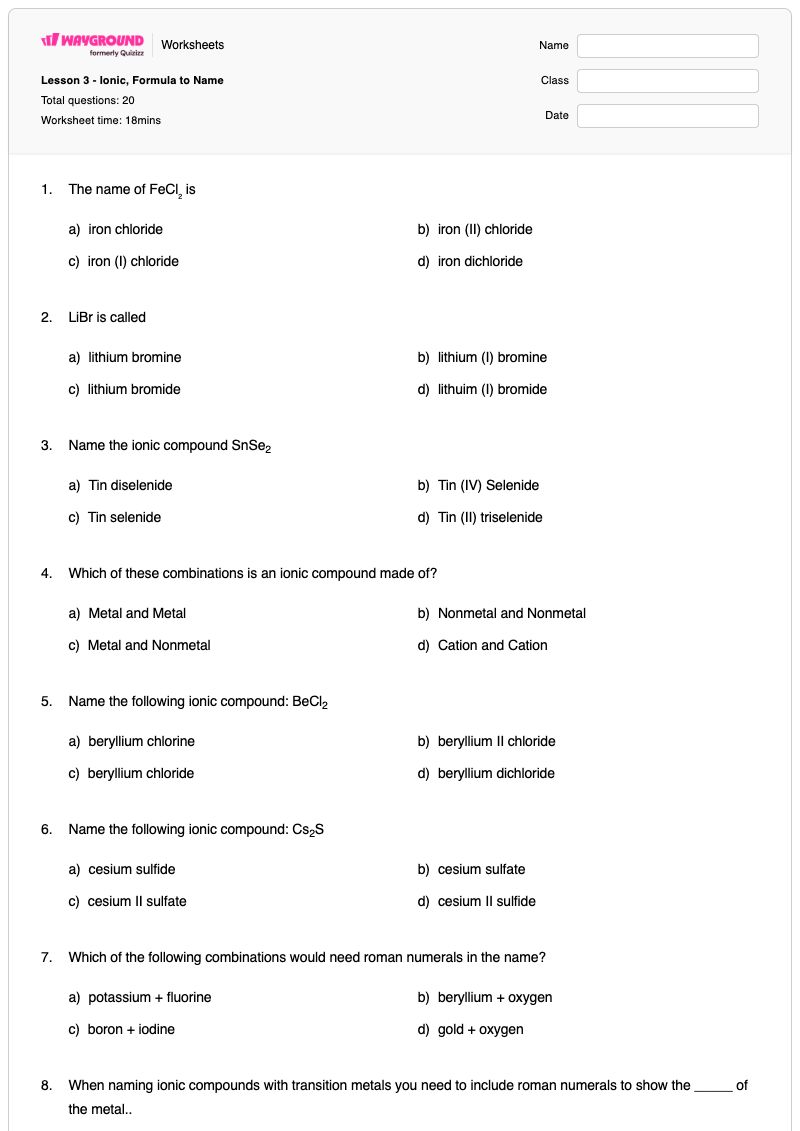
Lesson 3 - Ionic, Formula to Name

คำถามทั้งหมด: 20

ชื่อ
ระดับ
วันที่
1.

The name of FeCl₂ is

a)

iron chloride

b)

iron (II) chloride

c)

iron (I) chloride

d)

iron dichloride

2.

LiBr is called

a)

lithium bromine

b)

lithium (I) bromine

c)

lithium bromide

d)

lithuim (I) bromide

3.

Name the ionic compound SnSe2

a)

Tin diselenide

b)

Tin (IV) Selenide

c)

Tin selenide

d)

Tin (II) triselenide

4.

Which of these combinations is an ionic compound made of?

a)

Metal and Metal

b)

Nonmetal and Nonmetal

c)

Metal and Nonmetal

d)

Cation and Cation

5.

Name the following ionic compound: BeCl2

a)

beryllium chlorine

b)

beryllium II chloride

c)

beryllium chloride

d)

beryllium dichloride

6.

Name the following ionic compound: Cs2S

a)

cesium sulfide

b)

cesium sulfate

c)

cesium II sulfate

d)

cesium II sulfide

7.

Which of the following combinations would need roman numerals in the name?

a)

potassium + fluorine

b)

beryllium + oxygen

c)

boron + iodine

d)

gold + oxygen

8.

When naming ionic compounds with transition metals you need to include roman numerals to show the _____ of the metal..

a)

atomic number

b)

mass number

c)

charge

d)

ionization energy

9.

When naming a compound, which of these is written first?

a)

Metal

b)

Nonmetal

c)

Anion

d)

Cation

10.

When naming a compound, what must the last part be?

a)

the element with "ide" at the end

b)

the element with the ending "ite"

c)

the name of the element

d)

the element with "ide" at the end, unless its a polyatomic ion

11.

What is the name of the compound Na2(SO4)?

a)

Sodium sulfate

b)

Sodium sulfide

c)

Sodium sulfite

d)

Sodium sulfuroxide

12.

What is the name of the compound Sc(OH)3?

a)

Scandium (III) hydroxide

b)

Scandium (I) hydroxide

c)

Scandium (II) hydroxide

d)

Scandium hydroxide

13.

The name of the compound Ca3(PO4)2

a)

calcium phosphate

b)

tricalcium diphosphate

c)

calcium phosphorus oxide

d)

calcium phosphide

14.

The number that tells you if an ion has lost or gained electrons

a)

atomic number

b)

oxidation number

c)

mass number

d)

electron number

15.

If I gain electrons I become

a)

Positive because I've added to my atom

b)

negative because I've added electrons

c)

same because i'm balanced

d)

equal because now I have electrons

16.

By looking at the formula of an ionic compound, we can determine the charge (oxidation state) of a transition metal.

a)

True

b)

False

17.
Name this compound: 
KF
a)
Potassium fluoride
b)
Potassium fluorite
c)
Fluorine potasside 
d)
Potassium fluorate
18.

AlCl3

a)

Aluminum dichlorine

b)

Aluminum trichlorine

c)

Monoaluminum chloride

d)

Aluminum chloride

19.

MgI2

a)

Magnesium Iodine

b)

Monomagnesium di-iodide

c)

Magnesium iodide

d)

Magnesium tetraiodide

20.

NaCl

a)

Sodium monochlorine

b)

Sodium chloride

c)

Sodium monochloride

d)

Sodium chlorine

แป้นคำตอบ

Lesson 3 - Ionic, Formula to Name

คำถามทั้งหมด: 20

1.
b)

iron (II) chloride

2.
c)

lithium bromide

3.
b)

Tin (IV) Selenide

4.
c)

Metal and Nonmetal

5.
c)

beryllium chloride

6.
a)

cesium sulfide

7.
d)

gold + oxygen

8.
c)

charge

9.
d)

Cation

10.
d)

the element with "ide" at the end, unless its a polyatomic ion

11.
a)

Sodium sulfate

12.
a)

Scandium (III) hydroxide

13.
a)

calcium phosphate

14.
b)

oxidation number

15.
b)

negative because I've added electrons

16.
a)

True

17.
a) Potassium fluoride
18.
d)

Aluminum chloride

19.
c)

Magnesium iodide

20.
b)

Sodium chloride

คำถามที่พบบ่อย

แบบฝึกหัดการตั้งชื่อสารประกอบไอออนิกนี้ครอบคลุมหัวข้ออะไรบ้าง?

แบบฝึกหัดนี้ครอบคลุมการตั้งชื่อสารประกอบไอออนิกจากสูตรเคมีผ่านคำถามแบบเลือกตอบ 20 ข้อ นักเรียนจะได้ฝึกฝนการระบุแคตไอออนและแอนไอออน การใช้คำลงท้าย “-ide” สำหรับแอนไอออนที่เหมาะสม การจำแนกไอออนหลายอะตอม และการเพิ่มเลขโรมันเพื่อแสดงประจุของโลหะทรานซิชัน เช่น เหล็ก ดีบุก และสแกนเดียม

ฉันจะใช้แบบฝึกหัดนี้ในการสอนการตั้งชื่อสารประกอบไอออนิกได้อย่างไร?

แนะนำลำดับการตั้งชื่อที่ใช้ในแบบฝึกหัด: ระบุแคตไอออนก่อน พิจารณาว่าโลหะมีประจุแปรผันหรือไม่ แล้วจึงตั้งชื่อแอนไอออนโดยใช้คำลงท้ายที่เหมาะสมหรือชื่อไอออนหลายอะตอม ทำตัวอย่างเช่น FeCl₂, SnSe₂ และ Na₂SO₄ ร่วมกัน โดยขอให้นักเรียนอธิบายว่าสูตรเคมีบ่งบอกถึงประจุของโลหะอย่างไร ก่อนที่พวกเขาจะทำแบบฝึกหัดแบบเลือกตอบด้วยตนเอง

ฉันควรระวังข้อผิดพลาดอะไรบ้างเมื่อนักเรียนระบุชื่อสารประกอบในแบบฝึกหัดนี้?

ระวังนักเรียนที่ละเว้นเลขโรมันสำหรับโลหะที่มีประจุแปรผัน สับสนระหว่างประจุของโลหะกับเลขอะตอมหรือเลขมวล หรือใช้ตัวเลขห้อยเป็นคำนำหน้า เช่น “ไดคลอไรด์” นักเรียนอาจสับสนระหว่างซัลไฟด์กับซัลเฟตหรือซัลไฟต์ ลืมว่าต้องตั้งชื่อแคตไอออนก่อน หรือใช้คำลงท้าย “-ide” สำหรับไอออนหลายอะตอม เช่น ซัลเฟต ไฮดรอกไซด์ หรือฟอสเฟต

ฉันจะมอบหมายและให้คะแนนแบบฝึกหัดการตั้งชื่อสารประกอบไอออนิกนี้ได้อย่างไร?

แบบฝึกหัดนี้มีให้ดาวน์โหลดในรูปแบบ PDF ที่สามารถพิมพ์ได้ และเป็นแบบทดสอบดิจิทัลบน Wayground พร้อมเฉลยคำตอบครบถ้วนสำหรับคำถามแบบเลือกตอบทั้ง 20 ข้อ สำหรับการส่งงานในรูปแบบพิมพ์ คุณสามารถตรวจงานของนักเรียนได้โดยการสแกนด้วยแอป Wayground for Teachers รูปแบบพิมพ์ยังช่วยสนับสนุนห้องเรียนที่ลดเวลาการใช้หน้าจอได้อีกด้วย

ฉันจะปรับแบบฝึกหัดการตั้งชื่อสารประกอบไอออนิกนี้ให้เหมาะสมกับนักเรียนของฉันได้อย่างไร?

ในการตั้งค่าขั้นสูงของแบบฝึกหัด ให้ปรับระยะห่างระหว่างตัวอักษรหรือขนาดตัวอักษรเพื่อให้สูตรเคมี ตัวห้อย และตัวเลือกคำตอบอ่านง่ายขึ้น นอกจากนี้ คุณยังสามารถใช้แบบอักษรที่เหมาะสำหรับผู้ที่มีภาวะดิสเล็กเซีย หรือแปลแบบฝึกหัดเป็นภาษาอื่นได้โดยยังคงแบบฝึกหัดการเลือกคำตอบหลายข้อเกี่ยวกับการแปลงสูตรเป็นชื่อสารเคมีไว้เหมือนเดิม

ฉันจะหาแบบฝึกหัดแบบนี้เพิ่มเติมได้ที่ไหนบน Wayground?

Wayground มีแบบฝึกหัดและโจทย์ฝึกหัดให้ดาวน์โหลดฟรีมากมายในทุกวิชา รวมถึงไฟล์ PDF และเฉลยคำตอบ เพื่อช่วยให้นักเรียนเชี่ยวชาญทักษะและแนวคิดที่สำคัญ ดูแหล่งข้อมูลเพิ่มเติมได้ที่ https://wayground.com/en-us/worksheets