

Wayground
Where Do Chemical Elements Come From? - Printable ศาสตร์ Worksheets ระดับ 10 - Wayground

Where Do Chemical Elements Come From?

Lynn Chuang

สร้างโดย Lynn Chuang

24 คำถาม

10th ระดับชั้น

ศาสตร์

อัปเดตแล้ว พ.ค. 2569

ธาตุเคมีมาจากไหน? เป็นแบบฝึกหัดวิทยาศาสตร์สำหรับนักเรียนชั้นมัธยมศึกษาปีที่ 4 เกี่ยวกับวิธีการที่ดาวฤกษ์สร้างและปล่อยธาตุเคมีออกมา นักเรียนจะได้ศึกษาการระเบิดของดาวฤกษ์ ระบุธาตุที่มีอยู่ในดาวฤกษ์ นิยามนิวเคลียสซินเทซิส และแยกแยะปฏิกิริยานิวเคลียร์ที่เกี่ยวข้องกับดาวฤกษ์ที่มีมวลต่างกัน แบบฝึกหัดนี้ยังกล่าวถึงการก่อตัวของนิวเคลียส ไอโซโทป กระบวนการ S และการยุบตัวของแกนเหล็กด้วย แบบฝึกหัดประกอบด้วย 24 ข้อ แบ่งเป็นคำถามแบบเลือกตอบ 13 ข้อ และคำถามปลายเปิด 11 ข้อ ช่วยให้นักเรียนได้ฝึกฝนการจดจำคำศัพท์ทางดาราศาสตร์ที่สำคัญและการอธิบายเกี่ยวกับการก่อตัวของธาตุ คำถามอ้างอิงถึงดาวฤกษ์ 1054 ที่สังเกตได้ในกลุ่มดาววัว และให้นักเรียนเชื่อมโยงองค์ประกอบของดาวฤกษ์ ปฏิกิริยาฟิวชัน และการผลิตธาตุต่างๆ จนถึงเหล็ก แบบฝึกหัดที่พิมพ์ได้ฟรีนี้มีเฉลยคำตอบครบถ้วน เหมาะสำหรับใช้ในการสอน ทบทวน หรือประเมินผลวิชาวิทยาศาสตร์ชั้นมัธยมศึกษาปีที่ 4

การตั้งค่าแผ่นงาน

ขนาดตัวอักษร

S
M
L
XL
Waygroundแผ่นงาน

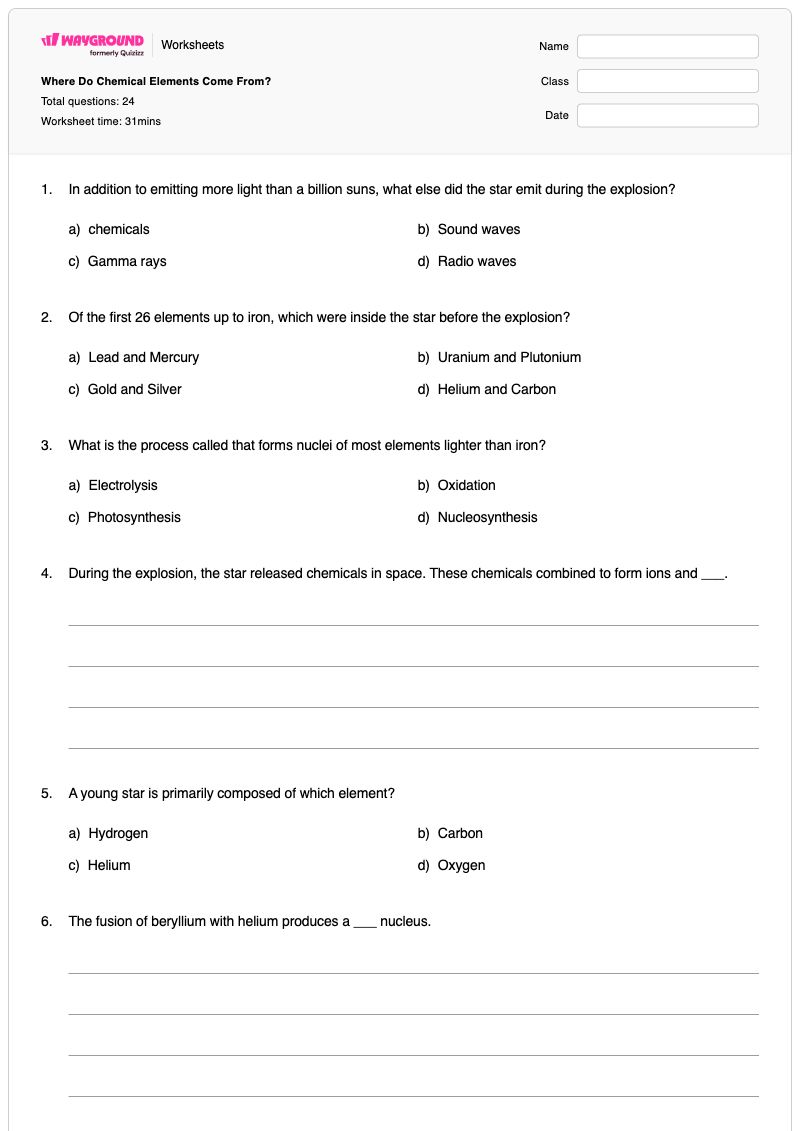
Where Do Chemical Elements Come From?

คำถามทั้งหมด: 24

ชื่อ
ระดับ
วันที่
1.

In addition to emitting more light than a billion suns, what else did the star emit during the explosion?

a)

chemicals

b)

Sound waves

c)

Gamma rays

d)

Radio waves

2.

Of the first 26 elements up to iron, which were inside the star before the explosion?

a)

Lead and Mercury

b)

Uranium and Plutonium

c)

Gold and Silver

d)

Helium and Carbon

3.

What is the process called that forms nuclei of most elements lighter than iron?

a)

Electrolysis

b)

Oxidation

c)

Photosynthesis

d)

Nucleosynthesis

4.

During the explosion, the star released chemicals in space. These chemicals combined to form ions and ___.

4 เส้น
5.

A young star is primarily composed of which element?

a)

Hydrogen

b)

Carbon

c)

Helium

d)

Oxygen

6.

The fusion of beryllium with helium produces a ___ nucleus.

4 เส้น
7.

The fusion of oxygen with helium produces a ___ nucleus.

4 เส้น
8.

In 1054, Chinese astronomers recorded a 'guest star' in which constellation?

a)

Scorpius

b)

Taurus

c)

Leo

d)

Orion

9.

What is the primary nuclear reaction in stars less massive than the sun?

a)

Iron to heavier elements conversion

b)

Helium to carbon conversion

c)

Hydrogen to helium conversion

d)

Carbon to oxygen conversion

10.

In stars more massive than eight solar masses, up to which element can the chain reaction produce?

a)

Iron

b)

Carbon

c)

Nickel

d)

Oxygen

11.

A star is a balancing act between gravity and ______ from nuclear reactions.

4 เส้น
12.

What happens when the core of a very massive star becomes pure iron nuclei?

a)

The star cools down

b)

The star expands

c)

The core collapses

d)

The core heats up

13.

The 's' process in stars involves the capture of ______ to form new nuclei.

4 เส้น
14.

Newly formed nuclei can be different versions of a given element called _________.

4 เส้น
15.

An isotope are different versions of the same element with the same number of protons but have different numbers of ________.

4 เส้น
16.

Nickel-64 and Nickel-65 are similar because they both contain 28 protons but

a)

nickel-64 contains 64 protons and nickel-65 contains 65 neutrons.

b)

nickel-64 contains 36 protons and nickel-65 contains 28 neutrons.

c)

nickel-64 contains 36 neutrons and nickel-64 contains 37 neutrons.

d)

nickel-64 contains 28 neutrons and nickel-65 contains 37 neutrons.

17.

Nickel-65 is radioactive and transforms into Copper-65 when a neutron of Nickel-65 transforms into a proton and an electron. This process is called

a)

"s" process

b)

"r" process

c)

beta decay

d)

supernova

18.

New elements are created during the explosion of a star. The nuclei of various elements captures neutrons that are released in the explosion. These elements then become the nuclei of the next element because a neutron will transform into a ________ and an electron.

4 เส้น
19.

What technique do scientists use to determine which chemical elements are formed inside stars?

a)

Mass spectrometry

b)

Visible spectroscopy

c)

Electron microscopy

d)

X-ray diffraction

20.

The emission spectrum of hydrogen consists of how many lines?

a)

Six

b)

Five

c)

Seven

d)

Four

21.

Atoms and molecules produce their own 'fingerprint' or 'signature' when the light they emit is spread in a ___.

4 เส้น
22.

What is the main component of the gas in an interstellar cloud?

a)

Oxygen

b)

Helium

c)

Carbon

d)

Hydrogen

23.

When an element formed through the

“r” process becomes really heavy, it

spontaneously breaks apart through a process called ___.

4 เส้น
24.

The nitrogen in our DNA and the calcium in our teeth were made in the interiors of ___.

4 เส้น
Waygroundแป้นคำตอบ

Where Do Chemical Elements Come From?

คำถามทั้งหมด: 24

1.
a)

chemicals

2.
d)

Helium and Carbon

3.
d)

Nucleosynthesis

4.
ไม่มี
5.
a)

Hydrogen

6.
ไม่มี
7.
ไม่มี
8.
b)

Taurus

9.
c)

Hydrogen to helium conversion

10.
a)

Iron

11.
ไม่มี
12.
c)

The core collapses

13.
ไม่มี
14.
ไม่มี
15.
ไม่มี
16.
c)

nickel-64 contains 36 neutrons and nickel-64 contains 37 neutrons.

17.
c)

beta decay

18.
ไม่มี
19.
b)

Visible spectroscopy

20.
d)

Four

21.
ไม่มี
22.
d)

Hydrogen

23.
ไม่มี
24.
ไม่มี

คำถามที่พบบ่อย

แบบฝึกหัด "ธาตุเคมีมาจากไหน?" ครอบคลุมเนื้อหาอะไรบ้าง?

แบบฝึกหัดวิทยาศาสตร์สำหรับนักเรียนชั้น ม.4 นี้ ประกอบด้วยคำถามแบบเลือกตอบ 13 ข้อ และคำถามปลายเปิด 11 ข้อ เพื่อสำรวจกระบวนการก่อตัวและปลดปล่อยธาตุต่างๆ ของดาวฤกษ์ผ่านกระบวนการสังเคราะห์นิวเคลียส นักเรียนจะได้ระบุองค์ประกอบของดาวฤกษ์ เปรียบเทียบปฏิกิริยานิวเคลียร์ในดาวฤกษ์ที่มีมวลต่างกัน ติดตามการก่อตัวของนิวเคลียส และแยกแยะไอโซโทปตามจำนวนโปรตอนและนิวตรอน

ฉันจะใช้แบบฝึกหัดนี้ในการสอนเรื่องการสังเคราะห์นิวเคลียสในดาวฤกษ์ได้อย่างไร?

เริ่มแบบฝึกหัดโดยทบทวนส่วนประกอบของดาวฤกษ์อายุน้อย จากนั้นอภิปรายว่าปฏิกิริยานิวเคลียร์แตกต่างกันอย่างไรในดาวฤกษ์ที่มีมวลน้อยกว่าดวงอาทิตย์และดาวฤกษ์ที่มีมวลมากกว่าแปดเท่าของมวลดวงอาทิตย์ ให้นักเรียนทำข้อสอบแบบเลือกตอบก่อน จากนั้นใช้คำถามปลายเปิดเพื่ออธิบายคำศัพท์ต่างๆ เช่น นิวเคลียสซินเทซิสและไอโซโทป และอภิปรายว่าการสังเกตการณ์ดาวฤกษ์รับเชิญ 1054 เชื่อมโยงการระเบิดของดาวฤกษ์กับการปล่อยสารเคมีอย่างไร

ฉันควรสังเกตข้อผิดพลาดอะไรบ้างเมื่อนักเรียนทำแบบฝึกหัดนี้เสร็จ?

นักเรียนอาจสับสนระหว่างกระบวนการสังเคราะห์นิวเคลียสกับกระบวนการอื่นที่ไม่เกี่ยวข้อง ระบุฮีเลียมแทนที่จะเป็นไฮโดรเจนว่าเป็นธาตุหลักในดาวฤกษ์อายุน้อย หรือเลือกปฏิกิริยานิวเคลียร์ผิดสำหรับดาวฤกษ์ที่มีมวลน้อยกว่าดวงอาทิตย์ ระวังความสับสนระหว่างขีดจำกัดของเหล็กในดาวฤกษ์ขนาดใหญ่กับจุดที่แกนเหล็กยุบตัวลง รวมถึงข้อผิดพลาดในการแยกแยะจำนวนโปรตอนของไอโซโทปออกจากจำนวนนิวตรอน

ฉันจะมอบหมายและให้คะแนนแบบฝึกหัดเรื่องธาตุเคมีนี้อย่างไร?

Wayground จัดเตรียมแบบฝึกหัดนี้ในรูปแบบไฟล์ PDF ที่สามารถพิมพ์ได้ และในรูปแบบแบบทดสอบดิจิทัล โดยทั้งสองเวอร์ชันมีเฉลยคำตอบครบถ้วน คุณสามารถตรวจคำตอบดิจิทัลได้ใน Wayground หรือสแกนงานที่นักเรียนทำเสร็จแล้วในรูปแบบไฟล์ PDF ด้วยแอป Wayground for Teachers รูปแบบไฟล์ที่พิมพ์ได้ยังช่วยสนับสนุนโรงเรียนที่ต้องการลดเวลาการใช้หน้าจออีกด้วย

ฉันจะปรับแบบฝึกหัดเรื่องการสังเคราะห์นิวเคลียสในดาวฤกษ์นี้ให้เหมาะสมกับนักเรียนของฉันได้อย่างไร?

ใช้การตั้งค่าขั้นสูงของแบบฝึกหัดเพื่อปรับระยะห่างระหว่างตัวอักษรและขนาดตัวอักษร เพื่อให้คำถามแบบเลือกตอบและคำถามปลายเปิดอ่านง่ายขึ้น นอกจากนี้ คุณยังสามารถใช้แบบอักษรที่เหมาะสำหรับผู้ที่มีภาวะดิสเล็กเซีย หรือแปลแบบฝึกหัดเป็นภาษาอื่น โดยคงคำถามเกี่ยวกับปฏิกิริยาของดาวฤกษ์ นิวเคลียส และไอโซโทปไว้เหมือนเดิม

ฉันจะหาแบบฝึกหัดแบบนี้เพิ่มเติมได้ที่ไหนบน Wayground?

Wayground มีแบบฝึกหัดและโจทย์ฝึกหัดมากมายให้ดาวน์โหลดฟรีในหลากหลายวิชา พร้อมไฟล์ PDF และเฉลยคำตอบ เพื่อช่วยให้นักเรียนพัฒนาทักษะและความเข้าใจในแนวคิดสำคัญๆ ดูแหล่งข้อมูลเพิ่มเติมได้ที่ https://wayground.com/en-us/worksheets