

Wayground
Cell Transport Review - Printable ศาสตร์ Worksheets 9th ระดับชั้น - Wayground

Cell Transport Review

Baiyinah Abdullah

สร้างโดย Baiyinah Abdullah

21 คำถาม

9th ระดับชั้น

ศาสตร์

อัปเดตแล้ว ก.ย. 2569

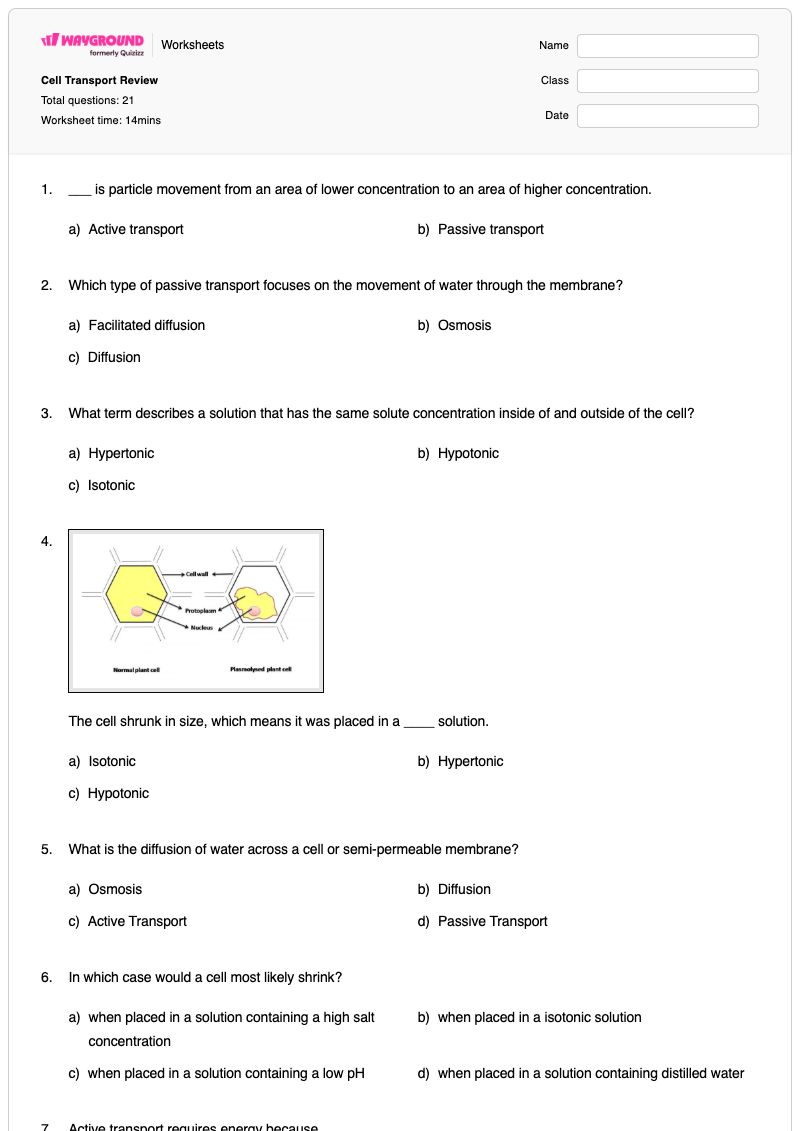
แบบฝึกหัดทบทวนการขนส่งในเซลล์สำหรับนักเรียนชั้นมัธยมศึกษาปีที่ 3 (เกรด 3) ช่วยให้นักเรียนแยกแยะการขนส่งแบบแอคทีฟและแบบพาสซีฟได้โดยการวิเคราะห์ความแตกต่างของความเข้มข้น ความต้องการพลังงาน การเคลื่อนที่ของเยื่อหุ้มเซลล์ และการเคลื่อนที่ของน้ำผ่านกระบวนการออสโมซิส นักเรียนยังสามารถระบุสารละลายไอโซโทนิก ไฮเปอร์โทนิก และไฮโปโทนิก และเชื่อมโยงสภาวะของสารละลายกับการเปลี่ยนแปลงของเซลล์ เช่น การหดตัวหรือการแข็งตัว แบบฝึกหัดเกี่ยวกับสถานการณ์ผักกาดหอมในน้ำและแบบฝึกหัดเกี่ยวกับการแพร่แบบเห็นภาพจะช่วยให้นักเรียนได้ประยุกต์ใช้แนวคิดเหล่านี้มากกว่าแค่คำจำกัดความง่ายๆ แบบฝึกหัดนี้มี 21 ข้อ: 19 ข้อเป็นแบบเลือกตอบ และ 2 ข้อเป็นแบบเลือกตอบหลายข้อ มีประโยชน์สำหรับการทบทวนการทำงานของเยื่อหุ้มเซลล์ การเปรียบเทียบการแพร่และการออสโมซิส และการตรวจสอบว่านักเรียนสามารถจำแนกกระบวนการขนส่งจากคำอธิบายของอนุภาคที่เคลื่อนที่ไปตามหรือสวนทางกับความแตกต่างของความเข้มข้นได้หรือไม่ แบบฝึกหัดที่พิมพ์ได้ฟรีนี้มีเฉลยคำตอบครบถ้วนสำหรับการทบทวน การฝึกฝนด้วยตนเอง หรือการประเมินผลอย่างมีประสิทธิภาพ

การตั้งค่าแผ่นงาน

ขนาดตัวอักษร

S
M
L
XL
Waygroundแผ่นงาน

Cell Transport Review

คำถามทั้งหมด: 21

ชื่อ
ระดับ
วันที่
1.

___ is particle movement from an area of lower concentration to an area of higher concentration.

a)

Active transport

b)

Passive transport

2.

Which type of passive transport focuses on the movement of water through the membrane?

a)

Facilitated diffusion

b)

Osmosis

c)

Diffusion

3.

What term describes a solution that has the same solute concentration inside of and outside of the cell?

a)

Hypertonic

b)

Hypotonic

c)

Isotonic

4.
The cell shrunk in size, which means it was placed in a ____ solution.

The cell shrunk in size, which means it was placed in a ____ solution.

a)

Isotonic

b)

Hypertonic

c)

Hypotonic

5.

What is the diffusion of water across a cell or semi-permeable membrane?

a)
Osmosis
b)
Diffusion
c)
Active Transport
d)
Passive Transport
6.
In which case would a cell most likely shrink?
a)
when placed in a solution containing a high salt concentration
b)
when placed in a isotonic solution
c)
when placed in a solution containing a low pH
d)
when placed in a solution containing distilled water
7.
Active transport requires energy because...
a)
The cell is moving something against a concentration gradient
b)
The cell is moving something with a concentration gradient
8.
A student noticed that placing wilted lettuce in a bowl of cool water caused the lettuce to become more crisp and firm. What is the best explanation for his observation?
a)
Water moved into the lettuce cells by active transport.
b)
Water moved into the lettuce cells by osmosis.
c)
Salt moved into the lettuce cells by diffusion.
d)
Water moved out of the lettuce cells by osmosis.
9.
What part of the cell regulates what can enter and leave the cell?

What part of the cell regulates what can enter and leave the cell?  

a)
Cell Membrane
b)
Nucleus
c)
Mitochondria
d)
Cytoplasm
10.
The picture below is an example of _________________.
a)
osmosis
b)
isotonic
c)
diffusion
d)
active transport
11.

Students are observing particles moving with the concentration gradient in a lab investigation. Which type of transport are they observing?

a)

using pumps to move things quickly

b)

passive transport

c)

osmosis

d)

endocytosis

12.

Students are observing particles moving against the concentration gradient in a lab investigation. Which type of transport are they observing?

a)

osmosis

b)

active Transport

c)

facilitated diffusion

d)

diffusion

13.

The cell membrane is responsible for allowing molecules to diffuse through a protein channel, from high concentration to low concentration. What type of transport is this?

a)

Passive Transport

b)

Active transport

14.

The cell membrane needs to use energy to move molecules quickly out of the cell through a pump. What type of transport is this?

a)

Passive transport

b)

Active transport

15.

The cell membrane is responsible for allowing molecules to diffuse into or out of the cell. What type of movement is diffusion?

a)

Passive transport

b)

Active transport

16.
This picture is a representation of what type of transport?

This picture is a representation of what type of transport?

a)

Osmosis because it is diffusing through a protein from an area of high concentration to low concentration.

b)

Facilitated diffusion because it is diffusing through a protein from an area of high concentration to low concentration.

c)

Facilitated diffusion because it is diffusing through a protein from an area of low concentration to high concentration.

d)

Simple diffusion because it is diffusing through a protein from an area of high concentration to low concentration.

17.
This picture describes the movement of molecules across the cell membrane. Choose 2 answers that correctly describes the…

This picture describes the movement of molecules across the cell membrane. Choose 2 answers that correctly describes the movement of the molecules.

a)

Molecules are moving up the concentration gradient.

b)

Molecules are moving from an area of low concentration to area of high concentration .

c)

Molecules are moving down the concentration gradient.

d)

Molecules are moving from an area of high concentration to area of low concentration.

18.
This a picture of an animal and plant cell placed in a solution. Describe the solution?

This a picture of an animal and plant cell placed in a solution. Describe the solution?

a)

Isotonic

b)

Hypotonic

c)

Hypertonic

19.
ภาพคำถาม
a)

A

b)

B

c)

C

d)

D

20.
ภาพคำถาม
a)

F

b)

G

c)

H

d)

J

21.
ภาพคำถาม
a)

A

b)

B

c)

C

d)

D

Waygroundแป้นคำตอบ

Cell Transport Review

คำถามทั้งหมด: 21

1.
a)

Active transport

2.
b)

Osmosis

3.
c)

Isotonic

4.
b)

Hypertonic

5.
a) Osmosis
6.
a) when placed in a solution containing a high salt concentration
7.
a) The cell is moving something against a concentration gradient
8.
b) Water moved into the lettuce cells by osmosis.
9.
a) Cell Membrane
10.
c) diffusion
11.
b)

passive transport

, c)

osmosis

12.
b)

active Transport

13.
a)

Passive Transport

14.
b)

Active transport

15.
a)

Passive transport

16.
b)

Facilitated diffusion because it is diffusing through a protein from an area of high concentration to low concentration.

17.
c)

Molecules are moving down the concentration gradient.

, d)

Molecules are moving from an area of high concentration to area of low concentration.

18.
b)

Hypotonic

19.
d)

D

20.
a)

F

21.
c)

C

คำถามที่พบบ่อย

แบบฝึกหัดทบทวนการลำเลียงสารในเซลล์ครอบคลุมหัวข้ออะไรบ้าง?

แบบฝึกหัดสำหรับนักเรียนชั้น ม.3 นี้ครอบคลุมหัวข้อการขนส่งแบบแอคทีฟ การขนส่งแบบพาสซีฟ การแพร่ การออสโมซิส และสารละลายไอโซโทนิก ไฮเปอร์โทนิก และไฮโปโทนิก แบบฝึกหัดประกอบด้วยคำถามแบบเลือกตอบ 19 ข้อ และคำถามแบบเลือกคำตอบ 2 ข้อ โดยให้นักเรียนจำแนกประเภทการขนส่งจากคำอธิบายความเข้มข้น-ความชัน ระบุว่าเมื่อใดที่ต้องการพลังงาน และทำนายการเปลี่ยนแปลงของเซลล์ เช่น การหดตัวหรือการแข็งตัว

ฉันจะใช้แบบฝึกหัดนี้ในการสอนเรื่องการลำเลียงสารภายในเซลล์ได้อย่างไร?

เริ่มแบบฝึกหัดโดยให้นักเรียนเปรียบเทียบการเคลื่อนที่ตามและสวนทางกับความเข้มข้นของสารละลาย จากนั้นเชื่อมโยงทิศทางการเคลื่อนที่เหล่านั้นเข้ากับการขนส่งแบบพาสซีฟและแบบแอคทีฟ ใช้คำถามเกี่ยวกับออสโมซิส ผักกาดหอมในน้ำ และความเข้มข้นของสารละลาย เพื่ออธิบายว่าการเคลื่อนที่ของน้ำส่งผลต่อเซลล์อย่างไร และขอให้นักเรียนอธิบายว่าทำไมเซลล์จึงหดตัวในสารละลายไฮเปอร์โทนิก ทบทวนข้อสอบแบบเลือกตอบหลายข้อร่วมกันในชั้นเรียน เพื่อให้นักเรียนแยกแยะความแตกต่างระหว่างการขนส่งแบบพาสซีฟและออสโมซิส แทนที่จะมองว่ากระบวนการทั้งสองไม่เกี่ยวข้องกัน

ฉันควรระวังข้อผิดพลาดอะไรบ้างเมื่อนักเรียนทำแบบฝึกหัดการลำเลียงสารในเซลล์นี้?

นักเรียนอาจสับสนการเคลื่อนที่ทั้งตามและสวนทางกับความเข้มข้น ทำให้พวกเขาสับสนระหว่างการขนส่งแบบแอคทีฟและแบบพาสซีฟ หรือไม่เข้าใจว่าทำไมการขนส่งแบบแอคทีฟจึงต้องใช้พลังงาน นอกจากนี้ พวกเขาอาจสับสนระหว่างออสโมซิสกับการแพร่ทั่วไป หรือสับสนผลกระทบของสารละลายไฮเปอร์โทนิก ไฮโปโทนิก และไอโซโทนิกต่อขนาดของเซลล์ ในคำถามแบบเลือกตอบหลายข้อ ให้สังเกตนักเรียนที่เลือกประเภทการขนส่งที่ถูกต้องเพียงประเภทเดียว เมื่อทั้งการขนส่งแบบพาสซีฟและออสโมซิสใช้ได้กับสิ่งที่สังเกตได้

ฉันจะมอบหมายและตรวจงานทบทวนการลำเลียงสารในเซลล์ได้อย่างไร?

Wayground จัดทำแบบฝึกหัดเรื่องการเคลื่อนที่ของเซลล์ในรูปแบบไฟล์ PDF ที่สามารถพิมพ์ได้ และในรูปแบบแบบทดสอบดิจิทัล พร้อมเฉลยคำตอบครบถ้วน คุณสามารถตรวจงานที่นักเรียนส่งมาในรูปแบบไฟล์พิมพ์ได้โดยการสแกนงานของพวกเขาด้วยแอป Wayground for Teachers นอกจากนี้ เวอร์ชันที่สามารถพิมพ์ได้ยังสามารถสนับสนุนการเรียนการสอนในโรงเรียนที่ลดเวลาการใช้หน้าจอได้อีกด้วย

ฉันจะปรับแบบฝึกหัดการลำเลียงสารในเซลล์นี้ให้เหมาะสมกับนักเรียนของฉันได้อย่างไร?

ใช้การตั้งค่าขั้นสูงของแบบฝึกหัดเพื่อปรับระยะห่างระหว่างตัวอักษรและขนาดตัวอักษร เพื่อให้คำจำกัดความเกี่ยวกับการขนส่ง คำอธิบายวิธีแก้ปัญหา และตัวเลือกคำตอบอ่านง่ายขึ้น นอกจากนี้ คุณยังสามารถเปิดใช้งานแบบอักษรที่เหมาะสำหรับผู้ที่มีภาวะดิสเล็กเซีย หรือแปลแบบฝึกหัดเป็นภาษาอื่นเพื่อช่วยให้เข้าถึงคำศัพท์และคำถามเกี่ยวกับการขนส่งในเซลล์ได้ดียิ่งขึ้น

ฉันจะหาแบบฝึกหัดแบบนี้เพิ่มเติมได้ที่ไหนบน Wayground?

Wayground มีแบบฝึกหัดและโจทย์ฝึกหัดมากมายให้ดาวน์โหลดฟรีในหลากหลายวิชา พร้อมไฟล์ PDF และเฉลยคำตอบ เพื่อช่วยให้นักเรียนพัฒนาทักษะและความเข้าใจในแนวคิดสำคัญๆ ดูแหล่งข้อมูลเพิ่มเติมได้ที่ https://wayground.com/en-us/worksheets