

Wayground
Osmosis y Difussion - Printable ศาสตร์ Worksheets 10th ระดับชั้น - Wayground

Osmosis y Difussion

Prof. Diana Escandon

สร้างโดย Prof. Diana Escandon

22 คำถาม

10th ระดับชั้น

ศาสตร์

อัปเดตแล้ว ธ.ค. 2568

แบบฝึกหัดวิทยาศาสตร์ระดับชั้น ม.4 (เกรด 4) ที่พิมพ์ได้ฟรีนี้ ช่วยเสริมสร้างความเข้าใจเกี่ยวกับออสโมซิสและการแพร่ผ่านคำถามแบบเลือกตอบ 22 ข้อ นักเรียนจะได้เรียนรู้ว่าน้ำและอนุภาคเคลื่อนที่อย่างไรเมื่อความเข้มข้นแตกต่างกัน แยกแยะความแตกต่างระหว่างออสโมซิส การแพร่ และการขนส่งแบบแอคทีฟ และตระหนักว่าการขนส่งแบบพาสซีฟไม่ต้องการพลังงาน คำถามยังกล่าวถึงบทบาทของเยื่อหุ้มเซลล์ในการควบคุมการเคลื่อนที่และการซึมผ่านแบบเลือกสรรด้วย นักเรียนจะนำแนวคิดเหล่านี้ไปประยุกต์ใช้กับแผนภาพเซลล์และสถานการณ์ในชีวิตจริง รวมถึงไข่ที่วางในน้ำบริสุทธิ์ น้ำหอมที่กระจายไปทั่วห้อง และเซลล์สัตว์ในสารละลายไฮโปโทนิก ไฮเปอร์โทนิก หรือไอโซโทนิก แบบฝึกหัดนี้เหมาะสำหรับบทเรียนชีววิทยาหรือเคมี การฝึกฝนด้วยตนเอง การทบทวน หรือการประเมินผลระหว่างเรียนเพื่อวัดความสามารถของนักเรียนในการทำนายว่าเซลล์จะบวม หดตัว หรือคงที่ มีเฉลยคำตอบครบถ้วนเพื่อการตรวจสอบและให้ข้อเสนอแนะอย่างมีประสิทธิภาพ

การตั้งค่าแผ่นงาน

ขนาดตัวอักษร

S
M
L
XL
Waygroundแผ่นงาน

Osmosis y Difussion

คำถามทั้งหมด: 22

ชื่อ
ระดับ
วันที่
1.
During osmosis
a)
water moves from high to low concentration
b)
large or oddly shaped molecules move across a cell membrane
c)
water moves when energy is used
d)
proteins are built
2.
In the given scenario what will happen?  An egg is placed in pure water for 48 hours.
a)
The egg will gain water and swell.
b)
Water will move in and out of the cell equally, and the cell with neither shrink nor swell.
c)
The egg will lose water and shrink.
3.
Ideally, your cells should be in a(n) _______ solution
a)
Hypertonic
b)
Hypotonic
c)
Isotonic
d)
Cola
4.
The picture below is an example of _________________.
a)
osmosis
b)
isotonic
c)
diffusion
d)
active transport
5.
Passive transport requires no
a)
concentration gradients
b)
osmosis
c)
motion
d)
energy
6.
_______ regulates what enters and leaves a cell.
_______ regulates what enters and leaves a cell.  
a)
Cell Membrane
b)
Nucleus
c)
Mitochondria
d)
Cytoplasm
7.
Osmosis
Osmosis
a)
diffusion of water molecules through a semi-permeable mebrane from an area of low concentration to an area of high concentration
b)
the diffusion of particles from an area of high concentration to an area of low concentration
c)
diffusion of water molecules through a semi-permeable membrane from an area of high concentration to an area of low concentration
d)
the diffusion of particles from an area of low concentration to an area of high concentration
8.
The cell below is in a _________ solution.
a)
Hypotonic
b)
Hypertonic
c)
Isotonic
9.
Which cell is placed into a hypotonic environment?
Which cell is placed into a hypotonic environment? 
a)
A
b)
B
c)
C
d)
D
10.
Which way will the water molecules move during osmosis?
a)
Out of the cell, so the cell shrinks.
b)
Out of the cell, so the cell swells.
c)
Into the cell, so the cell shrinks.
d)
Into the cell, so the cell swells.
11.
Where is there a low concentration of perfume?
a)
in the bottle
b)
on the hand
c)
in the room
d)
in the top
12.
What is diffusion?
a)
when molecules move 
b)
when molecules move from a high concentration to a low.
c)
no movement 
d)
molecules move everywhere
13.
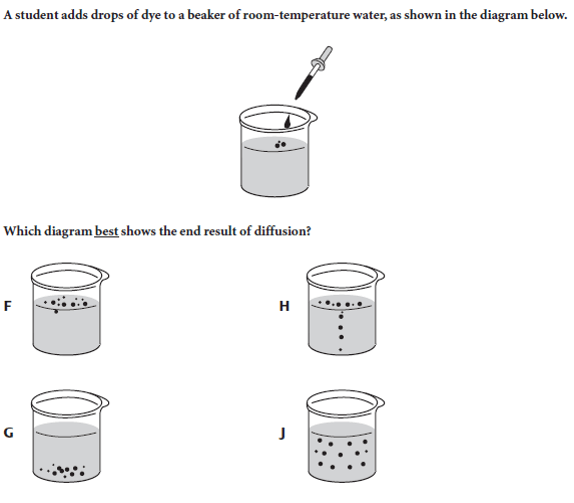
Which diagram best shows the end result of diffusion?
a)
F
b)
G
c)
H
d)
J
14.
 An animal cell placed in a hypertonic (salty) solution will
a)
Stay the same
b)
Shrink- get smaller
c)
Swell- get bigger
15.
What is the definition of Selective Permeability?
What is the definition of  Selective Permeability?
a)
The movement of materials across the cell membrane that requires NO ENERGY from the cell.
b)
The movement of materials through (or across) the cell membrane
c)
The ability of the cell membrane to allow some things to pass through while preventing other things from passing through.
d)
The movement of molecules from an area of high concentration to a area of low concentration 
16.
What is the diffusion of water only across a cell or semi-permeable membrane?
a)
Osmosis
b)
Diffusion
c)
Active Transport
d)
Passive Transport
17.
What type of cellular transport uses energy?
a)
Passive Transport
b)
Active Transport
18.
In which case would a cell most likely shrink?
a)
when placed in a solution containing a high salt concentration
b)
when placed in a isotonic solution
c)
when placed in a solution containing a low pH
d)
when placed in a solution containing distilled water
19.
Active transport requires energy because...
a)
The cell is moving something against a concentration gradient
b)
The cell is moving something with a concentration gradient
20.
A student noticed that placing wilted lettuce in a bowl of cool water caused the lettuce to become more crisp and firm. What is the best explanation for his observation?
a)
Water moved into the lettuce cells by active transport.
b)
Water moved into the lettuce cells by osmosis.
c)
Salt moved into the lettuce cells by diffusion.
d)
Water moved out of the lettuce cells by osmosis.
21.
Diffusion and Osmosis are examples of...
a)
Active Transport
b)
Passive Transport
22.
 If the volume of a cell increases when it is placed in a solution, that solution is said to be __________ to the cell
a)
 hypertonic
b)
subatomic
c)
 isotonic
d)
 hypotonic 
Waygroundแป้นคำตอบ

Osmosis y Difussion

คำถามทั้งหมด: 22

1.
a) water moves from high to low concentration
2.
a) The egg will gain water and swell.
3.
c) Isotonic
4.
c) diffusion
5.
d) energy
6.
a) Cell Membrane
7.
c) diffusion of water molecules through a semi-permeable membrane from an area of high concentration to an area of low concentration
8.
b) Hypertonic
9.
a) A
10.
a) Out of the cell, so the cell shrinks.
11.
c) in the room
12.
b) when molecules move from a high concentration to a low.
13.
d) J
14.
b) Shrink- get smaller
15.
c) The ability of the cell membrane to allow some things to pass through while preventing other things from passing through.
16.
a) Osmosis
17.
b) Active Transport
18.
a) when placed in a solution containing a high salt concentration
19.
a) The cell is moving something against a concentration gradient
20.
b) Water moved into the lettuce cells by osmosis.
21.
b) Passive Transport
22.
d)  hypotonic 

คำถามที่พบบ่อย

แบบฝึกหัดเรื่องออสโมซิสและการแพร่กระจายนี้ครอบคลุมหัวข้ออะไรบ้าง?

แบบฝึกหัดสำหรับนักเรียนชั้นมัธยมศึกษาปีที่ 4 นี้ ประกอบด้วยคำถามแบบเลือกตอบ 22 ข้อ เพื่อประเมินความเข้าใจเกี่ยวกับออสโมซิส การแพร่ การขนส่งแบบพาสซีฟ การซึมผ่านแบบเลือกสรร และบทบาทของเยื่อหุ้มเซลล์ในการควบคุมการเคลื่อนที่ นักเรียนจะต้องตีความความแตกต่างของความเข้มข้น แผนภาพเซลล์ และสถานการณ์ต่างๆ เช่น ไข่ในน้ำบริสุทธิ์ หรือเซลล์สัตว์ในสารละลายเกลือ เพื่อทำนายว่าน้ำจะเคลื่อนที่หรือไม่ และเซลล์จะบวม หดตัว หรือคงที่

ฉันจะใช้แบบฝึกหัดนี้สอนเรื่องออสโมซิสและการแพร่ได้อย่างไร?

เริ่มแบบฝึกหัดโดยทบทวนเรื่องความแตกต่างของความเข้มข้น เยื่อหุ้มเซลล์ที่เลือกผ่านได้ และความแตกต่างระหว่างการเคลื่อนที่ของอนุภาคในการแพร่และการเคลื่อนที่ของน้ำในกระบวนการออสโมซิส จากนั้นให้นักเรียนอธิบายสถานการณ์ไข่ในน้ำบริสุทธิ์และสถานการณ์ความเข้มข้นของเซลล์ ก่อนที่จะเลือกคำตอบ โดยใช้แผนภาพหรือสถานการณ์แต่ละอย่างเพื่ออธิบายทิศทางการเคลื่อนที่ที่คาดการณ์ไว้ จบด้วยการอธิบายว่าเหตุใดการขนส่งแบบพาสซีฟจึงไม่ใช้พลังงานและแตกต่างจากการขนส่งแบบแอคทีฟอย่างไร

ฉันควรสังเกตข้อผิดพลาดอะไรบ้างเมื่อนักเรียนทำแบบฝึกหัดนี้เสร็จ?

นักเรียนอาจสับสนทิศทางการเคลื่อนที่โดยเลือกความเข้มข้นจากต่ำไปสูง หรือสับสนระหว่างการแพร่ของอนุภาคกับออสโมซิส ซึ่งในแบบฝึกหัดได้นิยามไว้ว่าเป็นการเคลื่อนที่ของน้ำผ่านเยื่อกั้นกึ่งซึมผ่านได้ นอกจากนี้ นักเรียนอาจสับสนระหว่างสารละลายไฮโปโทนิก ไฮเปอร์โทนิก และไอโซโทนิก เมื่อทำนายว่าเซลล์จะบวม หดตัว หรือคงที่ ควรระวังนักเรียนที่ระบุว่าการขนส่งแบบพาสซีฟต้องใช้พลังงาน หรือสับสนระหว่างเยื่อหุ้มเซลล์กับโครงสร้างเซลล์อื่น

ฉันจะมอบหมายและตรวจงานเรื่องออสโมซิสและการแพร่ได้อย่างไร?

แบบฝึกหัดนี้มีให้เลือกทั้งในรูปแบบไฟล์ PDF ที่สามารถพิมพ์ได้ และแบบทดสอบดิจิทัลบน Wayground คุณจึงสามารถใช้คำถามแบบเลือกตอบ 22 ข้อนี้สำหรับการฝึกฝนบนกระดาษหรือการประเมินผลออนไลน์ได้ แบบฝึกหัดนี้มีเฉลยคำตอบครบถ้วน และสามารถตรวจให้คะแนนงานที่ส่งมาได้โดยการสแกนงานของนักเรียนด้วยแอป Wayground for Teachers นอกจากนี้ ตัวเลือกไฟล์ PDF ยังช่วยสนับสนุนโรงเรียนที่ต้องการลดเวลาการใช้หน้าจอได้อีกด้วย

ฉันจะปรับแบบฝึกหัดเรื่องออสโมซิสและการแพร่ให้เหมาะสมกับนักเรียนของฉันได้อย่างไร?

ใช้การตั้งค่าขั้นสูงของแบบฝึกหัดเพื่อปรับระยะห่างระหว่างตัวอักษรและขนาดตัวอักษร เพื่อให้ตัวเลือกแบบปรนัย สถานการณ์การไล่ระดับความเข้มข้น และแผนภาพเซลล์อ่านง่ายขึ้น นอกจากนี้ คุณยังสามารถใช้แบบอักษรที่เหมาะสำหรับผู้ที่มีภาวะดิสเล็กเซีย หรือแปลแบบฝึกหัดเป็นภาษาอื่นได้ เมื่อตัวเลือกเหล่านั้นช่วยให้เข้าถึงเนื้อหาเกี่ยวกับออสโมซิสและการแพร่กระจายได้ง่ายขึ้น

ฉันจะหาแบบฝึกหัดแบบนี้เพิ่มเติมได้ที่ไหนบน Wayground?

Wayground นำเสนอชุดแบบฝึกหัดและโจทย์ฝึกหัดฟรีที่ครอบคลุมหลากหลายวิชา พร้อมไฟล์ PDF และเฉลยคำตอบ เพื่อช่วยให้นักเรียนเชี่ยวชาญทักษะและแนวคิดที่สำคัญ ดูแหล่งข้อมูลเพิ่มเติมได้ที่ https://wayground.com/en-us/worksheets