

 แผ่นงาน
Ethos,Pathos, Logos
คำถามทั้งหมด: 8
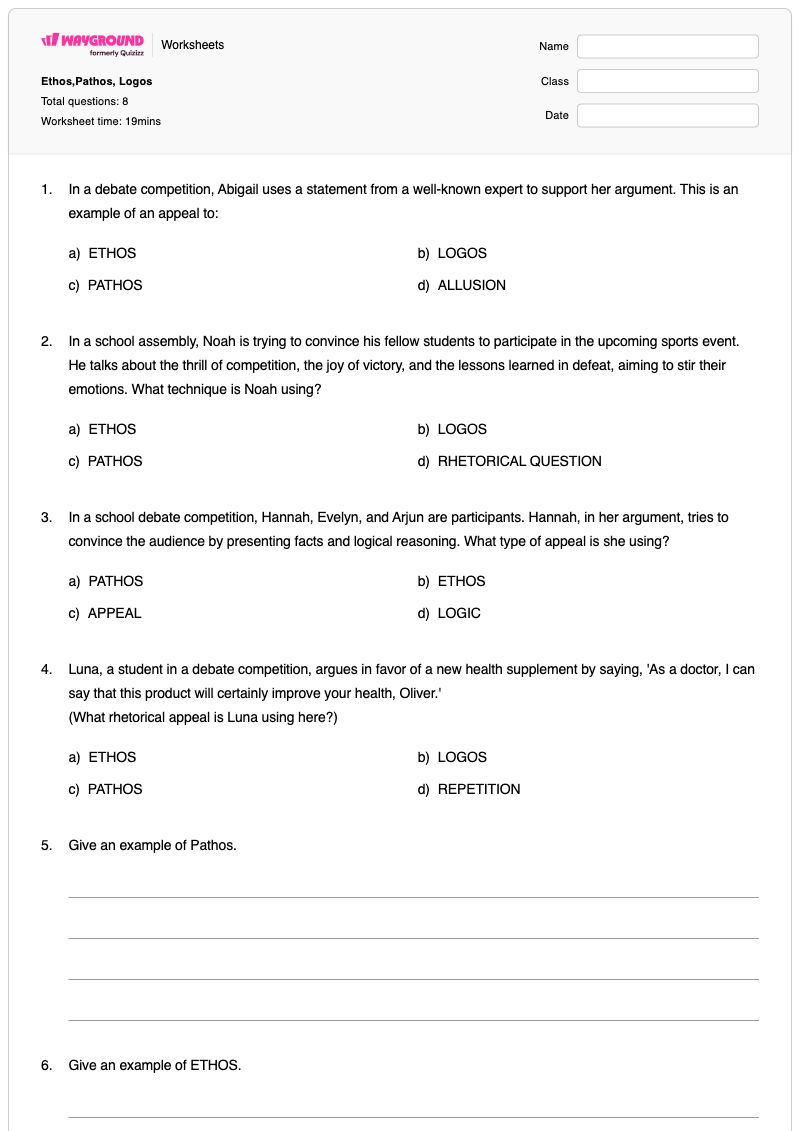
In a debate competition, Abigail uses a statement from a well-known expert to support her argument. This is an example of an appeal to:
ETHOS
LOGOS
PATHOS
ALLUSION
In a school assembly, Noah is trying to convince his fellow students to participate in the upcoming sports event. He talks about the thrill of competition, the joy of victory, and the lessons learned in defeat, aiming to stir their emotions. What technique is Noah using?
ETHOS
LOGOS
PATHOS
RHETORICAL QUESTION
In a school debate competition, Hannah, Evelyn, and Arjun are participants. Hannah, in her argument, tries to convince the audience by presenting facts and logical reasoning. What type of appeal is she using?
PATHOS
ETHOS
APPEAL
LOGIC
Luna, a student in a debate competition, argues in favor of a new health supplement by saying, 'As a doctor, I can say that this product will certainly improve your health, Oliver.'
(What rhetorical appeal is Luna using here?)
ETHOS
LOGOS
PATHOS
REPETITION
Give an example of Pathos.
Give an example of ETHOS.
Rhetorical Appeals in Speeches
Rhetorical appeals are powerful tools used by speakers to persuade their audience. These appeals are techniques that speakers use to make their arguments more convincing and compelling. There are three main types of rhetorical appeals: ethos, pathos, and logos.
Ethos appeals to the credibility and trustworthiness of the speaker. It involves establishing the speaker's authority and expertise on the topic. By presenting themselves as knowledgeable and reliable, speakers can gain the trust and respect of their audience.
Pathos appeals to the emotions of the audience. It involves using emotional language, vivid imagery, and personal anecdotes to evoke strong feelings and create a connection with the audience. By appealing to their emotions, speakers can make their arguments more relatable and persuasive.
What does ethos appeal to in speeches?
The emotions of the audience
The logic and reasoning of the speaker
The credibility and trustworthiness of the speaker
The use of persuasive language
What are rhetorical appeals used for?
To entertain the audience
To inform the audience
To persuade the audience
To confuse the audience
What do speakers use rhetorical appeals for?
To make their arguments more convincing and compelling
To entertain the audience
To confuse the listeners
To summarize their main points
What are some elements of pathos appeals?
Logical reasoning, statistical data, and facts
Humor, jokes, and puns
Ethical principles, moral values, and credibility
Emotional language, vivid imagery, and personal anecdotes
Example of Pathos
Pathos is a rhetorical appeal that aims to evoke emotions in the audience. It is often used to create a connection between the speaker or writer and the audience by appealing to their emotions. One example of pathos can be found in Martin Luther King Jr.'s famous speech, 'I Have a Dream.' In this speech, King appeals to the emotions of his audience by describing the injustices faced by African Americans and painting a vivid picture of a future where equality and justice prevail.
King's use of vivid imagery and emotional language, such as 'I have a dream that my four little children will one day live in a nation where they will not be judged by the color of their skin but by the content of their character,' evokes strong emotions in the audience. By appealing to their sense of empathy and justice, King is able to inspire his audience to take action and work towards achieving equality.
Overall, pathos is a powerful rhetorical appeal that can be used to effectively communicate a message and persuade an audience. By appealing to the emotions of the audience, speakers and writers can create a strong connection and inspire action.
What is an example of pathos in Martin Luther King Jr.'s speech 'I Have a Dream'?
Ethos
Logos
Pathos
Kairos
What effect does King's use of vivid imagery and emotional language have on the audience?
It confuses the audience
It bores the audience
It evokes strong emotions in the audience
It makes the audience laugh
What is the role of pathos in effective communication and audience persuasion?
What is the purpose of pathos in rhetoric?
To evoke emotions in the audience
To provide logical reasoning
To appeal to the audience's sense of ethics
To present factual evidence
What rhetorical technique does King use to engage his audience?
Logos
Ethos
Pathos
Kairos
แป้นคำตอบEthos,Pathos, Logos
คำถามทั้งหมด: 8
ETHOS
PATHOS
LOGIC
ETHOS
The credibility and trustworthiness of the speaker
To persuade the audience
To make their arguments more convincing and compelling
Emotional language, vivid imagery, and personal anecdotes
Pathos
It evokes strong emotions in the audience
To evoke emotions in the audience
Pathos