

Wayground
ESL #154- Domain III - Printable ภาษาต่างประเทศ Worksheets การพัฒนาทางอาชีพ - Wayground

ESL #154- Domain III

MARY MARTIN

สร้างโดย MARY MARTIN

11 คำถาม

การพัฒนาทางอาชีพ

ภาษาต่างประเทศ

อัปเดตแล้ว ก.ค. 2568

ESL #154- โดเมน III เป็นแบบฝึกหัดที่พิมพ์ได้ฟรีสำหรับนักเรียนชั้นมัธยมศึกษาปีที่ 4 ที่เตรียมพร้อมที่จะประยุกต์ใช้หลักการสอนภาษาอังกฤษสำหรับผู้เรียนภาษาต่างประเทศ แบบฝึกหัดนี้ประกอบด้วยคำถามตามสถานการณ์ 11 ข้อ—แบบเลือกตอบ 8 ข้อ และแบบเลือกคำตอบที่ถูกต้อง 3 ข้อ—เพื่อตรวจสอบการสอนที่ตอบสนองต่อวัฒนธรรม การมีส่วนร่วมของชุมชนและครอบครัว การลดอุปสรรคทางอารมณ์ ข้อกำหนดของรัฐบาลกลาง การประเมินโครงการ การสอนภาษาอังกฤษแบบมีผู้ช่วย และแนวทางที่เน้นจุดแข็งในการใช้หลายภาษา นักเรียนจะวิเคราะห์สถานการณ์ในห้องเรียน โรงเรียน และชุมชน เพื่อเลือกหรือระบุแนวทางการสอนที่เหมาะสม ข้อกำหนดทางกฎหมาย และกลยุทธ์การสนับสนุนสำหรับผู้เรียนภาษาอังกฤษ คำถามจะถามผู้เรียนให้แยกแยะแนวคิดต่างๆ เช่น การสอนที่ตอบสนองต่อวัฒนธรรมและการสอนภาษาอังกฤษแบบมีผู้ช่วย ตระหนักถึงบทบาทที่มีประสิทธิภาพของอาสาสมัครและบุคลากรสองภาษา และเชื่อมโยงภาษาและวัฒนธรรมของนักเรียนเข้ากับการเรียนรู้ แบบฝึกหัดนี้มีให้ดาวน์โหลดเป็นไฟล์ PDF ที่พิมพ์ได้ฟรี และมีเฉลยคำตอบครบถ้วนสำหรับการทบทวน การฝึกฝนด้วยตนเอง หรือการอภิปรายโดยครูผู้สอน

การตั้งค่าแผ่นงาน

ขนาดตัวอักษร

S
M
L
XL
Waygroundแผ่นงาน

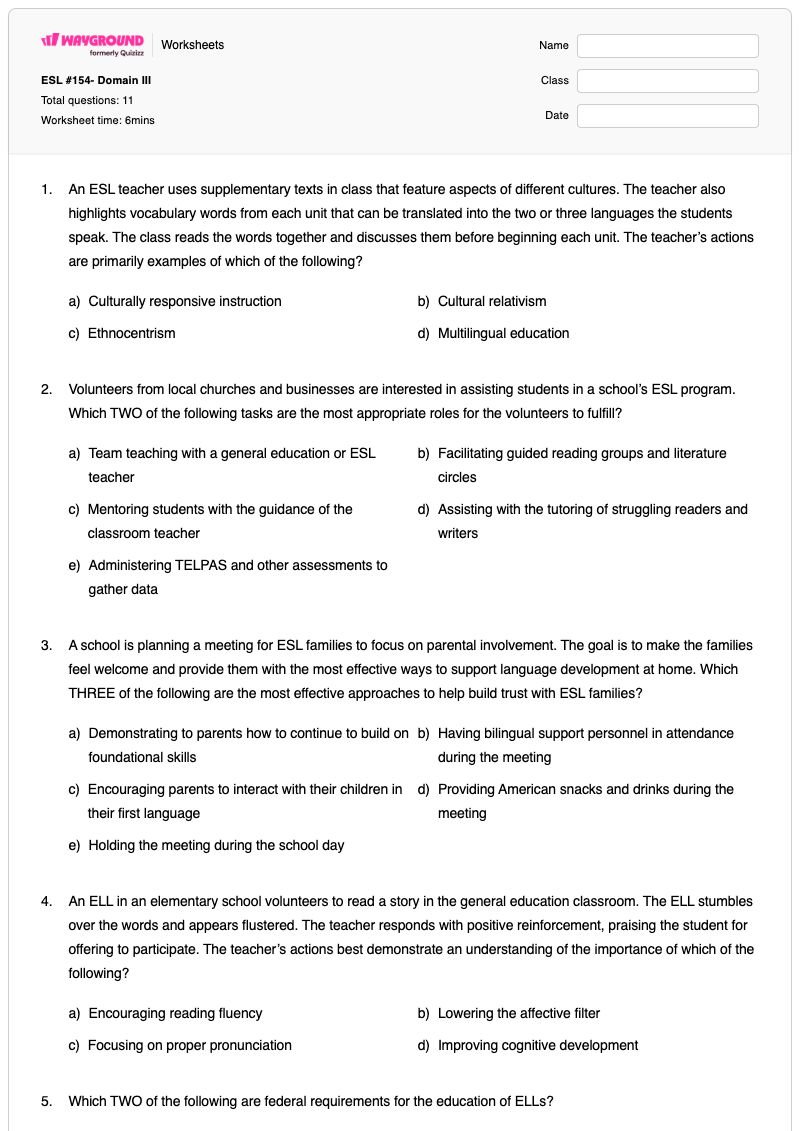
ESL #154- Domain III

คำถามทั้งหมด: 11

ชื่อ
ระดับ
วันที่
1.

An ESL teacher uses supplementary texts in class that feature aspects of different cultures. The teacher also highlights vocabulary words from each unit that can be translated into the two or three languages the students speak. The class reads the words together and discusses them before beginning each unit. The teacher’s actions are primarily examples of which of the following?

a)

Culturally responsive instruction

b)

Cultural relativism

c)

Ethnocentrism

d)

Multilingual education

2.

Volunteers from local churches and businesses are interested in assisting students in a school’s ESL program. Which TWO of the following tasks are the most appropriate roles for the volunteers to fulfill?

a)

Team teaching with a general education or ESL teacher

b)

Facilitating guided reading groups and literature circles

c)

Mentoring students with the guidance of the classroom teacher

d)

Assisting with the tutoring of struggling readers and writers

e)

Administering TELPAS and other assessments to gather data

3.

A school is planning a meeting for ESL families to focus on parental involvement. The goal is to make the families feel welcome and provide them with the most effective ways to support language development at home. Which THREE of the following are the most effective approaches to help build trust with ESL families?

a)

Demonstrating to parents how to continue to build on foundational skills

b)

Having bilingual support personnel in attendance during the meeting

c)

Encouraging parents to interact with their children in their first language

d)

Providing American snacks and drinks during the meeting

e)

Holding the meeting during the school day

4.

An ELL in an elementary school volunteers to read a story in the general education classroom. The ELL stumbles over the words and appears flustered. The teacher responds with positive reinforcement, praising the student for offering to participate. The teacher’s actions best demonstrate an understanding of the importance of which of the following?

a)

Encouraging reading fluency

b)

Lowering the affective filter

c)

Focusing on proper pronunciation

d)

Improving cognitive development

5.

Which TWO of the following are federal requirements for the education of ELLs?

a)

ELLs must have access to the core curriculum.

b)

ELLs must be given the opportunity to learn in their native language.

c)

ELLs must exit an ESL program in no less than three years.

d)

ELLs must be given opportunities for English-language development.

6.

A school district is establishing an ESL program for the first time and must do so in compliance with established criteria. The district first puts into place a mechanism that will determine the program’s effectiveness in achieving its instructional goals for ELLs. The evaluation ensures that the program will primarily fulfill requirements established by

a)

Brown v. Board of Education of Topeka.

b)

Castañeda v. Pickard.

c)

the No Child Left Behind Act of 2001.

d)

Plyler v. Doe.

7.

At the beginning of the year, an ESL teacher has each student create an “All About Me” book. Students with a higher level of English-language proficiency write and illustrate the book independently. Those students with a lower level of English-language proficiency are allowed to create the book in their native languages. Which of the following statements best explains the primary benefit of the activity?

a)

The ESL students will gain a greater mastery of the usage of written English.

b)

The teacher will gain an understanding of the cultural background of the students.

c)

The ESL students will gain a greater appreciation of American culture.

d)

The teacher will gain a better idea of the students’ organizational skills.

8.

An elementary school with a high number of ELLs wants to increase the participation of ELL families in the school’s Parent-Teacher Organization (PTO). Which of the following will encourage the greatest involvement by families of ELLs in the PTO?

a)

Asking the teachers to send home flyers detailing the activities led by the PTO

b)

Having the principal call each of the ELL families to ask them to become members of the PTO

c)

Providing translators at the PTO meetings while covering meaningful topics for ELL families

d)

Offering English classes for the parents of ELLs so that they can fully participate in PTO meetings

9.

Which of the following is a primary characteristic of teaching ELLs using the sheltered English instruction model?

a)

Students are provided with content adapted to their level of proficiency to facilitate comprehension.

b)

Students receive instruction exclusively in English and do not have the distractions of a mainstream classroom environment.

c)

Students are taught in both English and their native language so that they eventually become fluent in both.

d)

Students who recently arrived in the United States are given specific interventions to help their transition.

10.

A high school ESL teacher is creating a teacher training session focusing on the linguistic diversity of the school. Which of the following paradigms will most benefit the school’s ELLs?

a)

Using the ELLs’ native languages and cultures as a basis for building new knowledge

b)

Encouraging all students to use only English while at school

c)

Keeping ELLs in the ESL program as long as possible

d)

Asking administrators to allow teachers to lead the ESL program

11.

A high school ESL teacher hosts a career day in which bilingual professionals attend and give presentations about how proficiency in more than one language has helped them succeed. Which of the following is a primary benefit of the presentations for ELLs?

a)

Identifying with members of the community who speak their language

b)

Understanding the advantages of being multilingual

c)

Choosing best career paths that align with their goals

d)

Learning which companies emphasize multilingual careers

Waygroundแป้นคำตอบ

ESL #154- Domain III

คำถามทั้งหมด: 11

1.
a)

Culturally responsive instruction

2.
c)

Mentoring students with the guidance of the classroom teacher

, d)

Assisting with the tutoring of struggling readers and writers

3.
b)

Having bilingual support personnel in attendance during the meeting

, c)

Encouraging parents to interact with their children in their first language

, a)

Demonstrating to parents how to continue to build on foundational skills

4.
b)

Lowering the affective filter

5.
a)

ELLs must have access to the core curriculum.

, d)

ELLs must be given opportunities for English-language development.

6.
b)

Castañeda v. Pickard.

7.
b)

The teacher will gain an understanding of the cultural background of the students.

8.
c)

Providing translators at the PTO meetings while covering meaningful topics for ELL families

9.
a)

Students are provided with content adapted to their level of proficiency to facilitate comprehension.

10.
a)

Using the ELLs’ native languages and cultures as a basis for building new knowledge

11.
b)

Understanding the advantages of being multilingual

คำถามที่พบบ่อย

แบบฝึกหัด ESL Domain III นี้ครอบคลุมเนื้อหาอะไรบ้าง?

แบบฝึกหัดนี้ครอบคลุมถึงวิธีการที่ครูผู้สอนนำหลักการสอนภาษาอังกฤษเป็นภาษาที่สอง (ESL) ไปใช้ในสถานการณ์จริงในโรงเรียน โดยมีคำถามแบบเลือกตอบ 8 ข้อ และคำถามแบบเลือกคำตอบหลายข้อ 3 ข้อ นักเรียนจะได้เรียนรู้เกี่ยวกับการสอนที่คำนึงถึงความหลากหลายทางวัฒนธรรม แนวทางการมีส่วนร่วมของอาสาสมัครและครอบครัวที่เหมาะสม วิธีการลดอุปสรรคทางอารมณ์ ข้อกำหนดด้านการศึกษาสำหรับผู้เรียนภาษาอังกฤษเป็นภาษาที่สอง (ELL) การประเมินโครงการตามคดี Castañeda v. Pickard การสอนภาษาอังกฤษแบบบูรณาการ และการใช้ภาษาและวัฒนธรรมของนักเรียนอย่างมีประสิทธิภาพ

ฉันจะใช้แบบฝึกหัดนี้ในการสอนแนวคิด ESL โดเมน III ได้อย่างไร?

ใช้แบบฝึกหัดสถานการณ์จำลองหลังจากแนะนำหลักการทีละข้อ เช่น การสอนที่คำนึงถึงวัฒนธรรม การสอนภาษาอังกฤษแบบมีโครงสร้าง หรือการมีส่วนร่วมของครอบครัวอย่างมีความหมาย ขอให้นักเรียนอธิบายเหตุผลของแต่ละตัวเลือกที่เลือกโดยยกตัวอย่างจากสถานการณ์นั้นๆ เช่น เหตุใดการสนับสนุนสองภาษาและการสื่อสารด้วยภาษาที่ใช้ในบ้านจึงช่วยสร้างความไว้วางใจกับครอบครัวผู้เรียนภาษาอังกฤษเป็นภาษาที่สอง หรือเหตุใดการปรับเนื้อหาให้เหมาะสมกับระดับความสามารถจึงช่วยส่งเสริมความเข้าใจ สำหรับคำถามแบบเลือกตอบหลายข้อ ขอให้นักเรียนอธิบายว่าเหตุใดตัวเลือกที่ไม่ได้เลือกจึงไม่เหมาะสม

ฉันควรระวังข้อผิดพลาดอะไรบ้างเมื่อนักเรียนทำแบบฝึกหัดการสอนภาษาอังกฤษสำหรับผู้เรียนที่ไม่ใช่เจ้าของภาษา (ELL) นี้เสร็จ?

นักเรียนอาจเลือกตัวเลือกใดก็ได้ที่ฟังดูสนับสนุนโดยไม่จำเป็นต้องตรงกับบทบาทหรือข้อกำหนดเฉพาะในสถานการณ์นั้นๆ ระวังความสับสนระหว่างการลดอุปสรรคทางอารมณ์กับการปรับปรุงการออกเสียง ระหว่างการสอนภาษาอังกฤษแบบประคับประคองกับการศึกษาแบบสองภาษา และระหว่างการใช้ภาษาของครอบครัวเป็นแหล่งข้อมูลกับการกำหนดให้มีส่วนร่วมเฉพาะภาษาอังกฤษเท่านั้น ในข้อคำถามแบบเลือกหลายข้อ นักเรียนอาจเลือกบทบาทที่ดูสมเหตุสมผลแต่ไม่มีหลักฐานสนับสนุน เช่น การให้ผู้1อาสาสมัครทำการประเมิน หรือการสอนร่วมกันโดยอิสระ

ฉันจะมอบหมายและให้คะแนนแบบฝึกหัด ESL นี้อย่างไร?

แบบฝึกหัดนี้มีให้เลือกทั้งในรูปแบบไฟล์ PDF ที่สามารถพิมพ์ได้ และแบบทดสอบดิจิทัลบน Wayground พร้อมเฉลยคำตอบครบถ้วนสำหรับทั้ง 11 ข้อ สามารถใช้ไฟล์ PDF สำหรับการฝึกปฏิบัติบนกระดาษ หรือใช้แบบทดสอบดิจิทัลสำหรับการตอบคำถามออนไลน์ การส่งงานในรูปแบบไฟล์พิมพ์สามารถตรวจได้โดยการสแกนงานของนักเรียนด้วยแอป Wayground for Teachers รูปแบบไฟล์พิมพ์ยังช่วยสนับสนุนโรงเรียนที่ต้องการลดเวลาการใช้หน้าจอได้อีกด้วย

ฉันจะปรับแบบฝึกหัดนี้ให้เหมาะสมกับนักเรียนของฉันได้อย่างไร?

เนื่องจากแบบฝึกหัดนี้มีข้อสอบแบบปรนัยและเลือกหลายข้อที่ซับซ้อนและอิงตามสถานการณ์ คุณจึงสามารถปรับระยะห่างระหว่างตัวอักษรและขนาดตัวอักษรเพื่อให้ง่ายต่อการอ่านคำถามได้ นอกจากนี้ คุณยังสามารถใช้แบบอักษรที่เหมาะสำหรับผู้ที่มีภาวะดิสเล็กเซีย หรือแปลแบบฝึกหัดเป็นภาษาอื่นได้ตามความเหมาะสม ตัวเลือกเหล่านี้มีอยู่ใน การตั้งค่าขั้นสูง ของแบบฝึกหัด

ฉันจะหาแบบฝึกหัดฟรีแบบนี้เพิ่มเติมได้ที่ไหนบน Wayground?

Wayground นำเสนอชุดแบบฝึกหัดและโจทย์ฝึกหัดฟรีที่ครอบคลุมหลากหลายวิชา พร้อมไฟล์ PDF และเฉลยคำตอบ เพื่อช่วยเสริมสร้างทักษะและความเข้าใจในแนวคิดสำคัญ ดูแหล่งข้อมูลเพิ่มเติมได้ที่ https://wayground.com/en-us/worksheets