

Wayground
AP Macro Unit 3 Midway Practice - Printable Social Studies Worksheets - Wayground

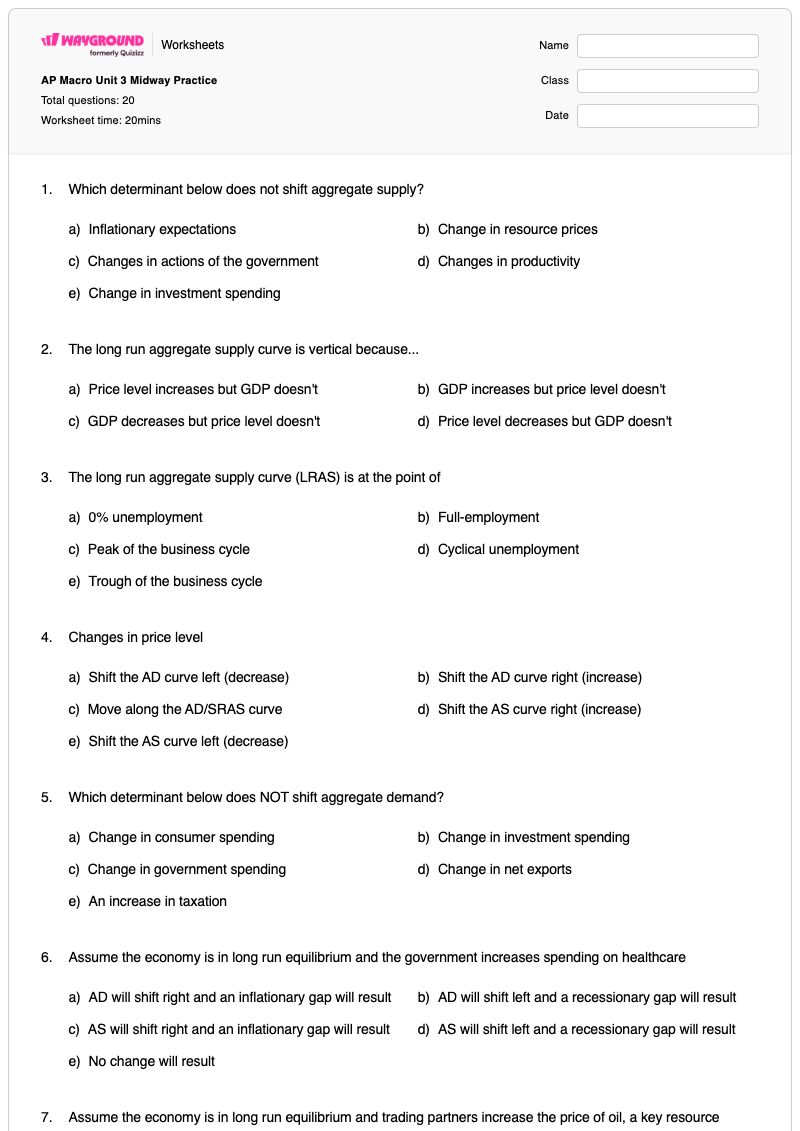
AP Macro Unit 3 Midway Practice

20 คำถาม

11th - 12th ระดับชั้น

Social Studies

แบบฝึกหัด AP Macro Unit 3 Midway Practice เป็นแบบฝึกหัดที่พิมพ์ได้ฟรีสำหรับนักเรียนชั้นมัธยมศึกษาปีที่ 11-12 ที่เรียนวิชาเศรษฐศาสตร์หรือ AP Macroeconomics แบบฝึกหัดประกอบด้วย 20 ข้อ—18 ข้อเป็นแบบเลือกตอบ และ 2 ข้อเป็นการเลือกคำตอบ—โดยเน้นเรื่องอุปสงค์รวม อุปทานรวมระยะสั้นและระยะยาว ปัจจัยที่ทำให้เส้นกราฟแต่ละเส้นเปลี่ยนแปลง การเคลื่อนที่ตามเส้นกราฟ และการเปลี่ยนแปลงของระดับราคาและผลผลิต นักเรียนจะได้นำความสัมพันธ์เหล่านี้ไปประยุกต์ใช้กับสถานการณ์ต่างๆ ที่เกี่ยวข้องกับการใช้จ่ายของรัฐบาล ราคาทรัพยากร การฝึกอบรมพนักงาน ความคาดหวังด้านเงินเฟ้อ การใช้จ่ายของผู้บริโภค การนำเข้า และการลงทุน นอกจากนี้ พวกเขายังต้องระบุจุดสมดุลระยะยาวที่การจ้างงานเต็มที่ และคาดการณ์ช่องว่างเงินเฟ้อหรือภาวะถดถอย และการปรับตัวในระยะยาว แบบฝึกหัดนี้มีเฉลยคำตอบที่สมบูรณ์เพื่อตรวจสอบความเข้าใจหรือแก้ไขข้อผิดพลาด

การตั้งค่าแผ่นงาน

ขนาดตัวอักษร

S
M
L
XL
แผ่นงาน

AP Macro Unit 3 Midway Practice

คำถามทั้งหมด: 20

ชื่อ
ระดับ
วันที่
1.

Which determinant below does not shift aggregate supply?

a)

Inflationary expectations

b)

Change in resource prices

c)

Changes in actions of the government

d)

Changes in productivity

e)

Change in investment spending

2.

The long run aggregate supply curve is vertical because...

a)

Price level increases but GDP doesn't

b)

GDP increases but price level doesn't

c)

GDP decreases but price level doesn't

d)

Price level decreases but GDP doesn't

3.

The long run aggregate supply curve (LRAS) is at the point of

a)

0% unemployment

b)

Full-employment

c)

Peak of the business cycle

d)

Cyclical unemployment

e)

Trough of the business cycle

4.

Changes in price level

a)

Shift the AD curve left (decrease)

b)

Shift the AD curve right (increase)

c)

Move along the AD/SRAS curve

d)

Shift the AS curve right (increase)

e)

Shift the AS curve left (decrease)

5.

Which determinant below does NOT shift aggregate demand?

a)

Change in consumer spending

b)

Change in investment spending

c)

Change in government spending

d)

Change in net exports

e)

An increase in taxation

6.

Assume the economy is in long run equilibrium and the government increases spending on healthcare

a)

AD will shift right and an inflationary gap will result

b)

AD will shift left and a recessionary gap will result

c)

AS will shift right and an inflationary gap will result

d)

AS will shift left and a recessionary gap will result

e)

No change will result

7.

Assume the economy is in long run equilibrium and trading partners increase the price of oil, a key resource

a)

AD will shift right and an inflationary gap will result

b)

AD will shift left and a recessionary gap will result

c)

AS will shift right and an inflationary gap will result

d)

AS will shift left and a recessionary gap will result

e)

No change will result

8.

Assume that the economy is at long run equilibrium and that the government increases spending. In the short run, AD will increase. In the long run, what will happen?

a)

AD will decrease

b)

AS will decrease back to equilibrium

c)

AD will increase

d)

AS will increase back to equilibrium

e)

LRAS will shift right

9.

Which of the following would increase aggregate demand?

a)

Increased saving

b)

Increasing import spending

c)

Increased taxation revenue

d)

Increased investment

e)

Increased interest rates

10.

Improved training of employees would:

a)

Shift SRAS outwards at each price

b)

Shift SRAS inwards at each price

c)

Shift LRAS to the right

d)

Shift AD outwards at each price

e)

Shift AD inwards at each price

11.

Aggregate demand will increase if:

a)

Consumption falls

b)

Investment falls

c)

Exports fall

d)

Imports fall

e)

Taxation increases

12.

An increase in inflationary expectations in the short run will

a)

shift AD to the right

b)

shift AD to the left

c)

move along the AS curve

d)

move the AS curve to the left

e)

move the AS curve to the right

13.

An increase in aggregate supply would shift the SRAS curve right in the short run. In the long run it would:

a)

Shift aggregate demand back to equilibrium at a lower price

b)

Shift aggregate demand back to equilibrium at a higher price

c)

Shift aggregate supply back to equilibrium at a lower price

d)

Shift LRAS to the left

e)

Shift LRAS to the right

14.

If consumer spending increased, the result would NOT be

a)

AD would shift right and an inflationary gap would result

b)

In the long run AS would decrease as prices and wages become unstuck

c)

The price level would increase

d)

Output would increase

e)

LRAS would shift right as prices and wages increase

15.

If there was a decrease in aggregate demand, what would NOT take place?

a)

SRAS would shift left in the long run at a lower price level

b)

AD would shift left creating a recessionary gap

c)

Output would decline

d)

Unemployment would increase

e)

Inflation would increase

16.

The government passes new subsidies to support manufacturing in the US. In the short run:

a)

AD shifts right

b)

AD shifts right

c)

SRAS shifts left

d)

LRAS shifts right

e)

SRAS shifts right

17.

Congress increases the income tax rate for the wealthiest individuals

a)

SRAS shifts left

b)

SRAS shifts right

c)

LRAS shifts left

d)

AD shifts left

e)

AD shifts right

18.

A strong stock market results in

a)

AD shifting left creating an expansionary gap

b)

AD shifting right creating an expansionary gap

c)

AS shifting right creating an expansionary gap

d)

AS shifting left creating recessionary gap

e)

LRAS shifting right

19.

When there is an expansionary gap the typical result is:

a)

an increase in output, a decrease in unemployment and an increase in the price level

b)

an increase in output, an increase in unemployment and an increase in the price level

c)

a decrease in output, an increase in unemployment and an increase in the price level

d)

a decrease in output, a decrease in unemployment and an increase in the price level

e)

No change in output, unemployment and the price level

20.

Which action below will most likely result in a rightward shift of LRAS

a)

an increase in consumer spending

b)

a tax incentive to promote business investment

c)

lower interest rates

d)

an increase in corporate tax rates

e)

a decrease in consumer tax rates

แป้นคำตอบ

AP Macro Unit 3 Midway Practice

คำถามทั้งหมด: 20

1.
e)

Change in investment spending

2.
a)

Price level increases but GDP doesn't

3.
b)

Full-employment

4.
c)

Move along the AD/SRAS curve

5.
e)

An increase in taxation

6.
a)

AD will shift right and an inflationary gap will result

7.
d)

AS will shift left and a recessionary gap will result

8.
b)

AS will decrease back to equilibrium

9.
d)

Increased investment

10.
c)

Shift LRAS to the right

11.
d)

Imports fall

12.
d)

move the AS curve to the left

13.
a)

Shift aggregate demand back to equilibrium at a lower price

14.
e)

LRAS would shift right as prices and wages increase

15.
e)

Inflation would increase

16.
e)

SRAS shifts right

17.
d)

AD shifts left

18.
b)

AD shifting right creating an expansionary gap

19.
a)

an increase in output, a decrease in unemployment and an increase in the price level

20.
b)

a tax incentive to promote business investment

คำถามที่พบบ่อย

แบบฝึกหัดกลางภาคเรียนที่ 3 ของวิชาเศรษฐศาสตร์มหภาค (AP Macro) ครอบคลุมเนื้อหาอะไรบ้าง?

แบบฝึกหัด 20 ข้อนี้ช่วยเสริมสร้างความสามารถของนักเรียนในการวิเคราะห์อุปสงค์รวม อุปทานรวมระยะสั้น (SRAS) และอุปทานรวมระยะยาว (LRAS) ในรูปแบบคำถามปรนัยและคำถามเลือกตอบ นักเรียนจะได้ระบุปัจจัยที่ทำให้เส้นโค้งแต่ละเส้นเปลี่ยนแปลง แยกแยะความแตกต่างระหว่างการเปลี่ยนแปลงกับการเคลื่อนที่ไปตามเส้นโค้ง และเชื่อมโยงสถานการณ์ต่างๆ เช่น การใช้จ่ายของรัฐบาลหรือราคาทรัพยากรที่สูงขึ้น กับช่องว่างของภาวะเงินเฟ้อหรือภาวะถดถอย และการปรับตัวในระยะยาว

ฉันจะใช้แบบฝึกหัดนี้สอนเรื่องการเปลี่ยนแปลงของ AD, SRAS และ LRAS ได้อย่างไร?

เริ่มด้วยการให้นักเรียนจัดเรียงสถานการณ์ต่างๆ เช่น การเปลี่ยนแปลงในการลงทุน ราคาน้ำมัน การฝึกอบรมพนักงาน และความคาดหวังด้านเงินเฟ้อ ว่าส่งผลกระทบต่ออุปสงค์รวม (AD) อุปทานรวมระยะสั้น (SRAS) หรืออุปทานรวมระยะยาว (LRAS) หรือไม่ จากนั้นให้นักเรียนอธิบายเหตุผลของแต่ละคำตอบที่เลือกโดยใช้กฎการเปลี่ยนแปลงเทียบกับการเคลื่อนที่ และอธิบายสิ่งที่เกิดขึ้นในระยะสั้นก่อนที่จะทบทวนคำถามเกี่ยวกับดุลยภาพระยะยาว

ฉันควรระวังข้อผิดพลาดอะไรบ้างเมื่อนักเรียนทำแบบฝึกหัดเรื่องอุปสงค์และอุปทานรวมนี้?

โปรดสังเกตนักเรียนที่มองการเปลี่ยนแปลงระดับราคาเป็นการเลื่อนของเส้นโค้ง แทนที่จะเป็นการเคลื่อนที่ไปตามเส้นโค้งอุปสงค์รวม (AD) หรืออุปทานรวมระยะสั้น (SRAS) พวกเขาอาจสับสนระหว่างปัจจัยกำหนด AD กับปัจจัยกำหนด AS มองข้ามความแตกต่างระหว่าง SRAS และ LRAS หรือระบุช่องว่างเงินเฟ้อหรือถดถอยเบื้องต้นโดยไม่ติดตามการปรับตัวในระยะยาว ข้อสอบแบบเลือกหลายข้อต้องการให้นักเรียนระบุทุกตัวเลือกที่เกี่ยวข้อง แทนที่จะเลือกเพียงตัวเลือกเดียว

ฉันจะมอบหมายและให้คะแนนแบบฝึกหัด AP Macro นี้ได้อย่างไร?

แบบฝึกหัดนี้มีให้ดาวน์โหลดในรูปแบบไฟล์ PDF ที่สามารถพิมพ์ได้ และเป็นแบบทดสอบดิจิทัลบน Wayground โดยมีเฉลยคำตอบครบถ้วนสำหรับคำถามแบบเลือกตอบ 18 ข้อ และคำถามแบบเลือกคำตอบหลายข้อ 2 ข้อ สำหรับการส่งงานแบบพิมพ์ ครูสามารถสแกนงานของนักเรียนด้วยแอป Wayground for Teachers เพื่อใช้ในการตรวจและให้คะแนนได้

ฉันจะปรับแบบฝึกหัดนี้ให้เหมาะสมกับนักเรียนของฉันได้อย่างไร?

ในการตั้งค่าขั้นสูงของแบบฝึกหัด ให้ปรับระยะห่างระหว่างตัวอักษรหรือขนาดตัวอักษรเพื่อให้คำถามสถานการณ์ AD, SRAS และ LRAS อ่านง่ายขึ้น และเปิดใช้งานแบบอักษรที่เป็นมิตรต่อผู้ที่มีภาวะดิสเล็กเซียเมื่อจำเป็น นอกจากนี้ คุณยังสามารถแปลข้อสอบแบบเลือกตอบและแบบเลือกหลายข้อเป็นภาษาอื่นได้ โดยยังคงเน้นแบบฝึกหัดทางเศรษฐศาสตร์เกี่ยวกับการเปลี่ยนแปลงของเส้นโค้ง สมดุล และช่องว่างราคาไว้

ฉันจะหาแบบฝึกหัดแบบนี้เพิ่มเติมได้ที่ไหนบน Wayground?

Wayground นำเสนอชุดแบบฝึกหัดและโจทย์ฝึกหัดฟรีที่ครอบคลุมหลากหลายวิชา พร้อมไฟล์ PDF และเฉลยคำตอบ เพื่อช่วยให้นักเรียนเชี่ยวชาญทักษะและแนวคิดที่สำคัญ ดูแบบฝึกหัดเพิ่มเติมได้ที่ https://wayground.com/en-us/worksheets