

Wayground
Semicolon and Colon Practice! - Printable Other Worksheets - Wayground

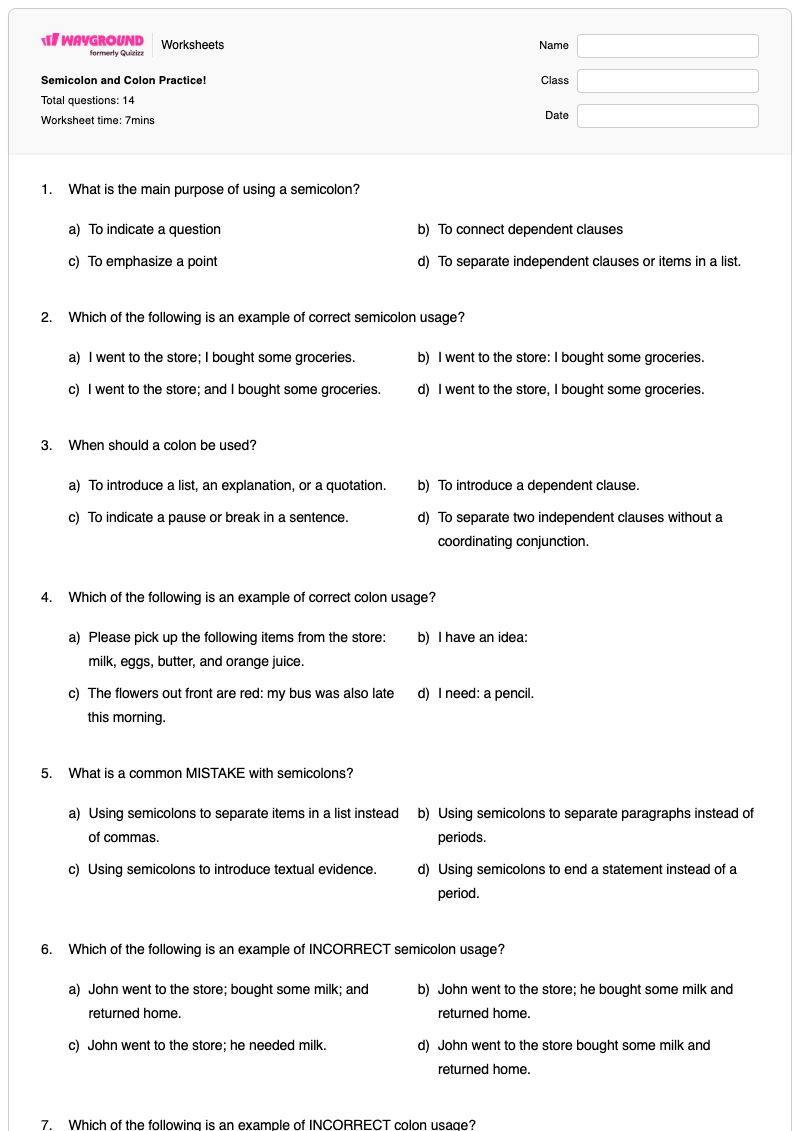
Semicolon and Colon Practice!

14 คำถาม

8th - 8th ระดับชั้น

Other

แบบฝึกหัดการใช้เครื่องหมายอัฒภาคและเครื่องหมายโคลอน! เป็นแบบฝึกหัดไวยากรณ์สำหรับนักเรียนชั้น ม.2 ที่สามารถพิมพ์ได้ฟรี ช่วยให้นักเรียนแยกแยะได้ว่าควรใช้เครื่องหมายอัฒภาคและเครื่องหมายโคลอนในประโยคที่สมบูรณ์เมื่อใด แบบฝึกหัดประกอบด้วยคำถามแบบเลือกตอบ 14 ข้อ ที่จะให้นักเรียนระบุวัตถุประสงค์ของเครื่องหมายวรรคตอนแต่ละชนิด เลือกตัวอย่างที่ใช้เครื่องหมายวรรคตอนถูกต้อง ตระหนักถึงการใช้ที่ไม่ถูกต้อง และแยกแยะความแตกต่างระหว่างเครื่องหมายอัฒภาคที่ใช้เชื่อมอนุประโยคอิสระที่เกี่ยวข้องกันอย่างใกล้ชิด กับเครื่องหมายโคลอนที่ใช้แนะนำรายการ คำอธิบาย ตัวอย่าง หรือคำอ้างอิง นักเรียนจะนำกฎการใช้เครื่องหมายวรรคตอนไปใช้กับตัวอย่างในระดับประโยค รวมถึงประโยคที่มีคำสันธานเชื่อมประโยค วลีนำหน้า และชุดของรายการ รูปแบบนี้ช่วยให้ครูมีวิธีที่เน้นเฉพาะเจาะจงในการตรวจสอบว่านักเรียนสามารถเลือกเครื่องหมายที่เหมาะสมและตรวจจับข้อผิดพลาด เช่น การเชื่อมอนุประโยคไม่ถูกต้อง หรือการวางเครื่องหมายโคลอนในที่ที่ไม่ควรอยู่ แบบฝึกหัดนี้ออกแบบมาสำหรับการสอนภาษาในระดับชั้น ม.2 การฝึกฝนด้วยตนเอง การทบทวน หรือการประเมินผลอย่างรวดเร็ว และมีเฉลยคำตอบที่สมบูรณ์เพื่อการตรวจสอบที่มีประสิทธิภาพ

การตั้งค่าแผ่นงาน

ขนาดตัวอักษร

S
M
L
XL
แผ่นงาน

Semicolon and Colon Practice!

คำถามทั้งหมด: 14

ชื่อ
ระดับ
วันที่
1.

What is the main purpose of using a semicolon?

a)

To indicate a question

b)

To connect dependent clauses

c)

To emphasize a point

d)

To separate independent clauses or items in a list.

2.

Which of the following is an example of correct semicolon usage?

a)

I went to the store; I bought some groceries.

b)

I went to the store: I bought some groceries.

c)

I went to the store; and I bought some groceries.

d)

I went to the store, I bought some groceries.

3.

When should a colon be used?

a)

To introduce a list, an explanation, or a quotation.

b)

To introduce a dependent clause.

c)

To indicate a pause or break in a sentence.

d)

To separate two independent clauses without a coordinating conjunction.

4.

Which of the following is an example of correct colon usage?

a)

Please pick up the following items from the store: milk, eggs, butter, and orange juice.

b)

I have an idea:

c)

The flowers out front are red: my bus was also late this morning.

d)

I need: a pencil.

5.

What is a common MISTAKE with semicolons?

a)

Using semicolons to separate items in a list instead of commas.

b)

Using semicolons to separate paragraphs instead of periods.

c)

Using semicolons to introduce textual evidence.

d)

Using semicolons to end a statement instead of a period.

6.

Which of the following is an example of INCORRECT semicolon usage?

a)

John went to the store; bought some milk; and returned home.

b)

John went to the store; he bought some milk and returned home.

c)

John went to the store; he needed milk.

d)

John went to the store bought some milk and returned home.

7.

Which of the following is an example of INCORRECT colon usage?

a)

My favorite hobbies include reading, painting, and hiking: each one allows me to explore different aspects of creativity and nature.

b)

To succeed in the world, one must possess certain key qualities: adaptability, resilience, and strong communication skills.

c)

The famous philosopher Aristotle once said it best: "Excellence is never an accident; it is the result of high intention, sincere effort, intelligent direction, skillful execution, and the vision to see obstacles as opportunities."

d)

I need to buy some groceries: milk, eggs, bread and, butter.

8.

When should a semicolon be used instead of a comma?

a)

When introducing a quote.

b)

When asking a question.

c)

When separating items in a list.

d)

When separating two independent clauses without a coordinating conjunction.

9.

When sentence uses a semicolon correctly?

a)

Middle school can be challenging; however, with determination and hard work, you can overcome any obstacle.

b)
  1. I love pizza; because it's so delicious.

c)
  1. Sarah enjoys playing soccer; her favorite subject is math.

d)
  1. Our school mascot is a lion; it's yellow and fierce.

10.

Which sentence uses a colon correctly?

a)
  1. My favorite colors are: blue and green.

b)
  1. She had three items on her to-do list: homework, go to the store, and clean her room.

c)
  1. The four seasons are: spring, summer, fall, and winter.

d)

My favorite school subjects are: science, because I love conducting experiments: math, because I enjoy solving challenging problems: and English, because I find it fun to write stories and essays.

11.

When is it appropriate to use a colon in a sentence?

a)

When asking a question.

b)

When separating items in a list.

c)

When connecting two independent clauses.

d)

When introducing an explanation or an example, introducing a quote, or introducing a list.

12.

What is the correct way to use a semicolon in a sentence?

a)

To introduce items in a list.

b)

To separate two independent clauses that are closely related.

c)

To separate two dependent clauses.

d)

To ask a question.

13.

Which of the following is an INCORRECT usage of a colon?

a)

She has two hobbies: reading and cooking.

b)

He has one goal in life: to be successful.

c)

She has two dogs: a poodle and a bulldog.

d)

He has one thing to do: to go to the store

14.

Which of the following is a CORRECT usage of a semicolon?

a)

She went to the store; she bought some groceries.

b)

He went to the park, he played basketball;

c)

She went to the library she read a book.

d)

He went to the gym: he worked out.

แป้นคำตอบ

Semicolon and Colon Practice!

คำถามทั้งหมด: 14

1.
d)

To separate independent clauses or items in a list.

2.
a)

I went to the store; I bought some groceries.

3.
a)

To introduce a list, an explanation, or a quotation.

4.
a)

Please pick up the following items from the store: milk, eggs, butter, and orange juice.

5.
a)

Using semicolons to separate items in a list instead of commas.

6.
a)

John went to the store; bought some milk; and returned home.

7.
d)

I need to buy some groceries: milk, eggs, bread and, butter.

8.
d)

When separating two independent clauses without a coordinating conjunction.

9.
a)

Middle school can be challenging; however, with determination and hard work, you can overcome any obstacle.

10.
b)
  1. She had three items on her to-do list: homework, go to the store, and clean her room.

11.
d)

When introducing an explanation or an example, introducing a quote, or introducing a list.

12.
b)

To separate two independent clauses that are closely related.

13.
d)

He has one thing to do: to go to the store

14.
a)

She went to the store; she bought some groceries.

คำถามที่พบบ่อย

แบบฝึกหัดเกี่ยวกับเครื่องหมายอัฒภาคและโคลอนนี้ครอบคลุมหัวข้ออะไรบ้าง?

แบบฝึกหัดสำหรับนักเรียนชั้น ม.2 นี้ ประกอบด้วยคำถามแบบเลือกตอบ 14 ข้อ เพื่อฝึกฝนการเลือกใช้เครื่องหมายอัฒภาคและเครื่องหมายโคลอนในตัวอย่างประโยค นักเรียนจะได้ระบุว่าควรใช้เครื่องหมายอัฒภาคเพื่อแยกอนุประโยคอิสระหรือรายการที่เกี่ยวข้องกันอย่างใกล้ชิด และใช้เครื่องหมายโคลอนเพื่อแนะนำรายการ คำอธิบาย ตัวอย่าง หรือคำพูดอ้างอิง พร้อมทั้งเรียนรู้การใช้เครื่องหมายวรรคตอนที่ไม่ถูกต้องด้วย

ฉันจะใช้แบบฝึกหัดนี้สอนการใช้เครื่องหมายเซมิโคลอนและโคลอนได้อย่างไร?

เริ่มแบบฝึกหัดโดยสาธิตวิธีการตรวจสอบว่าทั้งสองด้านของเครื่องหมายอัฒภาคที่เสนอเป็นประโยคอิสระหรือไม่ จากนั้นเปรียบเทียบการตัดสินใจนั้นกับเครื่องหมายโคลอนที่ตามหลังประโยคเกริ่นนำที่สมบูรณ์ ให้นักเรียนอธิบายว่าเหตุใดแต่ละตัวเลือกที่เลือกจึงใช้ได้ โดยเฉพาะอย่างยิ่งในคำถามที่มีรายการ คำพูดอ้างอิง และคำเชื่อม เช่น “อย่างไรก็ตาม”

ฉันควรสังเกตข้อผิดพลาดอะไรบ้างเมื่อนักเรียนทำแบบฝึกหัดนี้เสร็จ?

สังเกตนักเรียนที่เลือกใช้เครื่องหมายอัฒภาคเพียงเพราะประโยคมีจังหวะหยุด แทนที่จะตรวจสอบว่าประโยคย่อยสองประโยคมีความสัมพันธ์กันอย่างใกล้ชิดหรือไม่ นักเรียนอาจวางเครื่องหมายโคลอนทันทีหลังคำนำที่ไม่สมบูรณ์ สับสนระหว่างเครื่องหมายโคลอนกับเครื่องหมายอัฒภาคเมื่อนำเสนอรายการหรือคำอธิบาย หรือมองข้ามเครื่องหมายจุลภาคที่เกินมาและข้อผิดพลาดด้านเครื่องหมายวรรคตอนอื่นๆ ในตัวเลือกคำตอบ

ฉันจะมอบหมายและตรวจงานแบบฝึกหัดเรื่องเครื่องหมายเซมิโคลอนและโคลอนนี้อย่างไร?

แบบฝึกหัดนี้มีให้ดาวน์โหลดในรูปแบบไฟล์ PDF ที่สามารถพิมพ์ได้ และเป็นแบบทดสอบดิจิทัลบน Wayground คุณสามารถใช้ข้อสอบปรนัย 14 ข้อนี้สำหรับการฝึกฝนด้วยตนเอง การทบทวน หรือการประเมินผล แบบฝึกหัดนี้มีเฉลยคำตอบครบถ้วน และสามารถตรวจให้คะแนนงานที่ส่งมาได้โดยการสแกนงานของนักเรียนด้วยแอป **Wayground for Teachers**

ฉันจะปรับแบบฝึกหัดเรื่องเครื่องหมายอัฒภาคและเครื่องหมายโคลอนนี้ให้เหมาะสมกับนักเรียนของฉันได้อย่างไร?

ใช้การตั้งค่าขั้นสูงของแบบฝึกหัดเพื่อปรับระยะห่างระหว่างตัวอักษรและขนาดตัวอักษร เพื่อให้คำถามแบบเลือกตอบและตัวอย่างเครื่องหมายวรรคตอนอ่านง่ายขึ้น นอกจากนี้ คุณยังสามารถใช้แบบอักษรที่เหมาะสำหรับผู้ที่มีภาวะดิสเล็กเซีย หรือแปลแบบฝึกหัดเป็นภาษาอื่นได้ เมื่อตัวเลือกเหล่านั้นช่วยให้เข้าถึงแบบฝึกหัดระดับประโยคได้ง่ายขึ้น

ฉันจะหาแบบฝึกหัดแบบนี้เพิ่มเติมได้ที่ไหนบน Wayground?

Wayground มีแบบฝึกหัดและโจทย์ฝึกหัดมากมายให้ดาวน์โหลดฟรีในหลากหลายวิชา พร้อมไฟล์ PDF และเฉลยคำตอบ เพื่อช่วยเสริมสร้างทักษะและความเข้าใจในเนื้อหาสำคัญ ดูแหล่งข้อมูลเพิ่มเติมได้ที่ https://wayground.com/en-us/worksheets