

Wayground
Mesopotamia & The Fertile Crescent - Printable สังคมศึกษา Worksheets 6th - 8th ระดับชั้น - Wayground

Mesopotamia & The Fertile Crescent

Ashley McGaughey

สร้างโดย Ashley McGaughey

21 คำถาม

6th - 8th ระดับชั้น

สังคมศึกษา

อัปเดตแล้ว ต.ค. 2569

เมโสโปเตเมียและดินแดนพระจันทร์เสี้ยวอันอุดมสมบูรณ์ เป็นแบบฝึกหัดประวัติศาสตร์ที่สามารถพิมพ์ได้ฟรี สำหรับนักเรียนชั้นประถมศึกษาปีที่ 6-8 แบบฝึกหัดนี้มีคำถามแบบเลือกตอบ 21 ข้อ ช่วยเสริมสร้างความรู้เกี่ยวกับภูมิศาสตร์ของเมโสโปเตเมีย รวมถึงดินแดนพระจันทร์เสี้ยวอันอุดมสมบูรณ์ แม่น้ำไทกริสและยูเฟรติส ดินที่อุดมสมบูรณ์ ระบบชลประทาน และความหมายของเมโสโปเตเมีย นักเรียนยังจะได้ระบุลักษณะสำคัญของอารยธรรมยุคแรก เช่น ซิกกูแรต นครรัฐ อักษรลิ่ม ลัทธิพหุเทวนิยม และประมวลกฎหมายของฮัมมูราบี คำถามใช้คำจำกัดความ คำอธิบาย และการตรวจสอบความรู้โดยตรง เพื่อช่วยให้นักเรียนแยกแยะคำศัพท์ที่เกี่ยวข้องและเชื่อมโยงภูมิศาสตร์กายภาพกับการพัฒนาอารยธรรม นักเรียนเลือกคำตอบที่ดีที่สุดสำหรับแนวคิดต่างๆ เช่น ทำไมเมโสโปเตเมียจึงถูกเรียกว่า "แหล่งกำเนิดอารยธรรม" อักษรลิ่มใช้ทำอะไร และระบบชลประทานช่วยสนับสนุนพืชผลได้อย่างไร แบบฝึกหัดนี้มีเฉลยคำตอบครบถ้วน ทำให้มีประโยชน์สำหรับการฝึกฝนด้วยตนเอง การทบทวน หรือการประเมินผลการเรียนรู้ประวัติศาสตร์โบราณ

การตั้งค่าแผ่นงาน

ขนาดตัวอักษร

S
M
L
XL
Waygroundแผ่นงาน

Mesopotamia & The Fertile Crescent

คำถามทั้งหมด: 21

ชื่อ
ระดับ
วันที่
1.
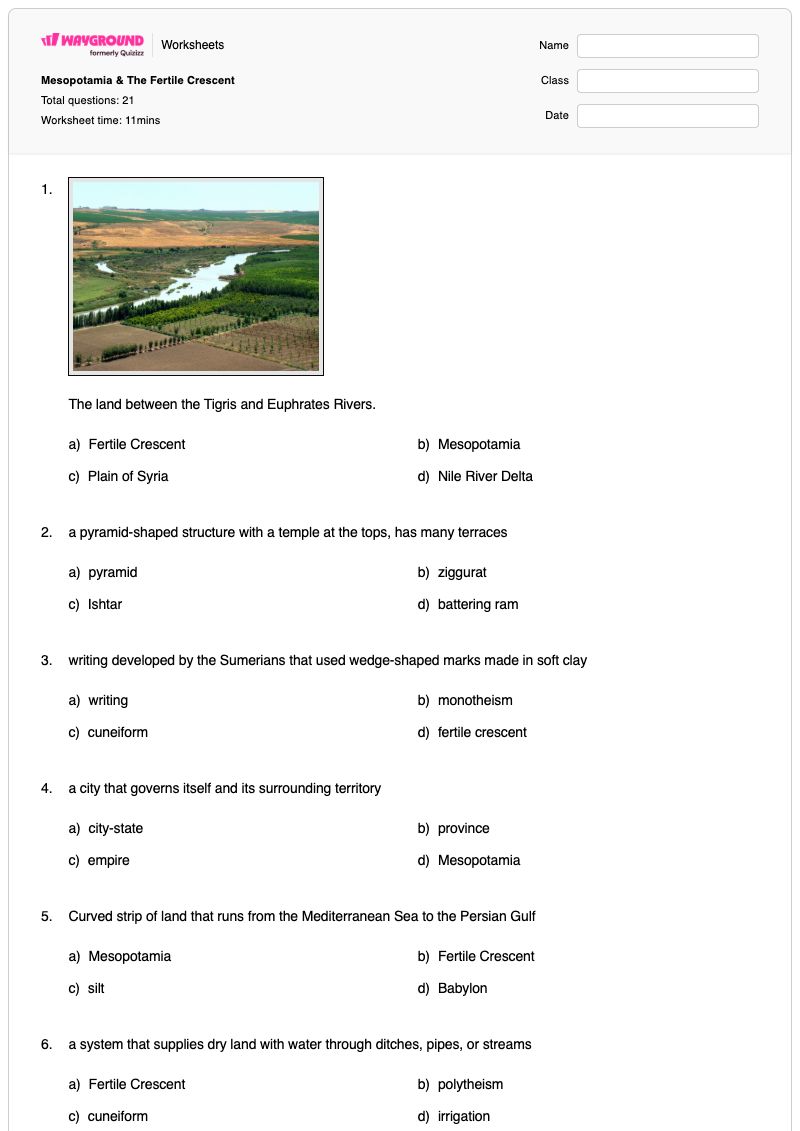
The land between the Tigris and Euphrates Rivers.
a)
Fertile Crescent
b)
Mesopotamia
c)
Plain of Syria
d)
Nile River Delta
2.
a pyramid-shaped structure with a temple at the tops, has many terraces
a)
pyramid
b)
ziggurat
c)
Ishtar
d)
battering ram
3.
writing developed by the Sumerians that used wedge-shaped marks made in soft clay
a)
writing
b)
monotheism
c)
cuneiform
d)
fertile crescent
4.
a city that governs itself and its surrounding territory
a)
city-state
b)
province
c)
empire
d)
Mesopotamia
5.
Curved strip of land that runs from the Mediterranean Sea to the Persian Gulf
a)
Mesopotamia
b)
Fertile Crescent
c)
silt
d)
Babylon
6.
a system that supplies dry land with water through ditches, pipes, or streams
a)
Fertile Crescent
b)
polytheism
c)
cuneiform
d)
irrigation
7.
What are the two main rivers in Mesopotamia?
a)
Tigris and Nile
b)
Tigris and Amazon
c)
Tigris and Euphrates
d)
Euphrates and Mississippi
8.
What were the rivers effect on people?
a)
provided fertile soil
b)
killed crops
c)
they were calming 
d)
were pretty to look at
9.
What was the purpose of irrigation?
a)
keep crops dry
b)
to provide water to crops
c)
provide indoor plumbing
d)
give people drinking water
10.
Who wrote a legal code that covered most areas of daily life?
a)
Gilgamesh
b)
Hammarabui
c)
Nineveh
d)
Sargon
11.
Sumerians were
a)
Monotheistic
b)
Polotheistic
12.
The Sumerian writing system was called
a)
Cunieform
b)
Hieroglyphzs
c)
English
d)
Sargon
13.
The Fertile Crescent....
a)
was a large geographical region
b)
stretched from the Persian Gulf to the Mediterranean Sea
c)
was the location where the earliest civilization started
d)
all of these
14.
Mesopotamia is called the "cradle of civilization" because
a)
many ideas and inventions used by other later civilizations came from Mesopotamia
b)
it was the world's first civilization
c)
none of the above
d)
It was were most babies were born
15.
The word "Mesopotamia" means
a)
middle of the fertile crescent
b)
land in the middle of the desert 
c)
land between the rivers
d)
land north of the sea
16.
Which problem did Mesopotamian's have to solve to protect their fields and homes?
a)
how to control flooding
b)
how to prevent wind erosion
c)
how to build bricks when they had no timber or stone
d)
how to defend against attacks from traders
17.
What did canals help with?
a)
Bringing a single ruler
b)
Decreasing the Population
c)
Controling Floods
d)
Bringing Drinking Water
18.
What modern day country is Mesopotamia mostly in?
a)
India
b)
Egypt
c)
China
d)
Iraq
19.
King Hammurabi was best known for what?
a)
The Hanging Gardens
b)
Owning Slaves
c)
Ruling the First Empire
d)
Writting down Laws
20.
After the rivers flooded a mixture of rich soil called ___________ covered the land and made it good for farming.
a)
Ziggurat
b)
Silt
c)
Polytheism
d)
Top Soil
21.
Each worker specializing in a task or job is known as ______________.
a)
Polytheism
b)
Irrigation
c)
Division of Labor
d)
Hammurabi's Code
Waygroundแป้นคำตอบ

Mesopotamia & The Fertile Crescent

คำถามทั้งหมด: 21

1.
b) Mesopotamia
2.
b) ziggurat
3.
c) cuneiform
4.
a) city-state
5.
b) Fertile Crescent
6.
d) irrigation
7.
c) Tigris and Euphrates
8.
a) provided fertile soil
9.
b) to provide water to crops
10.
b) Hammarabui
11.
b) Polotheistic
12.
a) Cunieform
13.
d) all of these
14.
a) many ideas and inventions used by other later civilizations came from Mesopotamia
15.
c) land between the rivers
16.
a) how to control flooding
17.
c) Controling Floods
18.
d) Iraq
19.
d) Writting down Laws
20.
b) Silt
21.
c) Division of Labor

คำถามที่พบบ่อย

แบบฝึกหัดเรื่อง เมโสโปเตเมียและดินแดนพระจันทร์เสี้ยวอันอุดมสมบูรณ์ ครอบคลุมเนื้อหาอะไรบ้าง?

แบบฝึกหัดประวัติศาสตร์สำหรับนักเรียนชั้นประถมศึกษาปีที่ 6-8 นี้ ประกอบด้วยคำถามแบบเลือกตอบ 21 ข้อ เพื่อประเมินความเข้าใจของนักเรียนเกี่ยวกับภูมิศาสตร์ของเมโสโปเตเมีย รวมถึงดินแดนพระจันทร์เสี้ยวอันอุดมสมบูรณ์ แม่น้ำไทกริสและยูเฟรติส ดินที่อุดมสมบูรณ์ ระบบชลประทาน และความหมายของเมโสโปเตเมีย นอกจากนี้ยังให้นักเรียนระบุอักษรลิ่ม ซิกกูแรต นครรัฐ ลัทธิพหุเทวนิยม และประมวลกฎหมายของฮัมมูราบี เพื่อพัฒนาความสามารถในการจับคู่คำศัพท์ทางประวัติศาสตร์กับคำจำกัดความและตัวอย่าง

ฉันจะใช้แบบฝึกหัดนี้ในการสอนเรื่องเมโสโปเตเมียและดินแดนพระจันทร์เสี้ยวอันอุดมสมบูรณ์ได้อย่างไร?

เริ่มแบบฝึกหัดโดยระบุตำแหน่งของแม่น้ำไทกริสและยูเฟรติส รวมถึงดินแดนพระจันทร์เสี้ยวอันอุดมสมบูรณ์บนแผนที่ จากนั้นทบทวนว่าดินที่อุดมสมบูรณ์และการชลประทานช่วยสนับสนุนการตั้งถิ่นฐานในยุคแรกได้อย่างไร ก่อนที่นักเรียนจะตอบคำถามด้วยตนเอง ให้พวกเขาลองจัดเรียงหรืออภิปรายคำศัพท์สำคัญ เช่น อักษรลิ่ม ซิกกูแรต นครรัฐ และลัทธิพหุเทวนิยม โดยใช้คำจำกัดความที่สะท้อนอยู่ในคำถาม ใช้ตัวเลือกคำตอบของนักเรียนเพื่อกระตุ้นให้พวกเขาอธิบายว่าภูมิศาสตร์มีอิทธิพลต่อการพัฒนาอารยธรรมเมโสโปเตเมียอย่างไร

ฉันควรระวังข้อผิดพลาดอะไรบ้างเมื่อนักเรียนทำแบบฝึกหัดเกี่ยวกับเมโสโปเตเมียนี้?

นักเรียนอาจสับสนระหว่างเมโสโปเตเมีย ดินแดนระหว่างแม่น้ำไทกริสและยูเฟรติส กับดินแดนที่กว้างใหญ่กว่าอย่างพระจันทร์เสี้ยวอันอุดมสมบูรณ์ หรืออาจเลือกคู่แม่น้ำผิด พวกเขายังอาจสับสนระหว่างอักษรลิ่ม ซึ่งเป็นระบบการเขียนรูปทรงลิ่มของชาวสุเมเรียน กับซิกกูแรต ซึ่งเป็นสิ่งก่อสร้างวิหารรูปทรงพีระมิด และเข้าใจผิดว่าการชลประทานคือการให้น้ำแก่พืชผล ระวังความสับสนระหว่างลัทธิพหุเทวนิยมและลัทธิเอกเทวนิยม และระหว่างผู้คนและสถาบันที่เกี่ยวข้องกับประวัติศาสตร์เมโสโปเตเมีย

ฉันจะมอบหมายและให้คะแนนแบบฝึกหัดเรื่องเมโสโปเตเมียนี้ได้อย่างไร?

คุณสามารถมอบหมายแบบฝึกหัดเรื่องเมโสโปเตเมียและดินแดนพระจันทร์เสี้ยวอันอุดมสมบูรณ์นี้ในรูปแบบไฟล์ PDF ที่พิมพ์ได้ หรือเป็นแบบทดสอบดิจิทัลบน Wayground แบบฝึกหัดนี้มีเฉลยคำตอบครบถ้วนสำหรับคำถามแบบเลือกตอบ 21 ข้อ และสามารถตรวจงานของนักเรียนได้โดยการสแกนงานของนักเรียนด้วยแอป Wayground for Teachers รูปแบบที่พิมพ์ได้ยังช่วยสนับสนุนห้องเรียนที่ต้องการลดเวลาการใช้หน้าจออีกด้วย

ฉันจะปรับแบบฝึกหัดเรื่องเมโสโปเตเมียนี้ให้เหมาะสมกับนักเรียนของฉันได้อย่างไร?

ใช้การตั้งค่าขั้นสูงของแบบฝึกหัดเพื่อปรับระยะห่างระหว่างตัวอักษร หรือเลือกขนาดตัวอักษรที่ใหญ่ขึ้น เพื่อให้ตัวเลือกแบบปรนัยและคำจำกัดความทางประวัติศาสตร์อ่านง่ายขึ้น นอกจากนี้ คุณยังสามารถเปิดใช้งานแบบอักษรที่เหมาะสำหรับผู้ที่มีภาวะดิสเล็กเซีย หรือแปลแบบฝึกหัดเป็นภาษาอื่น เพื่อช่วยให้นักเรียนเข้าถึงคำถามเกี่ยวกับภูมิศาสตร์และอารยธรรมเมโสโปเตเมียได้ง่ายขึ้น

ฉันจะหาแบบฝึกหัดแบบนี้เพิ่มเติมได้ที่ไหนบน Wayground?

Wayground นำเสนอชุดแบบฝึกหัดและโจทย์ฝึกหัดฟรีที่ครอบคลุมทุกวิชา พร้อมไฟล์ PDF และเฉลยคำตอบ เพื่อสนับสนุนทักษะและแนวคิดที่สำคัญ ดูแหล่งข้อมูลเพิ่มเติมได้ที่ https://wayground.com/en-us/worksheets