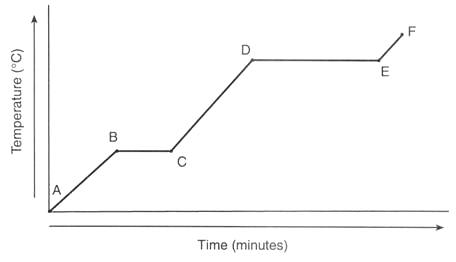

What line segment represents only the solid state?
a)
A-B
b)
B-C
c)
C-D
d)
D-E
2.
Between which points is the temperature of the substance remaining constant?
a)
A-B only.
b)
A-B, C-D, E-F
c)
B-C only.
d)
B-C, D-E
3.
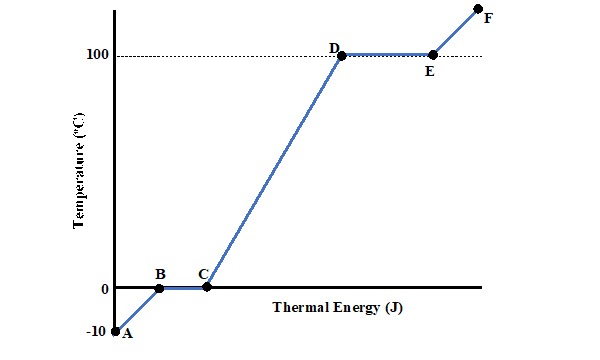
Between which two points is Heat of Fusion?
a)
A <----> B
b)
B <----> C
c)
C <----> D
d)
D <----> E
e)
E <----> F
4.
Between which two points is Heat of Vaporization?
a)
A <----> B
b)
B <----> C
c)
C <----> D
d)
D <----> E
e)
E <----> F
5.
In which segment is the kinetic energy remaining constant?
a)
A-B
b)
B-C
c)
C-D
d)
E-F
6.
A substance's heating curve is shown in the graph. What is its boiling point?
a)
100 C
b)
60 C
c)
80 C
d)
20 C
7.
Between which points is water changing states of matter?
a)
A <----> B
b)
B <----> C
c)
C <----> D
d)
D <----> E
e)
E <----> F
8.
Given the heating curve of a solid being heated at a constant rate, how much total time was required to boil this substance after it reached its melting point?
a)
3 minutes
b)
4 minutes
c)
10 minutes
d)
14 minutes
9.
Which of the following terms identifies the change from a liquid to gas?
a)
Vaporization
b)
Condensation
c)
Deposition
d)
Sublimation
10.
The melting point of the sample is
a)
-60 ºC
b)
-100 ºC
c)
60 ºC
d)
100 ºC
11.
What is water's freezing point?
a)
0 F
b)
32 C
c)
50 C
d)
0 C
12.
The slope of this graph shows the rate a substance heats up over time (or energy added). What does it mean that the slope of heating the liquid (water) is less than the slope for ice or steam? (Choose all correct answers.)
a)
It means it takes more energy to increase the temp of water
b)
It means it takes less energy increase the temp of water
c)
It means the liquid heats up faster than the solid or gas
d)
It means the liquid heats up slower than solid or gas.
13.
What does the length of the boiling line represent?
a)
It takes more energy to vaporize the sample than it does to melt it.
b)
It takes more energy to increase the temp of the gas than the liquid
c)
The substance stays at the boiling point for a short time.
d)
The substance prefers the gas phase over the other phases.
แป้นคำตอบ
Heating Curves
คำถามทั้งหมด: 13
1.
a) A-B
2.
d) B-C, D-E
3.
b)
B <----> C
4.
d)
D <----> E
5.
b) B-C
6.
b) 60 C
7.
d)
D <----> E
, b)
B <----> C
8.
b)
4 minutes
9.
a) Vaporization
10.
a)
-60 ºC
11.
d) 0 C
12.
a)
It means it takes more energy to increase the temp of water
, d)
It means the liquid heats up slower than solid or gas.
13.
a)
It takes more energy to vaporize the sample than it does to melt it.