

Wayground
Mutually Exclusive and Inclusive Events - Printable คณิตศาสตร์ Worksheets 10th ระดับชั้น - Wayground

Mutually Exclusive and Inclusive Events

Anthony Clark

สร้างโดย Anthony Clark

20 คำถาม

10th ระดับชั้น

คณิตศาสตร์

อัปเดตแล้ว ก.ย. 2569

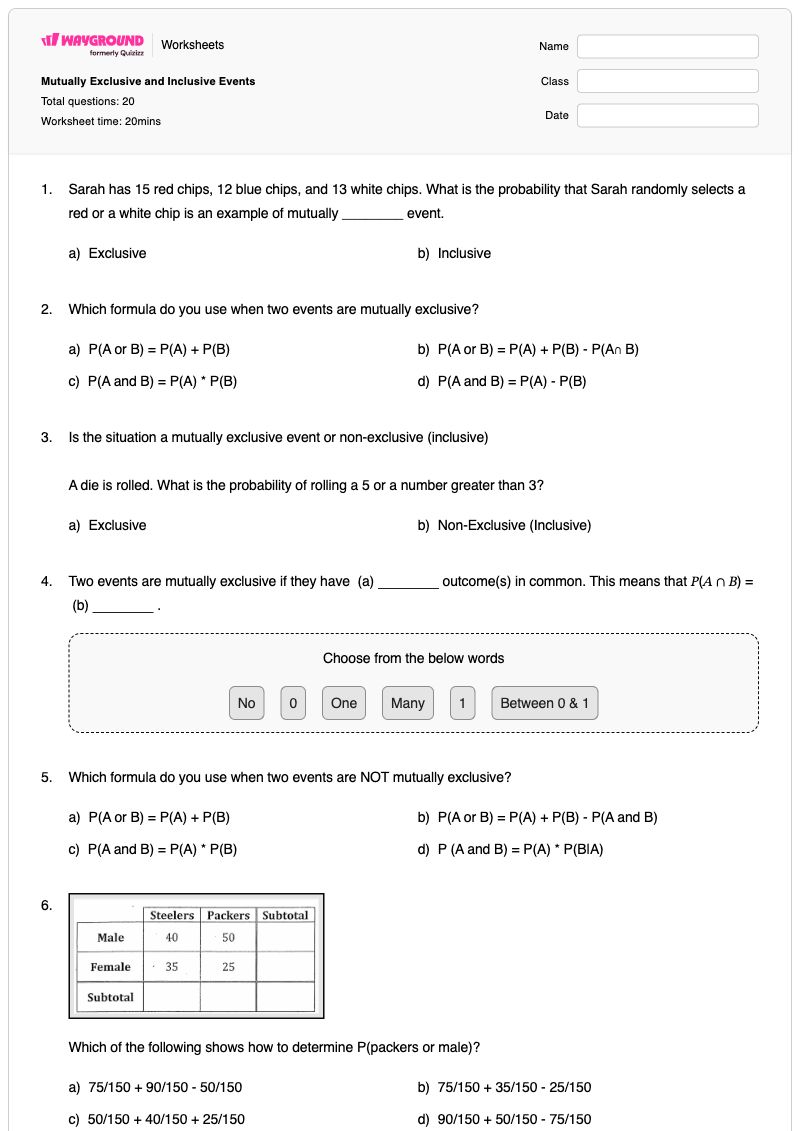
แบบฝึกหัดคณิตศาสตร์ ม.4 นี้ช่วยเสริมสร้างทักษะความเข้าใจเกี่ยวกับเหตุการณ์ที่ไม่เกิดขึ้นพร้อมกันและเหตุการณ์ที่เกิดขึ้นพร้อมกัน นักเรียนจะต้องพิจารณาว่าเหตุการณ์สองเหตุการณ์สามารถเกิดขึ้นพร้อมกันได้หรือไม่ ระบุว่าส่วนที่ทับซ้อนกันนั้นว่างเปล่าหรือไม่ และเลือกกฎการบวกที่เหมาะสมสำหรับ P(A หรือ B) รวมถึงการลบส่วนที่ทับซ้อนกันเมื่อเหตุการณ์ไม่เกิดขึ้นพร้อมกัน แบบฝึกหัดนี้ประกอบด้วย 20 ข้อ โดยนักเรียนจะต้องทำแบบฝึกหัดแบบเลือกตอบ 19 ข้อ และแบบฝึกหัดแบบลากและวาง 1 ข้อ โจทย์ใช้ชิป ลูกเต๋า ไพ่ ข้อมูลนักเรียน ตัวเลือกกีฬาและเครื่องดนตรี และแผนภาพพื้นที่แรเงา เพื่อประยุกต์ใช้สูตรความน่าจะเป็น ตีความส่วนที่ทับซ้อนกันและส่วนเติมเต็ม และคำนวณความน่าจะเป็นของการรวม แบบฝึกหัดที่พิมพ์ได้ฟรีนี้ออกแบบมาสำหรับการฝึกฝน ทบทวน หรือประเมินผลความน่าจะเป็นของ ม.4 และมีเฉลยคำตอบเพื่อความสะดวกในการตรวจสอบ

การตั้งค่าแผ่นงาน

ขนาดตัวอักษร

S
M
L
XL
Waygroundแผ่นงาน

Mutually Exclusive and Inclusive Events

คำถามทั้งหมด: 20

ชื่อ
ระดับ
วันที่
1.

Sarah has 15 red chips, 12 blue chips, and 13 white chips. What is the probability that Sarah randomly selects a red or a white chip is an example of mutually ________ event.

a)

Exclusive

b)

Inclusive

2.

Which formula do you use when two events are mutually exclusive?

a)

P(A or B) = P(A) + P(B)

b)

P(A or B) = P(A) + P(B) - P(A∩ B)

c)

P(A and B) = P(A) * P(B)

d)

P(A and B) = P(A) - P(B)

3.

Is the situation a mutually exclusive event or non-exclusive (inclusive)


A die is rolled. What is the probability of rolling a 5 or a number greater than 3?

a)

Exclusive

b)

Non-Exclusive (Inclusive)

4.

Two events are mutually exclusive if they have ​ (a)   outcome(s) in common. This means that 𝑃(𝐴 ∩ 𝐵) =

​ (b)   .

เลือกจากคำด้านล่าง

No

0

One

Many

1

Between 0 & 1

5.

Which formula do you use when two events are NOT mutually exclusive?

a)

P(A or B) = P(A) + P(B)

b)

P(A or B) = P(A) + P(B) - P(A and B)

c)

P(A and B) = P(A) * P(B)

d)

P (A and B) = P(A) * P(B|A)

6.
Which of the following shows how to determine P(packers or male)?

Which of the following shows how to determine P(packers or male)?

a)

75/150 + 90/150 - 50/150

b)

75/150 + 35/150 - 25/150

c)

50/150 + 40/150 + 25/150

d)

90/150 + 50/150 - 75/150

7.

The enrollment at Southburg High School is 1400.  Suppose 550 students take French, 700 take algebra, and 400 take both French and algebra.  What is the probability that a student selected randomly takes French or algebra?

a)

1250/1400

b)

700/1400

c)

550/1400

d)

17/28

8.
Which of the following shows how to determine P(diamond or face card)?

Which of the following shows how to determine P(diamond or face card)?

a)

13/52 + 12/52 - 3/52

b)

3/52 + 13/52 -12/52

c)

3/52 + 12/52 - 13/52

d)

1/13 + 3/52 - 1/4

9.
Which of the following shows how to determine P(odd number or shaded number)?

Which of the following shows how to determine P(odd number or shaded number)?

a)

4/8 + 3/8 - 1/8

b)

3/8 + 6/8 - 4/8

c)

4/8 - 5/8 + 3/8

d)

4/8 + 4/8 - 4/8

10.
Identify the shaded area...

Identify the shaded area...

a)

A∩B

b)

A∪B

c)

A'∩B'

d)

A'∪B'

11.

Is the following mutually exclusive or inclusive?
Probability of drawing a queen or a diamond from a standard deck of cards.

a)

mutually exclusive

b)

inclusive

12.
What is the probability that a student is a female or left-handed?

What is the probability that a student is a female or left-handed?

a)

53/121

b)

58/121

c)

7/53

d)

12/121

13.
Find the probability of choosing a student at random that plays an instrument OR a sport.

Find the probability of choosing a student at random that plays an instrument OR a sport.

a)

1/2

b)

13/20

c)

21/20

d)

4/5

14.
Identify the shaded area...

Identify the shaded area...

a)

A

b)

B

c)

A'

d)

B'

15.

A jar contains 9 balls, numbered from one to nine. You randomly pick a ball. What is the probability that you select a one or a six?

a)

inclusive

b)

mutually exclusive

16.
If you roll one die, what is the probability of getting an odd number or a 4? Are the events inclusive or mutually exclusive?

If you roll one die, what is the probability of getting an odd number or a 4?  Are the events inclusive or mutually exclusive?

a)

Not Mutually Exclusive 

b)

Mutually exclusive

17.

Two events are mutually exclusive if:

a)

they cannot happen at the same time

b)

they can happen at the same time

c)

they always happen 

d)

they never happen 

18.
Identify if the events are mutually exclusive or not mutually exclusive, then calculate the probability. Leave as a fraction.

Identify if the events are mutually exclusive or not mutually exclusive, then calculate the probability. Leave as a fraction.

a)

    512\frac{5}{12}  

b)

    112\frac{1}{12}  

c)

   12121\frac{12}{121}  

d)

   712\frac{7}{12}  

19.
Identify if the events are mutually exclusive or not mutually exclusive, then calculate the probability. Leave as a…

Identify if the events are mutually exclusive or not mutually exclusive, then calculate the probability. Leave as a percentage.

a)

      910\frac{9}{10}  

b)

      710\frac{7}{10}  

c)

      29\frac{2}{9}  

d)

      12\frac{1}{2}  

20.

Which of the following pairs of events is mutually exclusive?

a)

Cards: Aces and Spades

b)

Two dice: Odd and even

c)

Sit down and stand up

d)

Sit down and scratch your nose

Waygroundแป้นคำตอบ

Mutually Exclusive and Inclusive Events

คำถามทั้งหมด: 20

1.
a)

Exclusive

2.
a)

P(A or B) = P(A) + P(B)

3.
b)

Non-Exclusive (Inclusive)

4.

No

,

0

5.
b)

P(A or B) = P(A) + P(B) - P(A and B)

6.
a)

75/150 + 90/150 - 50/150

7.
d)

17/28

8.
a)

13/52 + 12/52 - 3/52

9.
d)

4/8 + 4/8 - 4/8

10.
a)

A∩B

11.
b)

inclusive

12.
b)

58/121

13.
b)

13/20

14.
d)

B'

15.
b)

mutually exclusive

16.
b)

Mutually exclusive

17.
a)

they cannot happen at the same time

18.
d)

   712\frac{7}{12}  

19.
b)

      710\frac{7}{10}  

20.
c)

Sit down and stand up

คำถามที่พบบ่อย

แบบฝึกหัดนี้ครอบคลุมเรื่องอะไรบ้างเกี่ยวกับเหตุการณ์ที่ไม่เกี่ยวข้องกันและเหตุการณ์ที่เกี่ยวข้องกัน?

แบบฝึกหัดสำหรับนักเรียนชั้น ม.4 นี้ ให้นักเรียนจำแนกคู่เหตุการณ์ว่าเป็นเหตุการณ์ที่ไม่เกิดขึ้นพร้อมกันหรือเหตุการณ์ที่เกิดขึ้นพร้อมกัน และเลือกกฎการบวกที่ถูกต้องสำหรับ P(A หรือ B) แบบฝึกหัดนี้ประกอบด้วยคำถามแบบเลือกตอบ 19 ข้อ และแบบฝึกหัดแบบลากและวาง 1 ข้อ ซึ่งจะช่วยให้นักเรียนรู้จักว่าเมื่อใดที่ P(A ∩ B) = 0 ลบส่วนที่ทับซ้อนกันสำหรับเหตุการณ์ที่เกิดขึ้นพร้อมกัน และตีความส่วนที่ทับซ้อนกันและส่วนเติมเต็มที่แรเงา

ฉันจะใช้แบบฝึกหัดนี้ในการสอนเรื่องเหตุการณ์ที่ไม่เกี่ยวข้องกันและเหตุการณ์ที่เกี่ยวข้องกันได้อย่างไร?

เริ่มแบบฝึกหัดโดยให้นักเรียนตัดสินใจว่าผลลัพธ์สองอย่างสามารถเกิดขึ้นพร้อมกันได้หรือไม่ เช่น การจั่วไพ่ควีนหรือไพ่ข้าวหลามตัดจากสำรับไพ่มาตรฐาน จากนั้นใช้สูตรในแบบฝึกหัดเพื่อเชื่อมโยงเหตุผลนั้นกับ P(A หรือ B) = P(A) + P(B) สำหรับเหตุการณ์ที่ไม่เกิดขึ้นพร้อมกัน และ P(A หรือ B) = P(A) + P(B) − P(A ∩ B) เมื่อผลลัพธ์เกิดขึ้นพร้อมกัน จบด้วยแบบฝึกหัดเกี่ยวกับไพ่ การลงทะเบียนเรียน และพื้นที่แรเงา เพื่อให้นักเรียนอธิบายว่าผลลัพธ์ที่เกิดขึ้นพร้อมกันนั้นปรากฏอยู่ที่ใด

ฉันควรระวังข้อผิดพลาดอะไรบ้างเมื่อนักเรียนทำแบบฝึกหัดความน่าจะเป็นนี้?

สังเกตนักเรียนที่ระบุว่าเหตุการณ์เป็นเหตุการณ์ที่ไม่เกิดขึ้นพร้อมกัน แม้ว่าเหตุการณ์เหล่านั้นจะมีผลลัพธ์ร่วมกัน เช่น ควีนและไดมอนด์ หรือบวกความน่าจะเป็นของทั้งสองเหตุการณ์โดยไม่หักลบส่วนที่ทับซ้อนกัน นักเรียนอาจเลือกใช้สูตรเหตุการณ์ที่ไม่เกิดขึ้นพร้อมกันสำหรับสถานการณ์ที่เหตุการณ์เกิดขึ้นพร้อมกันได้ สับสนระหว่าง A ∩ B กับ A ∪ B ในแผนภาพที่มีการแรเงา หรือใส่ค่าที่ไม่ถูกต้องลงในส่วนที่ทับซ้อนกัน แบบฝึกหัดแบบลากและวางนี้จะตรวจสอบว่านักเรียนเข้าใจหรือไม่ว่าเหตุการณ์ที่ไม่เกิดขึ้นพร้อมกันนั้นไม่มีผลลัพธ์ร่วมกัน และ P(A ∩ B) = 0

ฉันจะมอบหมายและให้คะแนนแบบฝึกหัดเกี่ยวกับเหตุการณ์ที่ไม่เกี่ยวข้องกันและเหตุการณ์ที่เกี่ยวข้องกันนี้ได้อย่างไร?

Wayground จัดเตรียมแบบฝึกหัดนี้ในรูปแบบไฟล์ PDF ที่สามารถพิมพ์ได้ และในรูปแบบแบบทดสอบดิจิทัล พร้อมเฉลยคำตอบครบถ้วนสำหรับทั้ง 20 ข้อ การส่งงานในรูปแบบไฟล์พิมพ์สามารถตรวจได้โดยการสแกนงานของนักเรียนด้วยแอป Wayground for Teachers ในขณะที่เวอร์ชันดิจิทัลรองรับการทำและตรวจงานทางออนไลน์

ฉันจะปรับแบบฝึกหัดนี้ให้เหมาะสมกับนักเรียนของฉันได้อย่างไร?

ใช้การตั้งค่าขั้นสูงของแบบฝึกหัดเพื่อปรับระยะห่างระหว่างตัวอักษรและขนาดตัวอักษรสำหรับสูตร ความน่าจะเป็น และคำถามเกี่ยวกับพื้นที่แรเงา นอกจากนี้ คุณยังสามารถเลือกแบบอักษรที่เหมาะสำหรับผู้ที่มีภาวะดิสเล็กเซีย หรือแปลแบบฝึกหัดเป็นภาษาอื่น เพื่อช่วยให้นักเรียนเข้าถึงคำถามแบบเลือกตอบและคำแนะนำแบบลากและวางได้โดยไม่ต้องเปลี่ยนแปลงแนวคิดเรื่องความน่าจะเป็นที่กำลังประเมินอยู่

ฉันจะหาแบบฝึกหัดฟรีแบบนี้เพิ่มเติมได้ที่ไหนบน Wayground?

Wayground มีแบบฝึกหัดและโจทย์ฝึกหัดมากมายให้ดาวน์โหลดฟรีในหลากหลายวิชา พร้อมไฟล์ PDF และเฉลยคำตอบ เพื่อช่วยเสริมสร้างทักษะและความเข้าใจในแนวคิดสำคัญๆ ดูแบบฝึกหัดเพิ่มเติมได้ที่ https://wayground.com/en-us/worksheets