
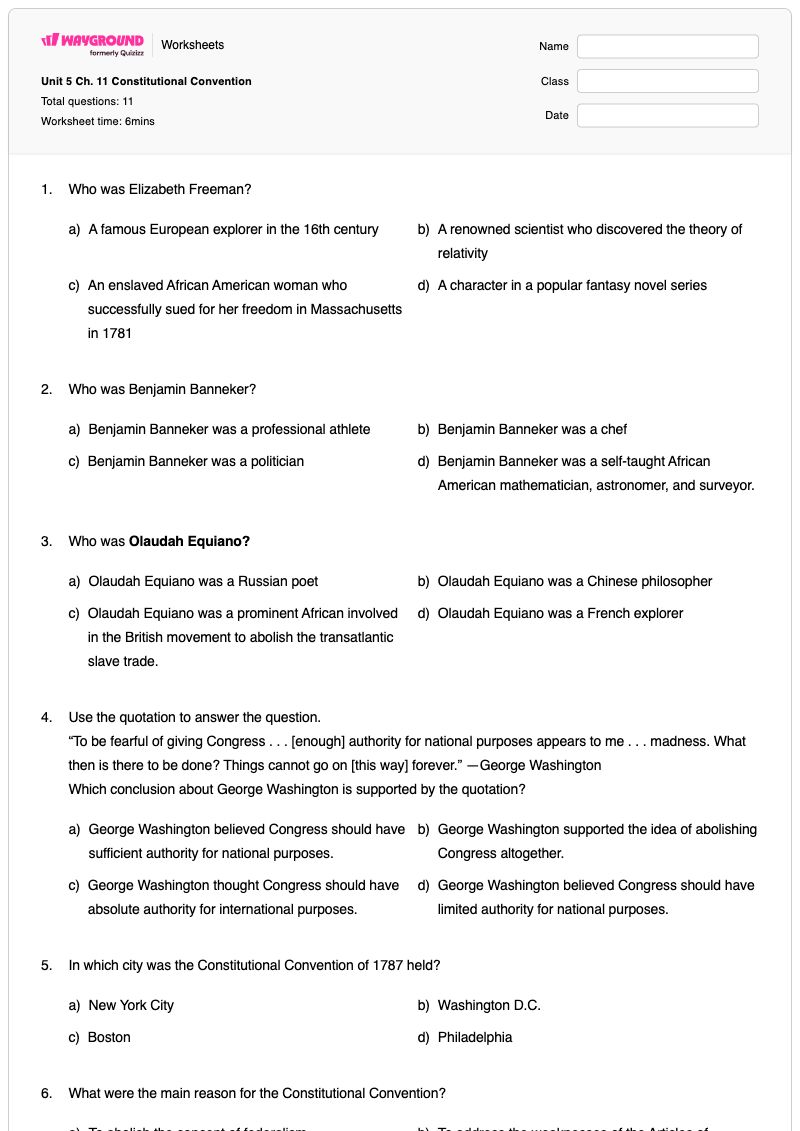

แบบฝึกหัดวิชาสังคมศึกษา ชั้นประถมศึกษาปีที่ 6 บทที่ 11 หน่วยที่ 5 การประชุมร่างรัฐธรรมนูญ ใช้ตรวจสอบความเข้าใจของนักเรียนเกี่ยวกับบุคคลสำคัญ เหตุการณ์ แผนการ และข้อตกลงประนีประนอมที่เกี่ยวข้องกับการร่างรัฐธรรมนูญ นักเรียนจะต้องระบุตัวตนของ Elizabeth Freeman, Benjamin Banneker และ Olaudah Equiano; ระบุที่ตั้งของการประชุมปี 1787 ในฟิลาเดลเฟีย; อธิบายเหตุผลที่จัดการประชุม; แยกแยะความแตกต่างระหว่างแผนเวอร์จิเนียและแผนนิวเจอร์ซีย์; และเชื่อมโยงข้อตกลงประนีประนอมครั้งใหญ่และข้อตกลงประนีประนอมสามในห้าส่วนกับประเด็นสำคัญ
แบบฝึกหัดนี้ยังพัฒนาทักษะการอ่านเชิงวิเคราะห์ผ่านคำถามแบบเลือกตอบโดยใช้คำคมจาก George Washington และ Benjamin Franklin นักเรียนจะต้องพิจารณาว่าแต่ละข้อความเผยให้เห็นอะไรเกี่ยวกับอำนาจของรัฐสภา อคติ ผลประโยชน์ในท้องถิ่น และการร่างรัฐธรรมนูญ แบบฝึกหัดนี้มีคำถามแบบเลือกตอบ 10 ข้อ และคำถามแบบเลือกตอบหลายข้อ 1 ข้อ พร้อมเฉลยคำตอบ ช่วยให้ครูสามารถทบทวนการอภิปรายในการประชุม การเป็นตัวแทน การเป็นทาส และมุมมองทางประวัติศาสตร์ได้อย่างมีประสิทธิภาพ
การตั้งค่าแผ่นงาน
ขนาดตัวอักษร
S
M
L
XL
แผ่นงาน
Unit 5 Ch. 11 Constitutional Convention
คำถามทั้งหมด: 11
ชื่อ
ระดับ
วันที่
1.
Who was Elizabeth Freeman?
a)
A famous European explorer in the 16th century
b)
A renowned scientist who discovered the theory of relativity
c)
An enslaved African American woman who successfully sued for her freedom in Massachusetts in 1781
d)
A character in a popular fantasy novel series
2.
Who was Benjamin Banneker?
a)
Benjamin Banneker was a professional athlete
b)
Benjamin Banneker was a chef
c)
Benjamin Banneker was a politician
d)
Benjamin Banneker was a self-taught African American mathematician, astronomer, and surveyor.
3.
Who was Olaudah Equiano?
a)
Olaudah Equiano was a Russian poet
b)
Olaudah Equiano was a Chinese philosopher
c)
Olaudah Equiano was a prominent African involved in the British movement to abolish the transatlantic slave trade.
d)
Olaudah Equiano was a French explorer
4.
Use the quotation to answer the question.
“To be fearful of giving Congress . . . [enough] authority for national purposes appears to me . . . madness. What then is there to be done? Things cannot go on [this way] forever.” —George Washington
Which conclusion about George Washington is supported by the quotation?
a)
George Washington believed Congress should have sufficient authority for national purposes.
b)
George Washington supported the idea of abolishing Congress altogether.
c)
George Washington thought Congress should have absolute authority for international purposes.
d)
George Washington believed Congress should have limited authority for national purposes.
5.
In which city was the Constitutional Convention of 1787 held?
a)
New York City
b)
Washington D.C.
c)
Boston
d)
Philadelphia
6.
What were the main reason for the Constitutional Convention?
a)
To abolish the concept of federalism
b)
To address the weaknesses of the Articles of Confederation and create a stronger central government.
c)
To establish a monarchy in the United States
d)
To strengthen the power of individual states
7.
What were the names of the two plans that were arguments for the Constitution?
a)
Georgia Plan and 3/5ths Plan
b)
Virginia Plan and New Jersey Plan
c)
Pennsylvania Plan and Virginia Plan
d)
Ohio Plan and New Jersey Plan
8.
Most states supported the Virginia Plan?
a)
true
b)
false
9.
Which of the following were components of the Great Compromise? Select the two correct answers.
a)
Each state has one senator in Congress
b)
Representation in the Senate is equal for all states
c)
All members of Congress serve two-year terms
d)
Representation in the House of Representatives is based on population
10.
The Three-Fifths Compromise was directly related to
a)
representation and trade
b)
representation and legislation
c)
representation and slavery
d)
taxation and representation
11.
Use the excerpt from Benjamin Franklin’s speech at the Constitutional Convention to answer the question.
"I doubt too whether any other Convention we can obtain, may be able to make a better Constitution. For when you assemble a number of men to have the advantage of their joint wisdom, you inevitably assemble with those men, all their prejudices, their passions, their errors of opinion, their local interests, and their selfish views."
The quotation supports the idea that the Constitution
a)
is not influenced by any biases or prejudices
b)
is influenced by the diverse opinions, biases, and interests of the individuals involved in its creation.
c)
is solely based on the wisdom of a few individuals
d)
is created without considering local interests
แป้นคำตอบ
Unit 5 Ch. 11 Constitutional Convention
คำถามทั้งหมด: 11
1.
c) An enslaved African American woman who successfully sued for her freedom in Massachusetts in 1781
2.
d) Benjamin Banneker was a self-taught African American mathematician, astronomer, and surveyor.
3.
c) Olaudah Equiano was a prominent African involved in the British movement to abolish the transatlantic slave trade.
4.
a) George Washington believed Congress should have sufficient authority for national purposes.
5.
d) Philadelphia
6.
b) To address the weaknesses of the Articles of Confederation and create a stronger central government.
7.
b) Virginia Plan and New Jersey Plan
8.
a)
true
9.
b)
Representation in the Senate is equal for all states
, d)
Representation in the House of Representatives is based on population
10.
c)
representation and slavery
11.
b) is influenced by the diverse opinions, biases, and interests of the individuals involved in its creation.
นักเรียนอาจสับสนระหว่าง Elizabeth Freeman, Benjamin Banneker และ Olaudah Equiano เพราะคำถามต้องการให้จับคู่แต่ละคนกับผลงานหรือบทบาทที่แตกต่างกัน ระวังนักเรียนที่บิดเบือนข้อตกลง Great Compromise โดยกำหนดการเป็นตัวแทนตามจำนวนประชากรในวุฒิสภา เลือกคำตอบเพียงข้อเดียวจากคำถามที่มีสองคำตอบ หรือตีความข้อความจาก Washington และ Franklin กว้างเกินกว่าหลักฐานที่ปรากฏ