

Wayground
Rhyme Scheme - Printable อีแอลเอ Worksheets ระดับ 6 - Wayground

Rhyme Scheme

Kelli Wingate

สร้างโดย Kelli Wingate

20 คำถาม

6th ระดับชั้น

อีแอลเอ

อัปเดตแล้ว ก.ย. 2569

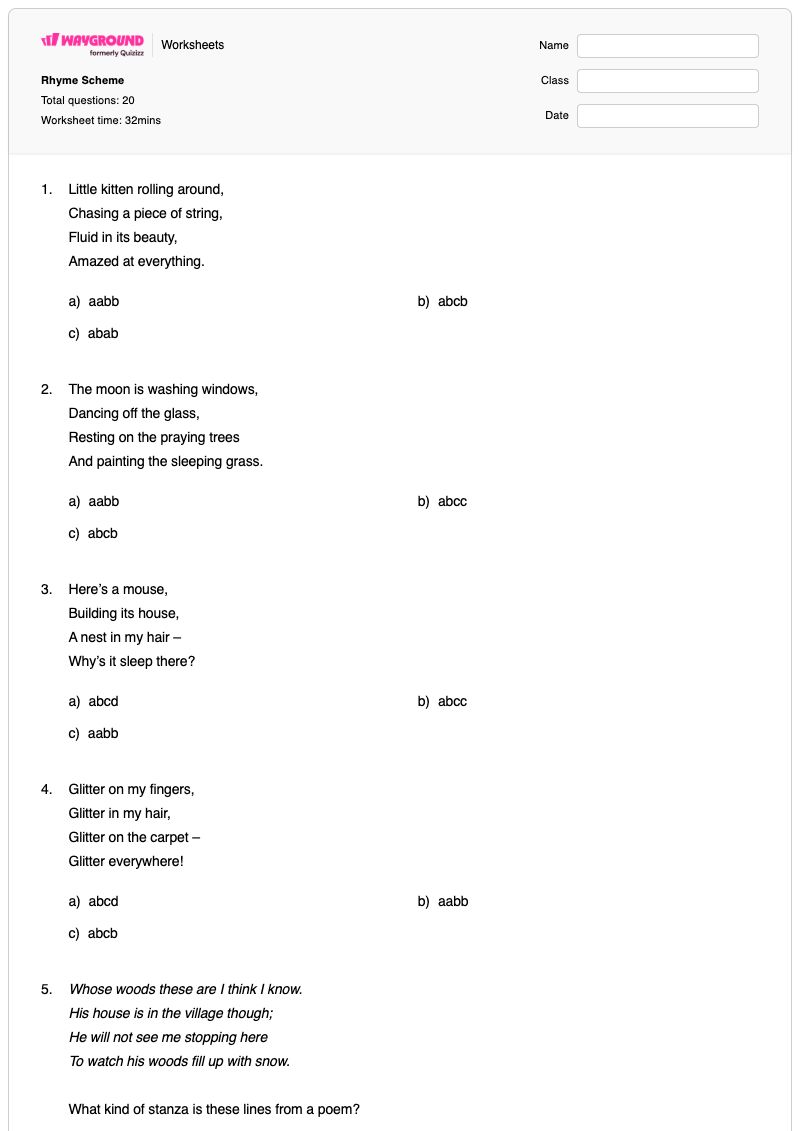
แบบฝึกหัดภาษาอังกฤษสำหรับนักเรียนชั้นประถมศึกษาปีที่ 6 นี้ ช่วยเสริมสร้างความสามารถของนักเรียนในการระบุสัมผัสและวิเคราะห์รูปแบบสัมผัสในบทกวี แบบฝึกหัดประกอบด้วย 20 ข้อ—19 ข้อเป็นแบบเลือกตอบ และ 1 ข้อเป็นแบบจับคู่—นักเรียนจะได้ศึกษาบทกวีสั้นๆ และข้อความที่ตัดตอนมา ระบุรูปแบบต่างๆ เช่น AABB, ABAB, ABCB และ ABCCB และแยกแยะความแตกต่างระหว่างสัมผัสกับรูปแบบสัมผัส นอกจากนี้ นักเรียนยังสามารถจำแนกบทกวีเป็นบทคู่ บทสาม หรือบทสี่ โดยพิจารณาจากจำนวนบรรทัดและรูปแบบที่ปรากฏ แบบฝึกหัดนี้ช่วยพัฒนาคำศัพท์และการอ่านอย่างละเอียด โดยให้นักเรียนเชื่อมโยงเสียงลงท้ายกับรูปแบบตัวอักษร และตระหนักถึงโครงสร้างของบทกวี แบบฝึกหัดนี้มีประโยชน์สำหรับการแนะนำสัญลักษณ์รูปแบบสัมผัส การฝึกฝนแบบมีผู้แนะนำ การทบทวนด้วยตนเอง หรือการประเมินภาษาอังกฤษอย่างรวดเร็วสำหรับนักเรียนชั้นประถมศึกษาปีที่ 6 นี่คือแบบฝึกหัดที่พิมพ์ได้ฟรีพร้อมเฉลยคำตอบครบถ้วน ช่วยให้ครูมีแหล่งข้อมูลพร้อมใช้งานสำหรับการตรวจสอบความเข้าใจโครงสร้างของบทกวีของนักเรียน

การตั้งค่าแผ่นงาน

ขนาดตัวอักษร

S
M
L
XL
Waygroundแผ่นงาน

Rhyme Scheme

คำถามทั้งหมด: 20

ชื่อ
ระดับ
วันที่
1.

Little kitten rolling around,

Chasing a piece of string,

Fluid in its beauty,

Amazed at everything.

a)

aabb

b)

abcb

c)

abab

2.

The moon is washing windows,

Dancing off the glass,

Resting on the praying trees

And painting the sleeping grass.

a)

aabb

b)

abcc

c)

abcb

3.

Here’s a mouse,

Building its house,

A nest in my hair –

Why’s it sleep there?

a)

abcd

b)

abcc

c)

aabb

4.

Glitter on my fingers,

Glitter in my hair,

Glitter on the carpet –

Glitter everywhere!

a)

abcd

b)

aabb

c)

abcb

5.

Whose woods these are I think I know.

His house is in the village though;

He will not see me stopping here

To watch his woods fill up with snow.


What kind of stanza is these lines from a poem?

a)

couplet (two lines rhyme)

b)

tercet (three lines rhyme)

c)

quatrain (four lines rhyme)

6.

The lady who has loved you as you've grown

Will always love and cherish you for all time.

She has the greatest heart ever known.


What kind of stanza is these lines from a poem?

a)

couplet

b)

tercet

c)

quatrain

7.

I saw a little hermit crab

His coloring was oh so drab


These line make a...

a)

couplet

b)

tercet

c)

quatrain

8.

Tell me not, in mournful numbers,

Life is but an empty dream!—

For the soul is dead that slumbers,

And things are not what they seem.


What is the rhyme scheme of these lines from a poem?

a)

AABB

b)

ABAB

c)

ABBA

9.

On the beach I find myself

Happily patrolling the shore

I see many ships sailing about

And wonder what they're for

a)

AABB

b)

DEFE

c)

ABCB

10.

The fallen leaves are cornflakes

That fills the lawn's wide dish,

And night and noon

The wind's a spoon

That stirs them with a swish

a)

AABBB

b)

ABABC

c)

ABCCB

11.

True friends are by your side

through it all

True friends are there

to catch you when you fall

a)

ABCB

b)

AABB

c)

ABAB

12.

When you wish upon a star,

makes no difference who you are,

anything you heart desires will come to you

a)

BAC

b)

AAA

c)

AAB

13.

Read the following poem. What is the rhyme scheme?


I love the sun

I love the moon

I love having fun

I love a nice tune

I love life!


I love my cars

I love my home

I love the stars

I love to roam.

I love life!

a)

ababa, ababa

b)

aabbc, aabbx

c)

ababc, ababc

d)

abca, abca

14.

Rhyme Scheme is...

a)

A word inside a line rhymes with another word on the same line

b)

A pattern of rhyme (usually end rhyme, but not always).

c)

Words sound alike because they share the same ending vowel and consonant sounds.

d)

A word at the end of one line rhymes with a word at the end of another line

15.

Rhyme is...

a)

A word inside a line rhymes with another word on the same line

b)

A pattern of rhyme (usually end rhyme, but not always).

c)

Words sound alike because they share the same ending vowel and consonant sounds.

d)

A word at the end of one line rhymes with a word at the end of another line

16.

Match the following sound effects:

This beat can be created by can be created by meter, rhyme, alliteration and refrain.

Rhythm

Words that imitate the sound they are

Onomatopoeia

The use of a word, phrase, or line more than once

Repetition

17.

Which word rhymes with all three?

butterfly

shy

multiply

a)

bite

b)

eye

18.

What is the most logical line to complete the poem?

Mary had a little poodle

All day long she ate a __________

a)

noodle

b)

lamb

19.

Instead of a paragraph, in poetry we call the chunks...

a)

stanzas

b)

sections

20.

When you wish upon a star,

makes no difference who you are,

anything you heart desires will come to you

a)

AAB

b)

AAA

Waygroundแป้นคำตอบ

Rhyme Scheme

คำถามทั้งหมด: 20

1.
b)

abcb

2.
c)

abcb

3.
c)

aabb

4.
c)

abcb

5.
c)

quatrain (four lines rhyme)

6.
b)

tercet

7.
a)

couplet

8.
b)

ABAB

9.
c)

ABCB

10.
c)

ABCCB

11.
a)

ABCB

12.
c)

AAB

13.
c)

ababc, ababc

14.
b)

A pattern of rhyme (usually end rhyme, but not always).

15.
c)

Words sound alike because they share the same ending vowel and consonant sounds.

16.

This beat can be created by can be created by meter, rhyme, alliteration and refrain.

 - 

Rhythm

, 

Words that imitate the sound they are

 - 

Onomatopoeia

, 

The use of a word, phrase, or line more than once

 - 

Repetition

17.
b)

eye

18.
a)

noodle

19.
a)

stanzas

20.
a)

AAB

คำถามที่พบบ่อย

แบบฝึกหัดเรื่องรูปแบบการสัมผัสคล้องจองนี้ครอบคลุมหัวข้ออะไรบ้าง?

แบบฝึกหัดภาษาอังกฤษสำหรับนักเรียนชั้นประถมศึกษาปีที่ 6 นี้ ให้นักเรียนระบุคำคล้องจอง ระบุรูปแบบคำคล้องจองในบทกวีสั้นๆ โดยใช้รูปแบบตัวอักษร เช่น AABB, ABAB, ABCB และ ABCCB และจำแนกบทกวีที่ยกมาว่าเป็นบทคู่ บทสาม หรือบทสี่ แบบฝึกหัดนี้ประกอบด้วยคำถามแบบเลือกตอบ 19 ข้อ และแบบฝึกหัดจับคู่ 1 ข้อ ช่วยเสริมสร้างความสามารถของนักเรียนในการเชื่อมโยงเสียงลงท้ายที่ซ้ำกันกับโครงสร้างของบทกวี

ฉันจะใช้แบบฝึกหัดนี้ในการสอนเรื่องรูปแบบการสัมผัสและประเภทของบทกลอนได้อย่างไร?

เริ่มสอนเรื่องสัมผัสคล้องจองโดยให้นักเรียนอ่านคำสุดท้ายในแต่ละบรรทัดและฟังเสียงที่ตรงกันก่อนที่จะกำหนดตัวอักษรให้กับรูปแบบ จากนั้นใช้ตัวอย่างบทกวีในแบบฝึกหัดเพื่อเป็นแบบอย่างของรูปแบบที่ซ้ำกันหนึ่งตัวอย่าง และตัวอย่างของบทคู่ บทสาม หรือบทสี่อีกหนึ่งตัวอย่าง นักเรียนสามารถทำแบบฝึกหัดแบบเลือกตอบและจับคู่ที่เหลือได้ด้วยตนเอง หรืออธิบายตัวเลือกของตนเองกับเพื่อนก็ได้

ฉันควรสังเกตข้อผิดพลาดอะไรบ้างเมื่อนักเรียนทำแบบฝึกหัดนี้เสร็จ?

นักเรียนอาจกำหนดตัวอักษรที่แตกต่างกันให้กับคำที่คล้องจองกัน พิจารณาแบบแผนโดยอิงจากการสะกดคำแทนที่จะเป็นเสียงท้ายคำ หรือเริ่มต้นลำดับตัวอักษรใหม่ไม่ถูกต้องเมื่อรูปแบบเดิมกลับมาอีกครั้ง นอกจากนี้ พวกเขายังอาจสับสนระหว่างชื่อของบทกวีกับรูปแบบการคล้องจอง ตัวอย่างเช่น การระบุข้อความที่ตัดตอนมาสี่บรรทัดว่าเป็นบทกวีสี่บรรทัด (quatrain) ไม่ได้หมายความว่ารูปแบบของบทกวีนั้นจะเป็น AABB, ABAB หรือการจัดเรียงแบบอื่นเสมอไป

ฉันจะมอบหมายและให้คะแนนแบบฝึกหัดเรื่องรูปแบบการสัมผัสคล้องจองนี้ได้อย่างไร?

Wayground จัดเตรียมแบบฝึกหัดนี้ในรูปแบบไฟล์ PDF ที่สามารถพิมพ์ได้ และในรูปแบบแบบทดสอบดิจิทัล โดยมีเฉลยคำตอบครบถ้วนสำหรับทั้ง 20 ข้อ คุณสามารถตรวจงานที่ส่งมาในรูปแบบไฟล์ PDF ได้โดยการสแกนงานของนักเรียนด้วยแอป Wayground for Teachers หรือตรวจสอบคำตอบผ่านแบบทดสอบดิจิทัลก็ได้

ในแบบฝึกหัดนี้ ความแตกต่างระหว่างสัมผัสคล้องจองและรูปแบบสัมผัสคล้องจองคืออะไร?

ในแบบฝึกหัดนี้ คำว่า "สัมผัส" หมายถึงคำที่มีเสียงสระและเสียงพยัญชนะท้ายเหมือนกัน ส่วนคำว่า "รูปแบบสัมผัส" หมายถึงรูปแบบที่คำเหล่านั้นสร้างขึ้นในแต่ละบรรทัด ซึ่งแทนด้วยตัวอักษร เช่น ABAB หรือ AAB นักเรียนจะใช้ทั้งสองแนวคิดนี้ในการวิเคราะห์บทกวีและเลือกรูปแบบที่ถูกต้อง

ฉันจะหาแบบฝึกหัดแบบนี้เพิ่มเติมได้ที่ไหนบน Wayground?

Wayground มีแบบฝึกหัดและโจทย์ฝึกหัดมากมายให้ดาวน์โหลดฟรีในหลากหลายวิชา พร้อมไฟล์ PDF และเฉลยคำตอบ เพื่อช่วยให้นักเรียนพัฒนาทักษะและความเข้าใจในแนวคิดสำคัญๆ ดูแหล่งข้อมูลเพิ่มเติมได้ที่ https://wayground.com/en-us/worksheets