

Wayground
Blood Vessles - Printable ศาสตร์ Worksheets 11th ระดับชั้น - Wayground

Blood Vessles

Desiree Boyett

สร้างโดย Desiree Boyett

28 คำถาม

11th ระดับชั้น

ศาสตร์

อัปเดตแล้ว ต.ค. 2569

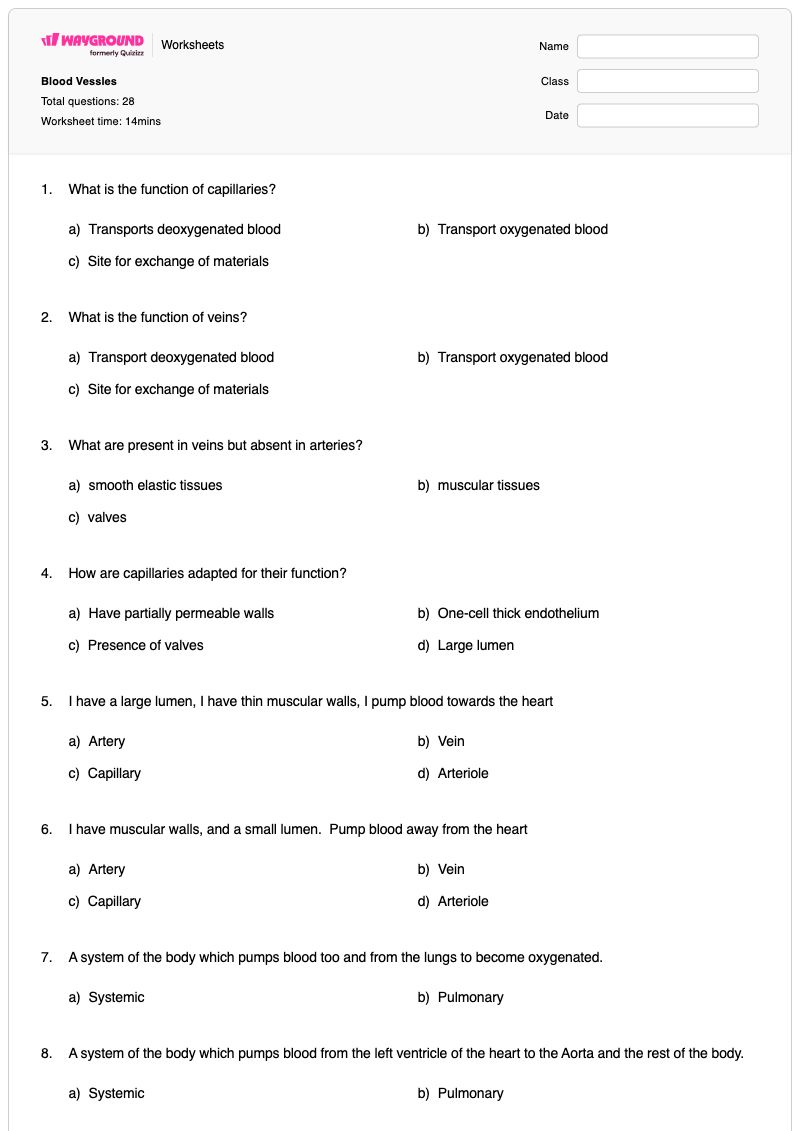
แบบฝึกหัดวิทยาศาสตร์สำหรับนักเรียนชั้นมัธยมศึกษาปีที่ 4 เรื่องหลอดเลือด ช่วยพัฒนาความเข้าใจของนักเรียนเกี่ยวกับโครงสร้าง หน้าที่ และเส้นทางการไหลเวียนของเลือด แบบฝึกหัดนี้มีคำถาม 28 ข้อ นักเรียนจะได้ระบุบทบาทของเส้นเลือดฝอย เส้นเลือดดำ เส้นเลือดแดง และเส้นเลือดฝอย เชื่อมโยงการปรับตัวของหลอดเลือด เช่น ขนาดของช่องภายใน ความหนาของผนัง ลิ้น และเยื่อบุผนังหลอดเลือดที่มีความหนาเพียงเซลล์เดียว กับหน้าที่การทำงาน และแยกแยะความแตกต่างระหว่างการไหลเวียนของเลือดในปอดและการไหลเวียนของเลือดทั่วร่างกาย แบบฝึกหัดนี้ยังทบทวนหลอดเลือดที่สำคัญและคำศัพท์ต่างๆ รวมถึงเส้นเลือดแดงใหญ่ เส้นเลือดดำใหญ่ เส้นเลือดต้นขา การสร้างหลอดเลือดใหม่ และเส้นเลือดดำใหญ่ที่ขา แบบฝึกหัดที่พิมพ์ได้ฟรีนี้ประกอบด้วยคำถามแบบเลือกตอบ 25 ข้อ คำถามแบบเลือกหลายข้อ 2 ข้อ และคำถามแบบจำแนกประเภท 1 ข้อ เพื่อตรวจสอบทั้งการจดจำและการประยุกต์ใช้ นักเรียนต้องตีความคำบอกใบ้ เลือกการปรับตัวที่เหมาะสมทั้งหมด ระบุหลอดเลือดตามทิศทางการไหลของเลือด และจำแนกข้อมูลเกี่ยวกับหลอดเลือด มีเฉลยคำตอบให้ด้วย ทำให้เหมาะสำหรับการฝึกฝน ทบทวน หรือประเมินผลวิชาชีววิทยาชั้นมัธยมศึกษาปีที่ 4

การตั้งค่าแผ่นงาน

ขนาดตัวอักษร

S
M
L
XL
Waygroundแผ่นงาน

Blood Vessles

คำถามทั้งหมด: 28

ชื่อ
ระดับ
วันที่
1.

What is the function of capillaries?

a)

Transports deoxygenated blood

b)

Transport oxygenated blood

c)

Site for exchange of materials

2.

What is the function of veins?

a)

Transport deoxygenated blood

b)

Transport oxygenated blood

c)

Site for exchange of materials

3.

What are present in veins but absent in arteries?

a)

smooth elastic tissues

b)

muscular tissues

c)

valves

4.

How are capillaries adapted for their function?

a)

Have partially permeable walls

b)

One-cell thick endothelium

c)

Presence of valves

d)

Large lumen

5.
I have a large lumen, I have thin muscular walls, I pump blood towards the heart
a)
Artery
b)
Vein
c)
Capillary
d)
Arteriole
6.
I have muscular walls, and a small lumen.  Pump blood away from the heart
a)
Artery
b)
Vein
c)
Capillary
d)
Arteriole
7.
A system of the body which pumps blood too and from the lungs to become oxygenated. 
a)
Systemic
b)
Pulmonary 
8.
A system of the body which pumps blood from the left ventricle of the heart to the Aorta and the rest of the body. 
a)
Systemic
b)
Pulmonary
9.
Which is the largest artery in the body?
a)
Aorta 
b)
Superior Vena Cava
10.
Which is the largest vein in the body?
a)
Aorta 
b)
Arteriole 
c)
Superior Vena Cava 
11.
Which of these blood vessels have small lumens? (Two answers)

Which of these blood vessels have small lumens? (Two answers)

a)

Artery

b)

Vein

c)

Capillary

12.

Which vessels take deoxygenated blood from the body to the heart?

a)

Aorta

b)

Pulmonary Artery

c)

Pulmonary Vein

d)

Superior and Inferior Vena Cava

13.

Longest vein in the body

a)

Hepatic vein

b)

Greater saphenous vein

c)

Radial vein

d)

Lumbar vein

14.

The main blood vessels of the thigh is the

a)

femoral artery/vein.

b)

tibial artery/vein.

c)

Renal artery/vein.

d)

Temporal artery/vein.

15.

The formation of new capillaries is

a)

Fenestrations

b)

Angiogenesis

c)

Atherosclerosis

d)

Perfusion

16.

The tunica media is the middle and thickest layer of vessel walls. It is made of ______ which allows for ______.

a)

smooth muscle and elastic fibers / contraction and relaxation to control pressure.

b)

elastic fibers and cartilage / quick exchange of gasses.

c)

vaso vasorum and cartilage / a blood supple to thick blood vessel walls.

d)

cardiac muscle and smooth muscle / electrical signals to be sent through the vessels.

17.

Round, muscular rings that control the rate of blood flow in capillaries are

a)

lumen

b)

arterioles

c)

rouleaus

d)

sphincters

18.

Organize these options into the right categories

จัดหมวดหมู่ดังต่อไปนี้

Gas exchange occurs here

Three tunics

To heart

Away from heart

Valves

Wall is one cell thick

Has sphincters

Lowest pressure

Highest pressure

Medium pressure

Thickest walls

Has arterioles

Has venules

Branch

Merge

RBCs travel in rouleau

Arteries
Capillaries
Veins
Arteries and veins
19.

This blood vessel layer faces the lumen.

a)

Tunica intima

b)

Tunica media

c)

Tunica externa

d)

Vasa vasorum

20.

_ prevent backflow in veins.

a)

Shunts

b)

Vaso vasorum

c)

Valves

d)

Venules

21.

The _____ arteries/veins supply and drain the kidneys.

a)

dorsalis pedis

b)

axillary

c)

iliac

d)

renal

22.
Skeletal muscles help blood to move towards the heart when it

Skeletal muscles help blood to move towards the heart when it

a)

contract.

b)

relax.

23.
Contract and expand with the heart beat:
a)
arteries
b)
veins
c)
venules
d)
capillaries
24.

What type of blood do the arteries usually carry?

a)

Oxygenated Blood

b)

Deoxygenated Blood

25.

The thickest and strongest blood vessel is the

a)

vein

b)

artery

c)

capillary

d)

both veins and capillaries

26.

The blood vessel that has the largest diameter is

a)

vein

b)

artery

c)

capillary

27.

These are one cell thick

a)

arteries

b)

capillaries

c)

veins

28.
Where material exchange takes place between the cells and blood vessels:
a)
arteries
b)
veins
c)
venules
d)
capillaries
Waygroundแป้นคำตอบ

Blood Vessles

คำถามทั้งหมด: 28

1.
c)

Site for exchange of materials

2.
a)

Transport deoxygenated blood

3.
c)

valves

4.
a)

Have partially permeable walls

, b)

One-cell thick endothelium

5.
b) Vein
6.
a) Artery
7.
b) Pulmonary 
8.
a) Systemic
9.
a) Aorta 
10.
c) Superior Vena Cava 
11.
c)

Capillary

, a)

Artery

12.
d)

Superior and Inferior Vena Cava

13.
b)

Greater saphenous vein

14.
a)

femoral artery/vein.

15.
b)

Angiogenesis

16.
a)

smooth muscle and elastic fibers / contraction and relaxation to control pressure.

17.
d)

sphincters

18.
Arteries

Away from heart

Highest pressure

Thickest walls

Has arterioles

Merge

Capillaries

Gas exchange occurs here

Wall is one cell thick

Has sphincters

Lowest pressure

RBCs travel in rouleau

Veins

To heart

Valves

Medium pressure

Has venules

Branch

Arteries and veins

Three tunics

19.
a)

Tunica intima

20.
c)

Valves

21.
d)

renal

22.
a)

contract.

23.
a) arteries
24.
a)

Oxygenated Blood

25.
b)

artery

26.
a)

vein

27.
b)

capillaries

28.
d) capillaries

คำถามที่พบบ่อย

แบบฝึกหัดเกี่ยวกับหลอดเลือดนี้ครอบคลุมหัวข้ออะไรบ้าง?

แบบฝึกหัดสำหรับนักเรียนชั้นมัธยมศึกษาปีที่ 4 (เกรด 11) นี้ครอบคลุมถึงวิธีการระบุหลอดเลือดแดง หลอดเลือดดำ หลอดเลือดฝอย และหลอดเลือดแดงฝอย โดยพิจารณาจากโครงสร้างและหน้าที่ แบบฝึกหัดประกอบด้วยคำถามแบบเลือกตอบ 25 ข้อ คำถามแบบเลือกคำตอบที่ถูกต้อง 2 ข้อ และคำถามจำแนกประเภท 1 ข้อ โดยให้นักเรียนเชื่อมโยงคุณลักษณะต่างๆ เช่น ขนาดของช่องว่างภายในหลอดเลือด ผนังกล้ามเนื้อ ลิ้นหัวใจ และผนังเซลล์บางๆ ที่ยอมให้สารผ่านได้บางส่วน กับบทบาทของหลอดเลือด นอกจากนี้ยังตรวจสอบความเข้าใจเกี่ยวกับระบบไหลเวียนโลหิตในปอดและระบบไหลเวียนโลหิตทั่วร่างกาย รวมถึงหลอดเลือดหลัก เช่น หลอดเลือดแดงใหญ่และหลอดเลือดดำใหญ่ด้วย

ฉันจะใช้แบบฝึกหัดนี้ในการสอนเรื่องโครงสร้างและการไหลเวียนของเลือดได้อย่างไร?

เริ่มแบบฝึกหัดโดยให้นักเรียนเปรียบเทียบเบาะแสเกี่ยวกับหลอดเลือดในคำถาม เช่น ช่องว่างภายในหลอดเลือดขนาดใหญ่และผนังกล้ามเนื้อบางสำหรับหลอดเลือดดำ หรือช่องว่างภายในหลอดเลือดขนาดเล็กและผนังกล้ามเนื้อสำหรับหลอดเลือดแดง จากนั้นขอให้นักเรียนอธิบายว่าการปรับตัวของเส้นเลือดฝอยช่วยสนับสนุนการแลกเปลี่ยนสารอย่างไร ก่อนที่จะทำข้อสอบแบบเลือกตอบ ใช้คำถามเกี่ยวกับการไหลเวียนโลหิตในปอดเทียบกับการไหลเวียนโลหิตทั่วร่างกายเป็นการตรวจสอบขั้นสุดท้ายว่านักเรียนสามารถนำความรู้เกี่ยวกับหลอดเลือดไปประยุกต์ใช้กับเส้นทางการไหลเวียนของเลือดได้หรือไม่

ฉันควรระวังข้อผิดพลาดอะไรบ้างเมื่อนักเรียนทำแบบฝึกหัดเกี่ยวกับหลอดเลือดนี้?

นักเรียนอาจสับสนระหว่างหลอดเลือดแดงและหลอดเลือดดำเมื่อใช้คำใบ้เกี่ยวกับทิศทางการไหลของเลือดในแบบฝึกหัด โดยเฉพาะอย่างยิ่งหากพึ่งพาเพียงแค่ว่าเลือดมีออกซิเจนหรือไม่ แทนที่จะระบุหลอดเลือดที่อธิบายไว้ นอกจากนี้ พวกเขาอาจเลือกลิ้นเป็นลักษณะที่ปรับตัวเข้ากับเส้นเลือดฝอย หรือเลือกคำตอบที่ถูกต้องเพียงข้อเดียวในคำถามแบบเลือกตอบเกี่ยวกับโครงสร้างของเส้นเลือดฝอยและช่องขนาดเล็ก ระวังความสับสนระหว่างการไหลเวียนโลหิตในปอดและทั่วร่างกาย หลอดเลือดแดงใหญ่และหลอดเลือดดำใหญ่ส่วนบน และหลอดเลือดแดงต้นขาและหลอดเลือดแดงหน้าแข้ง

ฉันจะมอบหมายและตรวจให้คะแนนแบบฝึกหัดเกี่ยวกับหลอดเลือดนี้อย่างไร?

คุณสามารถมอบหมายแบบฝึกหัดเรื่องหลอดเลือดนี้ในรูปแบบไฟล์ PDF ที่พิมพ์ได้ หรือเป็นแบบทดสอบดิจิทัลบน Wayground แบบฝึกหัดนี้มีเฉลยคำตอบครบถ้วนสำหรับคำถามทั้ง 28 ข้อ รวมถึงคำถามแบบเลือกตอบและคำถามจำแนกประเภท สำหรับการส่งแบบฝึกหัดแบบพิมพ์ สามารถตรวจได้โดยการสแกนงานของนักเรียนด้วยแอป Wayground for Teachers

ฉันจะปรับแบบฝึกหัดเกี่ยวกับหลอดเลือดนี้ให้เหมาะสมกับนักเรียนของฉันได้อย่างไร?

ในการตั้งค่าขั้นสูงของแบบฝึกหัด ให้ปรับระยะห่างระหว่างตัวอักษรและขนาดตัวอักษรเพื่อให้คำอธิบายเกี่ยวกับหลอดเลือด ตัวเลือกคำตอบ และรายการจำแนกประเภทอ่านง่ายขึ้น นอกจากนี้ คุณยังสามารถเปิดใช้งานแบบอักษรที่เป็นมิตรต่อผู้ที่มีภาวะดิสเล็กเซีย หรือแปลแบบฝึกหัดเป็นภาษาอื่นได้ ตัวเลือกเหล่านี้ช่วยให้นักเรียนเข้าถึงคำถามแบบเลือกตอบและแบบเลือกหลายข้อได้โดยไม่ต้องเปลี่ยนแปลงเนื้อหาเกี่ยวกับหลอดเลือด

ฉันจะหาแบบฝึกหัดแบบนี้เพิ่มเติมได้ที่ไหนบน Wayground?

Wayground มีแบบฝึกหัดและโจทย์ฝึกหัดมากมายให้ดาวน์โหลดฟรีในหลากหลายวิชา พร้อมไฟล์ PDF และเฉลยคำตอบ เพื่อช่วยเสริมสร้างทักษะและความเข้าใจในเนื้อหาสำคัญ ดูแหล่งข้อมูลเพิ่มเติมได้ที่ https://wayground.com/en-us/worksheets