

Wayground
Cell Membrane Structure and Function - Printable ศาสตร์ Worksheets 7th ระดับชั้น - Wayground

Cell Membrane Structure and Function

Elizabeth Campbell

สร้างโดย Elizabeth Campbell

15 คำถาม

7th ระดับชั้น

ศาสตร์

อัปเดตแล้ว ต.ค. 2569

แบบฝึกหัดวิทยาศาสตร์สำหรับนักเรียนชั้น ม.1 เรื่อง โครงสร้างและหน้าที่ของเยื่อหุ้มเซลล์ เป็นแบบฝึกหัดที่พิมพ์ได้ฟรี ช่วยเสริมสร้างความเข้าใจเกี่ยวกับโครงสร้างของเยื่อหุ้มเซลล์และการควบคุมการแลกเปลี่ยนกับสิ่งแวดล้อมภายในเซลล์ นักเรียนจะได้ทบทวนโครงสร้างของฟอสโฟลิปิด ส่วนหัวที่ชอบน้ำและส่วนหางที่ไม่ชอบน้ำ ชั้นฟอสโฟลิปิดสองชั้น แบบจำลองโมเสกของเหลว โปรตีนในเยื่อหุ้มเซลล์ การซึมผ่านได้บางส่วน และภาวะสมดุล แบบฝึกหัดนี้มี 15 ข้อ ประกอบด้วยคำถามแบบเลือกตอบ 12 ข้อ และคำถามแบบเลือกคำตอบ 3 ข้อ นักเรียนจะได้ระบุส่วนประกอบและหน้าที่ของเยื่อหุ้มเซลล์ แยกแยะสารที่ชอบน้ำและสารที่ไม่ชอบน้ำ ระบุว่าโมเลกุลใดผ่านได้ง่าย และเชื่อมโยงการเคลื่อนที่แบบเลือกสรรกับการอยู่รอดและการสื่อสารของเซลล์ แบบฝึกหัดนี้เหมาะสำหรับการฝึกปฏิบัติแบบมีผู้แนะนำ การทบทวนด้วยตนเอง หรือการประเมินผลอย่างรวดเร็วในหน่วยการเรียนรู้ชีววิทยาของชั้น ม.1 แบบฝึกหัดนี้มีให้ดาวน์โหลดเป็นไฟล์ PDF ที่พิมพ์ได้ฟรี และมีเฉลยคำตอบครบถ้วน

การตั้งค่าแผ่นงาน

ขนาดตัวอักษร

S
M
L
XL
Waygroundแผ่นงาน

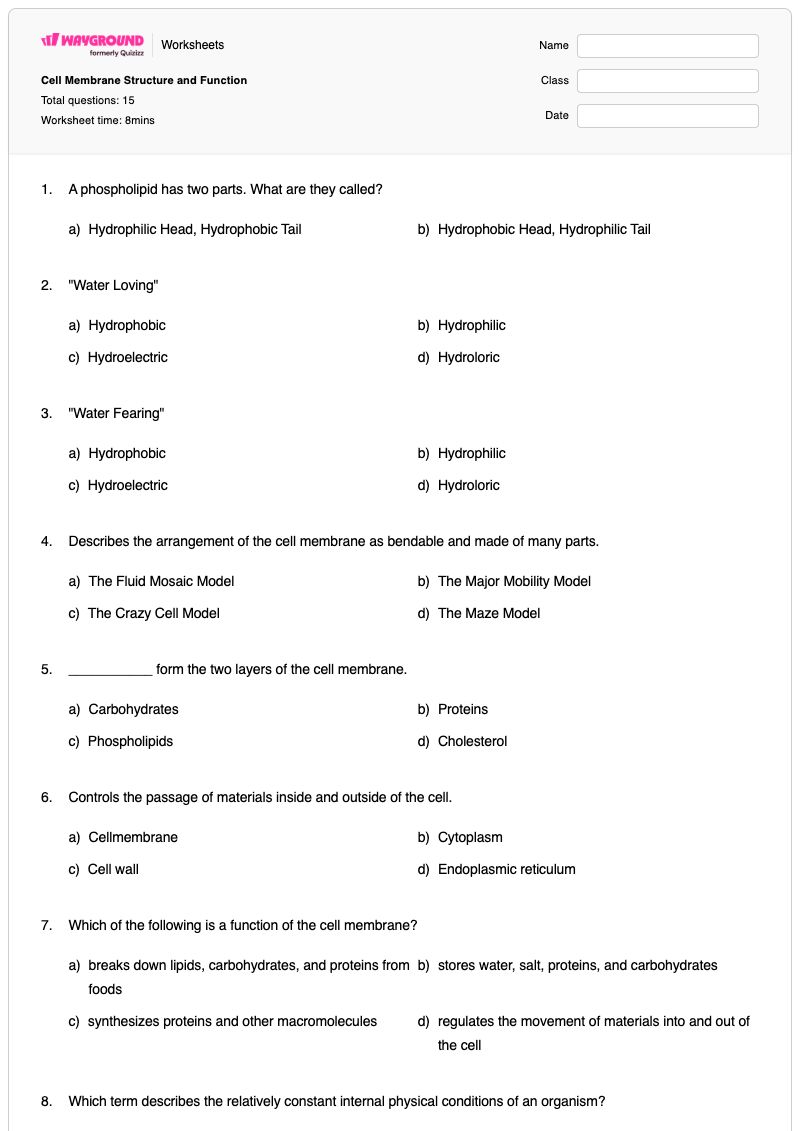
Cell Membrane Structure and Function

คำถามทั้งหมด: 15

ชื่อ
ระดับ
วันที่
1.

A phospholipid has two parts. What are they called?

a)

Hydrophilic Head, Hydrophobic Tail

b)

Hydrophobic Head, Hydrophilic Tail

2.
"Water Loving"
a)
Hydrophobic
b)
Hydrophilic 
c)
Hydroelectric 
d)
Hydroloric
3.
"Water Fearing" 
a)
Hydrophobic
b)
Hydrophilic 
c)
Hydroelectric 
d)
Hydroloric
4.
Describes the arrangement of the cell membrane as bendable and made of many parts. 
a)
The Fluid Mosaic Model 
b)
The Major Mobility Model 
c)
The Crazy Cell Model
d)
The Maze Model
5.
___________ form the two layers of the cell membrane. 
a)
Carbohydrates 
b)
Proteins 
c)
Phospholipids 
d)
Cholesterol
6.

Controls the passage of materials inside and outside of the cell.

a)

Cellmembrane

b)

Cytoplasm

c)

Cell wall

d)

Endoplasmic reticulum

7.

Which of the following is a function of the cell membrane?

a)

breaks down lipids, carbohydrates, and proteins from foods

b)

stores water, salt, proteins, and carbohydrates

c)

synthesizes proteins and other macromolecules

d)

regulates the movement of materials into and out of the cell

8.

Which term describes the relatively constant internal physical conditions of an organism?

a)

cell specialization

b)

homeostasis

c)

permeability

d)

unicellularity

9.

Which of the following is a true statement?

a)

Cells are small because it allows a faster rate of chemical exchange.

b)

Cells are small because it allows a slower rate of chemical exchange.

c)

Cells are large because it allows a faster rate of chemical exchange.

d)

Cells are large because it allows a slower rate of chemical exchange.

10.

Which of the following molecules pass easily through the cell membrane, requiring little extra help or energy? Select all that apply.

a)

sodium

b)

glucose

c)

oxygen

d)

carbon dioxide

11.

Which of the following molecules don't pass easily through the cell membrane, requiring extra help or input of energy?

a)

sodium

b)

glucose

c)

oxygen

d)

carbon dioxide

12.

The ability to allow only certain molecules into or out of the cell.

a)

Semipermeability

b)

Permeability

c)

Impermeability

d)

Unpermeability

13.

Why is the cell membrane like a window screen?

a)

They both allow everything to pass through.

b)

Neither allow anything to pass through.

c)

They both allow certain things to pass through, while blocking the passage of others.

d)

They are not similar to each other at all.

14.

Which of the following is the function of the cell membrane? Select all that apply.

a)

Provides instructions to the cell and other organelles.

b)

Regulates compounds in and out fo the cell.

c)

Allows cells to communicate and interact with other cells.

d)

Breaks down wastes and other compounds.

e)

Protects the cell from its environment.

15.

Which of the following are embedded in the phospholipid bilayer and help substances pass through?

a)

lipids

b)

proteins

c)

cholesterol

d)

carbohydrates

Waygroundแป้นคำตอบ

Cell Membrane Structure and Function

คำถามทั้งหมด: 15

1.
a)

Hydrophilic Head, Hydrophobic Tail

2.
b) Hydrophilic 
3.
a) Hydrophobic
4.
a) The Fluid Mosaic Model 
5.
c) Phospholipids 
6.
a)

Cellmembrane

7.
d)

regulates the movement of materials into and out of the cell

8.
b)

homeostasis

9.
a)

Cells are small because it allows a faster rate of chemical exchange.

10.
d)

carbon dioxide

, c)

oxygen

11.
a)

sodium

, b)

glucose

12.
a)

Semipermeability

13.
c)

They both allow certain things to pass through, while blocking the passage of others.

14.
b)

Regulates compounds in and out fo the cell.

, c)

Allows cells to communicate and interact with other cells.

, e)

Protects the cell from its environment.

15.
b)

proteins

คำถามที่พบบ่อย

แบบฝึกหัดเรื่องโครงสร้างและหน้าที่ของเยื่อหุ้มเซลล์ครอบคลุมหัวข้ออะไรบ้าง?

แบบฝึกหัดวิทยาศาสตร์สำหรับนักเรียนชั้น ม.1 นี้ ประกอบด้วยคำถามแบบเลือกตอบ 12 ข้อ และคำถามแบบเลือกคำตอบ 3 ข้อ เพื่อประเมินโครงสร้างและหน้าที่ของเยื่อหุ้มเซลล์ นักเรียนจะได้ระบุส่วนประกอบของฟอสโฟลิปิดและชั้นไขมันสองชั้น ประยุกต์ใช้คำศัพท์เกี่ยวกับสารที่ชอบน้ำและไม่ชอบน้ำ รู้จักแบบจำลองโมเสกของเหลว ระบุว่าโมเลกุลใดผ่านได้ง่าย และอธิบายการซึมผ่านแบบเลือกสรร การรักษาสมดุล การสื่อสาร และการป้องกัน

ฉันจะใช้แบบฝึกหัดนี้ในการสอนเรื่องโครงสร้างเยื่อหุ้มเซลล์และการซึมผ่านแบบเลือกสรรได้อย่างไร?

เริ่มด้วยการอธิบายโครงสร้างฟอสโฟลิปิดไบเลเยอร์ โดยให้นักเรียนระบุหรืออธิบายส่วนหัวที่ชอบน้ำ (hydrophilic head) และส่วนหางที่ไม่ชอบน้ำ (hydrophobic tail) จากนั้นใช้คำถามเกี่ยวกับคำศัพท์ในแบบฝึกหัดเพื่อตรวจสอบความเข้าใจพื้นฐานนั้น ก่อนที่จะทำแบบฝึกหัดแบบเลือกตอบหลายข้อ ให้ถามนักเรียนว่าออกซิเจน คาร์บอนไดออกไซด์ โซเดียม และกลูโคส สามารถผ่านเยื่อหุ้มเซลล์ได้ง่ายหรือไม่ และให้เหตุผลประกอบการเลือกของตนโดยใช้หลักการกึ่งซึมผ่านได้ (semipermeability) และบทบาทของโปรตีนในเยื่อหุ้มเซลล์

ฉันควรระวังข้อผิดพลาดอะไรบ้างเมื่อนักเรียนทำแบบฝึกหัดเกี่ยวกับเยื่อหุ้มเซลล์นี้?

นักเรียนอาจสับสนระหว่างสารที่ชอบน้ำและสารที่ไม่ชอบน้ำ สับสนระหว่างฟอสโฟลิปิดกับโปรตีนในฐานะวัสดุที่ประกอบเป็นเยื่อหุ้มเซลล์ หรือเลือกการซึมผ่านแทนที่จะเป็นการซึมผ่านได้บางส่วนเมื่อคำถามอธิบายถึงการยอมให้เฉพาะโมเลกุลบางชนิดผ่านได้เท่านั้น ในคำถามแบบเลือกตอบหลายข้อ ให้ระวังนักเรียนที่เลือกโซเดียมหรือกลูโคสเป็นโมเลกุลที่ผ่านได้ง่าย หรือเลือกหน้าที่ของเยื่อหุ้มเซลล์ที่ถูกต้องเพียงข้อเดียวแทนที่จะเลือกการควบคุม การสื่อสาร และการป้องกัน

ฉันจะมอบหมายและตรวจให้คะแนนแบบฝึกหัดเยื่อหุ้มเซลล์นี้ได้อย่างไร?

แบบฝึกหัดนี้มีให้ดาวน์โหลดในรูปแบบไฟล์ PDF สำหรับพิมพ์ และเป็นแบบทดสอบดิจิทัลบน Wayground พร้อมเฉลยคำตอบครบถ้วนสำหรับทั้ง 15 ข้อ คุณสามารถตรวจงานของนักเรียนที่พิมพ์ออกมาได้โดยการสแกนด้วยแอป Wayground for Teachers หรือตรวจสอบคำตอบจากแบบทดสอบดิจิทัลได้

ฉันจะปรับแบบฝึกหัดเกี่ยวกับเยื่อหุ้มเซลล์นี้ให้เหมาะสมกับนักเรียนของฉันได้อย่างไร?

ในการตั้งค่าขั้นสูงของแบบฝึกหัด ให้ปรับระยะห่างระหว่างตัวอักษรหรือเลือกขนาดตัวอักษรที่ใหญ่ขึ้น เพื่อให้ข้อคำถามแบบเลือกตอบและเลือกหลายข้อที่มีคำศัพท์เฉพาะทางอ่านง่ายขึ้น นอกจากนี้ คุณยังสามารถใช้แบบอักษรที่เหมาะสำหรับผู้ที่มีภาวะดิสเล็กเซีย หรือแปลแบบฝึกหัดเป็นภาษาอื่นในขณะที่นักเรียนกำลังเรียนรู้เกี่ยวกับแนวคิดต่างๆ เช่น ชั้นไขมันฟอสโฟลิปิดสองชั้นและการซึมผ่านแบบเลือกได้

ฉันจะหาแบบฝึกหัดแบบนี้เพิ่มเติมได้ที่ไหนบน Wayground?

Wayground นำเสนอชุดแบบฝึกหัดและโจทย์ฝึกหัดฟรีที่ครอบคลุมทุกวิชา พร้อมไฟล์ PDF และเฉลยคำตอบ เพื่อช่วยเสริมสร้างทักษะและความเข้าใจในแนวคิดสำคัญ ดูแหล่งข้อมูลเพิ่มเติมได้ที่ https://wayground.com/en-us/worksheets