

Wayground
Weather Review - Molecules - Printable ศาสตร์ Worksheets ระดับ 6 - Wayground

Weather Review - Molecules

Diane Bacon

By Diane Bacon

22 คำถาม

6th - 6th ระดับชั้น

ศาสตร์

40 เล่น

อัปเดตแล้ว พ.ค. 2568

แบบฝึกหัดวิทยาศาสตร์สำหรับนักเรียนชั้นประถมศึกษาปีที่ 6 เรื่อง "ทบทวนสภาพอากาศ - โมเลกุล" เป็นแบบฝึกหัดที่พิมพ์ได้ฟรี ซึ่งทบทวนว่าการเคลื่อนที่ของโมเลกุล พลังงานจลน์ ความร้อน ความเย็น และความหนาแน่น อธิบายกระบวนการที่เกี่ยวข้องกับสภาพอากาศได้อย่างไร นักเรียนจะต้องตอบคำถาม 22 ข้อ—21 ข้อเป็นแบบเลือกตอบ และ 1 ข้อเป็นแบบเลือกตอบหลายตัวเลือก—ครอบคลุมหัวข้อการนำความร้อน การพาความร้อน การแผ่รังสี ระบบปิด การเคลื่อนที่ของอากาศ ปริมาณน้ำฝน ความเร็วลม และสภาพอากาศ แบบฝึกหัดนี้ช่วยให้นักเรียนเชื่อมโยงการเปลี่ยนแปลงในระดับอนุภาคกับรูปแบบสภาพอากาศที่สังเกตได้ พวกเขาจะระบุว่าความร้อนและความเย็นส่งผลต่อความเร็วและระยะห่างของโมเลกุลอย่างไร แยกแยะวิธีการถ่ายเทพลังงานความร้อนสามวิธี และประยุกต์ใช้แนวคิดเกี่ยวกับความหนาแน่นและอากาศที่ลอยขึ้น แบบฝึกหัดข้อสุดท้ายถามให้นักเรียนระบุการสังเกตและข้อมูลที่สนับสนุนข้ออ้าง ซึ่งเป็นการเสริมสร้างการให้เหตุผลทางวิทยาศาสตร์ขั้นพื้นฐาน มีเฉลยคำตอบครบถ้วน ทำให้แบบฝึกหัดที่พิมพ์ได้ฟรีนี้มีประโยชน์สำหรับการทบทวน การฝึกฝนด้วยตนเอง การบ้าน หรือการตรวจสอบความเข้าใจ

การตั้งค่าแผ่นงาน

ขนาดตัวอักษร

S
M
L
XL
Waygroundแผ่นงาน

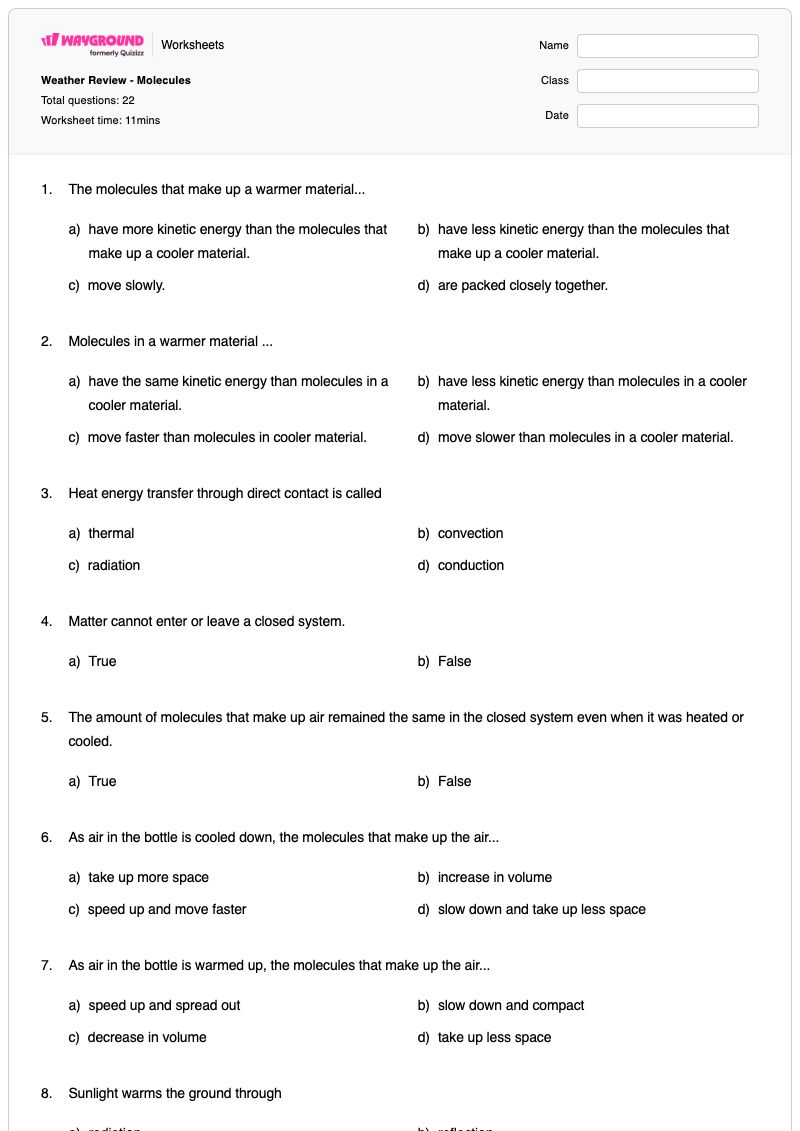
Weather Review - Molecules

คำถามทั้งหมด: 22

ชื่อ
ระดับ
วันที่
1.

The molecules that make up a warmer material...

a)

have more kinetic energy than the molecules that make up a cooler material.

b)

have less kinetic energy than the molecules that make up a cooler material.

c)

move slowly.

d)

are packed closely together.

2.

Molecules in a warmer material ...

a)

have the same kinetic energy than molecules in a cooler material.

b)

have less kinetic energy than molecules in a cooler material.

c)

move faster than molecules in cooler material.

d)

move slower than molecules in a cooler material.

3.

Heat energy transfer through direct contact is called

a)

thermal

b)

convection

c)

radiation

d)

conduction

4.

Matter cannot enter or leave a closed system.

a)

True

b)

False

5.

The amount of molecules that make up air remained the same in the closed system even when it was heated or cooled.

a)

True

b)

False

6.

As air in the bottle is cooled down, the molecules that make up the air...

a)

take up more space

b)

increase in volume

c)

speed up and move faster

d)

slow down and take up less space

7.

As air in the bottle is warmed up, the molecules that make up the air...

a)

speed up and spread out

b)

slow down and compact

c)

decrease in volume

d)

take up less space

8.

Sunlight warms the ground through

a)

radiation

b)

reflection

c)

conduction

d)

temperature

9.

Less dense air rises.

a)

True

b)

False

10.

Heating the air makes the particles move faster and spread out, making it

a)

cooler

b)

more compact

c)

more dense

d)

less dense

11.

Thermal energy is transferred from the ground to the air right above it by

a)

thermal energy

b)

conduction

c)

radiation

d)

convection

12.

Precipitation is not

a)

rain

b)

snow

c)

hail

d)

lightning

13.

Wind speed is an example of a weather condition.

a)

True

b)

False

14.

Conditions on days when it hails could include.

a)

An increase in temperature, decrease in humidity and no wind.

b)

A lack of wind and decrease in humidity.

c)

A drop in temperature, increase in humidity, and increase in wind speed.

15.

Evidence

a)

Answers a question.

b)

Supports the claim.

c)

Explains why or how

d)

Can be observations.

16.

Heat transfers from the ground to the air above by radiation.

a)

True

b)

False

17.

The weather balloon data showed

a)

temperature increased as the altitude increased.

b)

temperature decreased as the altitude increased.

c)

it got warmer as the balloon went higher.

18.

Heat increases kinetic energy.

a)

True

b)

False

19.

When air molecules are cooled they

a)

become more dense and move closer together.

b)

become more dense and move further apart.

c)

become less dense and move further apart.

d)

become less dense and move close together.

20.

A claim

a)

provides supporting evidence.

b)

explains why or how something is true

c)

Starts with "I think"

d)

answers the question.

21.

What happens to the volume of air when it is heated?

a)

It increases

b)

It decreases

c)

It remains the same

d)

It becomes zero

22.

When air is cooled, the molecules that make up the air...

a)

move faster and spread out

b)

slow down and move closer together

c)

increase in volume

d)

take up more space

Waygroundแป้นคำตอบ

Weather Review - Molecules

คำถามทั้งหมด: 22

1.
a)

have more kinetic energy than the molecules that make up a cooler material.

2.
c)

move faster than molecules in cooler material.

3.
d)

conduction

4.
a)

True

5.
a)

True

6.
d)

slow down and take up less space

7.
a)

speed up and spread out

8.
a)

radiation

9.
a)

True

10.
d)

less dense

11.
b)

conduction

12.
d)

lightning

13.
a)

True

14.
c)

A drop in temperature, increase in humidity, and increase in wind speed.

15.
b)

Supports the claim.

, d)

Can be observations.

16.
b)

False

17.
b)

temperature decreased as the altitude increased.

18.
a)

True

19.
a)

become more dense and move closer together.

20.
d)

answers the question.

21.
a)

It increases

22.
b)

slow down and move closer together

คำถามที่พบบ่อย

แบบฝึกหัดทบทวนสภาพอากาศ - โมเลกุล ครอบคลุมเนื้อหาอะไรบ้าง?

แบบฝึกหัดวิทยาศาสตร์สำหรับนักเรียนชั้นประถมศึกษาปีที่ 6 นี้ ประกอบด้วยคำถามแบบเลือกตอบ 21 ข้อ และคำถามแบบเลือกคำตอบ 1 ข้อ เพื่อประเมินว่าการเคลื่อนที่ของโมเลกุลอธิบายปรากฏการณ์ความร้อน ความเย็น ความหนาแน่นของอากาศ และสภาพอากาศได้อย่างไร นักเรียนจะได้ระบุการนำความร้อน การพาความร้อน และการแผ่รังสี อธิบายว่าโมเลกุลของอากาศเปลี่ยนแปลงความเร็วและระยะห่างในระบบปิดได้อย่างไร เชื่อมโยงอากาศที่มีความหนาแน่นน้อยกว่ากับอากาศที่ลอยขึ้น และแยกแยะความแตกต่างระหว่างฝนกับสภาพอากาศอื่นๆ ส่วนคำถามแบบเลือกคำตอบข้อสุดท้ายยังถามให้นักเรียนระบุหลักฐานที่สนับสนุนข้ออ้างนั้นด้วย

ฉันจะใช้แบบฝึกหัดนี้ในการสอนเรื่องการเคลื่อนที่ของโมเลกุลและสภาพอากาศได้อย่างไร?

ใช้ใบงานหลังจากจำลองว่าโมเลกุลที่อุ่นกว่าจะมีพลังงานจลน์มากกว่า เคลื่อนที่เร็วกว่า และกระจายตัวออกไป ในขณะที่โมเลกุลที่เย็นกว่าจะเคลื่อนที่ช้ากว่าและใช้พื้นที่น้อยกว่า ให้นักเรียนอธิบายสิ่งของในขวดปิดด้วยภาพวาดอนุภาค จากนั้นจัดเรียงตัวอย่างของแสงแดดที่ทำให้พื้นดินอุ่นขึ้น ความร้อนจากพื้นดินสู่อากาศ และอากาศที่ลอยขึ้นตามการแผ่รังสี การนำความร้อน หรือการพาความร้อน ปิดท้ายด้วยการอภิปรายว่าอุณหภูมิ ความชื้น และสภาพลมมีความสัมพันธ์กับลูกเห็บอย่างไร และหลักฐานสนับสนุนข้ออ้างทางวิทยาศาสตร์อย่างไร

ฉันควรสังเกตข้อผิดพลาดอะไรบ้างเมื่อนักเรียนทำแบบฝึกหัดนี้เสร็จ?

นักเรียนอาจสับสนระหว่างอุณหภูมิกับการเคลื่อนที่ของโมเลกุล เลือกคำตอบว่าโมเลกุลที่อุ่นกว่าเคลื่อนที่ช้ากว่า หรือสันนิษฐานว่าการให้ความร้อนจะเพิ่มหรือลดจำนวนโมเลกุลในระบบปิด ระวังความสับสนระหว่างการแผ่รังสีจากแสงแดด การนำความร้อนผ่านการสัมผัสโดยตรง และการพาความร้อนที่เกี่ยวข้องกับอากาศที่มีความหนาแน่นน้อยกว่าที่ลอยขึ้น นักเรียนอาจจัดประเภทฟ้าผ่าเป็นหยาดน้ำฟ้า หรือเลือกเพียงตัวเลือกเดียวในคำถามแบบเลือกตอบหลายข้อสุดท้าย แม้ว่าทั้งสองตัวเลือกจะสนับสนุนข้ออ้างและเป็นการสังเกตการณ์ที่ถูกต้องก็ตาม

ฉันจะมอบหมายและให้คะแนนแบบฝึกหัดทบทวนสภาพอากาศ - โมเลกุล นี้ได้อย่างไร?

บน Wayground คุณสามารถมอบหมายแบบฝึกหัดนี้เป็นไฟล์ PDF ที่พิมพ์ได้ หรือใช้เป็นแบบทดสอบดิจิทัลได้ แบบฝึกหัดนี้มีเฉลยคำตอบครบถ้วนสำหรับคำถามแบบเลือกตอบ 21 ข้อ และคำถามแบบเลือกหลักฐานหลายข้อ และงานของนักเรียนที่พิมพ์ออกมาสามารถตรวจได้โดยการสแกนด้วยแอป Wayground for Teachers รูปแบบที่พิมพ์ได้ยังช่วยสนับสนุนโรงเรียนที่กำลังลดเวลาการใช้หน้าจอได้อีกด้วย

ฉันจะปรับแบบฝึกหัดเรื่องการเคลื่อนที่ของโมเลกุลและสภาพอากาศนี้ให้เหมาะสมกับนักเรียนของฉันได้อย่างไร?

ในการตั้งค่าขั้นสูง ให้ปรับระยะห่างระหว่างตัวอักษรและขนาดตัวอักษรเพื่อให้ข้อความคำถามและตัวเลือกคำตอบอ่านง่ายขึ้น หรือเปิดใช้งานแบบอักษรที่เป็นมิตรต่อผู้ที่มีภาวะดิสเล็กเซียสำหรับหัวข้อเกี่ยวกับการเคลื่อนที่ของโมเลกุลและสภาพอากาศ นอกจากนี้ คุณยังสามารถแปลแบบฝึกหัดเป็นภาษาอื่นเพื่อให้ผู้เรียนสามารถมุ่งเน้นไปที่การตีความแนวคิดต่างๆ เช่น การนำความร้อน ความหนาแน่น ปริมาณน้ำฝน และหลักฐาน แทนที่จะต้องเสียเวลาไปกับการถอดรหัสภาษาที่ไม่คุ้นเคย

ฉันจะหาแบบฝึกหัดแบบนี้เพิ่มเติมได้ที่ไหนบน Wayground?

Wayground นำเสนอชุดแบบฝึกหัดและโจทย์ฝึกหัดฟรีที่ครอบคลุมทุกวิชา พร้อมไฟล์ PDF และเฉลยคำตอบ เพื่อช่วยให้นักเรียนเชี่ยวชาญทักษะและแนวคิดที่สำคัญ ดูแหล่งข้อมูลเพิ่มเติมได้ที่ https://wayground.com/en-us/worksheets