

Wayground
Annotations - Printable อีแอลเอ Worksheets ระดับ 11 - Wayground

Annotations

Andole Mosley

สร้างโดย Andole Mosley

17 คำถาม

11th ระดับชั้น

อีแอลเอ

อัปเดตแล้ว ก.ย. 2569

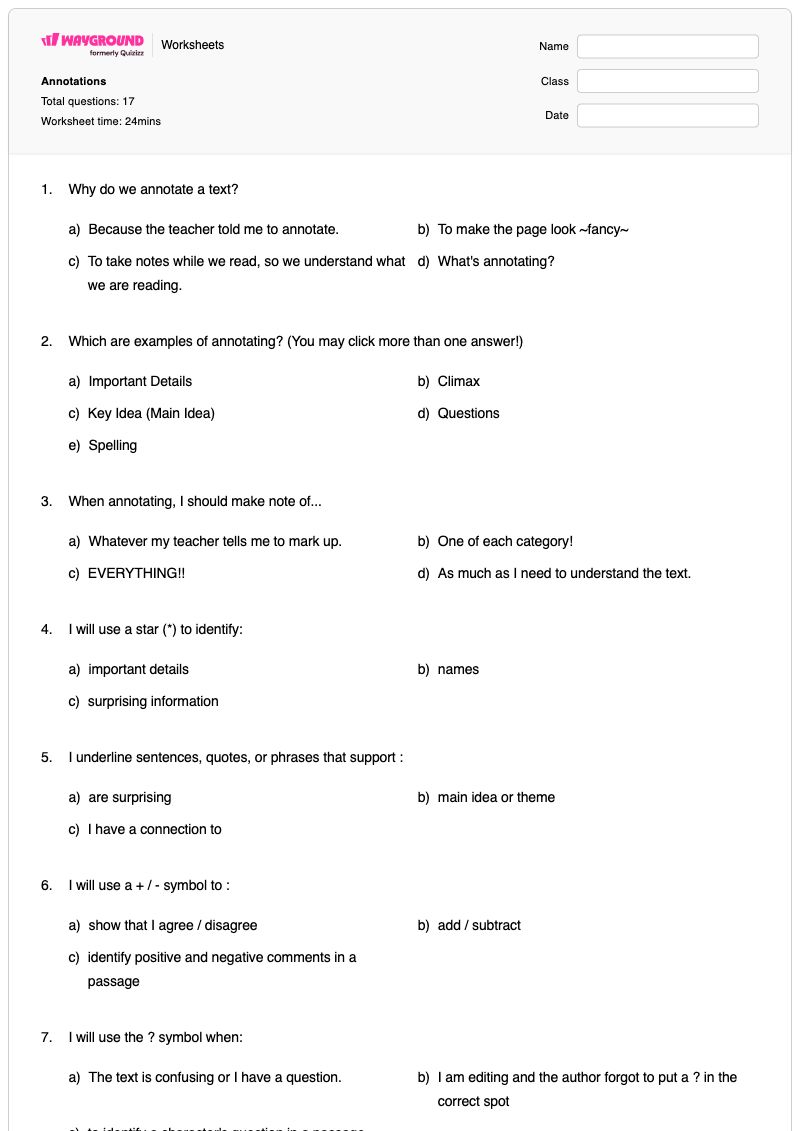
แบบฝึกหัดการเขียนคำอธิบายประกอบ (Annotations) สำหรับวิชาภาษาอังกฤษ ชั้นมัธยมศึกษาปีที่ 4 (เกรด 11) สอนให้นักเรียนรู้จักวิธีโต้ตอบกับเนื้อหาผ่านการใส่คำอธิบายประกอบอย่างมีจุดประสงค์ แบบฝึกหัดนี้ประกอบด้วย 17 ข้อ—16 ข้อเป็นแบบเลือกตอบ และ 1 ข้อเป็นแบบเลือกตอบหลายตัวเลือก—นักเรียนจะได้ระบุว่าเหตุใดการใส่คำอธิบายประกอบจึงช่วยสนับสนุนความเข้าใจในการอ่าน เลือกสิ่งที่ควรทำเครื่องหมาย และแยกแยะความแตกต่างระหว่างบันทึกที่มีประโยชน์กับการทำเครื่องหมายที่มากเกินไปหรือไม่ได้รับการสนับสนุน นอกจากนี้ นักเรียนยังได้ฝึกฝนการใช้หลักเกณฑ์การใส่คำอธิบายประกอบต่างๆ เช่น เครื่องหมายดอกจันสำหรับรายละเอียดที่สำคัญ ขีดเส้นใต้สำหรับหลักฐานของความคิดหลักหรือหัวข้อหลัก เครื่องหมายบวกและลบสำหรับการเห็นด้วยหรือไม่เห็นด้วย เครื่องหมายคำถามสำหรับความสับสนหรือคำถาม เครื่องหมายอัศเจรีย์สำหรับข้อมูลที่น่าประหลาดใจ และลูกศรสำหรับการเชื่อมโยงเนื้อหาเข้ากับตนเอง เนื้อหาต่อเนื้อหา หรือเนื้อหาต่อโลก แบบฝึกหัดนี้ยังกล่าวถึงการใช้บริบทเพื่อหาคำศัพท์ที่ไม่คุ้นเคย การเพิ่มบันทึกย่อเพื่อเชื่อมโยงเนื้อหา และการอ่านแบบคร่าวๆ เพื่อหาชื่อ ตัวเลข และคำที่เน้นตัวหนา แบบฝึกหัดนี้สามารถพิมพ์ได้ฟรีสำหรับใช้ในการสอนและการทบทวนวิชาภาษาอังกฤษ ชั้นมัธยมศึกษาปีที่ 4 และมีเฉลยคำตอบครบถ้วน

การตั้งค่าแผ่นงาน

ขนาดตัวอักษร

S
M
L
XL
Waygroundแผ่นงาน

Annotations

คำถามทั้งหมด: 17

ชื่อ
ระดับ
วันที่
1.

Why do we annotate a text?

a)

Because the teacher told me to annotate.

b)

To make the page look ~fancy~

c)

To take notes while we read, so we understand what we are reading.

d)

What's annotating?

2.

Which are examples of annotating? (You may click more than one answer!)

a)

Important Details

b)

Climax

c)

Key Idea (Main Idea)

d)

Questions

e)

Spelling

3.

When annotating, I should make note of...

a)

Whatever my teacher tells me to mark up.

b)

One of each category!

c)

EVERYTHING!!

d)

As much as I need to understand the text.

4.

I will use a star (*) to identify:

a)

important details

b)

names

c)

surprising information

5.

I underline sentences, quotes, or phrases that support :

a)

are surprising

b)

main idea or theme

c)

I have a connection to

6.

I will use a + / - symbol to :

a)

show that I agree / disagree

b)

add / subtract

c)

identify positive and negative comments in a passage

7.

I will use the ? symbol when:

a)

The text is confusing or I have a question.

b)

I am editing and the author forgot to put a ? in the correct spot

c)

to identify a character's question in a passage

8.

I will use the ! symbol when text is:

a)

confusing

b)

surprising or shocking

c)

connected to my life, and I am surprised about it.

9.

I will use the arrow symbol when:

a)

I am referring to an illustration

b)

I make connections to myself, something I've read, or something in the world (news, etc).

c)

When I need to connect one piece of text to another only.

10.

When I make a connection with the arrow annotation symbol, I must write something on the sides.

a)

True

b)

False

11.

It is completely acceptable to simply highlight words, sentences, and phrases when reading and count that as your annotations.

a)

True

b)

False

12.

Once you "box in" a word that you do not know the meaning of, what should you do next?

a)

nothing

b)

try to use context clues to figure out its meaning and jot it down near the word you circled

c)

Never circle a word that you don't know the meaning of because then Mose will expect you to do more work to find out what it means.

13.

Annotation helps you to interact with the text for better reading comprehension.

a)

True

b)

False

14.

Which example shows how to most effectively annotate a text?

a)
Which example shows how to most effectively annotate a text?
b)
Which example shows how to most effectively annotate a text?
c)
Which example shows how to most effectively annotate a text?
d)
Which example shows how to most effectively annotate a text?
15.

What should you look first for when skimming the text? Select all that apply.

a)

Names

b)

Numbers

c)

Words in bold

d)

All of the above

16.

What does annotating help us to do? Select three.

a)

Summarize

b)

Notice Important Details

c)

Prepare for analysis

d)

Highlight the text.

17.

Define SSR.

a)

Skim

Survey

Read

b)

Self

Selected

Reading

c)

Summarize

Survey

Read

d)

Sentences

Summarizing

Reading

Waygroundแป้นคำตอบ

Annotations

คำถามทั้งหมด: 17

1.
c)

To take notes while we read, so we understand what we are reading.

2.
a)

Important Details

, c)

Key Idea (Main Idea)

, d)

Questions

3.
d)

As much as I need to understand the text.

4.
a)

important details

5.
b)

main idea or theme

6.
a)

show that I agree / disagree

7.
a)

The text is confusing or I have a question.

8.
b)

surprising or shocking

9.
b)

I make connections to myself, something I've read, or something in the world (news, etc).

10.
a)

True

11.
b)

False

12.
b)

try to use context clues to figure out its meaning and jot it down near the word you circled

13.
a)

True

14.
a)
15.
d)

All of the above

16.
c)

Prepare for analysis

17.
a)

Skim

Survey

Read

คำถามที่พบบ่อย

แบบฝึกหัดการเขียนคำอธิบายประกอบครอบคลุมเนื้อหาอะไรบ้าง?

แบบฝึกหัดภาษาอังกฤษสำหรับนักเรียนชั้นมัธยมศึกษาปีที่ 4 (เกรด 11) นี้ ประกอบด้วยคำถาม 17 ข้อ ทั้งแบบเลือกตอบและเลือกคำตอบที่ถูกต้อง เพื่อประเมินความสามารถในการใส่คำอธิบายประกอบในเนื้อหาอย่างมีจุดประสงค์ นักเรียนจะต้องระบุว่าการใส่คำอธิบายประกอบช่วยในการเข้าใจเนื้อหาอย่างไร ตัดสินใจว่าจะทำเครื่องหมายอะไรบ้าง ใช้สัญลักษณ์ต่างๆ เช่น ดาว ขีดเส้นใต้ เครื่องหมายคำถาม เครื่องหมายอัศเจรีย์ เครื่องหมายบวก/ลบ และลูกศร และใช้บริบทเพื่ออธิบายคำศัพท์ที่ไม่คุ้นเคย

ฉันจะใช้แบบฝึกหัดการเขียนคำอธิบายประกอบนี้เพื่อสอนนักเรียนวิธีการเขียนคำอธิบายประกอบในข้อความได้อย่างไร?

แนะนำการจดบันทึกประกอบการอ่าน เพื่อช่วยให้เข้าใจเนื้อหาได้ดียิ่งขึ้น จากนั้นสาธิตการใช้สัญลักษณ์ในแบบฝึกหัดกับข้อความสั้นๆ ดังนี้: ทำเครื่องหมายรายละเอียดสำคัญด้วยเครื่องหมายดาว ขีดเส้นใต้ข้อความที่สนับสนุนความคิดหลักหรือหัวข้อ และใส่เครื่องหมายคำถามข้างๆ ข้อความที่แสดงถึงความสับสน หลังจากที่นักเรียนทำแบบฝึกหัดเสร็จแล้ว ให้พวกเขาอธิบายว่าเหตุใดการไฮไลต์เพียงอย่างเดียวจึงไม่เพียงพอ และฝึกเขียนบันทึกข้างๆ ลูกศรที่แสดงถึงความเชื่อมโยงระหว่างข้อความกับตนเอง ข้อความกับข้อความอื่นๆ หรือข้อความกับโลกภายนอก

ฉันควรระวังข้อผิดพลาดอะไรบ้างเมื่อนักเรียนทำแบบฝึกหัดการเขียนคำอธิบายประกอบนี้?

สังเกตดูว่านักเรียนบางคนใช้การขีดเส้นใต้เพื่อเน้นทุกอย่าง ทำเครื่องหมายเฉพาะสิ่งที่ครูบอก หรือเลือกใช้สัญลักษณ์ตามความหมายในชีวิตประจำวันมากกว่าวัตถุประสงค์ของการทำเครื่องหมายหรือไม่ นอกจากนี้ นักเรียนอาจสับสนระหว่างเครื่องหมายคำถามกับเครื่องหมายแสดงความสับสนของผู้อ่าน ละเว้นคำอธิบายที่จำเป็นสำหรับการเชื่อมต่อลูกศร หรือวงกลมคำที่ไม่คุ้นเคยโดยไม่ใช้บริบทและบันทึกความหมาย

ฉันจะมอบหมายและให้คะแนนแบบฝึกหัดการเขียนคำอธิบายประกอบได้อย่างไร?

คุณสามารถมอบหมายแบบฝึกหัดการเขียนคำอธิบายประกอบในรูปแบบไฟล์ PDF ที่พิมพ์ได้ หรือเป็นแบบทดสอบดิจิทัลบน Wayground แบบฝึกหัดนี้มีเฉลยคำตอบครบถ้วนสำหรับคำถามแบบเลือกตอบและแบบเลือกหลายข้อ และสามารถตรวจงานส่งในรูปแบบไฟล์พิมพ์ได้โดยการสแกนงานของนักเรียนด้วยแอป Wayground for Teachers รูปแบบไฟล์พิมพ์ยังช่วยให้โรงเรียนมีทางเลือกในการลดเวลาการใช้หน้าจออีกด้วย

ฉันจะปรับแบบฝึกหัดการเขียนคำอธิบายประกอบให้เหมาะสมกับนักเรียนแต่ละคนได้อย่างไร?

ในการตั้งค่าขั้นสูงของแบบฝึกหัด ให้ปรับระยะห่างระหว่างตัวอักษรหรือขนาดตัวอักษรเพื่อให้ตัวเลือกสัญลักษณ์คำอธิบายและข้อความอธิบายอ่านง่ายขึ้น และเปิดใช้งานแบบอักษรที่เป็นมิตรต่อผู้ที่มีภาวะดิสเล็กเซียเมื่อเหมาะสม นอกจากนี้ คุณยังสามารถแปลแบบฝึกหัดเป็นภาษาอื่นได้โดยยังคงรักษาจุดเน้นที่สัญลักษณ์คำอธิบาย การอ่านเพื่อความเข้าใจ เบาะแสบริบท และการเชื่อมโยงข้อความไว้

ฉันจะหาแบบฝึกหัดฟรีแบบนี้เพิ่มเติมได้ที่ไหนบน Wayground?

Wayground นำเสนอชุดแบบฝึกหัดและโจทย์ฝึกหัดฟรีที่ครอบคลุมหลากหลายวิชา พร้อมไฟล์ PDF และเฉลยคำตอบ เพื่อช่วยให้นักเรียนเชี่ยวชาญทักษะและแนวคิดที่สำคัญ ดูแหล่งข้อมูลเพิ่มเติมได้ที่ https://wayground.com/en-us/worksheets