Wayground
Eye Parts and Functions - Printable ศาสตร์ Worksheets ระดับ 6 - Wayground

Eye Parts and Functions

Connie Jo Earls

สร้างโดย Connie Jo Earls

20 คำถาม

6th ระดับชั้น

ศาสตร์

อัปเดตแล้ว ก.ย. 2569

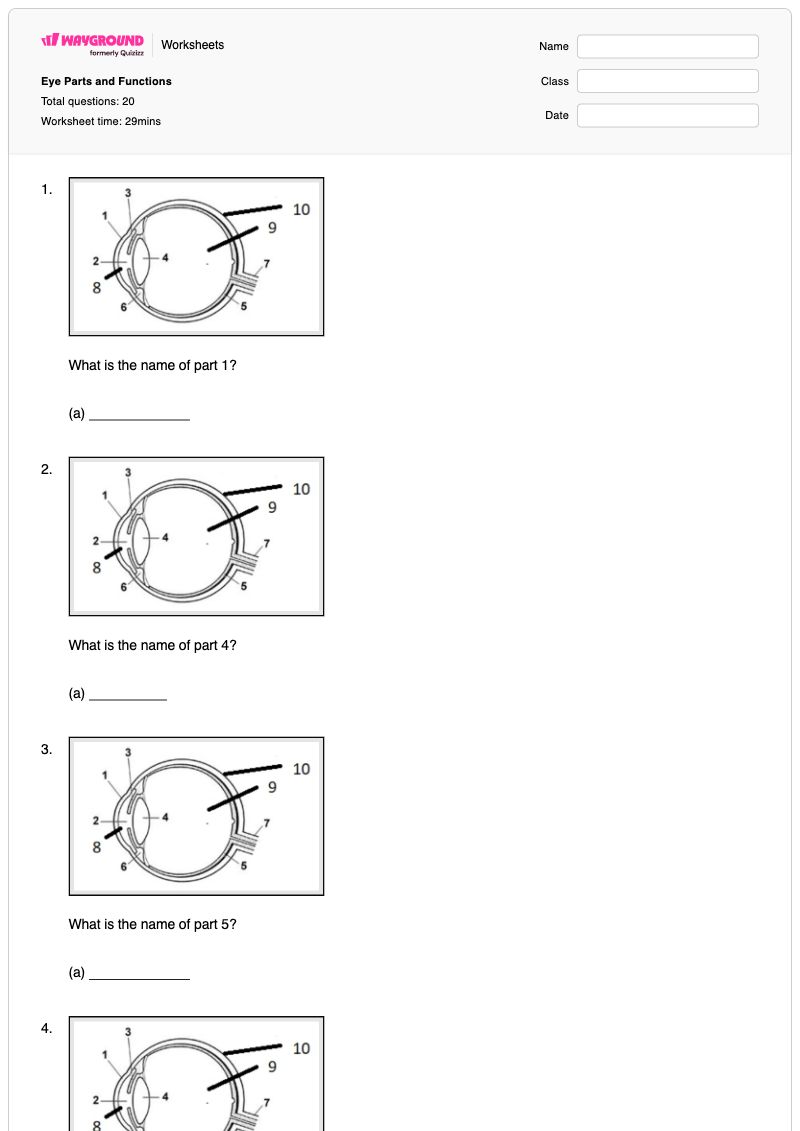
แบบฝึกหัดวิทยาศาสตร์สำหรับนักเรียนชั้นประถมศึกษาปีที่ 6 เรื่อง ส่วนประกอบและหน้าที่ของดวงตา ช่วยให้นักเรียนระบุโครงสร้างหลักของดวงตาและเชื่อมโยงแต่ละส่วนกับบทบาทในการมองเห็น แบบฝึกหัดประกอบด้วยคำถาม 20 ข้อ แบ่งเป็นแบบเติมคำในช่องว่าง 9 ข้อ และแบบเลือกตอบ 11 ข้อ นักเรียนจะต้องระบุหมายเลขของส่วนต่างๆ ของดวงตา เช่น กระจกตา เลนส์ จอประสาทตา เส้นประสาทตา ส่วนตาขาว และม่านตา จากนั้นนำความรู้ไปประยุกต์ใช้กับการควบคุมแสง การหักเหของแสง เซลล์รูปแท่งและรูปกรวย และการส่งสัญญาณไปยังสมอง แบบฝึกหัดนี้ยังตรวจสอบความเข้าใจเกี่ยวกับวิธีการเปลี่ยนแปลงรูปร่างของเลนส์เมื่อโฟกัสวัตถุที่อยู่ไกล การเปลี่ยนแปลงของน้ำวุ้นตาที่ส่งผลต่อจอประสาทตา และความสัมพันธ์ระหว่างการมองเห็นปกติและต้อกระจกกับการทำงานของดวงตา ใช้แบบฝึกหัดที่พิมพ์ได้ฟรีนี้ในการสอนวิทยาศาสตร์ชั้นประถมศึกษาปีที่ 6 การฝึกฝนด้วยตนเอง การทบทวน หรือการประเมินผล มีเฉลยคำตอบครบถ้วนเพื่อการตรวจสอบและให้ข้อเสนอแนะอย่างมีประสิทธิภาพ

การตั้งค่าแผ่นงาน

ขนาดตัวอักษร

S
M
L
XL
Waygroundแผ่นงาน

Eye Parts and Functions

คำถามทั้งหมด: 20

ชื่อ
ระดับ
วันที่
1.
What is the name of part 1?

What is the name of part 1?

(a)  

2.
What is the name of part 4?

What is the name of part 4?

(a)  

3.
What is the name of part 5?

What is the name of part 5?

(a)  

4.
What is the name of part 7?

What is the name of part 7?

(a)  

5.
What is the name of part 10?

What is the name of part 10?

(a)  

6.
What is the name of the bluish green part surrounding the pupil?

What is the name of the bluish green part surrounding the pupil?

(a)  

7.
Which two parts control the amount of light entering your eye?

Which two parts control the amount of light entering your eye?

a)

lens and cornea

b)

cornea and pupil

c)

pupil and iris

d)

retina and optic nerve

8.
Which two parts refract light entering your eye?

Which two parts refract light entering your eye?

a)

lens and cornea

b)

cornea and pupil

c)

pupil and iris

d)

retina and optic nerve

9.
Which eye part contains rods and cones to help us see in dim light and color?

Which eye part contains rods and cones to help us see in dim light and color?

a)

Sclera

b)

Lens

c)

Cornea

d)

Retina

10.
Which eye part carries the electrical signal from the retina to the brain so you can interpret the image?

Which eye part carries the electrical signal from the retina to the brain so you can interpret the image?

(a)  

11.
What is the most common form of blindness in people over the age of 40?

What is the most common form of blindness in people over the age of 40?

a)

cancer

b)

glaucoma

c)

pink eye

d)

cataracts

12.
What happens to the lens in your eye when you focus on something distant?

What happens to the lens in your eye when you focus on something distant?

a)

The lens stays the same shape

b)

The lens becomes wider in the middle

c)

The lens becomes more flattened

d)

The lens becomes softer

13.
"Floaters" can occur in your eye when the consistency of the _________ __________ changes and parts of it tear away.

"Floaters" can occur in your eye when the consistency of the _________ __________ changes and parts of it tear away.

(a)  

14.
When the consistency of the vitreous humor changes, it could cause your to tear or detach.

When the consistency of the vitreous humor changes, it could cause your (a)   to tear or detach.

15.
What is it called when light rays converge and focus on the retina?

What is it called when light rays converge and focus on the retina?

a)

nearsightedness

b)

Farsightedness

c)

Normal Vision

d)

Blindness

16.
What is it called when light rays converge beyond the retina (eyeball is too short?)

What is it called when light rays converge beyond the retina (eyeball is too short?)

a)

Normal Vision

b)

Nearsightedness

c)

Blindness

d)

Farsightedness

17.
What is it called when light rays converge too soon before they reach the retina? (Eyeball is too long.)

What is it called when light rays converge too soon before they reach the retina? (Eyeball is too long.)

a)

Blindness

b)

Nearsightedness

c)

Farsightedness

d)

Normal Vision

18.
The eye operates very similar to the way a _________works.

The eye operates very similar to the way a _________works.

a)

Telescope

b)

Microscope

c)

Stethoscope

d)

Camera

19.
Which pupil represents someone who is in a dim or dark setting?

Which pupil represents someone who is in a dim or dark setting?

a)

A

b)

B

20.
What causes optical illusions?

What causes optical illusions?

a)

The lens

b)

The retina

c)

The brain

d)

The optic nerve

Waygroundแป้นคำตอบ

Eye Parts and Functions

คำถามทั้งหมด: 20

1.
cornea
2.
lens
3.
retina
4.
optic nerve
5.
sclera
6.
iris
7.
c)

pupil and iris

8.
a)

lens and cornea

9.
d)

Retina

10.
optic nerve
11.
d)

cataracts

12.
c)

The lens becomes more flattened

13.
vitreous humor
14.
retina
15.
c)

Normal Vision

16.
d)

Farsightedness

17.
b)

Nearsightedness

18.
d)

Camera

19.
a)

A

20.
c)

The brain

คำถามที่พบบ่อย

แบบฝึกหัดเรื่องส่วนประกอบและหน้าที่ของดวงตาครอบคลุมหัวข้ออะไรบ้าง?

แบบฝึกหัดวิทยาศาสตร์สำหรับนักเรียนชั้นประถมศึกษาปีที่ 6 นี้ ฝึกฝนการระบุโครงสร้างของดวงตาจากคำถามที่กำหนดหมายเลข และจับคู่กับหน้าที่การทำงานของแต่ละส่วน แบบฝึกหัดประกอบด้วย 20 ข้อ—แบบเติมคำในช่องว่าง 9 ข้อ และแบบเลือกตอบ 11 ข้อ—ซึ่งเน้นเรื่องกระจกตา เลนส์ ม่านตา รูม่านตา จอประสาทตา เส้นประสาทตา ตาขาว น้ำวุ้นตา การหักเหของแสง การควบคุมแสง และสัญญาณการมองเห็น

ฉันจะใช้แบบฝึกหัดนี้ในการสอนเรื่องส่วนต่างๆ ของดวงตาและหน้าที่ของมันได้อย่างไร?

เริ่มต้นด้วยการทบทวนหมายเลขกำกับส่วนต่างๆ ของดวงตา แล้วให้นักเรียนระบุโครงสร้างต่างๆ เช่น กระจกตา เลนส์ จอประสาทตา เส้นประสาทตา และส่วนตาขาว จากนั้นใช้แบบทดสอบแบบเลือกตอบเพื่ออธิบายว่าม่านตาและรูม่านตาควบคุมแสงที่เข้ามาอย่างไร กระจกตาและเลนส์หักเหแสงอย่างไร และจอประสาทตาและเส้นประสาทตาช่วยในการตีความภาพอย่างไร จบด้วยการอภิปรายเกี่ยวกับการเปลี่ยนแปลงรูปร่างของเลนส์และภาวะต่างๆ ของดวงตาที่อยู่ในแบบฝึกหัด

ฉันควรระวังข้อผิดพลาดอะไรบ้างเมื่อนักเรียนทำแบบฝึกหัดกายวิภาคของดวงตาชุดนี้?

นักเรียนอาจสับสนระหว่างม่านตาและรูม่านตา แม้ว่าในแบบฝึกหัดจะระบุว่าทั้งสองส่วนนี้ควบคุมปริมาณแสงที่เข้าสู่ดวงตาเหมือนกันก็ตาม นอกจากนี้ พวกเขาอาจสับสนระหว่างกระจกตาและเลนส์ว่าเป็นส่วนที่หักเหแสง หรือสับสนระหว่างเรตินาซึ่งประกอบด้วยเซลล์รูปแท่งและเซลล์รูปกรวย กับเส้นประสาทตาซึ่งส่งสัญญาณไฟฟ้าไปยังสมอง ตรวจสอบคำตอบในช่องว่างว่าถูกต้องหรือไม่ และตรวจสอบความสับสนระหว่างน้ำวุ้นตาและเรตินาในหัวข้อเกี่ยวกับจุดลอยในตาและภาวะจอประสาทตาหลุดลอก

ฉันจะมอบหมายและตรวจงานแบบฝึกหัดเรื่องส่วนประกอบและหน้าที่ของดวงตาได้อย่างไร?

คุณสามารถมอบหมายแบบฝึกหัดนี้เป็นไฟล์ PDF ที่พิมพ์ได้ หรือเป็นแบบทดสอบดิจิทัลบน Wayground ก็ได้ และแบบฝึกหัดนี้มีเฉลยคำตอบครบถ้วนสำหรับทั้ง 20 ข้อ การส่งงานแบบพิมพ์ได้สามารถตรวจได้โดยการสแกนงานของนักเรียนด้วยแอป Wayground for Teachers รูปแบบที่พิมพ์ได้ยังช่วยสนับสนุนห้องเรียนที่ลดเวลาการใช้หน้าจอได้อีกด้วย

ฉันจะปรับแบบฝึกหัดเรื่องส่วนต่างๆ ของดวงตาให้เหมาะสมกับนักเรียนของฉันได้อย่างไร?

ใช้การตั้งค่าขั้นสูงของแบบฝึกหัดเพื่อปรับระยะห่างระหว่างตัวอักษรหรือขนาดตัวอักษร เพื่อให้คำถามระบุหมายเลขและตัวเลือกคำตอบอ่านง่ายขึ้น นอกจากนี้ คุณยังสามารถใช้แบบอักษรที่เหมาะสำหรับผู้ที่มีภาวะดิสเล็กเซีย หรือแปลแบบฝึกหัดเป็นภาษาอื่นเพื่อช่วยให้เข้าถึงคำถามแบบเติมคำในช่องว่างและคำถามแบบเลือกตอบได้ง่ายขึ้น

ฉันจะหาแบบฝึกหัดแบบนี้เพิ่มเติมได้ที่ไหนบน Wayground?

Wayground นำเสนอชุดแบบฝึกหัดและโจทย์ฝึกหัดฟรีที่ครอบคลุมหลากหลายวิชา พร้อมไฟล์ PDF และเฉลยคำตอบ เพื่อช่วยให้นักเรียนเชี่ยวชาญทักษะและแนวคิดที่สำคัญ ดูแหล่งข้อมูลเพิ่มเติมได้ที่ https://wayground.com/en-us/worksheets
