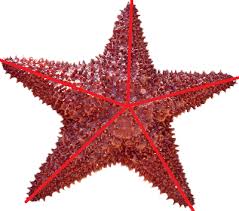

What type of symmetry is displayed in the picture?
a)
asymmetry
b)
bilateral symmetry
c)
radial symmetry
d)
photosynthesis
5.
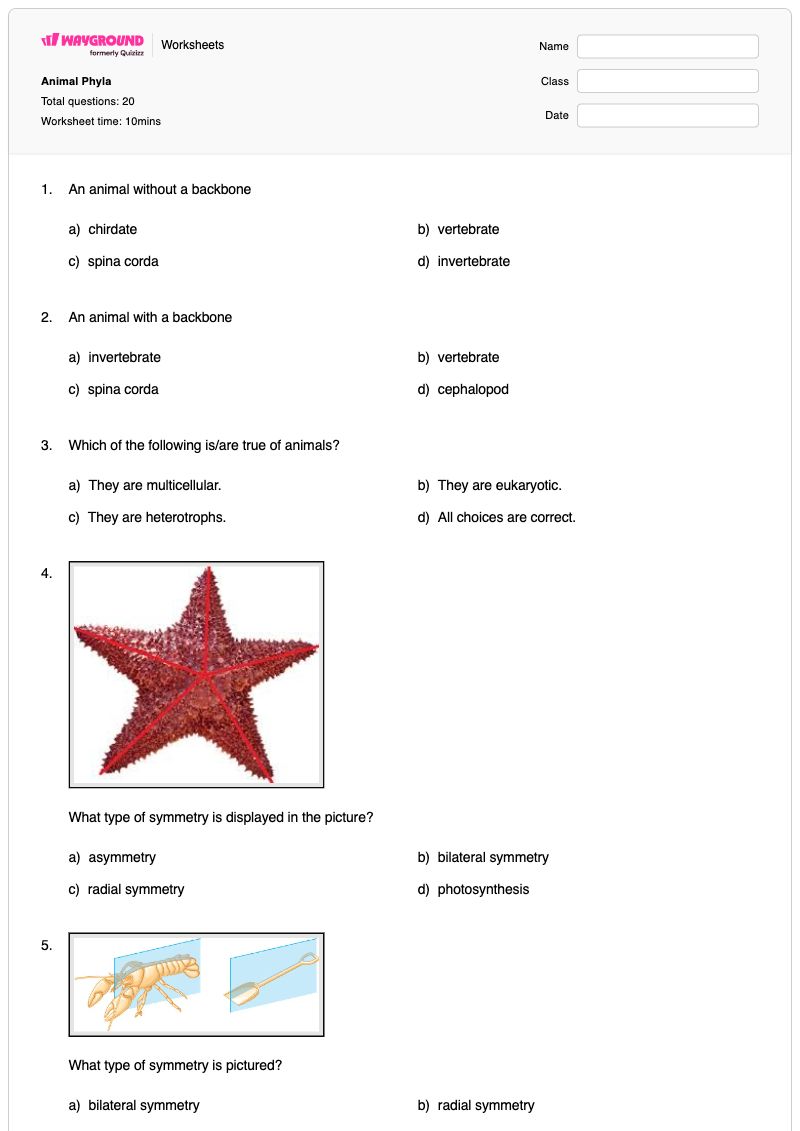
What type of symmetry is pictured?
a)
bilateral symmetry
b)
radial symmetry
c)
asymmetry
d)
cellular respiration
6.
Which animal (such as Reptiles and Amphibians) cannot regulate their own body temperature? (hint: often called as cold-blooded)
a)
endothermic
b)
ectothermic
c)
endoskeleton
d)
exoskeleton
7.
What kind of skeletons does the following animals have: Birds, snakes, frog and fish.
a)
Exoskeleton
b)
Endoskeleton
8.
What kind of skeleton does the following animals have?
Spider, cricket and scorpion.
a)
Endoskeleton
b)
Exoskeleton
9.
Organisms, like sponges, lacking body tissues and body symmetry belong to which of the following phyla?
a)
Cnidaria
b)
Mollusca
c)
Nematoda
d)
Porifera
10.
This phylum has a medusa and polyp stage, stinging tentacles, and radial symmetry. What phyla is it?
a)
Arthropods
b)
Annelids
c)
Cnidarian
d)
Echinoderms
e)
Mollusks
11.
Identify this animal.
a)
Porifera
b)
Cnidaria
c)
Platyhelminthes
d)
Nematoda
12.
Which phylum includes hookworms, pinworms, and heart worms? They are also known as roundworms, and many are parasites.
a)
Platyhelminthes
b)
Nematoda
c)
Annelida
13.
Animals with a hard, spiny, outer body covering, and radial symmetry, that live in marine environments are part of which phylum?
a)
echinoderms
b)
cnidarians
c)
annelids
d)
arthropods
14.
Animals that have no backbone, segmented bodies, and bilateral symmetry, that can live in either land or marine environments are part of which phylum?
a)
arthropods
b)
cnidarians
c)
chordates
d)
annelids
15.
Animals with soft bodies that are sometimes protected by a shell, but other times are not, and can live either on land or in water are part of which phylum?
a)
echinoderms
b)
mollusks
c)
annelids
d)
chordates
16.
Animals that have a backbone belong in which phylum?
a)
cnidarians
b)
mollusks
c)
arthropods
d)
chordates
17.
Which animal phylum does this organism belong to?
a)
echinoderms
b)
cnidarians
c)
arthropods
d)
mollusks
18.
Which organisms are classified in the class Amphibia?