

Wayground
Unit 2 Lesson 1 Formation of the Solar System - Printable ศาสตร์ Worksheets ระดับ 6 - Wayground

Unit 2 Lesson 1 Formation of the Solar System

Carrie Casey

สร้างโดย Carrie Casey

16 คำถาม

6th ระดับชั้น

ศาสตร์

อัปเดตแล้ว ก.ย. 2569

แบบฝึกหัดวิทยาศาสตร์สำหรับนักเรียนชั้นประถมศึกษาปีที่ 6 บทที่ 1 การก่อตัวของระบบสุริยะ ช่วยให้นักเรียนอธิบายว่าระบบสุริยะก่อตัวขึ้นได้อย่างไร และโครงสร้างของระบบสุริยะสะท้อนกระบวนการนั้นอย่างไร แบบฝึกหัดประกอบด้วย 16 ข้อ—คำถามแบบเลือกตอบ 15 ข้อ และคำถามแบบเลือกคำตอบ 1 ข้อ—นักเรียนจะได้ระบุเนบิวลาสุริยะ เรียงลำดับขั้นตอนการก่อตัวที่สำคัญ เชื่อมโยงแรงโน้มถ่วงของดวงอาทิตย์กับวงโคจรของดาวเคราะห์ และอธิบายว่าทำไมดาวเคราะห์ชั้นนอกจึงมีดวงจันทร์มากกว่า และทำไมดาวเคราะห์แก๊สและดาวเคราะห์น้ำแข็งจึงอยู่ไกลจากดวงอาทิตย์มากกว่า นอกจากนี้ นักเรียนยังใช้หลักฐานและการสังเกตการณ์ทางดาราศาสตร์เพื่อระบุการหมุนของดวงอาทิตย์ ตระหนักถึงวิธีการที่นักวิทยาศาสตร์ศึกษาวัฏจักรชีวิตของดาวฤกษ์ ระบุดาวหางและดาวเคราะห์น้อยว่าเป็นวัสดุที่เหลือจากการก่อตัว และแยกแยะระบบดาวฤกษ์ออกจากระบบสุริยะของเรา แบบฝึกหัดที่พิมพ์ได้ฟรีนี้มีประโยชน์สำหรับการแนะนำหรือทบทวนแนวคิดการก่อตัวของระบบสุริยะในวิชาวิทยาศาสตร์ชั้นประถมศึกษาปีที่ 6 รวมถึงเฉลยคำตอบที่สมบูรณ์เพื่อตรวจสอบความเข้าใจของนักเรียนทั้งในส่วนของลำดับการก่อตัวและคำถามที่เกี่ยวข้องโดยอิงจากหลักฐาน

การตั้งค่าแผ่นงาน

ขนาดตัวอักษร

S
M
L
XL
Waygroundแผ่นงาน

Unit 2 Lesson 1 Formation of the Solar System

คำถามทั้งหมด: 16

ชื่อ
ระดับ
วันที่
1.
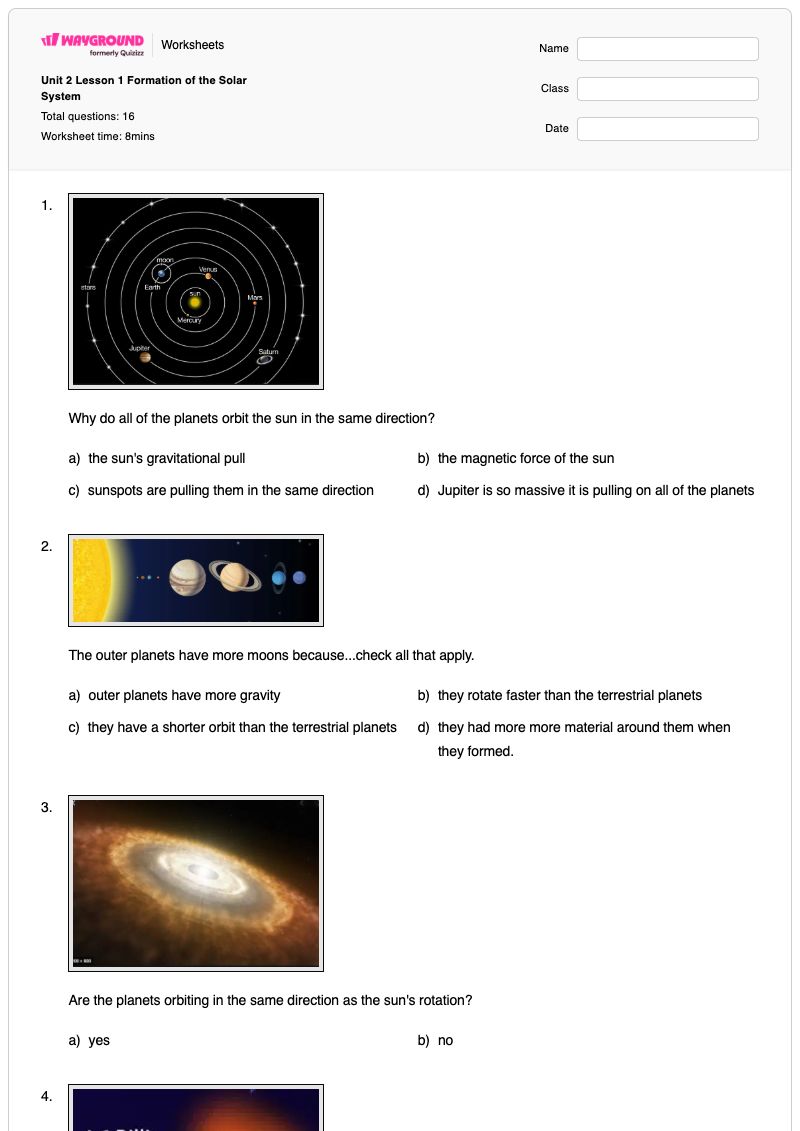
Why do all of the planets orbit the sun in the same direction?

Why do all of the planets orbit the sun in the same direction?

a)

the sun's gravitational pull

b)

the magnetic force of the sun

c)

sunspots are pulling them in the same direction

d)

Jupiter is so massive it is pulling on all of the planets

2.
The outer planets have more moons because...check all that apply.

The outer planets have more moons because...check all that apply.

a)

outer planets have more gravity

b)

they rotate faster than the terrestrial planets

c)

they have a shorter orbit than the terrestrial planets

d)

they had more more material around them when they formed.

3.
Are the planets orbiting in the same direction as the sun's rotation?

Are the planets orbiting in the same direction as the sun's rotation?

a)

yes

b)

no

4.
What is a solar nebula?

What is a solar nebula?

a)

the place where comets go when they move through the solar system

b)

clouds of dust & gas that formed the solar system

c)

protoplanets

d)

the finished solar system we see today

5.

What is the 1st step in the formation of the solar system?

a)
What is the 1st step in the formation of the solar system?
b)
What is the 1st step in the formation of the solar system?
c)
What is the 1st step in the formation of the solar system?
d)
What is the 1st step in the formation of the solar system?
6.

What is the 2nd step in the formation of the solar system?

a)
What is the 2nd step in the formation of the solar system?
b)
What is the 2nd step in the formation of the solar system?
c)
What is the 2nd step in the formation of the solar system?
d)
What is the 2nd step in the formation of the solar system?
7.

What is the 3rd step in the formation of the solar system?

a)
What is the 3rd step in the formation of the solar system?
b)
What is the 3rd step in the formation of the solar system?
c)
What is the 3rd step in the formation of the solar system?
d)
What is the 3rd step in the formation of the solar system?
8.

What is the 4th step in the formation of the solar system?

a)
What is the 4th step in the formation of the solar system?
b)
What is the 4th step in the formation of the solar system?
c)
What is the 4th step in the formation of the solar system?
d)
What is the 4th step in the formation of the solar system?
9.

What is the final step in the formation of the solar system?

a)
What is the final step in the formation of the solar system?
b)
What is the final step in the formation of the solar system?
c)
What is the final step in the formation of the solar system?
d)
What is the final step in the formation of the solar system?
10.
What evidence is there that the sun is rotating?

What evidence is there that the sun is rotating?

a)

scientists have observed sunspots on the sun

b)

scientists have observed that the sun tends to move around a lot

c)

by the rovers that have been put on the sun

d)

by the astronauts who have landed on the sun

11.
By observing stars, scientists can predict the life cycle of a star.

By observing stars, scientists can predict the life cycle of a star.

a)

true

b)

false

12.
Why are the gas and ice giants so far from the sun?

Why are the gas and ice giants so far from the sun?

a)

ice giants would melt and gas giants would not have formed

b)

they are too big to be by the sun

c)

the gravitational pull would have sucked them in

d)

they pulled away from the sun because they are so big

13.
How long ago did the Solar System form?

How long ago did the Solar System form?

a)

1 year ago

b)

10 years ago

c)

500 million years ago

d)

4.5 billion years ago

14.
What other objects formed from left over remains of the solar systems formation?

What other objects formed from left over remains of the solar systems formation?

a)

planets

b)

dwarf planets

c)

comets and asteroids

d)

dust and gas

15.
What is a star system?

What is a star system?

a)

comets and asteroids

b)

our sun and planets

c)

dust and gas

d)

other groupings of a star and orbiting planets

16.
Where in the solar system are most gases found other than the sun?

Where in the solar system are most gases found other than the sun?

a)

the terrestrial planets or inner planets

b)

the Jovian planets or outer planets

c)

on the moon trapped in the soil

d)

the asteroid belt or Kuiper belt & dwarf planets

Waygroundแป้นคำตอบ

Unit 2 Lesson 1 Formation of the Solar System

คำถามทั้งหมด: 16

1.
a)

the sun's gravitational pull

2.
a)

outer planets have more gravity

3.
a)

yes

4.
b)

clouds of dust & gas that formed the solar system

5.
b)
6.
c)
7.
a)
8.
d)
9.
a)
10.
a)

scientists have observed sunspots on the sun

11.
a)

true

12.
a)

ice giants would melt and gas giants would not have formed

13.
d)

4.5 billion years ago

14.
c)

comets and asteroids

15.
d)

other groupings of a star and orbiting planets

16.
b)

the Jovian planets or outer planets

คำถามที่พบบ่อย

แบบฝึกหัดเรื่องการก่อตัวของระบบสุริยะนี้ช่วยให้นักเรียนเรียนรู้อะไรบ้าง?

แบบฝึกหัดวิทยาศาสตร์สำหรับนักเรียนชั้นประถมศึกษาปีที่ 6 นี้ ประกอบด้วยคำถามแบบเลือกตอบ 15 ข้อ และคำถามแบบเลือกคำตอบหลายข้ออีก 1 ข้อ เพื่อประเมินการพัฒนาของเนบิวลาสุริยะไปสู่ระบบสุริยะ นักเรียนจะต้องเรียงลำดับขั้นตอนการก่อตัว อธิบายบทบาทของแรงโน้มถ่วงของดวงอาทิตย์ที่มีต่อวงโคจรของดาวเคราะห์ เชื่อมโยงตำแหน่งของดาวเคราะห์กับองค์ประกอบ และระบุหลักฐานต่างๆ เช่น จุดบนดวงอาทิตย์ ที่แสดงให้เห็นว่าดวงอาทิตย์หมุนรอบตัวเอง

ฉันจะใช้แบบฝึกหัดนี้ในการสอนเรื่องการก่อตัวของระบบสุริยะได้อย่างไร?

แนะนำแบบจำลองเนบิวลาสุริยะก่อนที่นักเรียนจะตอบคำถามเกี่ยวกับขั้นตอนการก่อตัวขั้นที่หนึ่ง สอง สาม สี่ และขั้นสุดท้าย หลังจากนักเรียนทำเสร็จแล้ว ให้พวกเขาอธิบายเหตุผลของคำตอบเกี่ยวกับทิศทางการโคจรที่ใช้ร่วมกัน จำนวนดวงจันทร์ที่มากกว่ารอบดาวเคราะห์ชั้นนอก และตำแหน่งของดาวเคราะห์แก๊สและน้ำแข็งยักษ์ โดยใช้หลักฐานจากแรงโน้มถ่วง วัสดุ และอุณหภูมิ ใช้ข้อสอบแบบเลือกตอบหลายข้อเป็นหัวข้อสนทนาสั้นๆ เกี่ยวกับเหตุผลที่อาจมีคำอธิบายมากกว่าหนึ่งข้อที่ใช้ได้

ฉันควรสังเกตข้อผิดพลาดอะไรบ้างเมื่อนักเรียนทำแบบฝึกหัดนี้เสร็จ?

นักเรียนอาจสับสนระหว่างแรงดึงดูดของดวงอาทิตย์กับแรงแม่เหล็ก จุดบนดวงอาทิตย์ หรือมวลของดาวพฤหัสบดี เมื่ออธิบายว่าทำไมดาวเคราะห์จึงโคจรไปในทิศทางเดียวกัน นอกจากนี้ พวกเขาอาจเลือกเหตุผลเพียงข้อเดียวในคำถามแบบเลือกตอบเกี่ยวกับดวงจันทร์ของดาวเคราะห์ชั้นนอก หรือสับสนระหว่างเนบิวลาสุริยะกับดาวเคราะห์ก่อนกำเนิดหรือระบบสุริยะที่สมบูรณ์แล้ว ตรวจสอบให้แน่ใจว่านักเรียนสามารถแยกแยะหลักฐานที่สังเกตได้ของการหมุน—จุดบนดวงอาทิตย์—ออกจากตัวเลือกที่ไม่ได้รับการสนับสนุนซึ่งเกี่ยวข้องกับนักบินอวกาศหรือยานสำรวจบนดวงอาทิตย์

ฉันจะมอบหมายและตรวจงานเรื่องการก่อตัวของระบบสุริยะนี้อย่างไร?

คุณสามารถมอบหมายแบบฝึกหัดนี้เป็นไฟล์ PDF ที่พิมพ์ได้ หรือเป็นแบบทดสอบดิจิทัลบน Wayground แบบฝึกหัดนี้มีเฉลยคำตอบครบถ้วน และสามารถตรวจให้คะแนนงานที่ส่งในรูปแบบไฟล์พิมพ์ได้โดยการสแกนงานของนักเรียนด้วยแอป Wayground for Teachers รูปแบบไฟล์พิมพ์ยังช่วยให้โรงเรียนมีตัวเลือกในการลดเวลาการใช้หน้าจอขณะที่นักเรียนฝึกฝนแนวคิดเกี่ยวกับการก่อตัวของระบบสุริยะ

ฉันจะปรับแบบฝึกหัดเรื่องการก่อตัวของระบบสุริยะนี้ให้เหมาะสมกับนักเรียนของฉันได้อย่างไร?

ใช้การตั้งค่าขั้นสูงของแบบฝึกหัดเพื่อปรับระยะห่างระหว่างตัวอักษรและขนาดตัวอักษร เพื่อให้ลำดับการก่อตัวและข้อสอบแบบเลือกตอบที่อิงตามหลักฐานอ่านง่ายขึ้น นอกจากนี้ คุณยังสามารถเปิดใช้งานแบบอักษรที่เหมาะสำหรับผู้ที่มีภาวะดิสเล็กเซีย หรือแปลแบบฝึกหัดเป็นภาษาอื่นได้ หากตัวเลือกเหล่านั้นช่วยให้เข้าถึงคำศัพท์และคำถามเกี่ยวกับระบบสุริยะได้ดีขึ้น

ฉันจะหาแบบฝึกหัดแบบนี้เพิ่มเติมได้ที่ไหนบน Wayground?

Wayground มีแบบฝึกหัดและโจทย์ฝึกหัดมากมายให้ดาวน์โหลดฟรีในหลากหลายวิชา พร้อมไฟล์ PDF และเฉลยคำตอบ เพื่อช่วยให้นักเรียนพัฒนาทักษะและความเข้าใจในแนวคิดสำคัญๆ ดูแหล่งข้อมูลเพิ่มเติมได้ที่ https://wayground.com/en-us/worksheets