

Wayground
Cell Transport - Printable Biology, Science Worksheets - Wayground

Cell Transport

20 คำถาม

9th - 9th ระดับชั้น

Biology, Science

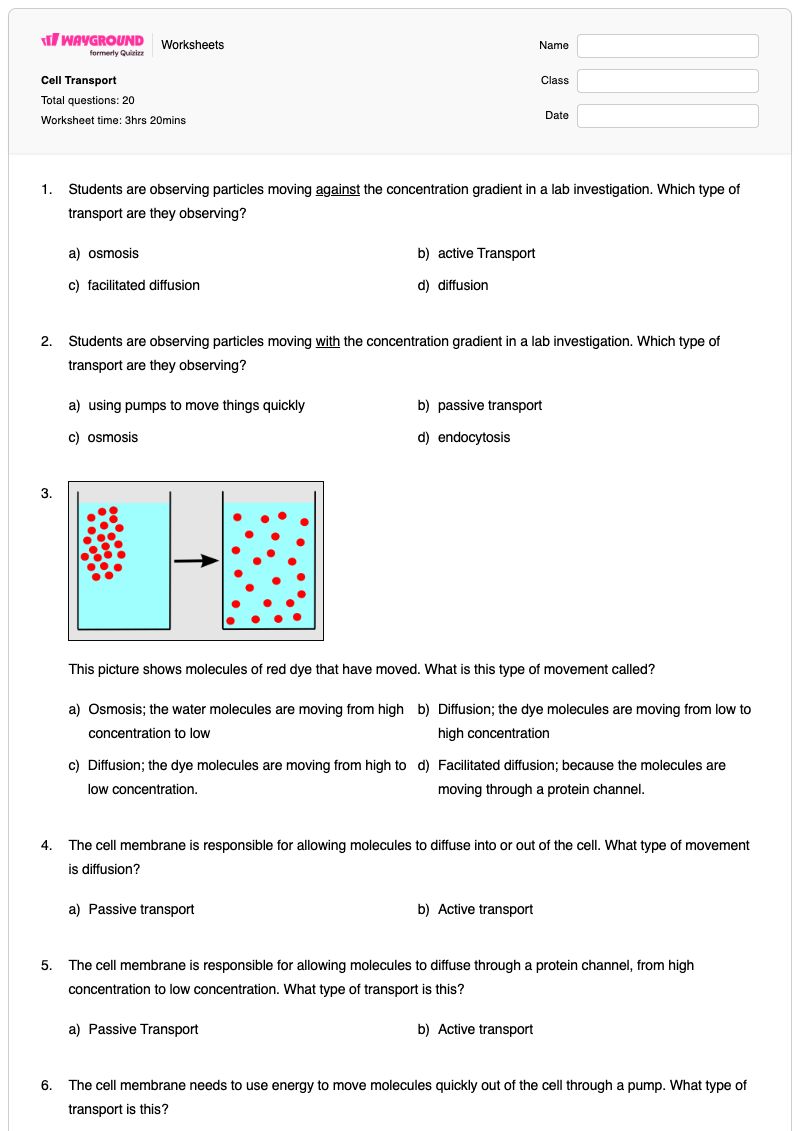
แบบฝึกหัดชีววิทยาสำหรับนักเรียนชั้น ม.3 เรื่องการขนส่งสารภายในเซลล์ ช่วยให้นักเรียนจำแนกวิธีการเคลื่อนที่ของสารผ่านเยื่อหุ้มเซลล์ แบบฝึกหัดนี้ประกอบด้วย 20 ข้อ—18 ข้อเป็นแบบเลือกตอบ และ 2 ข้อเป็นแบบเลือกตอบหลายข้อ—ช่วยให้นักเรียนแยกแยะความแตกต่างระหว่างการขนส่งแบบแอคทีฟและการขนส่งแบบพาสซีฟ ระบุการแพร่ การออสโมซิส และการแพร่แบบอำนวยความสะดวก และตีความการเคลื่อนที่ที่สัมพันธ์กับความเข้มข้น หลายข้อใช้ภาพประกอบของโมเลกุลและเซลล์เพื่อเชื่อมโยงคำศัพท์เกี่ยวกับการขนส่งกับกระบวนการที่เกิดขึ้นในเยื่อหุ้มเซลล์ แบบฝึกหัดนี้ยังให้นักเรียนระบุสารละลายไอโซโทนิก ไฮโปโทนิก และไฮเปอร์โทนิก ในสถานการณ์ของเซลล์พืชและสัตว์ และตระหนักถึงวิธีที่ผนังเซลล์ช่วยป้องกันไม่ให้เซลล์พืชที่เต่งตึงแตก แบบฝึกหัดนี้มีประโยชน์สำหรับการแนะนำหรือทบทวนเรื่องการขนส่งสารภายในเซลล์ และตรวจสอบว่านักเรียนสามารถนำคำจำกัดความไปใช้กับแผนภาพ การสังเกตในห้องปฏิบัติการ และคำอธิบายของสารละลายได้หรือไม่ แบบฝึกหัดที่พิมพ์ได้ฟรีนี้มีเฉลยคำตอบครบถ้วน และยังมีให้ใช้งานในรูปแบบแบบทดสอบดิจิทัลบน Wayground ด้วย

การตั้งค่าแผ่นงาน

ขนาดตัวอักษร

S
M
L
XL
แผ่นงาน

Cell Transport

คำถามทั้งหมด: 20

ชื่อ
ระดับ
วันที่
1.

Students are observing particles moving against the concentration gradient in a lab investigation. Which type of transport are they observing?

a)

osmosis

b)

active Transport

c)

facilitated diffusion

d)

diffusion

2.

Students are observing particles moving with the concentration gradient in a lab investigation. Which type of transport are they observing?

a)

using pumps to move things quickly

b)

passive transport

c)

osmosis

d)

endocytosis

3.

This picture shows molecules of red dye that have moved. What is this type of movement called?

a)

Osmosis; the water molecules are moving from high concentration to low

b)

Diffusion; the dye molecules are moving from low to high concentration

c)

Diffusion; the dye molecules are moving from high to low concentration.

d)

Facilitated diffusion; because the molecules are moving through a protein channel.

4.

The cell membrane is responsible for allowing molecules to diffuse into or out of the cell. What type of movement is diffusion?

a)

Passive transport

b)

Active transport

5.

The cell membrane is responsible for allowing molecules to diffuse through a protein channel, from high concentration to low concentration. What type of transport is this?

a)

Passive Transport

b)

Active transport

6.

The cell membrane needs to use energy to move molecules quickly out of the cell through a pump. What type of transport is this?

a)

Passive transport

b)

Active transport

7.

Passive transport is when molecules move ________ the concentration gradient.

a)

against

b)

up

c)

down

d)

with

8.

Active transport is when molecules move ________ the concentration gradient.

a)

against

b)

up

c)

down

d)

with

9.

This picture is a representation of what type of transport?

a)

Osmosis because it is diffusing through a protein from an area of high concentration to low concentration.

b)

Facilitated diffusion because it is diffusing through a protein from an area of high concentration to low concentration.

c)

Facilitated diffusion because it is diffusing through a protein from an area of low concentration to high concentration.

d)

Simple diffusion because it is diffusing through a protein from an area of high concentration to low concentration.

10.

This picture describes the movement of molecules across the cell membrane. Choose 2 answers that correctly describes the movement of the molecules.

a)

Molecules are moving up the concentration gradient.

b)

Molecules are moving from an area of low concentration to area of high concentration .

c)

Molecules are moving down the concentration gradient.

d)

Molecules are moving from an area of high concentration to area of low concentration.

11.

What do you think will not allow the turgid plant cell to burst?

a)

chloroplast

b)

cell membrane

c)

cell wall

d)

central vacuole

12.

This a picture of an animal and plant cell placed in a solution. Describe the solution?

a)

Isotonic

b)

Hypotonic

c)

Hypertonic

13.

This a picture of an animal and plant cell placed in a solution. Describe the solution?

a)

Isotonic

b)

Hypotonic

c)

Hypertonic

14.

What type of solution was this plant placed in?

a)

hypertonic

b)

isotonic

c)

hypotonic

15.

What type of solution was this plant placed in?

a)

hypotonic

b)

isotonic

c)

hypertonic

16.

A cell with a 10% salt solution; is placed in distilled water with 0% starch concentration. Water can travel across a semipermeable membrane but starch cannot. Would you expect to see after an hour?

a)

The solution inside the cell is hypotonic and moves into the cell.

b)

The solution inside the cell is hypertonic so the water moves into the cell.

c)

The solution inside the cell is hypotonic and moves out of the cell.

d)

The solution inside the cell is isotonic so the water doesn't move.

17.

Which cell do you think would be most ideal for maintaining homeostasis?

a)

The smallest cell because it would be more efficient to remove and obtains molecules

b)

The largest one because it would be able to obtain more food and store for longer periods of time.

c)

The largest one because it has more room to grow

d)

The medium cell because it would be more efficient to remove and obtains molecules

18.

What is the monomer for a lipid?

a)

monosaccharide

b)

glycerol and fatty acid

c)

amino acids

d)

nucleic acid

19.

What is the name of this macromolecule?

a)

protein

b)

carbohydrate

c)

lipid

d)

nucleic acid

20.

What is the main function of this macromolecule?

a)

Insolation, and components of the cell membrane

b)

quick energy

c)

structure muscles and growth.

d)

storage of genetic information

แป้นคำตอบ

Cell Transport

คำถามทั้งหมด: 20

1.
b)

active Transport

2.
b)

passive transport

, c)

osmosis

3.
c)

Diffusion; the dye molecules are moving from high to low concentration.

4.
a)

Passive transport

5.
a)

Passive Transport

6.
b)

Active transport

7.
d)

with

8.
a)

against

9.
b)

Facilitated diffusion because it is diffusing through a protein from an area of high concentration to low concentration.

10.
c)

Molecules are moving down the concentration gradient.

, d)

Molecules are moving from an area of high concentration to area of low concentration.

11.
c)

cell wall

12.
b)

Hypotonic

13.
c)

Hypertonic

14.
a)

hypertonic

15.
a)

hypotonic

16.
b)

The solution inside the cell is hypertonic so the water moves into the cell.

17.
a)

The smallest cell because it would be more efficient to remove and obtains molecules

18.
b)

glycerol and fatty acid

19.
c)

lipid

20.
a)

Insolation, and components of the cell membrane

คำถามที่พบบ่อย

แบบฝึกหัดการลำเลียงสารภายในเซลล์นี้ช่วยให้นักเรียนเรียนรู้อะไรบ้าง?

แบบฝึกหัดชีววิทยาสำหรับนักเรียนชั้น ม.3 นี้ ช่วยเสริมสร้างความสามารถของนักเรียนในการจำแนกการเคลื่อนที่ของเยื่อหุ้มเซลล์เป็นแบบ การขนส่งแบบแอคทีฟ การขนส่งแบบพาสซีฟ การแพร่ การออสโมซิส หรือการแพร่แบบอำนวยความสะดวก แบบฝึกหัดประกอบด้วยคำถามแบบเลือกตอบ 18 ข้อ และคำถามแบบเลือกคำตอบ 2 ข้อ ซึ่งจะทดสอบความสามารถของนักเรียนในการใช้ทิศทางความเข้มข้น การใช้พลังงาน ช่องโปรตีน และภาพจำลองเซลล์ เพื่อระบุถึงกระบวนการที่ถูกต้อง นอกจากนี้ นักเรียนยังจะได้ประยุกต์ใช้แนวคิดเหล่านี้กับสารละลายไอโซโทนิก ไฮโปโทนิก และไฮเปอร์โทนิก รวมถึงโครงสร้างของเซลล์พืชด้วย

ฉันจะใช้แบบฝึกหัดนี้ในการสอนเรื่องการลำเลียงสารภายในเซลล์ได้อย่างไร?

เริ่มแบบฝึกหัดโดยอธิบายความแตกต่างระหว่างการเคลื่อนที่ไปตามและสวนทางกับความเข้มข้น จากนั้นเชื่อมโยงการใช้พลังงานและช่องโปรตีนเข้ากับประเภทของการขนส่ง ให้นักเรียนอธิบายหลักฐานในแต่ละแผนภาพหรือการสังเกตในห้องปฏิบัติการก่อนเลือกคำตอบ โดยเฉพาะอย่างยิ่งเมื่อต้องแยกแยะความแตกต่างระหว่างออสโมซิส การแพร่ และการแพร่แบบอำนวยความสะดวก ใช้คำถามเกี่ยวกับสารละลายในเซลล์พืชและสัตว์เป็นการตรวจสอบการประยุกต์ใช้ขั้นสุดท้ายสำหรับสภาวะไอโซโทนิก ไฮโปโทนิก และไฮเปอร์โทนิก

ฉันควรระวังข้อผิดพลาดอะไรบ้างเมื่อนักเรียนทำแบบฝึกหัดการลำเลียงสารในเซลล์นี้?

นักเรียนอาจสับสนความหมายของคำว่า "ตาม" และ "สวนทางกับความเข้มข้น" หรือระบุว่าเป็น "การขนส่งแบบแอคทีฟ" โดยไม่สังเกตว่าเซลล์ใช้พลังงานหรือปั๊ม นอกจากนี้ พวกเขาอาจสับสนระหว่างออสโมซิสกับการแพร่ของโมเลกุลตัวถูกละลาย หรือระบุว่าการเคลื่อนที่ใดๆ ผ่านโปรตีนเป็นการขนส่งแบบแอคทีฟ แม้ว่าจะเคลื่อนที่จากความเข้มข้นสูงไปยังความเข้มข้นต่ำก็ตาม ในส่วนของแบบฝึกหัด ให้ตรวจสอบว่านักเรียนใช้แผนภาพเซลล์เพื่อแยกแยะสภาวะไฮเปอร์โทนิก ไฮโปโทนิก และไอโซโทนิก แทนที่จะเลือกจากเซลล์พืชหรือเซลล์สัตว์เพียงอย่างเดียว

ฉันจะมอบหมายและตรวจงานการลำเลียงสารในเซลล์นี้อย่างไร?

บน Wayground คุณสามารถมอบหมายงานเรื่องการเคลื่อนย้ายเซลล์เป็นไฟล์ PDF ที่พิมพ์ได้ หรือเป็นแบบทดสอบดิจิทัลก็ได้ แบบฝึกหัดนี้มีเฉลยคำตอบครบถ้วนสำหรับตรวจคำตอบแบบเลือกตอบ 18 ข้อ และแบบเลือกหลายคำตอบ 2 ข้อ และเมื่อส่งงานในรูปแบบที่พิมพ์ได้ นักเรียนสามารถส่งงานและสามารถตรวจได้โดยการสแกนงานของนักเรียนด้วยแอป Wayground for Teachers รูปแบบที่พิมพ์ได้ยังช่วยสนับสนุนโรงเรียนที่ต้องการลดเวลาการใช้หน้าจอได้อีกด้วย

ฉันจะปรับแบบฝึกหัดการลำเลียงสารในเซลล์นี้ให้เหมาะสมกับนักเรียนของฉันได้อย่างไร?

ใช้การตั้งค่าขั้นสูงของแบบฝึกหัดเพื่อปรับระยะห่างระหว่างตัวอักษรและขนาดตัวอักษร เพื่อให้แผนภาพการขนส่ง ตัวเลือกคำตอบ และคำอธิบายวิธีแก้ปัญหาอ่านง่ายขึ้น นอกจากนี้ คุณยังสามารถเปิดใช้งานแบบอักษรที่เหมาะสำหรับผู้ที่มีภาวะดิสเล็กเซีย หรือแปลแบบฝึกหัดเป็นภาษาอื่นโดยคงรูปแบบคำถามเกี่ยวกับการขนส่งเซลล์ไว้เหมือนเดิม

ฉันจะหาแบบฝึกหัดแบบนี้เพิ่มเติมได้ที่ไหนบน Wayground?

Wayground นำเสนอชุดแบบฝึกหัดและโจทย์ฝึกหัดฟรีที่ครอบคลุมหลากหลายวิชา พร้อมไฟล์ PDF และเฉลยคำตอบ เพื่อช่วยให้นักเรียนเชี่ยวชาญทักษะและแนวคิดที่สำคัญ ดูแหล่งข้อมูลเพิ่มเติมได้ที่ https://wayground.com/en-us/worksheets