
Wayground
Density Review - Printable ศาสตร์ Worksheets ระดับ 8 - Wayground

Density Review

Whitney Price

สร้างโดย Whitney Price

15 คำถาม

8th ระดับชั้น

ศาสตร์

อัปเดตแล้ว ส.ค. 2569

แบบฝึกหัดทบทวนเรื่องความหนาแน่นสำหรับนักเรียนชั้น ม.2 ประกอบด้วยคำถามแบบเลือกตอบ 15 ข้อ เน้นการคำนวณและการตีความความหนาแน่น นักเรียนจะได้ระบุหน่วยวัดมวลและปริมาตรที่ใช้ในการคำนวณความหนาแน่น เปรียบเทียบวัตถุที่มีมวลและปริมาตรต่างกัน คำนวณความหนาแน่นจากข้อมูลตัวเลข หาปริมาตรโดยการแทนที่น้ำ และหาปริมาตรของลูกบาศก์สี่เหลี่ยมผืนผ้า คำถามหลายข้อต้องการให้นักเรียนใช้ค่าความหนาแน่นที่คำนวณได้และแผนภูมิอ้างอิงเพื่อระบุสารหรือโลหะที่ไม่ทราบชนิด แบบฝึกหัดที่พิมพ์ได้ฟรีนี้ให้แบบฝึกหัดที่หลากหลายเกี่ยวกับการแก้ปัญหาความหนาแน่นที่เกี่ยวข้องกับวัตถุรูปทรงปกติและไม่ปกติ รวมถึงการวัดในหน่วยกรัม มิลลิลิตร และลูกบาศก์เซนติเมตร ช่วยให้ครูตรวจสอบว่านักเรียนสามารถใช้สูตรความหนาแน่น ลบปริมาตรเริ่มต้นออกจากปริมาตรสุดท้าย ใช้มิติในการหาปริมาตร และเชื่อมโยงผลลัพธ์กับตารางความหนาแน่นของวัสดุได้หรือไม่ มีเฉลยคำตอบให้เพื่อการทบทวนที่มีประสิทธิภาพ การฝึกฝนด้วยตนเอง การบ้าน หรือการประเมินวิชาวิทยาศาสตร์

การตั้งค่าแผ่นงาน

ขนาดตัวอักษร

S
M
L
XL
Waygroundแผ่นงาน

Density Review

คำถามทั้งหมด: 15

ชื่อ
ระดับ
วันที่
1.
What two types of measurements make up DENSITY? 
a)
Mass and Volume
b)
Temperature and Mass
c)
Grams and Centimeters
d)
Volume and Weight
2.
Jack has a rock. The rock has a mass of 14g and a volume of 2cm3. What is the density of the rock?
a)
7 mL
b)
7 g/cm3
c)
28 g/cm3
d)
1/7 g/cm3
3.
I have two objects with the same volume but different masses. Which object will be more dense?
I have two objects with the same volume but different masses.  Which object will be more dense?
a)
The object with less weight.
b)
The object with more weight.
c)
The object with more mass.
d)
The object with less mass.
4.
Which object has the highest density in this picture?

Which object has the highest density in this picture?

a)

A

b)

B

c)

C

5.
Which object has the lowest density in this picture?

Which object has the lowest density in this picture?

a)

A

b)

B

c)

C

6.
You calculated the density of an unknown substance to be 7.8g/cm 3 . According to the chart, which of the substances doe you…

You calculated the density of an unknown substance to be 7.8g/cm3. According to the chart, which of the substances doe you most likely have?

a)

Zinc

b)

Copper

c)

Tin

d)

Iron

7.
You calculated the density of an unknown substance to be 5.7g/cm 3 . According to the chart, which of the substances do you…

You calculated the density of an unknown substance to be 5.7g/cm3. According to the chart, which of the substances do you most likely have?

a)

Aluminum

b)

Iron

c)

Tin

d)

Zinc

8.
An irregular shaped object was placed in a graduated cylinder. The initial volume was 50mL. The final volume was 75mL. What…

An irregular shaped object was placed in a graduated cylinder. The initial volume was 50mL. The final volume was 75mL. What is the volume of the irregular shaped object?

a)

25mL

b)

125mL

c)

75mL

d)

50mL

9.
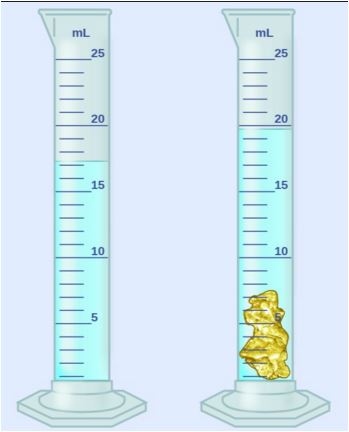
Calculate the density of the object below if it has a mass of 3g. (Hint: you need to find the volume.)

Calculate the density of the object below if it has a mass of 3g. (Hint: you need to find the volume.)

a)

60 g/cm3

b)

3 g/cm3

c)

20 g/cm3

d)

0.05 g/cm3

10.
An irregularly shaped piece of gold was lowered into a graduated cylinder holding a volume of water equal to 17 ml. The…
An irregularly shaped piece of gold was lowered into a graduated cylinder holding a volume of water equal to 17 ml. The height of the water rose to 20 ml. If the mass of the gold was 27 g, what was its density?
a)
9 g/mL
b)
10.5 g/mL
c)
6.5 g/mL
d)
8 g/mL
11.
Find the density of a 2 cm x 2 cm x 2 cm cube with a mass of 64 g.
a)
6 cm3
b)
12 g/cm3
c)
128 g/cm3
d)
8  g/cm3
12.

A 99 g object is dropped in water. The water level started at 30 mL and rose to 52 mL. What is its density?

a)

0.22 g/mL

b)

1.90 g/mL

c)

3.3 g/mL

d)

4.5 g/mL

13.

Calculate the density of an object with a mass of 240 g and a volume of 12 mL.

a)

20 g/mL

b)

0.05 g/mL

c)

252 g/mL

d)

2,800 g/mL

14.
A piece of unknown metal has a mass of 240 g and a volume of 23 mL. What is the metal most likely made of?

A piece of unknown metal has a mass of 240 g and a volume of 23 mL. What is the metal most likely made of?

a)

Aluminum

b)

Silver

c)

Lead

d)

Magnesium

15.
What metal do you have if you have a mass of 225 g and a volume of 21.4 cm 3 ?
What metal do you have if you have a mass of 225 g and a volume of 21.4 cm3?
a)
Zinc- 7.13 g/cm3
b)
Copper- 8.96 g/cm3
c)
Silver- 10.5 g/cm3
d)
Mercury- 13.55 g/cm3
Waygroundแป้นคำตอบ

Density Review

คำถามทั้งหมด: 15

1.
a) Mass and Volume
2.
b) 7 g/cm3
3.
c) The object with more mass.
4.
c)

C

5.
a)

A

6.
d)

Iron

7.
c)

Tin

8.
a)

25mL

9.
d)

0.05 g/cm3

10.
a) 9 g/mL
11.
d) 8  g/cm3
12.
d)

4.5 g/mL

13.
a)

20 g/mL

14.
b)

Silver

15.
c) Silver- 10.5 g/cm3

คำถามที่พบบ่อย

แบบฝึกหัดทบทวนความหนาแน่นครอบคลุมหัวข้ออะไรบ้าง?

แบบฝึกหัดวิทยาศาสตร์สำหรับนักเรียนชั้น ม.2 นี้ ประกอบด้วยคำถามแบบเลือกตอบ 15 ข้อ เพื่อเสริมสร้างทักษะเรื่องความหนาแน่น โดยครอบคลุมถึงมวล ปริมาตร และการระบุวัสดุ นักเรียนจะได้คำนวณความหนาแน่นของวัตถุรูปทรงปกติและไม่ปกติ หาปริมาตรโดยใช้กระบอกตวงหรือขนาดของลูกบาศก์ เปรียบเทียบความหนาแน่นสัมพัทธ์ และใช้แผนภูมิความหนาแน่นเพื่อระบุสารและโลหะที่ไม่ทราบชนิด

ฉันจะใช้แบบฝึกหัดนี้ในการสอนการคำนวณความหนาแน่นได้อย่างไร?

แนะนำความสัมพันธ์ระหว่างมวลและปริมาตรในเรื่องความหนาแน่น จากนั้นยกตัวอย่างโจทย์หนึ่งข้อที่ใช้การวัดโดยตรง และอีกข้อที่หาปริมาตรโดยการลบค่าเริ่มต้นของการอ่านค่าจากกระบอกตวงออกจากค่าสุดท้าย ให้นักเรียนอธิบายว่าทำไมวัตถุที่มีปริมาตรเท่ากันแต่มีมวลมากกว่าจึงมีความหนาแน่นมากกว่า ให้ทำแบบฝึกหัดด้วยตนเอง และอภิปรายว่าค่าที่คำนวณได้ตรงกับค่าในตารางอ้างอิงสำหรับวัสดุที่ไม่ทราบค่าอย่างไร

ฉันควรระวังข้อผิดพลาดอะไรบ้างเมื่อนักเรียนทำแบบฝึกหัดเรื่องความหนาแน่นนี้?

ระวังนักเรียนที่สับสนระหว่างมวลและปริมาตรในการคำนวณความหนาแน่น เลือกใช้ค่าที่อ่านได้จากกระบอกตวงครั้งสุดท้ายแทนที่จะใช้ปริมาตรที่ถูกแทนที่ หรือใช้ขนาดพื้นผิวของลูกบาศก์โดยไม่คำนวณปริมาตรก่อน นักเรียนอาจสับสนระหว่างความหนาแน่นกับมวล หรือเลือกวัสดุจากตารางก่อนที่จะเปรียบเทียบค่าที่คำนวณได้กับความหนาแน่นที่ระบุไว้

ฉันจะมอบหมายและให้คะแนนแบบฝึกหัดทบทวนความหนาแน่นได้อย่างไร?

แบบฝึกหัดทบทวนเรื่องความหนาแน่นมีให้ดาวน์โหลดในรูปแบบไฟล์ PDF ที่สามารถพิมพ์ได้ และเป็นแบบทดสอบดิจิทัลบน Wayground โดยมีเฉลยคำตอบครบถ้วนสำหรับคำถามแบบเลือกตอบทั้ง 15 ข้อ สำหรับการส่งงานแบบพิมพ์ คุณสามารถตรวจงานของนักเรียนได้โดยการสแกนด้วยแอป Wayground for Teachers

ฉันจะปรับแบบฝึกหัดเรื่องความหนาแน่นนี้ให้เหมาะสมกับนักเรียนของฉันได้อย่างไร?

ใช้การตั้งค่าขั้นสูงของแบบฝึกหัดเพื่อปรับระยะห่างระหว่างตัวอักษรหรือขนาดตัวอักษร เพื่อให้การคำนวณความหนาแน่น สถานการณ์เกี่ยวกับกระบอกตวง และตัวเลือกคำตอบอ่านง่ายขึ้น นอกจากนี้ คุณยังสามารถใช้แบบอักษรที่เหมาะสำหรับผู้ที่มีภาวะดิสเล็กเซีย หรือแปลแบบฝึกหัดทบทวนความหนาแน่นเป็นภาษาอื่นได้ เมื่อตัวเลือกเหล่านั้นช่วยให้เข้าถึงคำศัพท์ทางวิทยาศาสตร์และโจทย์ปัญหาทางคณิตศาสตร์ได้ง่ายขึ้น

ฉันจะหาแบบฝึกหัดแบบนี้เพิ่มเติมได้ที่ไหนบน Wayground?

Wayground นำเสนอชุดแบบฝึกหัดและโจทย์ฝึกหัดฟรีที่ครอบคลุมหลากหลายวิชา พร้อมไฟล์ PDF และเฉลยคำตอบ เพื่อช่วยเสริมสร้างทักษะและความเข้าใจในแนวคิดสำคัญ ดูแหล่งข้อมูลเพิ่มเติมได้ที่ https://wayground.com/en-us/worksheets