

Wayground
Historical Thinking - Printable สังคมศึกษา Worksheets 7th ระดับชั้น - Wayground

Historical Thinking

Christine Ceraolo

สร้างโดย Christine Ceraolo

17 คำถาม

7th ระดับชั้น

สังคมศึกษา

อัปเดตแล้ว พ.ค. 2568

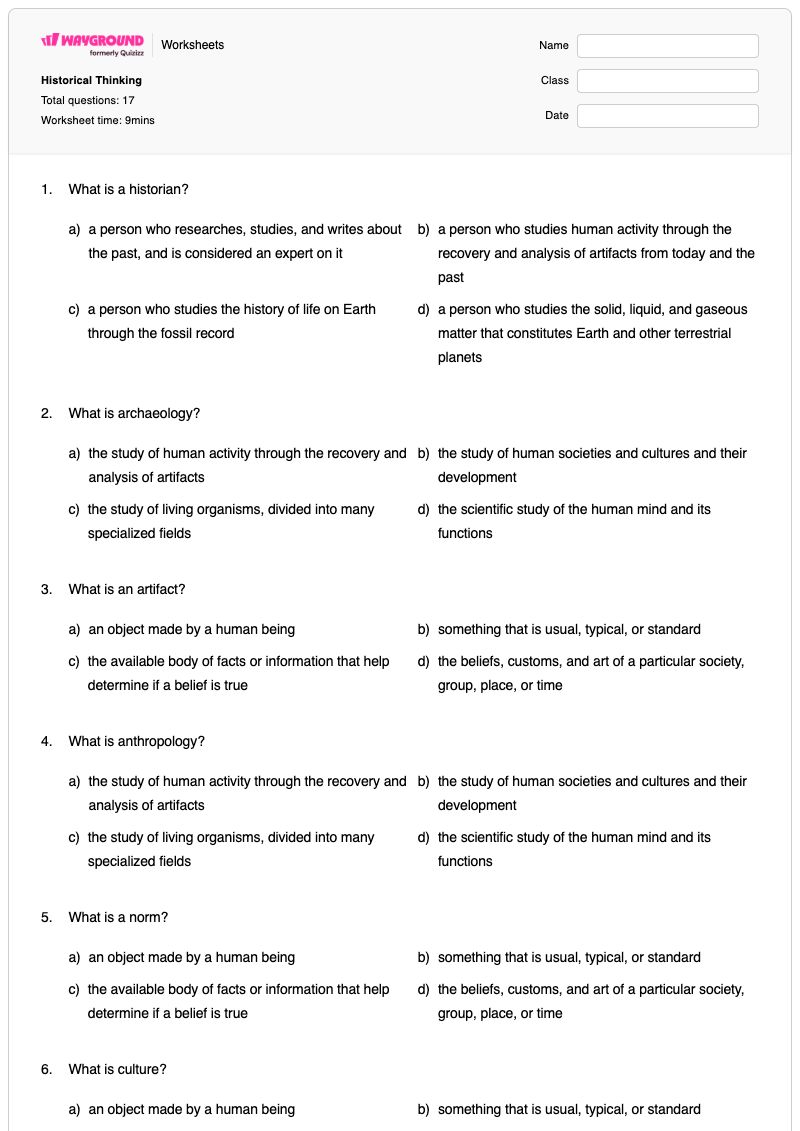
แบบฝึกหัดคำศัพท์วิชาสังคมศึกษา ชั้น ม.1 เรื่อง "การคิดเชิงประวัติศาสตร์" นี้ ช่วยแนะนำคำศัพท์ที่นักเรียนจำเป็นต้องใช้ในการศึกษาและตีความอดีต แบบฝึกหัดนี้ประกอบด้วยคำถามแบบเลือกตอบ 17 ข้อ นักเรียนจะได้ระบุบทบาทของนักประวัติศาสตร์ นักโบราณคดี และนักมานุษยวิทยา นิยามความหมายของสิ่งประดิษฐ์ บรรทัดฐาน วัฒนธรรม หลักฐาน และการตีความ แยกแยะแหล่งข้อมูลปฐมภูมิจากแหล่งข้อมูลทุติยภูมิ และรู้จักการอนุมาน อคติ ยุคสมัย ศตวรรษ และทศวรรษ แบบฝึกหัดนี้ช่วยให้นักเรียนสร้างพื้นฐานคำศัพท์เกี่ยวกับการคิดเชิงประวัติศาสตร์โดยการเลือกคำจำกัดความที่ถูกต้องจากตัวเลือกคำตอบที่เกี่ยวข้อง มีประโยชน์สำหรับการแนะนำคำศัพท์ ตรวจสอบความเข้าใจหลังการสอน หรือทบทวนแนวคิดก่อนที่นักเรียนจะวิเคราะห์แหล่งข้อมูลทางประวัติศาสตร์ แบบฝึกหัดที่พิมพ์ได้ฟรีนี้มีเฉลยคำตอบครบถ้วนเพื่อการตรวจสอบและอภิปรายความแตกต่างอย่างมีประสิทธิภาพ เช่น หลักฐานกับการอนุมาน และแหล่งข้อมูลปฐมภูมิกับแหล่งข้อมูลทุติยภูมิ

การตั้งค่าแผ่นงาน

ขนาดตัวอักษร

S
M
L
XL
Waygroundแผ่นงาน

Historical Thinking

คำถามทั้งหมด: 17

ชื่อ
ระดับ
วันที่
1.

What is a historian?

a)

a person who researches, studies, and writes about the past, and is considered an expert on it

b)

a person who studies human activity through the recovery and analysis of artifacts from today and the past

c)

a person who studies the history of life on Earth through the fossil record

d)

a person who studies the solid, liquid, and gaseous matter that constitutes Earth and other terrestrial planets

2.

What is archaeology?

a)

the study of human activity through the recovery and analysis of artifacts

b)

the study of human societies and cultures and their development

c)

the study of living organisms, divided into many specialized fields

d)

the scientific study of the human mind and its functions

3.

What is an artifact?

a)

an object made by a human being

b)

something that is usual, typical, or standard

c)

the available body of facts or information that help determine if a belief is true

d)

the beliefs, customs, and art of a particular society, group, place, or time

4.

What is anthropology?

a)

the study of human activity through the recovery and analysis of artifacts

b)

the study of human societies and cultures and their development

c)

the study of living organisms, divided into many specialized fields

d)

the scientific study of the human mind and its functions

5.

What is a norm?

a)

an object made by a human being

b)

something that is usual, typical, or standard

c)

the available body of facts or information that help determine if a belief is true

d)

the beliefs, customs, and art of a particular society, group, place, or time

6.

What is culture?

a)

an object made by a human being

b)

something that is usual, typical, or standard

c)

the available body of facts or information that help determine if a belief is true

d)

the beliefs, customs, and art of a particular society, group, place, or time

7.

What is evidence?

a)

an object made by a human being

b)

something that is usual, typical, or standard

c)

the available body of facts or information that help determine if a belief is true

d)

the beliefs, customs, and art of a particular society, group, place, or time

8.

What is an interpretation?

a)

an object made by a human being

b)

something that is usual, typical, or standard

c)

someone's understanding of a topic

d)

the beliefs, customs, and art of a particular society, group, place, or time

9.

What is a primary source?

a)

an artifact, a document, diary, manuscript, autobiography, a recording, or other source that was created at the time of study

b)

created later by someone who did not experience first-hand or participate in the events researched

c)

prejudice in favor of or against one thing, person, or group compared with another, usually in a way considered to be unfair

d)

an educated guess based on evidence & prior knowledge

10.

What is a secondary source?

a)

an artifact, a document, diary, manuscript, autobiography, a recording, or other source that was created at the time of study

b)

created later by someone who did not experience first-hand or participate in the events researched

c)

prejudice in favor of or against one thing, person, or group compared with another, usually in a way considered to be unfair

d)

an educated guess based on evidence & prior knowledge

11.

What is an inference?

a)

an artifact, a document, diary, manuscript, autobiography, a recording, or other source that was created at the time of study

b)

created later by someone who did not experience first-hand or participate in the events researched

c)

prejudice in favor of or against one thing, person, or group compared with another, usually in a way considered to be unfair

d)

an educated guess based on evidence & prior knowledge

12.

What is a bias?

a)

an artifact, a document, diary, manuscript, autobiography, a recording, or other source that was created at the time of study

b)

created later by someone who did not experience first-hand or participate in the events researched

c)

prejudice in favor of or against one thing, person, or group compared with another, usually in a way considered to be unfair

d)

an educated guess based on evidence & prior knowledge

13.

What is an era?

a)

a period of history with a particular feature or characteristic

b)

a period of ten years

c)

a period of a thousand years

d)

a period of a hundred years

14.

What is a century?

a)

a period of history with a particular feature or characteristic

b)

a period of ten years

c)

a period of a thousand years

d)

a period of a hundred years

15.

What is a decade?

a)

a period of history with a particular feature or characteristic

b)

a period of ten years

c)

a period of a thousand years

d)

a period of a hundred years

16.

What is a millennium?

a)

a period of history with a particular feature or characteristic

b)

a period of ten years

c)

a period of a thousand years

d)

a period of a hundred years

17.

What is a generalization?

a)

a period of history with a particular feature or characteristic

b)

a period of ten years

c)

a period of a thousand years

d)

assuming something about a group of people based on little information

Waygroundแป้นคำตอบ

Historical Thinking

คำถามทั้งหมด: 17

1.
a)

a person who researches, studies, and writes about the past, and is considered an expert on it

2.
a)

the study of human activity through the recovery and analysis of artifacts

3.
a)

an object made by a human being

4.
b)

the study of human societies and cultures and their development

5.
b)

something that is usual, typical, or standard

6.
d)

the beliefs, customs, and art of a particular society, group, place, or time

7.
c)

the available body of facts or information that help determine if a belief is true

8.
c)

someone's understanding of a topic

9.
a)

an artifact, a document, diary, manuscript, autobiography, a recording, or other source that was created at the time of study

10.
b)

created later by someone who did not experience first-hand or participate in the events researched

11.
d)

an educated guess based on evidence & prior knowledge

12.
c)

prejudice in favor of or against one thing, person, or group compared with another, usually in a way considered to be unfair

13.
a)

a period of history with a particular feature or characteristic

14.
d)

a period of a hundred years

15.
b)

a period of ten years

16.
c)

a period of a thousand years

17.
d)

assuming something about a group of people based on little information

คำถามที่พบบ่อย

แบบฝึกหัดการคิดเชิงประวัติศาสตร์ครอบคลุมเนื้อหาอะไรบ้าง?

แบบฝึกหัดวิชาสังคมศึกษา ชั้น ม.1 นี้ ประกอบด้วยคำถามแบบเลือกตอบ 17 ข้อ เพื่อช่วยเสริมสร้างคำศัพท์เกี่ยวกับการคิดเชิงประวัติศาสตร์ นักเรียนจะได้ระบุคำศัพท์ต่างๆ เช่น นักประวัติศาสตร์ โบราณคดี โบราณวัตถุ มานุษยวิทยา วัฒนธรรม หลักฐาน การตีความ แหล่งข้อมูลปฐมภูมิ แหล่งข้อมูลทุติยภูมิ การอนุมาน อคติ ยุคสมัย ศตวรรษ และทศวรรษ ซึ่งจะช่วยเสริมสร้างความสามารถในการแยกแยะแนวคิดที่เกี่ยวข้องที่ใช้ในการศึกษาประวัติศาสตร์

ฉันจะใช้แบบฝึกหัดนี้สอนคำศัพท์เกี่ยวกับการคิดเชิงประวัติศาสตร์ได้อย่างไร?

แนะนำคำศัพท์ต่างๆ เป็นกลุ่มเล็กๆ ก่อน เช่น บุคคลและสาขาวิชา แนวคิดทางวัฒนธรรม ประเภทของแหล่งข้อมูล คำศัพท์ที่ใช้ในการให้เหตุผล และช่วงเวลา ก่อนที่จะให้คำถามแบบเลือกตอบ ขอให้นักเรียนอธิบายว่าเหตุใดคำจำกัดความที่เลือกจึงเหมาะสม และเหตุใดตัวเลือกที่เกี่ยวข้องจึงไม่เหมาะสม โดยเฉพาะอย่างยิ่งเมื่อเปรียบเทียบหลักฐานกับการอนุมาน แหล่งข้อมูลปฐมภูมิกับแหล่งข้อมูลทุติยภูมิ และยุคสมัยกับศตวรรษหรือทศวรรษ

ฉันควรสังเกตข้อผิดพลาดอะไรบ้างเมื่อนักเรียนทำแบบฝึกหัดนี้เสร็จ?

นักเรียนอาจสับสนระหว่างโบราณคดีกับมานุษยวิทยา หรือระบุสิ่งประดิษฐ์ว่าเป็นข้อมูลทางประวัติศาสตร์ใดๆ แทนที่จะเป็นวัตถุที่มนุษย์สร้างขึ้น โปรดระวังการสลับกันระหว่างแหล่งข้อมูลปฐมภูมิและทุติยภูมิ ความสับสนระหว่างหลักฐานและการอนุมาน และการสับสนระหว่างยุคสมัยกับช่วงเวลาที่กำหนด เช่น ศตวรรษหรือทศวรรษ

ฉันจะมอบหมายและให้คะแนนแบบฝึกหัดการคิดเชิงประวัติศาสตร์ได้อย่างไร?

แบบฝึกหัดนี้มีให้ดาวน์โหลดในรูปแบบ PDF สำหรับพิมพ์ และเป็นแบบทดสอบดิจิทัลบน Wayground โดยมีเฉลยคำตอบครบถ้วน คุณสามารถตรวจงานที่ส่งมาในรูปแบบ PDF ได้โดยการสแกนงานของนักเรียนด้วยแอป Wayground for Teachers หรือใช้แบบทดสอบดิจิทัลเพื่อรวบรวมและตรวจงานทางออนไลน์

ฉันจะปรับแบบฝึกหัดคำศัพท์เกี่ยวกับการคิดเชิงประวัติศาสตร์นี้ให้เหมาะสมกับนักเรียนของฉันได้อย่างไร?

ใช้การตั้งค่าขั้นสูงของแบบฝึกหัดเพื่อปรับระยะห่างระหว่างตัวอักษรหรือเพิ่มขนาดตัวอักษร เพื่อให้นักเรียนสามารถอ่านและเปรียบเทียบคำจำกัดความแบบเลือกตอบได้ง่ายขึ้น นอกจากนี้ คุณยังสามารถเลือกแบบอักษรที่เหมาะสำหรับผู้ที่มีภาวะดิสเล็กเซีย หรือแปลคำถามคำศัพท์เป็นภาษาอื่นเพื่อช่วยให้เข้าใจคำศัพท์ต่างๆ เช่น การอนุมาน อคติ และแหล่งข้อมูลปฐมภูมิ ได้ดียิ่งขึ้น

ฉันจะหาแบบฝึกหัดแบบนี้เพิ่มเติมได้ที่ไหนบน Wayground?

Wayground นำเสนอชุดแบบฝึกหัดและโจทย์ฝึกหัดฟรีที่ครอบคลุมหลากหลายวิชา พร้อมไฟล์ PDF และเฉลยคำตอบ เพื่อช่วยเสริมสร้างทักษะและความเข้าใจในแนวคิดสำคัญ ดูแหล่งข้อมูลเพิ่มเติมได้ที่ https://wayground.com/en-us/worksheets