

Wayground
CER and Critical Thinking Review - Printable English Worksheets ระดับ 9 - Wayground

CER and Critical Thinking Review

15 คำถาม

9th - 9th ระดับชั้น

English

แบบฝึกหัด CER และการทบทวนการคิดเชิงวิพากษ์ เป็นแบบฝึกหัดภาษาอังกฤษระดับชั้น ม.3 ที่สามารถพิมพ์ได้ฟรี แบบฝึกหัดนี้ตรวจสอบความเข้าใจของนักเรียนเกี่ยวกับข้ออ้าง หลักฐาน และเหตุผล ในฐานะสูตรสำหรับการเขียนย่อหน้า แบบฝึกหัด 15 ข้อนี้ประกอบด้วยคำถามแบบเลือกตอบ 12 ข้อ และคำถามแบบเลือกคำตอบ 3 ข้อ ครอบคลุมความหมายและจุดประสงค์ของข้ออ้าง เหตุใดหลักฐานจึงสร้างความน่าเชื่อถือ วิธีที่เหตุผลเชื่อมโยงหลักฐานกับข้ออ้าง การเชื่อมโยงระหว่างหลักฐานกับการนำเสนอ ความคาดหวังของหลักฐานและเหตุผลอย่างน้อยสองส่วน และบทบาทของประโยคสรุป แบบฝึกหัดนี้ยังเสริมสร้างการคิดเชิงวิพากษ์ในฐานะชุดกลยุทธ์สำหรับการพิจารณาและประเมินแนวคิดใหม่ ๆ นักเรียนจะระบุการอนุมาน การวิเคราะห์ การประเมิน และการตีความ รวมถึงการรู้จัก "การอ่านระหว่างบรรทัด" การตัดสินความคิดโดยใช้หลักฐานและเหตุผล การแบ่งข้อมูลออกเป็นส่วน ๆ และการกำหนดความหมาย แบบฝึกหัดนี้ออกแบบมาสำหรับการทบทวนภาษาอังกฤษระดับชั้น ม.3 การประเมินผลระหว่างเรียน หรือการฝึกฝนด้วยตนเอง และมีเฉลยคำตอบที่สมบูรณ์เพื่อการตรวจสอบที่มีประสิทธิภาพ

การตั้งค่าแผ่นงาน

ขนาดตัวอักษร

S
M
L
XL
แผ่นงาน

CER and Critical Thinking Review

คำถามทั้งหมด: 15

ชื่อ
ระดับ
วันที่
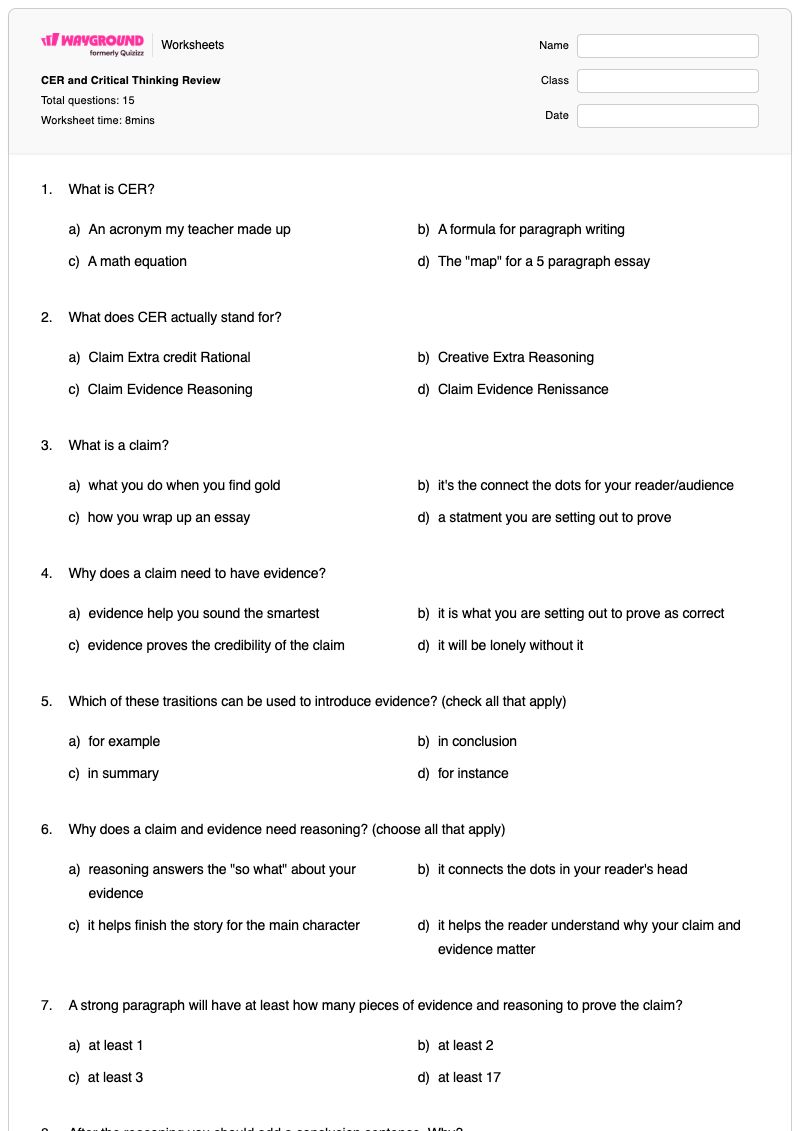
1.

What is CER?

a)

An acronym my teacher made up

b)

A formula for paragraph writing

c)

A math equation

d)

The "map" for a 5 paragraph essay

2.

What does CER actually stand for?

a)

Claim Extra credit Rational

b)

Creative Extra Reasoning

c)

Claim Evidence Reasoning

d)

Claim Evidence Renissance

3.

What is a claim?

a)

what you do when you find gold

b)

it's the connect the dots for your reader/audience

c)

how you wrap up an essay

d)

a statment you are setting out to prove

4.

Why does a claim need to have evidence?

a)

evidence help you sound the smartest

b)

it is what you are setting out to prove as correct

c)

evidence proves the credibility of the claim

d)

it will be lonely without it

5.

Which of these trasitions can be used to introduce evidence? (check all that apply)

a)

for example

b)

in conclusion

c)

in summary

d)

for instance

6.

Why does a claim and evidence need reasoning? (choose all that apply)

a)

reasoning answers the "so what" about your evidence

b)

it connects the dots in your reader's head

c)

it helps finish the story for the main character

d)

it helps the reader understand why your claim and evidence matter

7.

A strong paragraph will have at least how many pieces of evidence and reasoning to prove the claim?

a)

at least 1

b)

at least 2

c)

at least 3

d)

at least 17

8.

After the reasoning you should add a conclusion sentence. Why?

a)

it reminds the reader of the claim and closes the paragraph

b)

it is pretty

c)

it adds extra words and sentences which all teachers like

d)

it helps the reader understand the importance of everyone speaking their mind at all times

9.

A critical thinker does not necessarily believe everything they hear.

a)

True

b)

False

10.

What are critical thinking skills?

a)

thinking about critical things

b)

ways to answer an essay prompt

c)

ways to determine if you are critically ill

d)

they are strategies people use to consider and evaluate new ideas

11.

What are the four critical thinking skills? (check all that apply)

a)

inference

b)

analyze

c)

claim

d)

evaluate

e)

interpret

12.

When you "read between the lines" that means you are:

a)

making a mountain out of a molehill

b)

interpretation

c)

inference

d)

analysis

13.

When you evaluate an idea or text, what are you doing?

a)

analyzing the source of the problem

b)

making a judgement based on evidence and reasoning

c)

inferring who ate your leftovers

d)

finding similar patterns in a text

14.

When you break something down into its parts, what skill are you using?

a)

performing an analysis

b)

performing an evaluation

c)

making an inference

d)

jumping to a conclusion

15.

To understand the meaning of something in a particular way is to ______________________.

a)

investigate

b)

infer

c)

invent

d)

interpret

แป้นคำตอบ

CER and Critical Thinking Review

คำถามทั้งหมด: 15

1.
b)

A formula for paragraph writing

2.
c)

Claim Evidence Reasoning

3.
d)

a statment you are setting out to prove

4.
c)

evidence proves the credibility of the claim

5.
a)

for example

, d)

for instance

6.
a)

reasoning answers the "so what" about your evidence

, b)

it connects the dots in your reader's head

, d)

it helps the reader understand why your claim and evidence matter

7.
b)

at least 2

8.
a)

it reminds the reader of the claim and closes the paragraph

9.
a)

True

10.
d)

they are strategies people use to consider and evaluate new ideas

11.
a)

inference

, b)

analyze

, d)

evaluate

, e)

interpret

12.
c)

inference

13.
b)

making a judgement based on evidence and reasoning

14.
a)

performing an analysis

15.
d)

interpret

คำถามที่พบบ่อย

แบบฝึกหัด CER และการทบทวนการคิดเชิงวิเคราะห์ครอบคลุมเนื้อหาอะไรบ้าง?

แบบฝึกหัดภาษาอังกฤษสำหรับนักเรียนชั้น ม.3 นี้ ประกอบด้วยคำถามแบบเลือกตอบ 12 ข้อ และคำถามแบบเลือกคำตอบ 3 ข้อ เพื่อทบทวน CER—ข้ออ้าง หลักฐาน และเหตุผล—และทักษะการคิดเชิงวิเคราะห์ 4 ด้าน ได้แก่ การอนุมาน การวิเคราะห์ การประเมิน และการตีความ นักเรียนจะต้องระบุวัตถุประสงค์ของแต่ละองค์ประกอบของ CER เลือกคำเชื่อมหลักฐานที่เหมาะสม อธิบายว่าเหตุผลเชื่อมโยงหลักฐานกับข้ออ้างอย่างไร และแยกแยะความแตกต่างระหว่างกระบวนการคิดเชิงวิเคราะห์ต่างๆ

ฉันจะใช้แบบฝึกหัดนี้ในการสอน CER และการคิดเชิงวิเคราะห์ได้อย่างไร?

แนะนำ CER โดยให้นักเรียนนิยามคำว่า ข้ออ้าง หลักฐาน และเหตุผล จากนั้นสาธิตวิธีการที่เหตุผลตอบคำถาม “แล้วอย่างไร?” เกี่ยวกับหลักฐาน ใช้แบบฝึกหัดแบบเลือกตอบเพื่ออภิปรายว่าทำไม “เช่น” และ “ตัวอย่างเช่น” จึงเป็นการนำเสนอหลักฐาน และทำไมย่อหน้าจึงต้องมีประโยคสรุป หลังจากนั้น ขอให้นักเรียนอธิบายความแตกต่างระหว่างการอนุมาน การวิเคราะห์ การประเมิน และการตีความในย่อหน้าหรือข้อความที่พวกเขากำลังศึกษา

ฉันควรระวังข้อผิดพลาดอะไรบ้างเมื่อนักเรียนทำแบบประเมิน CER นี้เสร็จ?

นักเรียนอาจสับสนระหว่างข้ออ้างกับข้อสรุป เลือกใช้คำเชื่อมเช่น “โดยสรุปแล้ว” ในการนำเสนอหลักฐาน หรือมองข้ามบทบาทของการให้เหตุผลในการเชื่อมโยงหลักฐานกับข้ออ้าง ในคำถามแบบเลือกตอบหลายตัวเลือก ให้สังเกตนักเรียนที่เลือกคำตอบที่ถูกต้องเพียงข้อเดียว หรือใช้คำศัพท์เกี่ยวกับการคิดเชิงวิพากษ์ทั้งสี่คำแทนกันได้ เช่น สับสนระหว่างการอนุมานกับการวิเคราะห์หรือการประเมิน

ฉันจะมอบหมายและให้คะแนนแบบฝึกหัด CER และการทบทวนการคิดเชิงวิพากษ์นี้ได้อย่างไร?

แบบฝึกหัดนี้มีให้ดาวน์โหลดในรูปแบบไฟล์ PDF สำหรับพิมพ์ และเป็นแบบทดสอบดิจิทัลบน Wayground โดยมีเฉลยคำตอบครบถ้วนสำหรับทั้ง 15 ข้อ คุณสามารถตรวจงานส่งในรูปแบบไฟล์ PDF ได้โดยการสแกนงานของนักเรียนด้วยแอป Wayground for Teachers ในขณะที่แบบทดสอบดิจิทัลรองรับการทำและตรวจงานทางออนไลน์

แบบฝึกหัดนี้ช่วยทบทวนทักษะการคิดเชิงวิเคราะห์ด้านใดบ้าง?

ส่วนการคิดเชิงวิเคราะห์จะทบทวนการอนุมาน การวิเคราะห์ การประเมิน และการตีความโดยเฉพาะ ผ่านคำถามแบบเลือกตอบและแบบเลือกหลายตัวเลือก นักเรียนจะระบุว่าการอนุมานคือการอ่านระหว่างบรรทัด การประเมินคือการตัดสินใจโดยอาศัยหลักฐานและเหตุผล การวิเคราะห์คือการแบ่งสิ่งต่างๆ ออกเป็นส่วนๆ และการตีความคือการเข้าใจความหมายในลักษณะใดลักษณะหนึ่ง

ฉันจะหาแบบฝึกหัดแบบนี้เพิ่มเติมได้ที่ไหนบน Wayground?

Wayground นำเสนอชุดแบบฝึกหัดและโจทย์ฝึกหัดฟรีที่ครอบคลุมทุกวิชา พร้อมไฟล์ PDF และเฉลยคำตอบ เพื่อช่วยให้นักเรียนเชี่ยวชาญทักษะและแนวคิดที่สำคัญ ดูแหล่งข้อมูลเพิ่มเติมได้ที่ https://wayground.com/en-us/worksheets