

Wayground
Understanding the Constitution Vocabulary #1 (2025) - Printable สังคมศึกษา Worksheets ระดับ 7 - Wayground

Understanding the Constitution Vocabulary #1 (2025)

Neville Brown

สร้างโดย Neville Brown

20 คำถาม

7th ระดับชั้น

สังคมศึกษา

อัปเดตแล้ว พ.ค. 2568

แบบฝึกหัดคำศัพท์เกี่ยวกับรัฐธรรมนูญ #1 (2025) เป็นแบบฝึกหัดวิชาสังคมศึกษาสำหรับนักเรียนชั้น ม.1 ที่ช่วยเสริมสร้างคำศัพท์และความเข้าใจในแนวคิดสำคัญของรัฐธรรมนูญสหรัฐอเมริกา แบบฝึกหัดประกอบด้วย 20 ข้อ—คำถามแบบเลือกตอบ 14 ข้อ คำถามแบบเลือกคำตอบ 2 ข้อ และคำถามแบบเติมคำในช่องว่าง 4 ข้อ—นักเรียนจะได้ระบุคำศัพท์ต่างๆ เช่น กระบวนการยุติธรรม การให้สัตยาบัน บัญญัติสิทธิ การตรวจสอบโดยศาล การยับยั้ง สิทธิพลเมือง และการแก้ไข นอกจากนี้ยังช่วยให้นักเรียนเชื่อมโยงมาตรา 1, 2 และ 3 กับฝ่ายนิติบัญญัติ ฝ่ายบริหาร และฝ่ายตุลาการ และระบุวิธีการทำงานของระบบตรวจสอบและถ่วงดุลอำนาจ แบบฝึกหัดนี้ช่วยให้นักเรียนแยกแยะคำศัพท์ทางรัฐธรรมนูญ จับคู่อำนาจรัฐบาลกับฝ่ายที่ถูกต้อง และจดจำข้อเท็จจริงที่สำคัญ เช่น จำนวนการแก้ไขรัฐธรรมนูญ ส่วนคำถามแบบเลือกตอบจะให้นักเรียนระบุตัวอย่างของการแบ่งแยกอำนาจ ในขณะที่คำถามแบบเติมคำในช่องว่างต้องการความรู้คำศัพท์ที่แม่นยำ นี่คือแบบฝึกหัดที่สามารถพิมพ์ได้ฟรี พร้อมเฉลยคำตอบครบถ้วน สำหรับใช้ทบทวน ฝึกฝนด้วยตนเอง หรือประเมินผลระหว่างเรียน

การตั้งค่าแผ่นงาน

ขนาดตัวอักษร

S
M
L
XL
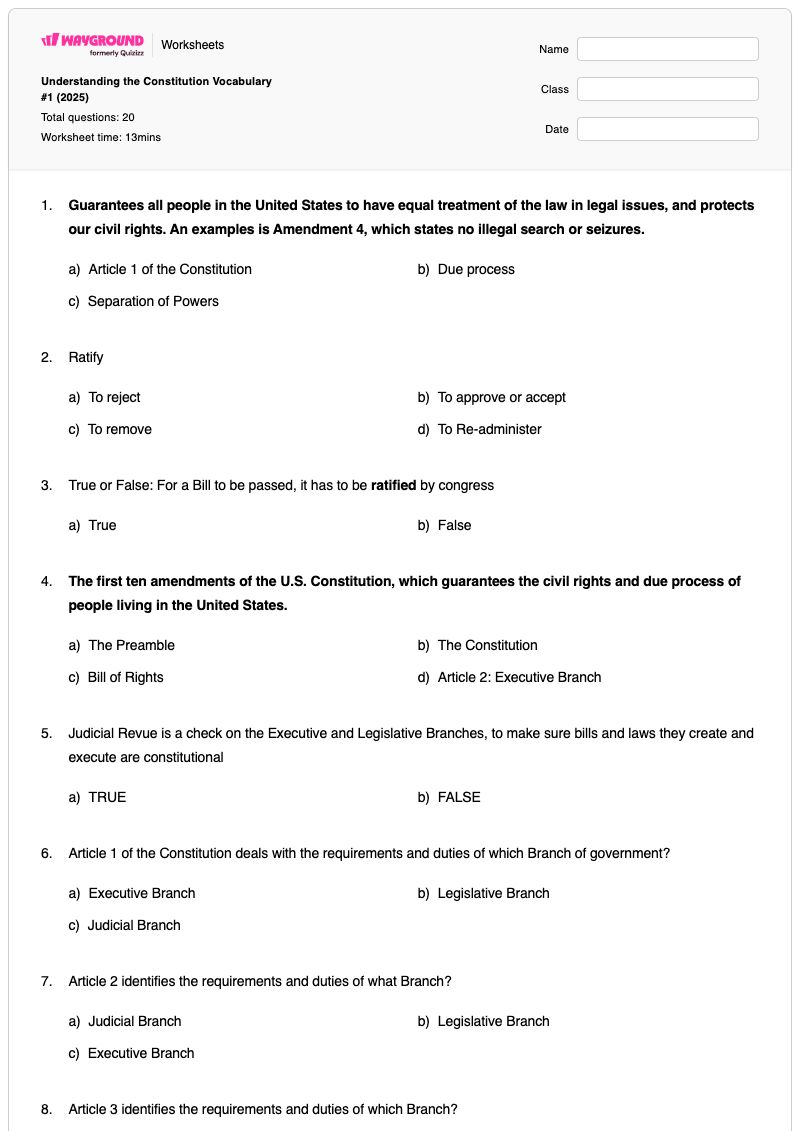
Waygroundแผ่นงาน

Understanding the Constitution Vocabulary #1 (2025)

คำถามทั้งหมด: 20

ชื่อ
ระดับ
วันที่
1.

Guarantees all people in the United States to have equal treatment of the law in legal issues, and protects our civil rights. An examples is Amendment 4, which states no illegal search or seizures.

a)

Article 1 of the Constitution

b)

Due process

c)

Separation of Powers

2.

Ratify

a)

To reject

b)

To approve or accept

c)

To remove

d)

To Re-administer

3.

True or False: For a Bill to be passed, it has to be ratified by congress

a)

True

b)

False

4.

The first ten amendments of the U.S. Constitution, which guarantees the civil rights and due process of people living in the United States.

a)

The Preamble

b)

The Constitution

c)

Bill of Rights

d)

Article 2: Executive Branch

5.

Judicial Revue is a check on the Executive and Legislative Branches, to make sure bills and laws they create and execute are constitutional

a)

TRUE

b)

FALSE

6.

Article 1 of the Constitution deals with the requirements and duties of which Branch of government?

a)

Executive Branch

b)

Legislative Branch

c)

Judicial Branch

7.

Article 2 identifies the requirements and duties of what Branch?

a)

Judicial Branch

b)

Legislative Branch

c)

Executive Branch

8.

Article 3 identifies the requirements and duties of which Branch?

a)

Executive Branch

b)

Judicial Branch

c)

Legislative Branch

9.

According to Article 1, Who has the power to make laws?

a)

The President

b)

Congress

c)

Supreme Court

10.

The power to review and interpret laws is an example of a check and balance by which Branch of the Federal Government?

a)

Legislative Branch

b)

Judicial Branch

c)

Executive Branch

11.

All of the following are examples of separation of power

(There are multiple correct answers)

a)

The president vetoes a Bill passed by Congress

b)

Congress over-rides a presidential veto by 2/3rd vote in the House and the Senate

c)

The Supreme Court uses judicial review to make a law unconstitutional

12.

A Bill is passed by Congress, but the president rejects it.

(a)  

13.

Fought for by many during the 1960's,  They include the right to vote, to a fair trial, to government services, and to a public education

(a)  

14.

To make changes or corrections to laws, procedures or behaviors.

(a)  

15.

The Constitution is a living document because it can be amended. How many constitutional amendments are there?

(a)  

16.

A proposed law presented to congress, where it is discussed and voted on.  If ratified or approved by 2/3rd vote, it becomes a law

a)

Rights

b)

A Bill

c)

A declaration

17.

Impeach: The act or process of charging, prosecuting and removing government officials from office.  The senate serves as the jury.  

This is an example of

a)

Separation of powers

b)

A check and balance of power

c)

10 Articles of Confederation

18.

The principle of government that says Federal and State governments must share power.

These powers are concurrent


a)

Republicanism

b)

Checks & Balances

c)

Federalism

d)

Separation of powers

19.

Power is equal between Federal and State government; this is an example of:


a)

Republicanism 

b)

Federalism 

c)

Checks and Balances

d)

Separation of Power

20.

 The three branches of government are given specific duties and roles, to provide checks and balance to decisions being made for the people


a)

Judicial Review

b)

Congressional Oversight

c)

Republicanism

d)

Separation of powers

Waygroundแป้นคำตอบ

Understanding the Constitution Vocabulary #1 (2025)

คำถามทั้งหมด: 20

1.
b)

Due process

2.
b)

To approve or accept

3.
a)

True

4.
c)

Bill of Rights

5.
a)

TRUE

6.
b)

Legislative Branch

7.
c)

Executive Branch

8.
b)

Judicial Branch

9.
b)

Congress

10.
b)

Judicial Branch

11.
a)

The president vetoes a Bill passed by Congress

, b)

Congress over-rides a presidential veto by 2/3rd vote in the House and the Senate

, c)

The Supreme Court uses judicial review to make a law unconstitutional

12.
veto
13.
Civil Rights
14.
Amend
15.
27
16.
b)

A Bill

17.
a)

Separation of powers

, b)

A check and balance of power

18.
c)

Federalism

19.
b)

Federalism 

20.
d)

Separation of powers

คำถามที่พบบ่อย

แบบฝึกหัด "ทำความเข้าใจคำศัพท์เกี่ยวกับรัฐธรรมนูญ #1" ครอบคลุมเนื้อหาอะไรบ้าง?

แบบฝึกหัดสำหรับนักเรียนชั้น ม.1 นี้ครอบคลุมคำศัพท์ทางรัฐธรรมนูญและความสัมพันธ์ระหว่างกระบวนการยุติธรรม การให้สัตยาบัน บัญญัติสิทธิ การตรวจสอบโดยศาล สิทธิพลเมือง การยับยั้ง การแก้ไขเพิ่มเติม และสามสาขาของรัฐบาล แบบฝึกหัดประกอบด้วย 20 ข้อ โดยใช้รูปแบบคำถามแบบเลือกตอบ เลือกหลายข้อ และเติมคำในช่องว่าง เพื่อให้นักเรียนระบุคำศัพท์ จับคู่มาตรา 1-3 กับสาขาของรัฐบาลที่ถูกต้อง ตระหนักถึงการตรวจสอบและถ่วงดุล และจดจำข้อเท็จจริงที่สำคัญ เช่น การแก้ไขเพิ่มเติม 27 ฉบับ

ฉันจะใช้แบบฝึกหัดนี้ในการสอนคำศัพท์เกี่ยวกับรัฐธรรมนูญและฝ่ายต่างๆ ของรัฐบาลได้อย่างไร?

เริ่มด้วยการแนะนำคำศัพท์โดยจัดหมวดหมู่ เช่น สิทธิ กระบวนการตามรัฐธรรมนูญ สาขา และการตรวจสอบและถ่วงดุลอำนาจ จากนั้นใช้มาตรา 1-3 และคำถามเกี่ยวกับสาขาต่างๆ เพื่อให้นักเรียนอธิบายว่าเหตุใดรัฐสภา ประธานาธิบดี หรือศาลฎีกาจึงตรงกับคำอธิบายแต่ละข้อ ตามด้วยการอภิปรายตัวอย่างแบบเลือกตอบหลายข้อ เช่น การยับยั้ง การลงมติลบล้างการยับยั้ง และการตรวจสอบโดยศาล ปิดท้ายด้วยแบบฝึกหัดเติมคำในช่องว่างเพื่อตรวจสอบความรู้เกี่ยวกับคำศัพท์เฉพาะ เช่น การยับยั้ง สิทธิพลเมือง และการแก้ไขรัฐธรรมนูญ

ฉันควรระวังข้อผิดพลาดอะไรบ้างเมื่อนักเรียนทำแบบฝึกหัดคำศัพท์เกี่ยวกับรัฐธรรมนูญนี้?

นักเรียนอาจสับสนระหว่างบัญญัติสิทธิกับรัฐธรรมนูญหรือคำนำ หรืออาจสับสนระหว่างฝ่ายต่างๆ ที่เกี่ยวข้องกับมาตรา 1, 2 และ 3 โปรดระวังนักเรียนที่เลือกคำตอบเพียงข้อเดียวในข้อคำถามแบบเลือกหลายข้อเกี่ยวกับการแบ่งแยกอำนาจ สับสนระหว่างการให้สัตยาบันกับการยับยั้งหรือการแก้ไข และให้คำตอบที่ไม่แม่นยำในข้อคำถามแบบเติมคำในช่องว่างที่ถามถึงจำนวนการแก้ไข

ฉันจะมอบหมายและตรวจงานคำศัพท์เกี่ยวกับรัฐธรรมนูญนี้อย่างไร?

คุณสามารถมอบหมายแบบฝึกหัด "ทำความเข้าใจคำศัพท์เกี่ยวกับรัฐธรรมนูญ #1" ในรูปแบบไฟล์ PDF ที่พิมพ์ได้ หรือเป็นแบบทดสอบดิจิทัลบน Wayground แบบฝึกหัดนี้มีเฉลยคำตอบครบถ้วน และสามารถตรวจให้คะแนนได้โดยการสแกนงานของนักเรียนด้วยแอป Wayground for Teachers รูปแบบที่พิมพ์ได้ยังช่วยสนับสนุนโรงเรียนที่ต้องการลดเวลาการใช้หน้าจอได้อีกด้วย

ฉันจะปรับแบบฝึกหัดคำศัพท์เกี่ยวกับรัฐธรรมนูญนี้ให้เหมาะสมกับนักเรียนของฉันได้อย่างไร?

ใช้การตั้งค่าขั้นสูงของแบบฝึกหัดเพื่อปรับระยะห่างระหว่างตัวอักษรและขนาดตัวอักษร เพื่อให้คำศัพท์เกี่ยวกับรัฐธรรมนูญ รายการระบุสาขา และคำถามเติมคำในช่องว่างอ่านง่ายขึ้น นอกจากนี้ คุณยังสามารถใช้แบบอักษรที่เหมาะสำหรับผู้ที่มีภาวะดิสเล็กเซีย หรือแปลแบบฝึกหัดเป็นภาษาอื่นได้ เมื่อนักเรียนต้องการความช่วยเหลือเพิ่มเติมเกี่ยวกับคำศัพท์ต่างๆ เช่น การให้สัตยาบัน กระบวนการที่ถูกต้องตามกฎหมาย และการตรวจสอบโดยศาล

ฉันจะหาแบบฝึกหัดแบบนี้เพิ่มเติมได้ที่ไหนบน Wayground?

Wayground นำเสนอชุดแบบฝึกหัดและโจทย์ฝึกหัดฟรีที่ครอบคลุมหลากหลายวิชา พร้อมไฟล์ PDF และเฉลยคำตอบ เพื่อช่วยให้นักเรียนเชี่ยวชาญทักษะและแนวคิดที่สำคัญ ดูแหล่งข้อมูลเพิ่มเติมได้ที่ https://wayground.com/en-us/worksheets