

Wayground
Covalent vs ionic bonding & Covalent naming - Printable ศาสตร์ Worksheets ระดับ 11 - Wayground

Covalent vs ionic bonding & Covalent naming

. Ade

สร้างโดย . Ade

25 คำถาม

11th ระดับชั้น

ศาสตร์

อัปเดตแล้ว พ.ย. 2568

แบบฝึกหัดวิทยาศาสตร์ระดับชั้น ม.4 นี้ช่วยเสริมสร้างความเข้าใจเกี่ยวกับพันธะไอออนิกและพันธะโคเวเลนต์ผ่านคำถาม 25 ข้อ: 24 ข้อเป็นแบบเลือกตอบ และ 1 ข้อเป็นแบบเลือกตอบหลายตัวเลือก นักเรียนจะได้ระบุอิเล็กตรอนวาเลนซ์ กำหนดความสัมพันธ์ระหว่างอะตอมที่เป็นกลางและไอออนกับโปรตอนและอิเล็กตรอน แยกแยะความแตกต่างระหว่างการถ่ายโอนอิเล็กตรอนและการแบ่งปันอิเล็กตรอน ทำนายประเภทของพันธะจากธาตุ และเข้าใจว่าทำไมอะตอมจึงเกิดพันธะ คำถามหลายข้อต้องการให้นักเรียนนับอะตอมจากสูตรเคมีและตีความองค์ประกอบโมเลกุล แบบฝึกหัดนี้ขยายความรู้เรื่องพันธะไปสู่การตั้งชื่อสารประกอบโคเวเลนต์ นักเรียนใช้คำนำหน้าและสัญลักษณ์ของธาตุในการตั้งชื่อสารประกอบ เช่น CH₄ และ CO₂ และเขียนสูตร เช่น PCl₃ และ PH₃ จากชื่อโคเวเลนต์ แบบฝึกหัดนี้ออกแบบมาสำหรับใช้ในการสอนวิทยาศาสตร์ระดับชั้น ม.4 การทบทวน หรือการประเมินทักษะพื้นฐานเรื่องพันธะและการตั้งชื่อ แบบฝึกหัดที่พิมพ์ได้ฟรีนี้มีเฉลยคำตอบครบถ้วน ทำให้ใช้งานได้จริงสำหรับการฝึกฝนด้วยตนเอง งานในชั้นเรียน การบ้าน หรือการตรวจสอบความเข้าใจหลังจากการสอนโดยตรง

การตั้งค่าแผ่นงาน

ขนาดตัวอักษร

S
M
L
XL
Waygroundแผ่นงาน

Covalent vs ionic bonding & Covalent naming

คำถามทั้งหมด: 25

ชื่อ
ระดับ
วันที่
1.
Ionic bonds form between metals and ____.
a)
metalloids
b)
metals
c)
nonmetals
2.
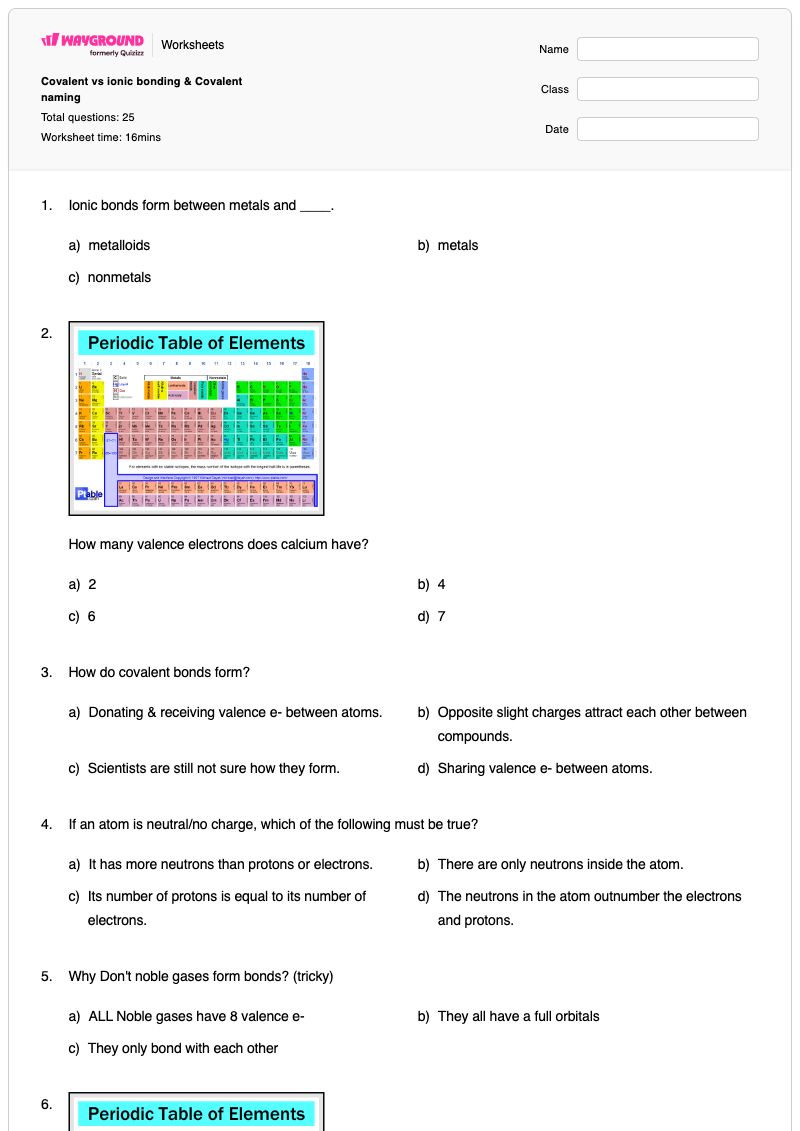
How many valence electrons does calcium have?

How many valence electrons does calcium have?

a)

2

b)

4

c)

6

d)

7

3.
How do covalent bonds form?
a)
Donating & receiving valence e- between atoms.
b)
Opposite slight charges attract each other between compounds.
c)
Scientists are still not sure how they form.
d)
Sharing valence e- between atoms.
4.

If an atom is neutral/no charge, which of the following must be true?

a)

It has more neutrons than protons or electrons.

b)

There are only neutrons inside the atom.

c)

Its number of protons is equal to its number of electrons.

d)

The neutrons in the atom outnumber the electrons and protons.

5.

Why Don't noble gases form bonds? (tricky)

a)

ALL Noble gases have 8 valence e-

b)

They all have a full orbitals

c)

They only bond with each other

6.
What kind of bond will Potassium form with Sulfur?

What kind of bond will Potassium form with Sulfur?

a)

ionic

b)

covalent

c)

metallic

d)

no bond

7.

How many atoms are in this molecule? C6H12O6

a)

6

b)

12

c)

18

d)

24

8.

What charge will a Neon ion have?

a)

+1

b)

-1

c)

-8

d)

Neon does not form ions.

9.

Electrons in the outer most shell are called.....

a)

Electrons

b)

Valence Electrons

c)

Protons

d)

Neutrons

10.

Bonds form because atoms are seeking....

a)

Protons

b)

Stability

c)

Instability

11.
Ionic bonds are between __________ and __________. 
a)
metals, non-metals
b)
metals, metals
c)
non-metals, non-metals
d)
metals, metalloids
12.
CH4 is a covalent compound, please select the proper name of that formula. 
a)
Carbon hydride
b)
Carbon tetrahydride
c)
Tetracarbon hydrogen
d)
Carbon tetrahydroxide
13.
Phosphorus trichloride is a covalent compound. What is the proper formula?
a)
PCl3
b)
P3Cl
c)
PCl
d)
PCl2
14.
CO2 is a covalent compound. The proper name for CO2 is ________. 
a)
Carbon dioxide
b)
Carbon oxide
c)
Oxygen dicarbon
d)
Carbon oxidedi
15.
ภาพคำถาม
a)
The image shows an ionic bond. 
b)
The image shows a covalent bond.
c)
The image shows a calcium bond.
d)
The image shows a metallic bond.
16.

What is the correct chemical formula for phosphorus trihydride?

a)

P2H3

b)

P4H2

c)

PH3

d)

P3H3

17.

Which of the following is the chemical formula for sulfur hexachloride?

a)

SCl6

b)

S6Cl

c)

S6Cl6

d)

S1Cl6

18.

Which of the following names matches the chemical formula N2O3?

a)

Dinitrogen triople oxide

b)

Nitrogen oxide

c)

Dinitrogen trioxide

d)

Trioxide nitrogen

19.

carbon tetrahydride is represented by which chemical formula?

a)

CH4

b)

CH5

c)

C4

d)

C4H4

20.
The name of the following covalent bond is...?

The name of the following covalent bond is...?

a)

Nitrogen oxide

b)

Mononitrogen oxide

c)

Nitrogen Oxygen

d)

Nitrogen dioxide

21.
Which is the most important characteristic in determining an element's chemical properties?
a)
the number of protons and neutrons in its nucleus
b)
which period it is found in
c)
the number of valence electrons it contains
d)
its outermost energy level
22.

Generally covalent molecules are poor conductors

a)

false

b)

true

23.

Metals form cations.

a)

True

b)

False

24.

Which of the following is a characteristic property of ionic compounds? (3 correct answers)

a)

They form hard, brittle crystals with characteristic shapes,

b)

They have low melting points

c)

They conduct electricity

d)

They contain no charged particles

e)

They contain charged particles

25.
Low Melting & Boiling Points
a)
Ionic
b)
Covalent
Waygroundแป้นคำตอบ

Covalent vs ionic bonding & Covalent naming

คำถามทั้งหมด: 25

1.
c) nonmetals
2.
a)

2

3.
d) Sharing valence e- between atoms.
4.
c)

Its number of protons is equal to its number of electrons.

5.
b)

They all have a full orbitals

6.
a)

ionic

7.
d)

24

8.
d)

Neon does not form ions.

9.
b)

Valence Electrons

10.
b)

Stability

11.
a) metals, non-metals
12.
b) Carbon tetrahydride
13.
a) PCl3
14.
a) Carbon dioxide
15.
a) The image shows an ionic bond. 
16.
c)

PH3

17.
a)

SCl6

18.
c)

Dinitrogen trioxide

19.
a)

CH4

20.
d)

Nitrogen dioxide

21.
c) the number of valence electrons it contains
22.
b)

true

23.
a)

True

24.
a)

They form hard, brittle crystals with characteristic shapes,

, c)

They conduct electricity

, e)

They contain charged particles

25.
b) Covalent

คำถามที่พบบ่อย

แบบฝึกหัดนี้ครอบคลุมเนื้อหาอะไรบ้างเกี่ยวกับการพันธะไอออนิกและพันธะโคเวเลนต์?

แบบฝึกหัดสำหรับนักเรียนชั้นมัธยมศึกษาปีที่ 4 (เกรด 11) นี้ประกอบด้วย 25 ข้อ—24 ข้อเป็นแบบเลือกตอบ และ 1 ข้อเป็นการเลือกคำตอบที่ถูกต้อง—เพื่อประเมินความรู้เกี่ยวกับอิเล็กตรอนวาเลนซ์ อะตอมที่เป็นกลางและไอออน การสร้างพันธะ พันธะไอออนิกและพันธะโคเวเลนต์ การนับอะตอมในสูตร และความเสถียร จากนั้นนักเรียนจะนำกฎการตั้งชื่อโคเวเลนต์ไปใช้โดยการจับคู่คำนำหน้าและสัญลักษณ์ธาตุกับสูตร เช่น การตั้งชื่อ CH₄ และเขียน PH₃ จากฟอสฟอรัสไตรไฮไดรด์

ฉันจะใช้แบบฝึกหัดนี้ในการสอนเรื่องพันธะไอออนิกและพันธะโคเวเลนต์ รวมถึงการตั้งชื่อสารประกอบโคเวเลนต์ได้อย่างไร?

ก่อนเริ่มทำแบบฝึกหัด ให้แนะนำอิเล็กตรอนวาเลนซ์และความแตกต่างระหว่างการถ่ายโอนอิเล็กตรอนในพันธะไอออนิกและการแบ่งปันอิเล็กตรอนในพันธะโคเวเลนต์ หลังจากที่นักเรียนทำแบบฝึกหัดเกี่ยวกับประเภทพันธะและสูตรเสร็จแล้ว ให้พวกเขาอธิบายว่าคำนำหน้ากำหนดสารประกอบได้อย่างไร เช่น คาร์บอนไดออกไซด์ คาร์บอนเตตระไฮไดรด์ PCl₃ และ PH₃ ใช้คำอธิบายของพวกเขาเพื่อเชื่อมโยงคำถามเกี่ยวกับการจำแนกประเภทกับงานการตั้งชื่อและการเขียนสูตรในภายหลัง

ฉันควรระวังข้อผิดพลาดอะไรบ้างในแบบฝึกหัดเรื่องความสัมพันธ์และการตั้งชื่อนี้?

นักเรียนอาจสับสนระหว่างพันธะไอออนิกส์ระหว่างโลหะและอโลหะกับพันธะโคเวเลนต์ซึ่งเกิดจากอิเล็กตรอนวาเลนซ์ที่ใช้ร่วมกัน หรืออาจคิดว่าอิเล็กตรอนวาเลนซ์เป็นอิเล็กตรอนทั้งหมดของอะตอม โปรดระวังข้อผิดพลาดในการนับอะตอมทุกตัวที่แสดงด้วยตัวเลขห้อยใน C₆H₁₂O₆ และการสลับหรือละเว้นคำนำหน้าโคเวเลนต์เมื่อตั้งชื่อสารประกอบหรือเขียนสูตร นอกจากนี้ นักเรียนอาจเลือกประจุไอออนสำหรับนีออนแม้ว่าในแบบฝึกหัดจะระบุว่านีออนไม่เกิดไอออนก็ตาม

ฉันจะมอบหมายและตรวจงานเรื่องพันธะไอออนิกและพันธะโคเวเลนต์นี้อย่างไร?

แบบฝึกหัดนี้มีให้ดาวน์โหลดในรูปแบบไฟล์ PDF ที่สามารถพิมพ์ได้ และเป็นแบบทดสอบดิจิทัลบน Wayground พร้อมเฉลยคำตอบครบถ้วนสำหรับคำถามเกี่ยวกับการตั้งชื่อพันธะและพันธะโคเวเลนต์ทั้ง 25 ข้อ คุณสามารถตรวจงานที่นักเรียนส่งมาในรูปแบบไฟล์พิมพ์ได้โดยการสแกนงานของพวกเขาด้วยแอป Wayground for Teachers รูปแบบไฟล์พิมพ์ยังช่วยสนับสนุนโรงเรียนที่ต้องการลดเวลาการใช้หน้าจอได้อีกด้วย

ฉันจะปรับแบบฝึกหัดนี้ให้เหมาะสมกับนักเรียนของฉันได้อย่างไร?

ในการตั้งค่าขั้นสูงของแบบฝึกหัด ให้ปรับระยะห่างระหว่างตัวอักษรหรือเลือกขนาดตัวอักษรที่ใหญ่ขึ้นเพื่อให้ข้อสอบแบบเลือกตอบเกี่ยวกับการตั้งชื่อพันธะและพันธะโคเวเลนต์อ่านง่ายขึ้น นอกจากนี้ คุณยังสามารถเปิดใช้งานแบบอักษรที่เหมาะสำหรับผู้ที่มีภาวะดิสเล็กเซีย หรือแปลแบบฝึกหัดเป็นภาษาอื่น เพื่อช่วยให้นักเรียนเข้าถึงสูตรเคมี คำนำหน้า และตัวเลือกคำตอบได้โดยไม่ต้องเปลี่ยนทักษะที่กำลังประเมิน

ฉันจะหาแบบฝึกหัดฟรีแบบนี้เพิ่มเติมได้ที่ไหนบน Wayground?

Wayground นำเสนอชุดแบบฝึกหัดและโจทย์ฝึกหัดฟรีที่ครอบคลุมหลากหลายวิชา พร้อมไฟล์ PDF และเฉลยคำตอบ เพื่อช่วยให้นักเรียนเชี่ยวชาญทักษะและแนวคิดที่สำคัญ ดูแบบฝึกหัดเพิ่มเติมได้ที่ https://wayground.com/en-us/worksheets