
Wayground
Interpreting story graphs - Printable Mathematics Worksheets - Wayground

Interpreting story graphs

20 คำถาม

8th - 8th ระดับชั้น

Mathematics

แบบฝึกหัดคณิตศาสตร์สำหรับนักเรียนชั้น ม.2 เรื่องการตีความกราฟเรื่องราว ช่วยให้นักเรียนอ่านและอธิบายการเคลื่อนที่ที่แสดงบนกราฟได้ แบบฝึกหัดนี้ประกอบด้วยคำถามแบบเลือกตอบ 20 ข้อ ช่วยให้นักเรียนระบุว่าวัตถุอยู่นิ่ง เคลื่อนที่ด้วยความเร็วคงที่ ระยะทางเพิ่มขึ้นหรือลดลง ความเร็วเปลี่ยนแปลง หรือเปลี่ยนทิศทาง นอกจากนี้ยังช่วยให้นักเรียนกำหนดระยะทาง ณ เวลาต่างๆ และจับคู่ส่วนของกราฟกับเรื่องราวในชีวิตจริงที่เป็นไปได้ เช่น นักเรียนเดินกลับบ้านหรือกลับไปโรงเรียน แบบฝึกหัดนี้ช่วยเสริมสร้างความสามารถของนักเรียนในการเชื่อมโยงลักษณะของกราฟกับคำอธิบายการเคลื่อนที่ แทนที่จะอ่านพิกัดแบบแยกส่วน คำถามต้องการให้นักเรียนตีความส่วนต่างๆ และช่วงเวลาที่ระบุไว้ แยกแยะเส้นที่เพิ่มขึ้นจากส่วนที่ราบเรียบ และใช้กราฟเพื่อเลือกคำอธิบายที่อิงตามหลักฐาน แบบฝึกหัดนี้สามารถพิมพ์ได้ฟรี พร้อมเฉลยคำตอบครบถ้วน เหมาะสำหรับการฝึกฝนคณิตศาสตร์ชั้น ม.2 การทำงานอิสระ การทบทวน หรือการตรวจสอบความเข้าใจของนักเรียนเกี่ยวกับกราฟเรื่องราว

การตั้งค่าแผ่นงาน

ขนาดตัวอักษร

S
M
L
XL
Waygroundแผ่นงาน

Interpreting story graphs

คำถามทั้งหมด: 20

ชื่อ
ระดับ
วันที่
1.
ภาพคำถาม
a)
F
b)
G
c)
H
d)
J
2.
Which runner stopped for a rest?

Which runner stopped for a rest?

a)

Albert

b)

Bob

c)

Charlie

3.
What happened during O to A point?
a)
not moving
b)
constant speed
c)
accelerating
d)
decelerating
4.
What is a plausible story for this graph?

What is a plausible story for this graph?

a)

A student was jogging from school to home. She stopped to tie her shoe and take a drink from her water bottle, then continued at the same pace as before.

b)

A student was jogging from school to home. She walked for a while, then continued jogging.

c)

A sled rider was going down a hill. The hill was steep at first, then kind of flat. At the end, it was steep again.

d)

A car was slowing down, then contued moving at a constant rate. Finally, it slowed to a stop,

5.
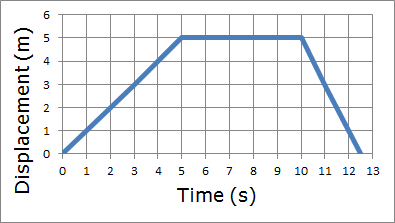
According to the graph how far does the person travel in the first 5 seconds?
a)
2 m
b)
10 m
c)
0 m
d)
5 m
6.

Which of these graphs do not show the object staying still?

a)
Which of these graphs do not show the object staying still?
b)
Which of these graphs do not show the object staying still?
c)
Which of these graphs do not show the object staying still?
d)
Which of these graphs do not show the object staying still?
7.
What is a plausible description of this graph?

What is a plausible description of this graph?

a)

The object began moving away quickly at a constant speed. It stopped. It then turned to return at a constant speed.

b)

The object changed diections three times.

c)

The object began walking away slowly then began running away. Both were at constant speeds. It then turned and walked back to where it started.

d)

The object began moving away at a constant speed. It continued moving away, but slowed its speed. It then turned around and returned home at a speed that was probably in between the first two speeds.

8.
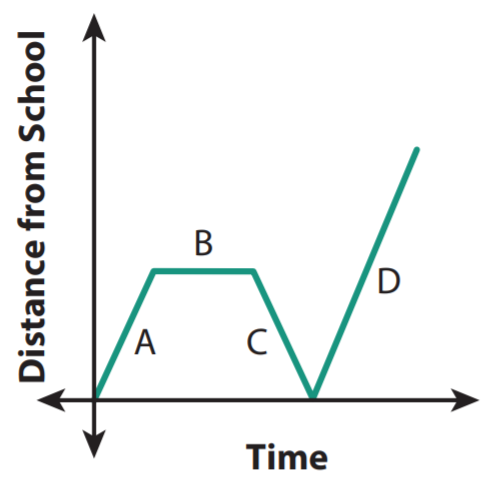
The graph shows Timmy's distance he is as he leaves school one afternoon. What happens in section C? Why is the distance…

The graph shows Timmy's distance he is as he leaves school one afternoon. What happens in section C? Why is the distance from school decreasing?

a)

Timmy is walking back to school because he forgot his math book.

b)

Timmy is talking to a friend and not walking.

c)

Timmy is walking faster home.

d)

Timmy is dancing in the street.

9.
Between 4 and 8 seconds the helicopter's distance is .....................

Between 4 and 8 seconds the helicopter's distance is .....................

a)

Increasing

b)

Decreasing

c)

Staying the same

10.
Between which seconds is the line INCREASING?
a)
Between 7 and 12 seconds
b)
Between 0 and 1 seconds
c)
Between 1 and 5 seconds
d)
Between 12 and 13.5 seconds
11.
ภาพคำถาม
a)
F
b)
G
c)
H
d)
J
12.
What happened during C to D point?
a)
not moving
b)
increasing speed at a constant rate
c)
moving at a constant speed
d)
moving at 0 m/s2 acceleration
13.
According to the graph how far does the person travel in the first 5 seconds?
a)
2 m
b)
10 m
c)
0 m
d)
5 m
14.
The graph shows Timmy's distance he is as he leaves school one afternoon. What happens in section B?

The graph shows Timmy's distance he is as he leaves school one afternoon. What happens in section B?

a)

Timmy is walking back to school because he forgot his math book.

b)

Timmy is talking to a friend and not walking.

c)

Timmy is walking faster home.

d)

Timmy is dancing in the street.

15.

Which graph (if any) shows the object moving at a constant speed, stopping, and then continuing to movie in the same direction?

a)
Which graph (if any) shows the object moving at a constant speed, stopping, and then continuing to movie in the same…
b)
Which graph (if any) shows the object moving at a constant speed, stopping, and then continuing to movie in the same…
c)
Which graph (if any) shows the object moving at a constant speed, stopping, and then continuing to movie in the same…
d)
Which graph (if any) shows the object moving at a constant speed, stopping, and then continuing to movie in the same…
e)

none of these

16.
What happened during C to D point?
a)
not moving
b)
increasing speed at a constant rate
c)
moving at a constant speed
d)
moving at 0 m/s2 acceleration
17.
The graph shows the speed of Mr. Sam driving to work. Which section shows Mr. Sam stopped in traffic?

The graph shows the speed of Mr. Sam driving to work. Which section shows Mr. Sam stopped in traffic?

a)

a.

b)

b.

c)

g.

d)

d.

e)

f.

18.
The graph shows the speed of Mr. Sam driving to work. Which section shows Mr. Sam driving on the interstate?

The graph shows the speed of Mr. Sam driving to work. Which section shows Mr. Sam driving on the interstate?

a)

a. - his rate of change is the steepest

b)

b. - he's going the fastest here

c)

g. - steep rate of change and not for a long time

d)

d. - shortest amount of time

e)

f. - he's going fast here

19.
The graph shows Timmy's distance he is as he leaves school one afternoon. What happens in section D?

The graph shows Timmy's distance he is as he leaves school one afternoon. What happens in section D?

a)

Timmy is walking back to school because he forgot his math book.

b)

Timmy is talking to a friend and not walking.

c)

Timmy is walking all the way home.

d)

Timmy is dancing in the street.

20.
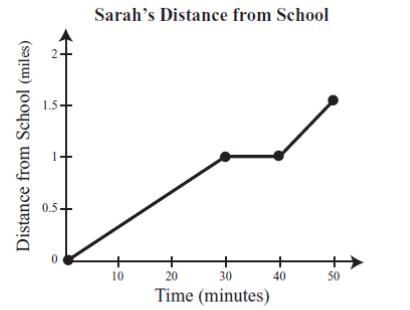
What is happening in the graph between 30 and 40 minutes?
a)
Sarah is accelerating
b)
Sarah is not moving
c)
Sarah is slowing down
d)
Sarah is travelling at a constant speed
Waygroundแป้นคำตอบ

Interpreting story graphs

คำถามทั้งหมด: 20

1.
c) H
2.
c)

Charlie

3.
c) accelerating
4.
a)

A student was jogging from school to home. She stopped to tie her shoe and take a drink from her water bottle, then continued at the same pace as before.

5.
d) 5 m
6.
b)
7.
d)

The object began moving away at a constant speed. It continued moving away, but slowed its speed. It then turned around and returned home at a speed that was probably in between the first two speeds.

8.
a)

Timmy is walking back to school because he forgot his math book.

9.
a)

Increasing

10.
c) Between 1 and 5 seconds
11.
c) H
12.
a) not moving
13.
d) 5 m
14.
b)

Timmy is talking to a friend and not walking.

15.
b)
16.
a) not moving
17.
d)

d.

18.
b)

b. - he's going the fastest here

19.
c)

Timmy is walking all the way home.

20.
b) Sarah is not moving

คำถามที่พบบ่อย

แบบฝึกหัดการตีความกราฟเรื่องราวครอบคลุมหัวข้ออะไรบ้าง?

แบบฝึกหัดคณิตศาสตร์ระดับชั้น ม.2 นี้ประกอบด้วยคำถามแบบเลือกตอบ 20 ข้อ เพื่อประเมินว่านักเรียนตีความกราฟระยะทาง-เวลาและกราฟความเร็ว-เวลาอย่างไร นักเรียนจะต้องระบุส่วนที่หยุดนิ่ง ระยะทางที่เพิ่มขึ้นหรือลดลง ความเร็วคงที่ การเปลี่ยนแปลงความเร็ว การเปลี่ยนทิศทาง และระยะทางที่เดินทางได้ ณ เวลาที่กำหนด จากนั้นเชื่อมโยงส่วนต่างๆ ของกราฟเข้ากับเรื่องราวการเคลื่อนที่ที่เป็นไปได้

ฉันจะใช้แบบฝึกหัดนี้สอนนักเรียนให้ตีความกราฟเรื่องราวได้อย่างไร?

แนะนำภาษาของกราฟก่อนมอบหมายคำถาม: ให้นักเรียนอธิบายความหมายของส่วนที่เพิ่มขึ้น ลดลง หรือส่วนแนวนอนของกราฟต่อการเคลื่อนที่ของวัตถุ จากนั้นสาธิตคำถามที่มีการระบุส่วนต่างๆ เช่น อธิบายว่าทำไมระยะทางที่ลดลงจึงหมายความว่าบุคคลนั้นกำลังเดินทางกลับไปยังโรงเรียน และขอให้นักเรียนอธิบายเหตุผลของแต่ละคำตอบแบบเลือกตอบโดยใช้ทิศทาง ความชัน และช่วงเวลาของกราฟ

ฉันควรสังเกตข้อผิดพลาดอะไรบ้างเมื่อนักเรียนทำแบบฝึกหัดนี้เสร็จ?

นักเรียนอาจตีความส่วนที่เพิ่มสูงขึ้นแต่ละส่วนว่าเป็นการเพิ่มความเร็ว แม้ว่าบางคำถามจะแยกแยะความแตกต่างระหว่างระยะทางที่เพิ่มขึ้นกับการเปลี่ยนแปลงความเร็วก็ตาม นอกจากนี้ พวกเขาอาจตีความส่วนที่เป็นเส้นตรงแนวนอนว่าเป็นการเคลื่อนที่ด้วยความเร็วคงที่แทนที่จะเป็นการหยุดนิ่ง หรืออาจมองข้ามไปว่าระยะทางที่ลดลงแสดงถึงการกลับไปยังจุดอ้างอิง ตรวจสอบให้แน่ใจว่านักเรียนใช้ส่วนต่างๆ ที่ระบุไว้และช่วงเวลาที่กำหนดไว้ แทนที่จะเดาจากรูปทรงโดยรวม

ฉันจะมอบหมายและให้คะแนนแบบฝึกหัดนี้อย่างไร?

แบบฝึกหัดการตีความกราฟเรื่องราวมีให้ดาวน์โหลดในรูปแบบไฟล์ PDF ที่สามารถพิมพ์ได้ และเป็นแบบทดสอบดิจิทัลบน Wayground แบบฝึกหัดนี้มีเฉลยคำตอบครบถ้วนสำหรับคำถามแบบเลือกตอบ 20 ข้อ และสามารถตรวจให้คะแนนงานที่ส่งในรูปแบบไฟล์พิมพ์ได้โดยการสแกนงานของนักเรียนด้วยแอป Wayground for Teachers รูปแบบไฟล์พิมพ์ยังช่วยสนับสนุนโรงเรียนที่ต้องการลดเวลาการใช้หน้าจออีกด้วย

ฉันจะปรับแบบฝึกหัดกราฟเรื่องราวนี้ให้เหมาะสมกับนักเรียนของฉันได้อย่างไร?

ใช้การตั้งค่าขั้นสูงของแบบฝึกหัดเพื่อปรับระยะห่างระหว่างตัวอักษรและขนาดตัวอักษร เพื่อให้ป้ายกำกับกราฟ ช่วงเวลา และตัวเลือกแบบปรนัยอ่านง่ายขึ้น นอกจากนี้ คุณยังสามารถเปิดใช้งานแบบอักษรที่เหมาะสำหรับผู้ที่มีภาวะดิสเล็กเซีย หรือแปลแบบฝึกหัดเป็นภาษาอื่นได้ เมื่อตัวเลือกเหล่านั้นรองรับการเข้าถึงคำถามเกี่ยวกับกราฟการเคลื่อนไหว

ฉันจะหาแบบฝึกหัดแบบนี้เพิ่มเติมได้ที่ไหนบน Wayground?

Wayground มีชุดแบบฝึกหัดและโจทย์ฝึกหัดแบบพิมพ์ได้ฟรีที่ครอบคลุมหลากหลายวิชา พร้อมไฟล์ PDF และเฉลยคำตอบ เพื่อช่วยให้นักเรียนเชี่ยวชาญทักษะและแนวคิดที่สำคัญ ดูแหล่งข้อมูลเพิ่มเติมได้ที่ https://wayground.com/en-us/worksheets