

Wayground
Unit 2 Review 6th grade Science  - Printable ศาสตร์ Worksheets ระดับ 6 - Wayground

Unit 2 Review 6th grade Science

Sara Salinas

สร้างโดย Sara Salinas

18 คำถาม

6th ระดับชั้น

ศาสตร์

อัปเดตแล้ว ก.ย. 2569

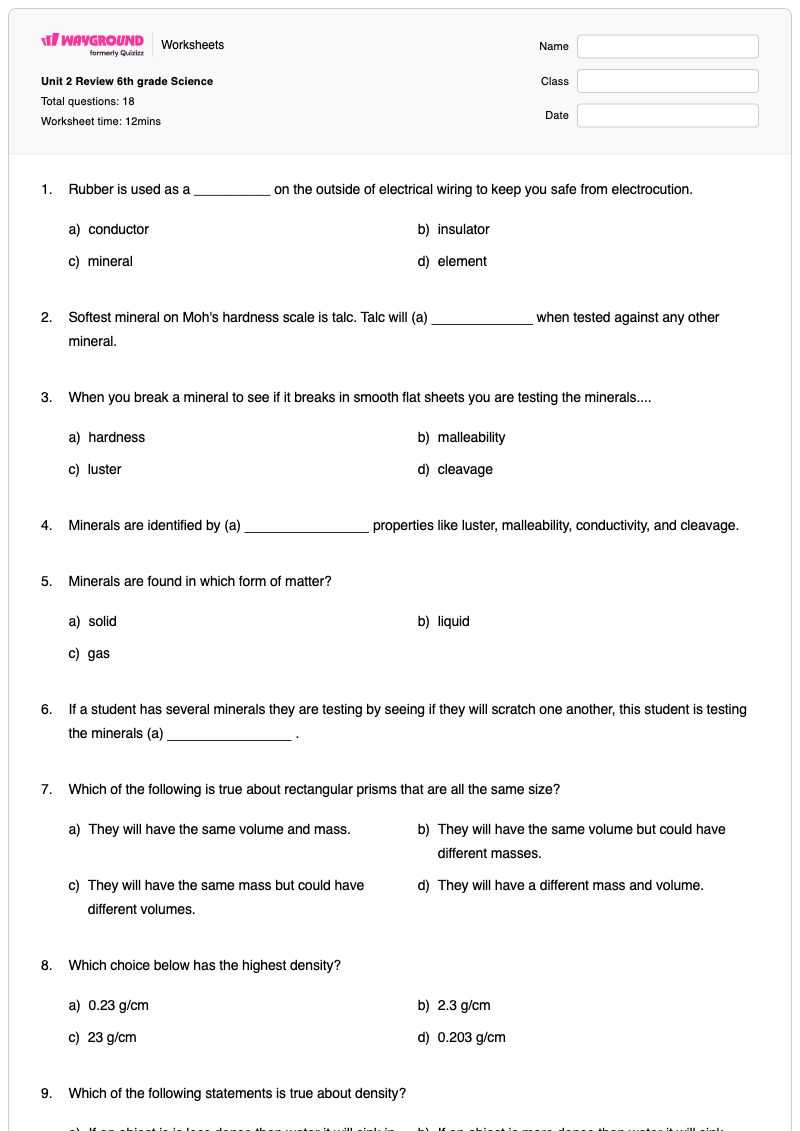
แบบฝึกหัดทบทวนบทที่ 2 วิชาวิทยาศาสตร์ ชั้นประถมศึกษาปีที่ 6 เป็นแบบฝึกหัดที่พิมพ์ได้ฟรีสำหรับนักเรียนชั้นประถมศึกษาปีที่ 6 เพื่อทบทวนวิธีการใช้สมบัติทางกายภาพในการระบุและจำแนกประเภทของสสาร แบบฝึกหัดประกอบด้วย 18 ข้อ แบ่งเป็นคำถามแบบเลือกตอบ 13 ข้อ และคำถามแบบเติมคำในช่องว่าง 5 ข้อ ครอบคลุมสมบัติของแร่ เช่น ความแข็ง ความแตกตัว ความมันวาว ความอ่อนตัว และการนำไฟฟ้า แร่ในรูปของแข็ง และความแตกต่างระหว่างตัวนำและฉนวน แบบฝึกหัดนี้ยังตรวจสอบความเข้าใจของนักเรียนเกี่ยวกับมวล ปริมาตร และความหนาแน่น นักเรียนจะได้เปรียบเทียบค่าความหนาแน่น ตีความกราฟความหนาแน่นและเส้นที่ลากผ่าน เชื่อมโยงความหนาแน่นกับการที่วัตถุลอยหรือจมในน้ำ และให้เหตุผลว่าทำไมปริซึมสี่เหลี่ยมผืนผ้าขนาดเดียวกันจึงมีมวลต่างกันได้ เฉลยคำตอบที่สมบูรณ์ช่วยให้การตรวจสอบและการสอนซ้ำมีประสิทธิภาพ ทำให้แบบฝึกหัดที่พิมพ์ได้ฟรีนี้มีประโยชน์สำหรับการทบทวนบทเรียน การฝึกฝนด้วยตนเอง หรือการประเมินวิทยาศาสตร์สั้นๆ

การตั้งค่าแผ่นงาน

ขนาดตัวอักษร

S
M
L
XL
Waygroundแผ่นงาน

Unit 2 Review 6th grade Science

คำถามทั้งหมด: 18

ชื่อ
ระดับ
วันที่
1.

Rubber is used as a __________ on the outside of electrical wiring to keep you safe from electrocution.

a)

conductor

b)

insulator

c)

mineral

d)

element

2.

Softest mineral on Moh's hardness scale is talc. Talc will (a)   when tested against any other mineral.

3.

When you break a mineral to see if it breaks in smooth flat sheets you are testing the minerals....

a)

hardness

b)

malleability

c)

luster

d)

cleavage

4.

Minerals are identified by (a)   properties like luster, malleability, conductivity, and cleavage.

5.

Minerals are found in which form of matter?

a)

solid

b)

liquid

c)

gas

6.

If a student has several minerals they are testing by seeing if they will scratch one another, this student is testing the minerals (a)   .

7.

Which of the following is true about rectangular prisms that are all the same size?

a)

They will have the same volume and mass.

b)

They will have the same volume but could have different masses.

c)

They will have the same mass but could have different volumes.

d)

They will have a different mass and volume.

8.

Which choice below has the highest density?

a)

0.23 g/cm

b)

2.3 g/cm

c)

23 g/cm

d)

0.203 g/cm

9.

Which of the following statements is true about density?

a)

If an object is is less dense than water it will sink in water.

b)

If an object is more dense than water it will sink when put into water.

10.

The objects density must be less than (a)   in order to float in water.

11.
What is the density according to the graph?

What is the density according to the graph?

a)

50 g/mL

b)

1 g/mL

c)

25 g/mL

d)

100 g/mL

12.
Which set of numbers will the density follow into according to the green J line on the graph?

Which set of numbers will the density follow into according to the green J line on the graph?

a)

1.00-1.25

b)

1.25-1.50

c)

2.0-2.5

d)

2.5-3.0

13.
Which set of numbers will the density follow into according to the blue B line on the graph?

Which set of numbers will the density follow into according to the blue B line on the graph?

a)

1.2-1.5

b)

1.5-2.0

c)

0.5-1.0

d)

2.0-2.5

14.

Which question would help you best determine if an element is a metal or a nonmetal?

a)

Is the object a solid?

b)

Does the object have cleavage?

c)

Is the object a conductor or an insulator?

d)

Does the object float in water?

15.
Which of the following would be the correct title for the first column of the chart?

Which of the following would be the correct title for the first column of the chart?

a)

Metals

b)

Nonmetals

c)

Metalloids

d)

Properties

16.
Which of the following is the title for the center column of the chart?

Which of the following is the title for the center column of the chart?

a)

Metals

b)

Nonmetals

c)

Metalloids

d)

Properties

17.
Which of the following is the title for the 3rd column of the chart?

Which of the following is the title for the 3rd column of the chart?

a)

Metals

b)

Nonmetals

c)

Metalloids

d)

Properties

18.

If an element has some properties of a metal and some properties of a nonmetal it is called a (a)   .

Waygroundแป้นคำตอบ

Unit 2 Review 6th grade Science

คำถามทั้งหมด: 18

1.
b)

insulator

2.
streak
3.
d)

cleavage

4.
physical
5.
a)

solid

6.
hardness
7.
b)

They will have the same volume but could have different masses.

8.
c)

23 g/cm

9.
b)

If an object is more dense than water it will sink when put into water.

10.
1, one, 1.0
11.
b)

1 g/mL

12.
d)

2.5-3.0

13.
a)

1.2-1.5

14.
c)

Is the object a conductor or an insulator?

15.
d)

Properties

16.
a)

Metals

17.
b)

Nonmetals

18.
metalloid, metaloid

คำถามที่พบบ่อย

แบบฝึกหัดวิทยาศาสตร์ชั้นประถมศึกษาปีที่ 6 นี้ครอบคลุมหัวข้ออะไรบ้าง?

แบบฝึกหัดนี้ทบทวนวิธีการที่นักเรียนใช้คุณสมบัติทางกายภาพ เช่น ความแข็ง การแตกตัว ความมันวาว ความอ่อนตัว และการนำไฟฟ้า เพื่อระบุและจำแนกประเภทแร่ธาตุและวัสดุ แบบฝึกหัดนี้ประกอบด้วยคำถามแบบเลือกตอบ 13 ข้อ และคำถามเติมคำในช่องว่าง 5 ข้อ ซึ่งยังช่วยให้นักเรียนเปรียบเทียบค่าความหนาแน่น ตีความช่วงความหนาแน่นจากกราฟ และเชื่อมโยงความหนาแน่นกับการลอยหรือจม

ฉันจะใช้แบบฝึกหัดนี้ในการสอนเรื่องคุณสมบัติและความหนาแน่นของแร่ได้อย่างไร?

ใช้คำถามเกี่ยวกับคุณสมบัติของแร่เพื่อกระตุ้นให้นักเรียนอธิบายว่าการทดสอบการขูดแตกต่างจากการทดสอบการแตกตัวอย่างไร และการนำไฟฟ้าช่วยแยกแยะโลหะออกจากอโลหะได้อย่างไร จากนั้นให้นักเรียนอธิบายเหตุผลของคำตอบเกี่ยวกับความหนาแน่นโดยการเปรียบเทียบมวลและปริมาตร อ่านเส้นกราฟที่มีป้ายกำกับ และทำนายว่าวัตถุจะลอยหรือจมในน้ำ

ฉันควรระวังข้อผิดพลาดอะไรบ้างเมื่อนักเรียนทำแบบฝึกหัดทบทวนวิชาวิทยาศาสตร์นี้?

นักเรียนอาจสับสนระหว่างความแข็ง ซึ่งทดสอบโดยการขูด กับการแตกตัว ซึ่งอธิบายถึงการแตกออกเป็นแผ่นเรียบๆ นอกจากนี้ พวกเขาอาจเลือกค่าความหนาแน่นโดยไม่เปรียบเทียบขนาด กลับความสัมพันธ์ระหว่างความหนาแน่นและการลอยตัว หรืออ่านช่วงที่แสดงโดยเส้นสีเขียว J และสีน้ำเงิน B บนกราฟผิดพลาด

ฉันจะมอบหมายและให้คะแนนแบบฝึกหัดทบทวนวิชาวิทยาศาสตร์หน่วยที่ 2 นี้อย่างไร?

แบบฝึกหัดนี้มีให้ดาวน์โหลดเป็นไฟล์ PDF สำหรับพิมพ์ และเป็นแบบทดสอบดิจิทัลบน Wayground โดยมีเฉลยคำตอบครบถ้วนสำหรับคำถามแบบเลือกตอบและแบบเติมคำในช่องว่าง สำหรับการส่งงานแบบพิมพ์ คุณสามารถตรวจงานของนักเรียนได้โดยการสแกนด้วยแอป Wayground for Teachers

ฉันจะปรับแบบฝึกหัดเรื่องแร่ธาตุและความหนาแน่นนี้ให้เหมาะสมกับนักเรียนของฉันได้อย่างไร?

ใช้การตั้งค่าขั้นสูงของแบบฝึกหัดเพื่อปรับระยะห่างระหว่างตัวอักษรและขนาดตัวอักษร เพื่อให้คำถามเกี่ยวกับคุณสมบัติของแร่ การเปรียบเทียบความหนาแน่น และช่องว่างต่างๆ อ่านง่ายขึ้น นอกจากนี้ คุณยังสามารถใช้แบบอักษรที่เหมาะสำหรับผู้ที่มีภาวะดิสเล็กเซีย หรือแปลแบบฝึกหัดเป็นภาษาอื่นโดยคงรูปแบบการทบทวนเอาไว้ได้

ฉันจะหาแบบฝึกหัดแบบนี้เพิ่มเติมได้ที่ไหนบน Wayground?

Wayground นำเสนอชุดแบบฝึกหัดและโจทย์ฝึกหัดฟรีที่ครอบคลุมหลากหลายวิชา พร้อมไฟล์ PDF และเฉลยคำตอบ เพื่อช่วยให้นักเรียนเชี่ยวชาญทักษะและแนวคิดที่สำคัญ ดูแหล่งข้อมูลเพิ่มเติมได้ที่ https://wayground.com/en-us/worksheets