
Wayground
Geometric Proofs - Printable Mathematics Worksheets ระดับ 9 - Wayground

Geometric Proofs

21 คำถาม

9th - 12th ระดับชั้น

Mathematics

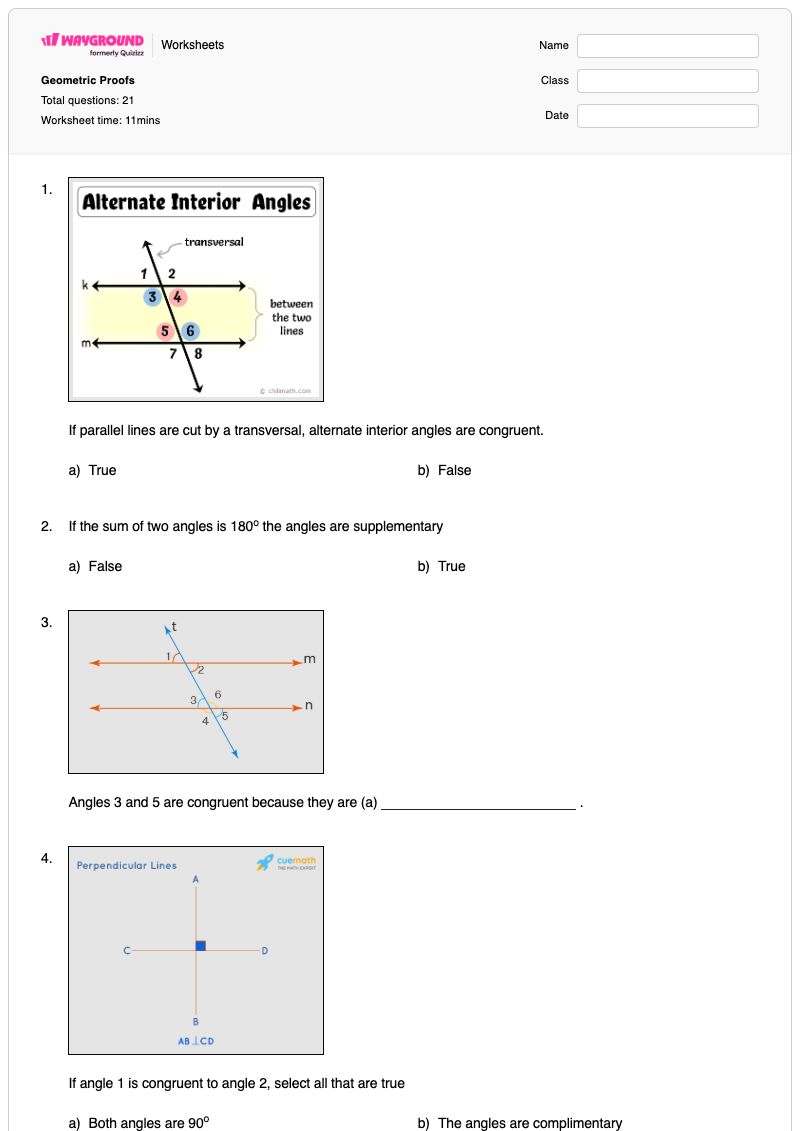
แบบฝึกหัดคณิตศาสตร์ "การพิสูจน์ทางเรขาคณิต" เป็นแบบฝึกหัดที่พิมพ์ได้ฟรีสำหรับนักเรียนระดับชั้น 9-12 ที่กำลังพัฒนาทักษะเกี่ยวกับความสัมพันธ์ของมุม ความสอดคล้อง และการเคลื่อนที่แบบคงรูป แบบฝึกหัดนี้ประกอบด้วย 21 ข้อ ให้นักเรียนได้ฝึกฝนผ่านคำถามแบบเลือกตอบ เติมคำในช่องว่าง และเลือกคำตอบที่ถูกต้อง ซึ่งเกี่ยวข้องกับเส้นขนานที่ถูกตัดด้วยเส้นตัดขวาง มุมตรงข้ามและมุมที่สมนัยกัน มุมภายในสลับ มุมเสริม มุมประชิด และขนาดของมุม แบบฝึกหัดนี้ยังให้นักเรียนแก้หาค่าที่ไม่ทราบค่า ระบุการเลื่อน การสะท้อน และการหมุนเป็นการเคลื่อนที่แบบคงรูป รู้จักว่าการเคลื่อนที่แบบคงรูปใดที่รักษาคุณสมบัติใดไว้ และหาค่ามุมที่สมนัยกัน ด้านที่เท่ากัน และความยาวด้านจากรูปทรงเรขาคณิต รูปแบบคำถามที่หลากหลายต้องการให้นักเรียนจดจำคำจำกัดความ แยกแยะความสัมพันธ์ของมุมที่เกี่ยวข้องกัน เลือกคำตอบที่ถูกต้องทุกข้อ และใช้เหตุผลทางเรขาคณิตแทนที่จะพึ่งพาแบบแผนคำตอบเดียว แบบฝึกหัดนี้เป็นแบบฝึกหัดที่พิมพ์ได้ฟรีพร้อมเฉลยคำตอบครบถ้วน ทำให้มีประโยชน์สำหรับการฝึกฝนแบบมีผู้แนะนำ การทบทวนด้วยตนเอง หรือการประเมินพื้นฐานทางเรขาคณิต

การตั้งค่าแผ่นงาน

ขนาดตัวอักษร

S
M
L
XL
แผ่นงาน

Geometric Proofs

คำถามทั้งหมด: 21

ชื่อ
ระดับ
วันที่
1.

If parallel lines are cut by a transversal, alternate interior angles are congruent.

a)

True

b)

False

2.

If the sum of two angles is 180o the angles are supplementary

a)

False

b)

True

3.

Angles 3 and 5 are congruent because they are (a)   .

4.

If angle 1 is congruent to angle 2, select all that are true

a)

Both angles are 90o

b)

The angles are complimentary

c)

The angles are supplementary

d)

The angles form a linear Pair

5.

If two angles form a (a)   , they are supplementary

6.

Corresponding angles are supplementary if two parallel lines are cut by a transversal

a)

True

b)

False

7.
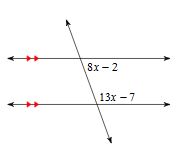
Solve for x.
a)
7
b)
-4
c)
8
d)
9
8.

Select all that are true

a)

Angles D and E are Linear Pairs

b)

Angles A, B and C are supplementary

c)

Angles A and E are congruent

d)

Angles D and B are congruent

9.

Which of the following are rigid motions

a)

Translation

b)

Reflection

c)

Dilation

d)

Rotation

10.

Rigid motions preserve congruency. (shape, size, perimeter, area, side length, and angle measure)

a)

True

b)

False

11.

what is the corresponding angles of ∠T?

(a)  

12.

What is the congruent side of RY?

(a)  

13.

What is the measures of the side TY?

(a)  

14.

Given 

ΔABC ≅ΔDEF \Delta ABC\ \cong\Delta DEF\  
∠A ≅ ?\angle A\ \cong\ ?  

a)

∠D\angle D  

b)

∠E\angle E  

c)

∠F\angle F  

d)

∠C\angle C  

15.

Given 

ΔABC ≅ΔDEF \Delta ABC\ \cong\Delta DEF\  
BC‾ ≅ ?\overline{BC}\ \cong\ ?  

a)

DE‾\overline{DE}  

b)

EF‾\overline{EF}  

c)

DF‾\overline{DF}  

d)

FE‾\overline{FE}  

16.
When quadrilateral PRST is translated to create quadrilateral P'R'S'T', which statement is true?
a)
The side lengths of quadrilateral P'R'S'T' are twice the side lengths of quadrilateral PRST
b)
The angle measures of quadrilateral P'R'S'T' are equal to the corresponding angle measures of quadrilateral PRST
c)
The side lengths of quadrilateral P'R'S'T' are 9 units longer than side lengths of quadrilateral PRST
d)
The angle measures of quadrilateral P'R'S'T' are greater than the angle measures of quadrilateral PRST
17.

Are the figures congruent?

(What type of transformation is shown?)

a)

Congruent (rotation)

b)

Congruent (reflection)

c)

NOT Congruent (rotation)

d)

NOT Congruent (reflection)

18.

Are the figures congruent?

(What type of transformation is shown?)

a)

Congruent (rotation)

b)

Congruent (reflection)

c)

NOT Congruent (rotation)

d)

NOT Congruent (reflection)

19.

Are the figures congruent?

(What type of transformation is shown?)

a)

NOT Congruent (dilation)

b)

NOT Congruent (translation)

c)

Congruent (dilation)

d)

Congruent (translation)

20.

Which statement is true about the transformation?

a)

The transformation preserves congruency and maintains orientation.

b)

The transformation preserves congruency and does not maintains orientation.

c)

The transformation does not preserves congruency but maintains orientation.

d)

The transformation does not preserves congruency or maintains orientation.

21.

Are the figures congruent?

a)

Yes

b)

No

c)

Can not determine

แป้นคำตอบ

Geometric Proofs

คำถามทั้งหมด: 21

1.
a)

True

2.
b)

True

3.
vertical angles, vertical
4.
a)

Both angles are 90o

, c)

The angles are supplementary

, d)

The angles form a linear Pair

5.
linear pair
6.
b)

False

7.
d) 9
8.
a)

Angles D and E are Linear Pairs

, b)

Angles A, B and C are supplementary

, c)

Angles A and E are congruent

9.
a)

Translation

, b)

Reflection

, d)

Rotation

10.
a)

True

11.
B
12.
UY
13.
5, 5cm
14.
a)

∠D\angle D  

15.
b)

EF‾\overline{EF}  

16.
b) The angle measures of quadrilateral P'R'S'T' are equal to the corresponding angle measures of quadrilateral PRST
17.
a)

Congruent (rotation)

18.
b)

Congruent (reflection)

19.
d)

Congruent (translation)

20.
a)

The transformation preserves congruency and maintains orientation.

21.
b)

No

คำถามที่พบบ่อย

แบบฝึกหัดการพิสูจน์ทางเรขาคณิตครอบคลุมเนื้อหาอะไรบ้าง?

แบบฝึกหัดสำหรับนักเรียนระดับชั้น ม.3-ม.6 นี้ ช่วยพัฒนาทักษะในการระบุความสัมพันธ์ของมุมที่เกิดจากเส้นขนานและเส้นตัดขวาง รวมถึงความสัมพันธ์ของมุมตรงข้าม มุมสลับภายใน มุมที่สมนัยกัน มุมเสริมกัน และมุมคู่เส้นตรง แบบฝึกหัดนี้มีคำถามแบบเลือกตอบ เติมคำในช่องว่าง และเลือกคำตอบที่ถูกต้องรวม 21 ข้อ นอกจากนี้ยังช่วยให้นักเรียนแก้หาค่าที่ไม่ทราบค่า ระบุการเคลื่อนที่แบบคงรูป และใช้มุมและด้านที่สมนัยกันในการให้เหตุผลเกี่ยวกับความเท่ากันทุกประการ

ฉันจะใช้แบบฝึกหัดนี้ในการสอนเรื่องความสัมพันธ์ของมุมและความเท่ากันทุกประการได้อย่างไร?

เริ่มแบบฝึกหัดโดยทบทวนวิธีการระบุมุมตรงข้าม มุมที่สมนัยกัน และมุมสลับภายใน จากนั้นเปรียบเทียบความสัมพันธ์ของมุมเสริมและมุมประกอบพร้อมตัวอย่าง ให้นักเรียนอธิบายว่าทำไมข้อความที่เลือกจึงถูกต้อง โดยเฉพาะในข้อที่เลือกได้หลายข้อ ก่อนที่จะทำแบบฝึกหัดเติมคำในช่องว่างเกี่ยวกับคู่มุมเส้นตรง มุมที่สมนัยกัน และด้านที่เท่ากันทุกประการ จบด้วยการเชื่อมโยงการเคลื่อนที่แบบคงรูปกับการรักษารูปทรงและขนาด

ฉันควรระวังข้อผิดพลาดอะไรบ้างในแบบฝึกหัดการพิสูจน์ทางเรขาคณิต?

นักเรียนอาจสับสนระหว่างมุมที่สมนัยกันกับมุมภายในสลับกัน หรืออาจทำเครื่องหมายมุมที่สมนัยกันผิดพลาดว่าเป็นมุมเสริมกันเมื่อแบบฝึกหัดแยกความแตกต่างระหว่างมุมที่สมนัยกันกับมุมที่เท่ากันทุกประการ ระวังความสับสนระหว่างมุมประกอบและมุมเสริมกัน การไม่เลือกตัวเลือกที่ถูกต้องทุกข้อในคำถามแบบเลือกตอบ และการมองว่าการขยายเป็นรูปทรงคงที่ นักเรียนอาจจับคู่ด้านหรือมุมที่สมนัยกันผิดเมื่ออ่านรูปที่มีป้ายกำกับ

ฉันจะมอบหมายและให้คะแนนแบบฝึกหัดการพิสูจน์ทางเรขาคณิตนี้ได้อย่างไร?

แบบฝึกหัดนี้มีให้เลือกทั้งในรูปแบบไฟล์ PDF ที่สามารถพิมพ์ได้ และแบบทดสอบดิจิทัลบน Wayground โดยมีเฉลยคำตอบครบถ้วนสำหรับทุกรูปแบบคำถาม การส่งงานในรูปแบบไฟล์พิมพ์สามารถตรวจได้โดยการสแกนงานของนักเรียนด้วยแอป Wayground for Teachers ในขณะที่เวอร์ชันดิจิทัลรองรับการส่งงานและการตรวจให้คะแนนทางออนไลน์

ฉันจะปรับแบบฝึกหัดการพิสูจน์ทางเรขาคณิตให้เหมาะสมกับนักเรียนของฉันได้อย่างไร?

ใช้การตั้งค่าขั้นสูงของแบบฝึกหัดเพื่อปรับระยะห่างระหว่างตัวอักษรและขนาดตัวอักษร เพื่อให้แผนภาพมุม ป้ายกำกับ และคำถามเติมคำในช่องว่างอ่านง่ายขึ้น นอกจากนี้ คุณยังสามารถเปิดใช้งานแบบอักษรที่เหมาะสำหรับผู้ที่มีภาวะดิสเล็กเซีย หรือแปลแบบฝึกหัดเป็นภาษาอื่นเมื่อเป็นประโยชน์สำหรับนักเรียนที่กำลังเรียนรู้คำศัพท์และคำแนะนำทางเรขาคณิต

ฉันจะหาแบบฝึกหัดแบบนี้เพิ่มเติมได้ที่ไหนบน Wayground?

Wayground นำเสนอชุดแบบฝึกหัดและโจทย์ฝึกหัดฟรีที่ครอบคลุมหลากหลายวิชา พร้อมไฟล์ PDF และเฉลยคำตอบ เพื่อช่วยให้นักเรียนเชี่ยวชาญทักษะและแนวคิดที่สำคัญ ดูแหล่งข้อมูลเพิ่มเติมได้ที่ https://wayground.com/en-us/worksheets