แบบทดสอบประวัติศาสตร์กายวิภาคศาสตร์ ชุดที่ 1 เป็นแบบฝึกหัดวิทยาศาสตร์และชีววิทยาสำหรับนักเรียนชั้นมัธยมศึกษาปีที่ 6 ที่ทบทวนพัฒนาการของความรู้ทางกายวิภาคศาสตร์ผ่านผลงานของบุคคลสำคัญในประวัติศาสตร์ นักเรียนจะได้ระบุว่า Andreas Vesalius คือบิดาแห่งกายวิภาคศาสตร์สมัยใหม่ เชื่อมโยง Galen of Pergamen กับการผ่าศพลิงบาร์บารี รู้จักคำอธิบายของ William Harvey เกี่ยวกับหัวใจและการไหลเวียนของเลือด และระบุถึงผลงานของ Marcello Malpighi ในการสังเกตหลอดเลือดขนาดเล็ก แบบฝึกหัดนี้ยังกล่าวถึงข้อจำกัดในยุคแรกๆ เกี่ยวกับการผ่าศพมนุษย์ หนังสือ De Humani Corporis Fabrica ของ Vesalius และคำว่า การชันสูตรศพ
แบบฝึกหัดที่พิมพ์ได้ฟรีนี้ประกอบด้วยคำถามแบบเลือกตอบ 10 ข้อ และคำถามแบบเลือกคำตอบ 2 ข้อ เพื่อตรวจสอบความจำและความสามารถของนักเรียนในการแยกแยะนักวิทยาศาสตร์ การค้นพบ แนวปฏิบัติทางประวัติศาสตร์ และคำศัพท์ที่เกี่ยวข้องกับกายวิภาคศาสตร์ เหมาะสำหรับการทบทวนชีววิทยาชั้นมัธยมศึกษาปีที่ 6 บทเรียนเบื้องต้นเกี่ยวกับประวัติศาสตร์กายวิภาคศาสตร์ หรือการประเมินผลหลังการสอน มีเฉลยคำตอบครบถ้วนเพื่อช่วยในการตรวจสอบและให้ข้อเสนอแนะอย่างมีประสิทธิภาพ
การตั้งค่าแผ่นงาน
ขนาดตัวอักษร
S
M
L
XL
แผ่นงาน
History of Anatomy Quiz 1
คำถามทั้งหมด: 12
ชื่อ
ระดับ
วันที่
1.
Who was regarded as the "Father of Modern Anatomy"
a)
Galen of Pergamen
b)
Leonardo Davinci
c)
Andreas Vesalius
d)
Willam Harvey
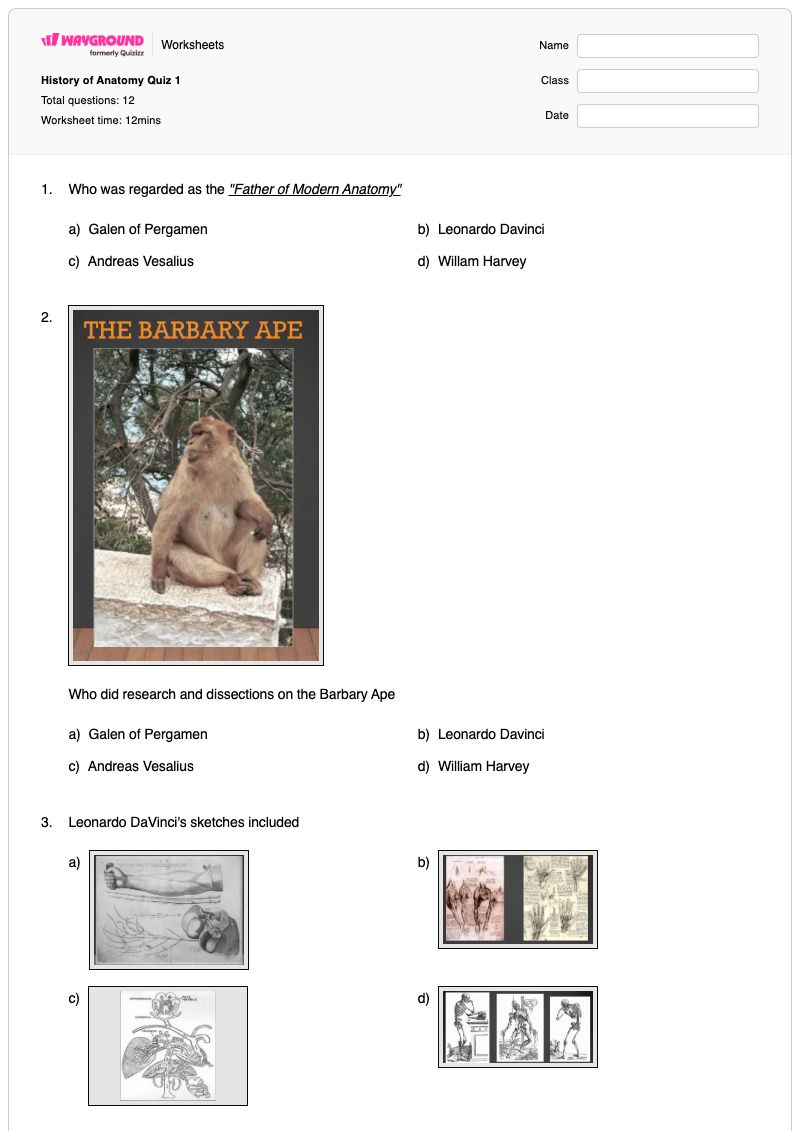
2.
Who did research and dissections on the Barbary Ape
a)
Galen of Pergamen
b)
Leonardo Davinci
c)
Andreas Vesalius
d)
William Harvey
3.
Leonardo DaVinci's sketches included
a)
b)
c)
d)
4.
William Harvey was the first person to describe
a)
the use of mummification
b)
the labeling of muscles and positioning of layers
c)
we descended from apes
d)
described the heart as a pump pushing blood through arteries and veins
5.
Dissecting human bodies was against the law because
a)
it was too messy
b)
early cultures were very superstitious and believed in the afterlife
c)
it was against God's will
d)
women wanted to perform surgeries
6.
Who is Galen of Pergamen
a)
b)
c)
d)
7.
Only __________ were allowed to be dissected because these early cultures were very superstitious and believed that an intact body was necessary for a successful afterlife and their bodies were ripped to pieces
a)
doctors
b)
criminals
c)
the church
d)
women
8.
This man also published his own anatomy textbookDE HUMANI CORPORIS FABRICAwhich contained many anatomically accurate drawings based on human dissections.
a)
Leonardo DaVinci
b)
Galen of Pergamen
c)
William Harvey
d)
Adreas Vesalius
9.
Which illustration did William Harvey contribute to Anatomy
a)
b)
c)
d)
10.
With the development of the microscope, the Italian anatomist, ____________________ was able to see the tiny blood vessels that Harvey could not see but had predicted their presence.
a)
MARCELLO MALPIGHI
b)
WILLIAM HARVEY
c)
ANDREAS VESALIUS
d)
LEONARDO DAVINCI
11.
This man showed that “function can be inferred from structure” and thus became known as the “Father of Physiology”.
a)
b)
c)
d)
12.
In the year 1286 we have reference to a human dissection being performed to determine the cause of death. Today, this procedure is called an __________
a)
autopsy
b)
criminal act
c)
take your dog to work day
แป้นคำตอบ
History of Anatomy Quiz 1
คำถามทั้งหมด: 12
1.
c)
Andreas Vesalius
2.
a)
Galen of Pergamen
3.
b)
4.
d)
described the heart as a pump pushing blood through arteries and veins
5.
b)
early cultures were very superstitious and believed in the afterlife


 แผ่นงาน


