

Wayground
Central Idea - Printable English Worksheets - Wayground

Central Idea

15 คำถาม

5th - 5th ระดับชั้น

English

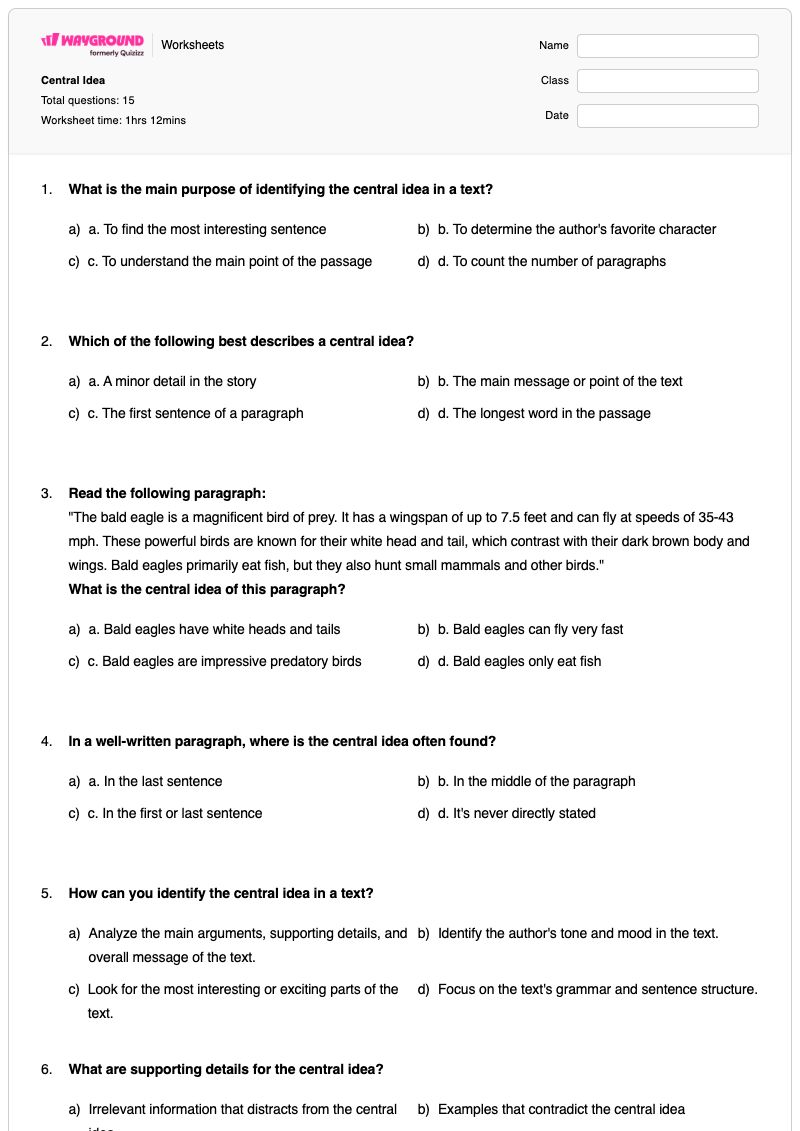
แบบฝึกหัด "ใจความสำคัญ" สำหรับนักเรียนชั้นประถมศึกษาปีที่ 5 นี้ ช่วยให้นักเรียนระบุประเด็นหลักหรือสาระสำคัญของข้อความ และแยกแยะความแตกต่างจากรายละเอียดสนับสนุน แบบฝึกหัดนี้ประกอบด้วยคำถามแบบเลือกตอบ 15 ข้อ ช่วยให้นักเรียนทบทวนว่าทำไมใจความสำคัญจึงมีความสำคัญ ตำแหน่งที่อาจปรากฏในย่อหน้า วิธีการใช้สาระสำคัญโดยรวมและข้อโต้แย้งหลักของผู้เขียน และวิธีที่รายละเอียดสนับสนุนให้หลักฐานหรือคำอธิบาย นอกจากนี้ นักเรียนยังสามารถนำทักษะเหล่านี้ไปใช้กับย่อหน้าข้อมูลสั้นๆ เกี่ยวกับนกอินทรีหัวขาว การรีไซเคิล กำแพงเมืองจีน สุนัขเป็นสัตว์เลี้ยง และการเปลี่ยนแปลงสภาพภูมิอากาศ พวกเขาต้องเลือกใจความสำคัญที่กว้างๆ แทนที่จะเลือกข้อเท็จจริงเพียงอย่างเดียว และระบุรายละเอียดที่สนับสนุนประเด็นหลักของข้อความ แบบฝึกหัดที่พิมพ์ได้ฟรีนี้มีเฉลยครบถ้วน และออกแบบมาสำหรับการฝึกฝนการอ่านเพื่อความเข้าใจ การทำงานอิสระ การทบทวน หรือการประเมินผลระหว่างเรียนของนักเรียนชั้นประถมศึกษาปีที่ 5

การตั้งค่าแผ่นงาน

ขนาดตัวอักษร

S
M
L
XL
แผ่นงาน

Central Idea

คำถามทั้งหมด: 15

ชื่อ
ระดับ
วันที่
1.

What is the main purpose of identifying the central idea in a text?

a)

a. To find the most interesting sentence

b)

b. To determine the author's favorite character

c)

c. To understand the main point of the passage

d)

d. To count the number of paragraphs


2.

Which of the following best describes a central idea?

a)

a. A minor detail in the story

b)

b. The main message or point of the text

c)

c. The first sentence of a paragraph

d)

d. The longest word in the passage


3.

Read the following paragraph:

"The bald eagle is a magnificent bird of prey. It has a wingspan of up to 7.5 feet and can fly at speeds of 35-43 mph. These powerful birds are known for their white head and tail, which contrast with their dark brown body and wings. Bald eagles primarily eat fish, but they also hunt small mammals and other birds."

What is the central idea of this paragraph?

a)

a. Bald eagles have white heads and tails

b)

b. Bald eagles can fly very fast

c)

c. Bald eagles are impressive predatory birds

d)

d. Bald eagles only eat fish


4.

In a well-written paragraph, where is the central idea often found?

a)

a. In the last sentence

b)

b. In the middle of the paragraph

c)

c. In the first or last sentence

d)

d. It's never directly stated


5.

How can you identify the central idea in a text?

a)

Analyze the main arguments, supporting details, and overall message of the text.

b)

Identify the author's tone and mood in the text.

c)

Look for the most interesting or exciting parts of the text.

d)

Focus on the text's grammar and sentence structure.

6.

What are supporting details for the central idea?

a)

Irrelevant information that distracts from the central idea

b)

Examples that contradict the central idea

c)

Specific pieces of information that support or explain the central idea of a text.

d)

Opinions that challenge the central idea

7.

Why are supporting details important in understanding the central idea?

a)

Supporting details distract from the central idea.

b)

Supporting details are irrelevant to the central idea.

c)

Supporting details confuse the central idea.

d)

Supporting details provide evidence and examples that clarify and reinforce the central idea.

8.

When trying to decide the main idea of a text, what is the first question you need to ask yourself?

a)

What are the vocabulary words

b)

What am I doing?

c)

What does the author want me to know about the topic?

9.

Read the following paragraph:

"Recycling is an important way to help our planet. When we recycle, we reduce the amount of waste in landfills. It also helps conserve natural resources by reusing materials. Recycling can save energy and reduce pollution too. Everyone can make a difference by recycling at home and school."

What is the central idea of this paragraph?

a)

a. Landfills are full of waste

b)

b. Natural resources are limited

c)

c. Recycling is beneficial for the environment

d)

d. Schools should have recycling programs


10.

How does identifying the central idea help a reader?

a)

a. It makes the story more exciting

b)

b. It helps the reader understand the main point

c)

c. It allows the reader to skip parts of the text

d)

d. It tells the reader how long the text is


11.

Read the following paragraph:

"The Great Wall of China is one of the most impressive structures in the world. It stretches over 13,000 miles across northern China. The wall was built over many centuries to protect Chinese states from invasions. Today, it's a popular tourist attraction and a symbol of Chinese history and culture."

What is the central idea of this paragraph?**

a)

a. The Great Wall is very long

b)

b. The Great Wall is a significant Chinese landmark

c)

c. Many tourists visit the Great Wall

d)

d. The Great Wall took a long time to build


12.

How is the central idea different from supporting details?

a)

a. The central idea is more specific than supporting details

b)

b. Supporting details explain or prove the central idea

c)

c. The central idea is always the last sentence

d)

d. Supporting details are more important than the central idea


13.

Read the following paragraph:

"Dogs make wonderful pets for many reasons. They are loyal companions who offer unconditional love to their owners. Dogs can also provide protection and make people feel safe. Additionally, taking care of a dog encourages exercise through daily walks and playtime. Owning a dog can even help reduce stress and improve overall health."

What is the central idea of this paragraph?

a)

a. Dogs need daily exercise

b)

b. Dogs can help reduce stress

c)

c. Dogs are great pets for various reasons

d)

d. Dogs provide protection for their owners


14.

Supporting details in a text are used to:

a)

a. Contradict the central idea

b)

b. Replace the central idea

c)

c. Provide evidence for the central idea

d)

d. Confuse the reader


15.

Read the following paragraph and identify a supporting detail:

"Climate change is affecting our planet in many ways. Rising temperatures are causing glaciers to melt, leading to rising sea levels. This puts coastal communities at risk of flooding. Additionally, changing weather patterns are causing more frequent and severe storms, droughts, and wildfires."**

Which of the following is a supporting detail for the central idea of climate change impacts?

a)

a. Climate change is affecting our planet

b)

b. Rising temperatures are causing glaciers to melt

c)

c. Our planet is round

d)

d. Climate change is not real


แป้นคำตอบ

Central Idea

คำถามทั้งหมด: 15

1.
c)

c. To understand the main point of the passage

2.
b)

b. The main message or point of the text

3.
c)

c. Bald eagles are impressive predatory birds

4.
c)

c. In the first or last sentence

5.
a)

Analyze the main arguments, supporting details, and overall message of the text.

6.
c)

Specific pieces of information that support or explain the central idea of a text.

7.
d)

Supporting details provide evidence and examples that clarify and reinforce the central idea.

8.
c)

What does the author want me to know about the topic?

9.
c)

c. Recycling is beneficial for the environment

10.
b)

b. It helps the reader understand the main point

11.
b)

b. The Great Wall is a significant Chinese landmark

12.
b)

b. Supporting details explain or prove the central idea

13.
c)

c. Dogs are great pets for various reasons

14.
c)

c. Provide evidence for the central idea

15.
b)

b. Rising temperatures are causing glaciers to melt

คำถามที่พบบ่อย

แบบฝึกหัดแนวคิดหลักนี้ช่วยให้นักเรียนชั้นประถมศึกษาปีที่ 5 เรียนรู้อะไร?

แบบฝึกหัดนี้ช่วยให้นักเรียนระบุใจความสำคัญหรือข้อความหลักของย่อหน้า และแยกแยะออกจากรายละเอียดสนับสนุนแต่ละส่วน แบบฝึกหัดนี้มีคำถามแบบเลือกตอบ 15 ข้อ ที่จะให้นักเรียนนำทักษะนี้ไปใช้กับย่อหน้าสั้นๆ เกี่ยวกับหัวข้อต่างๆ เช่น นกอินทรีหัวขาว การรีไซเคิล กำแพงเมืองจีน สุนัข และการเปลี่ยนแปลงสภาพภูมิอากาศ พร้อมทั้งทบทวนว่าหลักฐานและตัวอย่างต่างๆ สนับสนุนประเด็นหลักอย่างไร

ฉันจะใช้แบบฝึกหัดนี้ในการสอนเรื่องใจความสำคัญและรายละเอียดสนับสนุนได้อย่างไร?

เริ่มต้นด้วยการสาธิตวิธีการสรุปใจความสำคัญของย่อหน้าด้วยคำพูดของคุณเอง แทนที่จะเลือกข้อเท็จจริงที่น่าสนใจเพียงข้อเดียว จากนั้นให้นักเรียนพิจารณาข้อความสั้นๆ ในแบบฝึกหัดนี้ ขีดเส้นใต้รายละเอียดที่สนับสนุนใจความสำคัญของผู้เขียน และอธิบายว่าทำไมคำตอบที่ครอบคลุมจึงมีน้ำหนักมากกว่ารายละเอียดเพียงอย่างเดียว ใช้ข้อสอบแบบเลือกตอบเพื่ออภิปรายว่าจุดประสงค์ ข้อโต้แย้งหลัก และใจความสำคัญโดยรวมของผู้เขียนเป็นแนวทางในการตอบคำถามอย่างไร

ฉันควรระวังข้อผิดพลาดอะไรบ้างเมื่อนักเรียนทำแบบฝึกหัดหาใจความสำคัญนี้?

นักเรียนอาจเลือกรายละเอียดสนับสนุนที่ชัดเจน เช่น ความกว้างของปีกนกอินทรีหัวขาว ผลกระทบของการรีไซเคิลต่อหลุมฝังกลบขยะ หรือความยาวของกำแพงเมืองจีน แทนที่จะเลือกใจความสำคัญที่กว้างกว่า นอกจากนี้ พวกเขาอาจเข้าใจผิดว่าประโยคแรกเป็นใจความสำคัญโดยอัตโนมัติ แม้ว่าแบบฝึกหัดจะสอนให้นักเรียนพิจารณาทั้งย่อหน้าก็ตาม สำหรับหัวข้อการเปลี่ยนแปลงสภาพภูมิอากาศ ให้ตรวจสอบว่าพวกเขาเข้าใจว่าการละลายของธารน้ำแข็งเป็นหลักฐานสนับสนุนมากกว่าเป็นข้ออ้างโดยรวมของเนื้อหา

ฉันจะมอบหมายและให้คะแนนแบบฝึกหัดแนวคิดหลักนี้ได้อย่างไร?

คุณสามารถมอบหมายแบบฝึกหัดนี้เป็นไฟล์ PDF ที่พิมพ์ได้ หรือเป็นแบบทดสอบดิจิทัลบน Wayground แบบฝึกหัดนี้มีเฉลยคำตอบครบถ้วนสำหรับตรวจสอบคำตอบแบบเลือกตอบ 15 ข้อ และสามารถตรวจงานส่งของนักเรียนได้โดยการสแกนงานของนักเรียนด้วยแอป Wayground for Teachers รูปแบบที่พิมพ์ได้ยังช่วยสนับสนุนโรงเรียนที่ต้องการลดเวลาการใช้หน้าจอได้อีกด้วย

แบบฝึกหัดนี้ช่วยให้นักเรียนแยกแยะความคิดหลักออกจากรายละเอียดสนับสนุนได้อย่างไร?

คำถามหลายข้อจะเปรียบเทียบข้อความหลักกับข้อมูลเฉพาะที่อธิบายหรือพิสูจน์ข้อความนั้นโดยตรง นักเรียนจะได้ฝึกฝนการเลือกข้อความกว้างๆ เช่น ประโยชน์ของการรีไซเคิล หรือความสำคัญของกำแพงเมืองจีน เป็นแนวคิดหลัก จากนั้นจึงระบุหลักฐาน เช่น การละลายของธารน้ำแข็ง หรือข้อเท็จจริงอื่นๆ ในย่อหน้า เพื่อเป็นรายละเอียดสนับสนุน

ฉันจะหาแบบฝึกหัดฟรีแบบนี้เพิ่มเติมได้ที่ไหนบน Wayground?

Wayground นำเสนอชุดแบบฝึกหัดและโจทย์ฝึกหัดฟรีที่ครอบคลุมทุกวิชา พร้อมไฟล์ PDF และเฉลยคำตอบ เพื่อช่วยให้นักเรียนเชี่ยวชาญทักษะและแนวคิดที่สำคัญ ดูแหล่งข้อมูลเพิ่มเติมได้ที่ https://wayground.com/en-us/worksheets