

Wayground
photosynthesis and respiration - Printable ศาสตร์ Worksheets 9th ระดับชั้น - Wayground

photosynthesis and respiration

Megan Corona

สร้างโดย Megan Corona

20 คำถาม

9th ระดับชั้น

ศาสตร์

อัปเดตแล้ว ต.ค. 2569

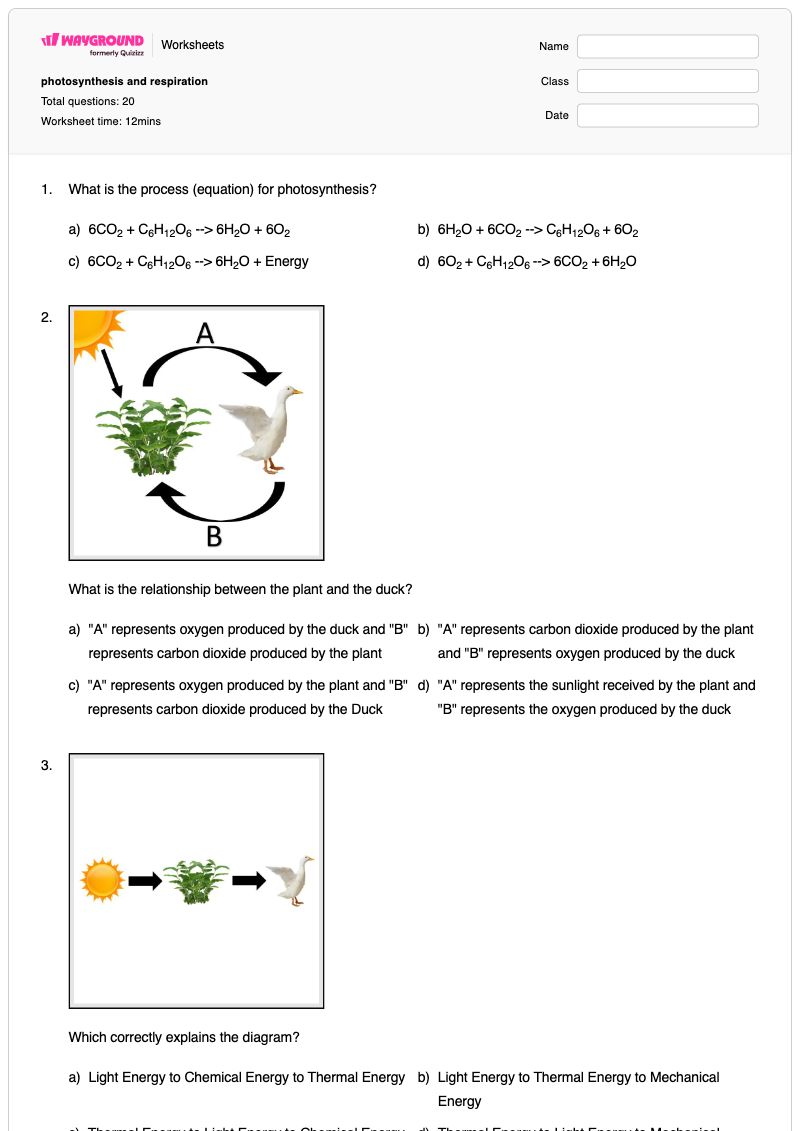
แบบฝึกหัดวิทยาศาสตร์ระดับชั้น ม.3 เรื่องการสังเคราะห์แสงและการหายใจ ประกอบด้วยคำถามแบบเลือกตอบ 20 ข้อ ที่เชื่อมโยงสมการ ผลิตภัณฑ์ สารตั้งต้น และการเปลี่ยนแปลงพลังงานของการสังเคราะห์แสงและการหายใจระดับเซลล์ นักเรียนจะได้ระบุสมการการสังเคราะห์แสง อธิบายวิธีการแลกเปลี่ยนก๊าซของพืชและสัตว์ ติดตามคาร์บอนจากคาร์บอนไดออกไซด์ไปเป็นกลูโคสและผ่านห่วงโซ่อาหาร และตระหนักว่าดวงอาทิตย์เป็นแหล่งพลังงานหลัก นอกจากนี้ พวกเขายังระบุ ATP ว่าเป็นโมเลกุลพลังงาน กำหนดสิ่งที่เกิดขึ้นกับพลังงานที่ไม่ได้ใช้ และตีความสมการการหายใจระดับเซลล์และผลิตภัณฑ์ของมัน แบบฝึกหัดนี้ช่วยให้นักเรียนแยกแยะความแตกต่างระหว่างสองกระบวนการนี้ว่าใช้และเปลี่ยนแปลงสสารและพลังงานอย่างไร แทนที่จะท่องจำคำศัพท์ที่แยกจากกัน รูปแบบคำถามแบบเลือกตอบช่วยให้ครูตรวจสอบความเข้าใจของนักเรียนเกี่ยวกับกระบวนการผลิตกลูโคส การแลกเปลี่ยนออกซิเจนและคาร์บอนไดออกไซด์ การสูญเสียความร้อน และการถ่ายโอนพลังงานในระบบสิ่งมีชีวิตได้อย่างตรงจุด แบบฝึกหัดนี้สามารถพิมพ์ได้ฟรี พร้อมเฉลยคำตอบครบถ้วน เหมาะสำหรับใช้ในการสอน การทบทวน หรือการประเมินผลระหว่างเรียนวิชาวิทยาศาสตร์ระดับชั้น ม.3

การตั้งค่าแผ่นงาน

ขนาดตัวอักษร

S
M
L
XL
Waygroundแผ่นงาน

photosynthesis and respiration

คำถามทั้งหมด: 20

ชื่อ
ระดับ
วันที่
1.

What is the process (equation) for photosynthesis?

a)

6CO2 + C6H12O6 --> 6H2O + 6O2

b)

6H2O + 6CO2 --> C6H12O6 + 6O2

c)

6CO2 + C6H12O6 --> 6H2O + Energy

d)

6O2 + C6H12O6 --> 6CO2 + 6H2O

2.
What is the relationship between the plant and the duck?

What is the relationship between the plant and the duck?

a)

"A" represents oxygen produced by the duck and "B" represents carbon dioxide produced by the plant

b)

"A" represents carbon dioxide produced by the plant and "B" represents oxygen produced by the duck

c)

"A" represents oxygen produced by the plant and "B" represents carbon dioxide produced by the Duck

d)

"A" represents the sunlight received by the plant and "B" represents the oxygen produced by the duck

3.
Which correctly explains the diagram?

Which correctly explains the diagram?

a)

Light Energy to Chemical Energy to Thermal Energy

b)

Light Energy to Thermal Energy to Mechanical Energy

c)

Thermal Energy to Light Energy to Chemical Energy

d)

Thermal Energy to Light Energy to Mechanical Energy

4.

What is produced in the leaves of the plant?

a)

oxygen and water

b)

carbon dioxide only

c)

glucose and oxygen

d)

oxygen only

5.

During photosynthesis the carbon atoms from the carbon dioxide molecule are turned into

a)

oxygen

b)

glucose

c)

water

d)

hydrogen

6.
Which describes the transfer in this image?

Which describes the transfer in this image?

a)

Carbon Dioxide from the air becomes glucose in the plant. The deer ingest the glucose and it becomes carbon.

b)

Carbon Dioxide from the air becomes water in the plant. The deer ingest the water and it becomes oxygen.

c)

Oxygen from the air becomes carbon dioxide in the plant. The deer ingest the carbon dioxide and it becomes carbon.

d)

Water from the air becomes Oxygen in the plant. The deer ingest the Water and it becomes Oxygen.

7.
As you move up the energy pyramid, 90% of the energy is lost. What happens to this energy?

As you move up the energy pyramid, 90% of the energy is lost. What happens to this energy?

a)

It is lost as heat or thermal energy

b)

It is lost to the sun

c)

This statement is not true

d)

The law of conservation does not apply to living systems

8.

What is the primary source of energy for all food chains or webs?

a)

decomposers

b)

producers

c)

consumers

d)

the sun

9.
What is the energy molecule?
a)
DNA
b)
ATP
c)
RNA
d)
AAA
10.
After cellular respiration is complete, on 38% of the energy in glucose is used. What happens to the rest of the energy?
a)
released as heat
b)
stored for later use
c)
eliminated by the digestive system
d)
turned into protein
11.
What gas is released into the air during cellular respiration?
a)
oxygen
b)
carbon dioxide
c)
water 
d)
glucose
12.

Cellular respiration is the process that our cells use to ….

a)

convert sugar (glucose) into energy (ATP)

b)

break food down into smaller molecules (sugars)

c)

makes acid

d)

breathe

13.

Where do animals get the glucose that is needed for cellular respiration?

a)

from the exercise they get

b)

from the water they drink

c)

from the food they eat

d)

from the sunlight they get

14.
What is the correct equation for cellular respiration?
a)
6O2 + C6H12O6 -> 6CO2 + 6H2O + Energy
b)
6O2 + C6H12O6 + Energy -> 6CO2 + 6H2O
c)
6CO2 + 6H2O -> 6O2 + C6H12O6 + Energy
d)
6CO2 + 6H2O + Energy -> 6O2 + C6H12O6
15.
Which of the following molecules can NOT be rearranged to form C6H12O6 (glucose)

Which of the following molecules can NOT be rearranged to form C6H12O6 (glucose)

a)
Protein

Protein

b)
Carbohydrate

Carbohydrate

c)
Fat

Fat

d)
Salt

Salt

16.

When there is not enough light.....

a)

...the rate of photosynthesis is at the optimum.

b)

...the rate of photosynthesis is limited.

c)

...the rate of photosynthesis will not be affected.

17.

Why does the amount of water affect rate of photosynthesis?

a)

It is produced by the reaction

b)

It is used in the reaction

c)

It affects the enzymes responsible for the reaction

d)

The plant cells have to stay turgid

18.

Which of the following is responsible for plants mass?

a)

carbon dioxide in the atmosphere

b)

Oxygen in the atmosphere

c)

Water in the soil

d)

nutrients in the soil

19.
The following graph represents a plant in a sealed ecosystem where the levels of carbon dioxide (pink) and oxygen (green)…

The following graph represents a plant in a sealed ecosystem where the levels of carbon dioxide (pink) and oxygen (green) can be observed.

Which of the following explains the changes to the gas levels over the 24 hour period?

a)

Carbon increases at night because there is less photosynthesis and more cellular respiration occuring in the plant

b)

Carbon increases during the day because there is less photosynthesis and more cellular respiration occuring in the plant

c)

Oxygen increases at night because there is more photosynthesis occuring in the dark

d)

cellular respiration does not occur in plants, so carbon dioxide decreases during the day in the light and never increases again.

20.
Why is the human body made up of only 1% carbohydrates if they eat 72% carbs each day?

Why is the human body made up of only 1% carbohydrates if they eat 72% carbs each day?

a)

All of the carbohydrates are used for cellular respiration and are no longer in the body

b)

Some carbohydrates are used for cellular respiration, others are rearranged into fat

c)

carbohydrates that are not needed are destroyed

d)

carbohydrates atoms are changed to other atoms

Waygroundแป้นคำตอบ

photosynthesis and respiration

คำถามทั้งหมด: 20

1.
b)

6H2O + 6CO2 --> C6H12O6 + 6O2

2.
c)

"A" represents oxygen produced by the plant and "B" represents carbon dioxide produced by the Duck

3.
a)

Light Energy to Chemical Energy to Thermal Energy

4.
c)

glucose and oxygen

5.
b)

glucose

6.
a)

Carbon Dioxide from the air becomes glucose in the plant. The deer ingest the glucose and it becomes carbon.

7.
a)

It is lost as heat or thermal energy

8.
d)

the sun

9.
b) ATP
10.
a) released as heat
11.
b) carbon dioxide
12.
a)

convert sugar (glucose) into energy (ATP)

13.
c)

from the food they eat

14.
a) 6O2 + C6H12O6 -> 6CO2 + 6H2O + Energy
15.
d)
16.
b)

...the rate of photosynthesis is limited.

17.
b)

It is used in the reaction

18.
a)

carbon dioxide in the atmosphere

19.
a)

Carbon increases at night because there is less photosynthesis and more cellular respiration occuring in the plant

20.
b)

Some carbohydrates are used for cellular respiration, others are rearranged into fat

คำถามที่พบบ่อย

แบบฝึกหัดเรื่องการสังเคราะห์แสงและการหายใจนี้ครอบคลุมหัวข้ออะไรบ้าง?

แบบฝึกหัดวิทยาศาสตร์ระดับชั้น ม.3 นี้ประกอบด้วยคำถามแบบเลือกตอบ 20 ข้อ เพื่อประเมินความเข้าใจเกี่ยวกับกระบวนการสังเคราะห์แสงและการหายใจระดับเซลล์ นักเรียนจะต้องเลือกและตีความสมการของทั้งสองกระบวนการ ระบุกลูโคส ออกซิเจน คาร์บอนไดออกไซด์ น้ำ และ ATP ในบริบทต่างๆ และติดตามการเคลื่อนที่ของสสารและพลังงานผ่านพืช สัตว์ และห่วงโซ่อาหาร

ฉันจะใช้แบบฝึกหัดนี้ในการสอนเรื่องการสังเคราะห์แสงและการหายใจระดับเซลล์ได้อย่างไร?

แนะนำสมการทั้งสองโดยให้นักเรียนระบุว่าอะไรเข้าและออกจากแต่ละกระบวนการ จากนั้นใช้คำถามเกี่ยวกับการแลกเปลี่ยนก๊าซระหว่างพืชและสัตว์ และการเปลี่ยนคาร์บอนเป็นกลูโคส เพื่อเชื่อมโยงสมการเข้ากับระบบสิ่งมีชีวิต หลังจากที่นักเรียนทำข้อสอบแบบเลือกตอบเสร็จแล้ว ให้ถามพวกเขาถึงเหตุผลว่าทำไมการสังเคราะห์แสงจึงเก็บพลังงานแสงไว้ในรูปของพลังงานเคมี ในขณะที่การหายใจระดับเซลล์เปลี่ยนกลูโคสเป็น ATP และปล่อยพลังงานบางส่วนออกมาในรูปของความร้อน

ฉันควรสังเกตข้อผิดพลาดอะไรบ้างเมื่อนักเรียนทำแบบฝึกหัดนี้เสร็จ?

ระวังนักเรียนที่สลับสารตั้งต้นและผลิตภัณฑ์ในสมการการสังเคราะห์แสงและการหายใจระดับเซลล์ โดยเฉพาะอย่างยิ่งการสับสนระหว่างคาร์บอนไดออกไซด์กับออกซิเจน นักเรียนอาจระบุว่ากลูโคสเป็นก๊าซ มองว่า ATP เป็นแหล่งอาหารแทนที่จะเป็นโมเลกุลพลังงาน หรือเข้าใจผิดว่าพลังงานถูกทำลายไปเมื่อแบบฝึกหัดถามว่าเกิดอะไรขึ้นกับพลังงานที่สูญเสียไปจากห่วงโซ่อาหารและการหายใจระดับเซลล์

ฉันจะมอบหมายและตรวจงานแบบฝึกหัดเรื่องการสังเคราะห์แสงและการหายใจนี้อย่างไร?

คุณสามารถมอบหมายงานนี้บน Wayground ในรูปแบบไฟล์ PDF ที่พิมพ์ได้ หรือเป็นแบบทดสอบดิจิทัล และแบบฝึกหัดนี้มีเฉลยคำตอบครบถ้วนสำหรับคำถามแบบเลือกตอบทั้ง 20 ข้อ สำหรับการส่งงานแบบพิมพ์ได้ ให้สแกนงานของนักเรียนด้วยแอป Wayground for Teachers เพื่อตรวจให้คะแนนได้อย่างมีประสิทธิภาพ

ฉันจะปรับแบบฝึกหัดเรื่องการสังเคราะห์แสงและการหายใจนี้ให้เหมาะสมกับนักเรียนของฉันได้อย่างไร?

ใช้การตั้งค่าขั้นสูงของแบบฝึกหัดเพื่อเพิ่มขนาดตัวอักษรหรือระยะห่างรอบคำถามแบบเลือกตอบ เลือกแบบอักษรที่เหมาะสำหรับผู้ที่มีภาวะดิสเล็กเซีย หรือแปลแบบฝึกหัดเป็นภาษาอื่น ตัวเลือกเหล่านี้สามารถทำให้ข้อสอบแบบสมการและตัวเลือกคำตอบอ่านง่ายขึ้นโดยไม่เปลี่ยนแปลงเนื้อหาเกี่ยวกับการสังเคราะห์แสงและการหายใจระดับเซลล์

ฉันจะหาแบบฝึกหัดแบบนี้เพิ่มเติมได้ที่ไหนบน Wayground?

Wayground นำเสนอชุดแบบฝึกหัดและโจทย์ฝึกหัดฟรีที่ครอบคลุมหลากหลายวิชา รวมถึงไฟล์ PDF และเฉลยคำตอบที่จะช่วยส่งเสริมการเรียนรู้ทักษะและแนวคิดที่สำคัญ ดูแหล่งข้อมูลเพิ่มเติมได้ที่ https://wayground.com/en-us/worksheets