

Wayground
Origins of Civilization - Printable สังคมศึกษา Worksheets ระดับ 6 - Wayground

Origins of Civilization

Jacqueline Beckmann

สร้างโดย Jacqueline Beckmann

18 คำถาม

6th ระดับชั้น

สังคมศึกษา

อัปเดตแล้ว ต.ค. 2568

แบบฝึกหัดเรื่องต้นกำเนิดอารยธรรมสำหรับนักเรียนชั้นประถมศึกษาปีที่ 6 สามารถพิมพ์ได้ฟรี พร้อมเฉลยคำตอบ แบบฝึกหัดนี้จะตรวจสอบว่าหลักฐานทางโบราณคดีช่วยให้นักประวัติศาสตร์เข้าใจมนุษย์ยุคแรกและการกำเนิดอารยธรรมได้อย่างไร ประกอบด้วยคำถาม 18 ข้อ แบ่งเป็นคำถามแบบเลือกตอบ 14 ข้อ และคำถามแบบเลือกตอบหลายข้อ 4 ข้อ ครอบคลุมหัวข้อต่างๆ เช่น ชั้นดินจากการขุดค้น การค้นพบฟอสซิล วิธีการฝังศพของมนุษย์นีแอนเดอร์ทาล การใช้ไฟ การอพยพของมนุษย์ การหาอาหารในยุคหินเก่า และความสามารถที่มนุษย์ยุคแรกมีร่วมกัน นอกจากนี้ นักเรียนยังจะได้เชื่อมโยงการเกษตร หุบเขาแม่น้ำที่อุดมสมบูรณ์ และอาหารที่เหลือเฟือกับการพัฒนาหมู่บ้านและเมืองต่างๆ พวกเขาจะตีความหลักฐานจากโครงกระดูก โบราณวัตถุ ภาพวาดในถ้ำ และแม่น้ำ และระบุว่ามนุษย์ยุคแรกปรับเปลี่ยนสภาพแวดล้อมอย่างไรผ่านการชลประทาน การถางป่า และการเลี้ยงสัตว์ แบบฝึกหัดนี้ออกแบบมาสำหรับใช้ในการสอนวิชาสังคมศึกษาชั้นประถมศึกษาปีที่ 6 ช่วยให้ครูสามารถตรวจสอบความเข้าใจของนักเรียนเกี่ยวกับหลักฐาน การปรับตัว และการเปลี่ยนแปลงทางสิ่งแวดล้อมที่เกี่ยวข้องกับต้นกำเนิดอารยธรรมได้อย่างมีประสิทธิภาพ

การตั้งค่าแผ่นงาน

ขนาดตัวอักษร

S
M
L
XL
Waygroundแผ่นงาน

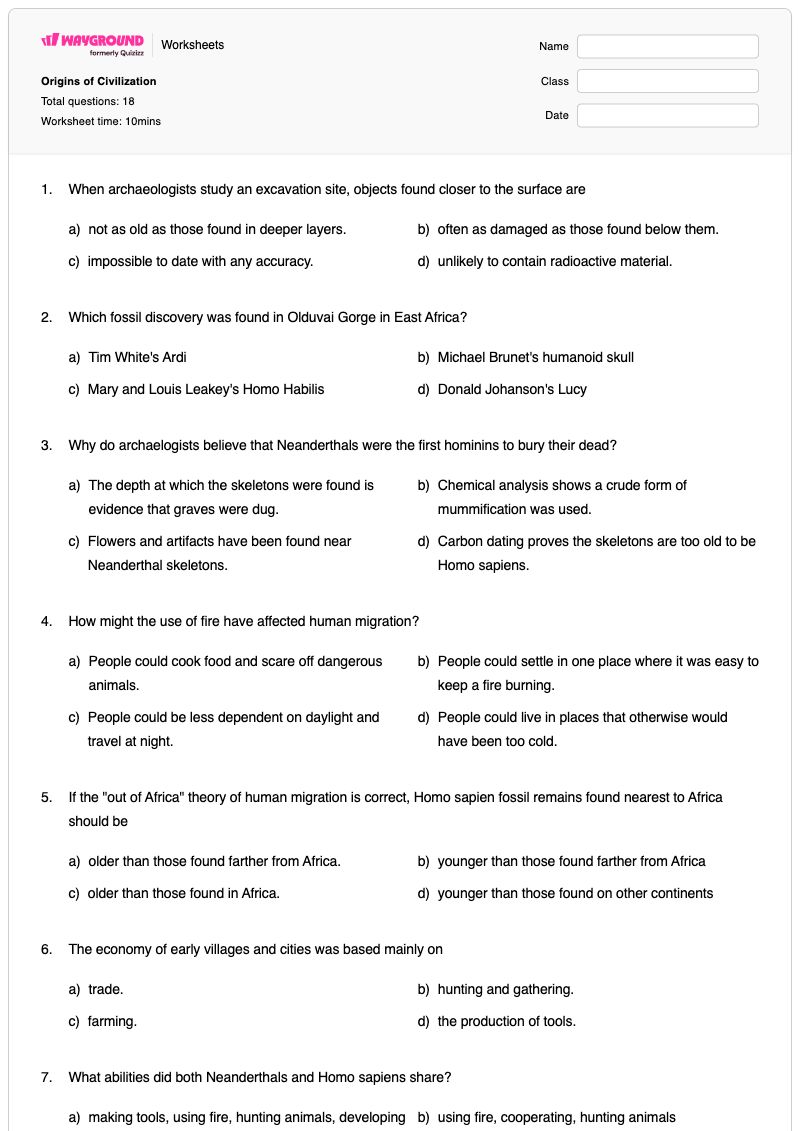
Origins of Civilization

คำถามทั้งหมด: 18

ชื่อ
ระดับ
วันที่
1.

When archaeologists study an excavation site, objects found closer to the surface are

a)

not as old as those found in deeper layers.

b)

often as damaged as those found below them.

c)

impossible to date with any accuracy.

d)

unlikely to contain radioactive material.

2.

Which fossil discovery was found in Olduvai Gorge in East Africa?

a)

Tim White's Ardi

b)

Michael Brunet's humanoid skull

c)

Mary and Louis Leakey's Homo Habilis

d)

Donald Johanson's Lucy

3.

Why do archaelogists believe that Neanderthals were the first hominins to bury their dead?

a)

The depth at which the skeletons were found is evidence that graves were dug.

b)

Chemical analysis shows a crude form of mummification was used.

c)

Flowers and artifacts have been found near Neanderthal skeletons.

d)

Carbon dating proves the skeletons are too old to be Homo sapiens.

4.

How might the use of fire have affected human migration?

a)

People could cook food and scare off dangerous animals.

b)

People could settle in one place where it was easy to keep a fire burning.

c)

People could be less dependent on daylight and travel at night.

d)

People could live in places that otherwise would have been too cold.

5.

If the "out of Africa" theory of human migration is correct, Homo sapien fossil remains found nearest to Africa should be

a)

older than those found farther from Africa.

b)

younger than those found farther from Africa

c)

older than those found in Africa.

d)

younger than those found on other continents

6.

The economy of early villages and cities was based mainly on

a)

trade.

b)

hunting and gathering.

c)

farming.

d)

the production of tools.

7.

What abilities did both Neanderthals and Homo sapiens share?

a)

making tools, using fire, hunting animals, developing complex language

b)

using fire, cooperating, hunting animals

c)

using fire, making tools, hunting animals

d)

making tools, developing complex language

8.

During the Paleolithic Era, People acquired food by

a)

herding and gathering

b)

hunting and trapping

c)

fishing and farming

d)

hunting and gathering

9.

Why did the earliest civilizations appear in areas like Mesopotamia and the Indus Valley?

a)

because these areas had the most domesticated animals

b)

because these areas were isolated from other regions

c)

because these areas were far away from oceans

d)

because these areas were near rivers and fertile soil

10.

Which types of information can scientists learn from discovering a skeleton and artifacts? Choose TWO

a)

the approximate age of the skeleton

b)

the size of the prehistoric community

c)

the types of pottery and tools early people used

d)

whether the person had migrated from another region

11.

Why are archaeologists interested in the cave paintings found near Lascaux in southern France?

a)

The paintings are the first evidence of early humans ever found in France.

b)

The caves did not exist during the last Ice Age.

c)

The paintings provide evidence that humans had become more complex.

d)

The cave paintings are worth a great deal of money.

12.

Look at this list of world rivers:

Nile

Euphrates

Indus

Huang


What do these rivers have in common?

a)

They were the locations of early civilizations?

b)

They were used to irrigate large rice fields.

c)

They had many shallow rapids.

d)

They were rich in mineral deposits.

13.

What factors were MOST responsible for villages developing into cities? Choose TWO correct answers.

a)

immigration from neighboring regions

b)

a surplus of food

c)

rapid population growth

d)

access to fresh water

14.

Which of the following are examples of how early civilizations affected the surrounding environment? Choose TWO correct answers.

a)

developing language to communicate

b)

building irrigation systems

c)

believing the gods controlled natural events

d)

clearing land by cutting down and burning trees

15.

Look at these actions of Prehistoric People:

Following herds of animals

Burying the dead with beads

Clearing trees and bushes

Domesticating animals for food


Which actions indicate people were modifying their environment? Choose TWO correct answers.

a)

Following herds of animals

b)

Burying the dead with beads

c)

Clearing trees and bushes

d)

Domesticating animals for food

16.

Choose the correct sequence from the earliest development to the latest development

a)

hunting and gathering, farming villages, sedentary agriculture, cities

b)

hunting and gathering, cities, domesticating animals

c)

domesticating animals, sedentary agriculture, complex language

d)

hunting and gathering, sedentary agriculture, farming villages, cities

17.

Look at this table:

Migrations of Homo sapiens

200,000 years ago --------appear in Africa

40,000 years ago ----------arrive in Europe

20,000-60,000 years ago---------?

15,000 years ago-------------------?


Beginning with the earlier development, what events will replace the question marks in the table?

a)

arrive in Asia; arrive in Australia and Pacific Islands

b)

arrive in Asia; arrive in the Americas

c)

arrive in Australia and Pacific islands; arrive in the Americas

d)

arrive in Australia and Pacific islands; arrive in Asia

18.

Suppose you are looking at an artifact that resembles a modern day knife, however it seems to be carved from stone.....


Which statement would describe it's significance?

a)

Prehistoric people had opposable thumbs.

b)

Some prehistoric tools survived to modern times.

c)

Prehistoric people developed artistic skills.

d)

Prehistoric people developed tools to survive.

Waygroundแป้นคำตอบ

Origins of Civilization

คำถามทั้งหมด: 18

1.
a)

not as old as those found in deeper layers.

2.
c)

Mary and Louis Leakey's Homo Habilis

3.
c)

Flowers and artifacts have been found near Neanderthal skeletons.

4.
d)

People could live in places that otherwise would have been too cold.

5.
a)

older than those found farther from Africa.

6.
c)

farming.

7.
c)

using fire, making tools, hunting animals

8.
d)

hunting and gathering

9.
d)

because these areas were near rivers and fertile soil

10.
c)

the types of pottery and tools early people used

, a)

the approximate age of the skeleton

11.
c)

The paintings provide evidence that humans had become more complex.

12.
a)

They were the locations of early civilizations?

13.
b)

a surplus of food

, c)

rapid population growth

14.
b)

building irrigation systems

, d)

clearing land by cutting down and burning trees

15.
d)

Domesticating animals for food

, c)

Clearing trees and bushes

16.
d)

hunting and gathering, sedentary agriculture, farming villages, cities

17.
b)

arrive in Asia; arrive in the Americas

18.
d)

Prehistoric people developed tools to survive.

คำถามที่พบบ่อย

แบบฝึกหัดเรื่องต้นกำเนิดอารยธรรมครอบคลุมเนื้อหาอะไรบ้าง?

แบบฝึกหัดวิชาสังคมศึกษา ชั้นประถมศึกษาปีที่ 6 นี้ ประกอบด้วยคำถามแบบเลือกตอบ 14 ข้อ และคำถามแบบเลือกคำตอบ 4 ข้อ เพื่อศึกษาว่าหลักฐานทางโบราณคดีอธิบายถึงชีวิตมนุษย์ยุคแรก การอพยพ และอารยธรรมได้อย่างไร นักเรียนจะต้องตีความชั้นดินจากการขุดค้น ฟอสซิล โครงกระดูก โบราณวัตถุ ภาพเขียนในถ้ำ และตำแหน่งของแม่น้ำ จากนั้นเชื่อมโยงการเกษตร ผลผลิตอาหารส่วนเกิน และการเปลี่ยนแปลงสภาพแวดล้อมเข้ากับการเติบโตของหมู่บ้านและเมืองต่างๆ

ฉันจะใช้แบบฝึกหัดนี้ในการสอนเรื่องต้นกำเนิดของอารยธรรมได้อย่างไร?

เริ่มแบบฝึกหัดโดยให้นักเรียนแยกแยะความแตกต่างระหว่างหลักฐานกับข้อสรุป เช่น โครงกระดูกและโบราณวัตถุสามารถบอกอะไรเกี่ยวกับชุมชนได้บ้าง หลังจากที่นักเรียนตอบคำถามเสร็จแล้ว ให้พูดคุยกันว่าการใช้ไฟ การอพยพ การทำเกษตรกรรมใกล้แม่น้ำที่อุดมสมบูรณ์ และอาหารที่เหลือเฟือ มีส่วนทำให้การตั้งถิ่นฐานมีความซับซ้อนมากขึ้นได้อย่างไร ใช้คำถามแบบเลือกตอบหลายข้อเพื่อให้นักเรียนอธิบายเหตุผลว่าทำไมหลักฐานแต่ละชิ้นที่เลือกจึงสนับสนุนข้อสรุปของพวกเขา

ฉันควรสังเกตข้อผิดพลาดอะไรบ้างเมื่อนักเรียนทำแบบฝึกหัดนี้เสร็จ?

นักเรียนอาจเข้าใจผิดเกี่ยวกับความสัมพันธ์ของชั้นทางโบราณคดี โดยสันนิษฐานว่าวัตถุที่อยู่ใกล้ผิวดินนั้นเก่ากว่าวัตถุที่อยู่ในชั้นลึกกว่า นอกจากนี้ พวกเขาอาจสับสนระหว่างหลักฐานกับการอนุมาน เช่น การเลือกข้อมูลที่โครงกระดูกและสิ่งประดิษฐ์ไม่ได้ให้ไว้ หรือมองข้ามไปว่าคำถามแบบเลือกตอบหลายข้อต้องการคำตอบเพียงสองข้อเท่านั้น ระวังความสับสนระหว่างการล่าสัตว์และเก็บเกี่ยวในยุคหินเก่ากับการเกษตรกรรมในหมู่บ้านและเมืองยุคแรกๆ

ฉันจะมอบหมายและให้คะแนนแบบฝึกหัดเรื่องต้นกำเนิดอารยธรรมนี้อย่างไร?

คุณสามารถส่งแบบฝึกหัดนี้เป็นไฟล์ PDF ที่พิมพ์ได้ หรือเป็นแบบทดสอบดิจิทัลบน Wayground ก็ได้ แบบฝึกหัดนี้มีเฉลยคำตอบครบถ้วนสำหรับคำถามเกี่ยวกับการขุดค้น การอพยพ อารยธรรมยุคแรก และผลกระทบต่อสิ่งแวดล้อม สำหรับการส่งงานแบบพิมพ์ได้ ให้สแกนงานของนักเรียนด้วยแอป Wayground for Teachers เพื่อตรวจคำตอบได้อย่างมีประสิทธิภาพ

ฉันจะปรับแบบฝึกหัดนี้ให้เหมาะสมกับนักเรียนของฉันได้อย่างไร?

ใช้การตั้งค่าขั้นสูงของแบบฝึกหัดเพื่อปรับระยะห่างระหว่างตัวอักษรและขนาดตัวอักษร เพื่อให้คำถามเชิงหลักฐานและตัวเลือกแบบเลือกหลายข้ออ่านง่ายขึ้น นอกจากนี้ คุณยังสามารถใช้แบบอักษรที่เหมาะสำหรับผู้ที่มีภาวะดิสเล็กเซีย หรือแปลแบบฝึกหัดเรื่องต้นกำเนิดอารยธรรมเป็นภาษาอื่นได้ หากการแปลแบบนั้นช่วยให้เข้าถึงเนื้อหาเกี่ยวกับโบราณคดีและอารยธรรมยุคแรกได้ดียิ่งขึ้น

ฉันจะหาแบบฝึกหัดแบบนี้เพิ่มเติมได้ที่ไหนบน Wayground?

Wayground นำเสนอชุดแบบฝึกหัดและโจทย์ฝึกหัดฟรีที่ครอบคลุมหลากหลายวิชา พร้อมไฟล์ PDF และเฉลยคำตอบ เพื่อช่วยเสริมสร้างทักษะและความเข้าใจในแนวคิดสำคัญ ดูแหล่งข้อมูลเพิ่มเติมได้ที่ https://wayground.com/en-us/worksheets