

Wayground
Experimental Design & Biochemistry Review - Printable ศาสตร์ Worksheets ระดับ 10 - Wayground

Experimental Design & Biochemistry Review

Olivia Conboy

สร้างโดย Olivia Conboy

15 คำถาม

10th ระดับชั้น

ศาสตร์

แบบฝึกหัดการออกแบบการทดลองและชีวเคมี สำหรับนักเรียนชั้นมัธยมศึกษาปีที่ 4 (เกรด 4) นี้ จะช่วยตรวจสอบความเข้าใจของนักเรียนเกี่ยวกับการเขียนสมมติฐาน วัตถุประสงค์ของกราฟแท่ง การจำแนกประเภทและหน้าที่ของโมเลกุลชีวภาพ คุณสมบัติและความสำคัญของน้ำ ปฏิกิริยาของเอนไซม์ ภาวะสมดุล และการตอบสนองต่อสิ่งเร้า นักเรียนจะต้องทำแบบฝึกหัดทั้งหมด 15 ข้อ ประกอบด้วยคำถามแบบเลือกตอบ 11 ข้อ คำถามแบบเลือกคำตอบ 3 ข้อ และแบบฝึกหัดระบุสารตั้งต้น 1 ข้อ แบบฝึกหัดนี้ช่วยให้นักเรียนเชื่อมโยงคำศัพท์สำคัญทางชีวเคมีกับหน้าที่ทางชีวภาพ และแยกแยะคำศัพท์ที่เกี่ยวข้อง เช่น สารตั้งต้น ผลิตภัณฑ์ สารตั้งต้น และเอนไซม์ คำถามแบบเลือกคำตอบจะให้นักเรียนประเมินข้อความหลายข้อ ในขณะที่แบบฝึกหัดระบุสารตั้งต้นจะใช้คำศัพท์เกี่ยวกับปฏิกิริยาในการระบุภาพ แบบฝึกหัดนี้มีประโยชน์สำหรับการทบทวน การประเมินผลระหว่างเรียน หรือการเตรียมตัวสำหรับการประเมินผลหน่วยการเรียนรู้ชีววิทยา เป็นแบบฝึกหัดที่พิมพ์ได้ฟรีพร้อมเฉลยคำตอบครบถ้วน และยังสามารถใช้งานแบบดิจิทัลบน Wayground ได้อีกด้วย

การตั้งค่าแผ่นงาน

ขนาดตัวอักษร

S
M
L
XL
Waygroundแผ่นงาน

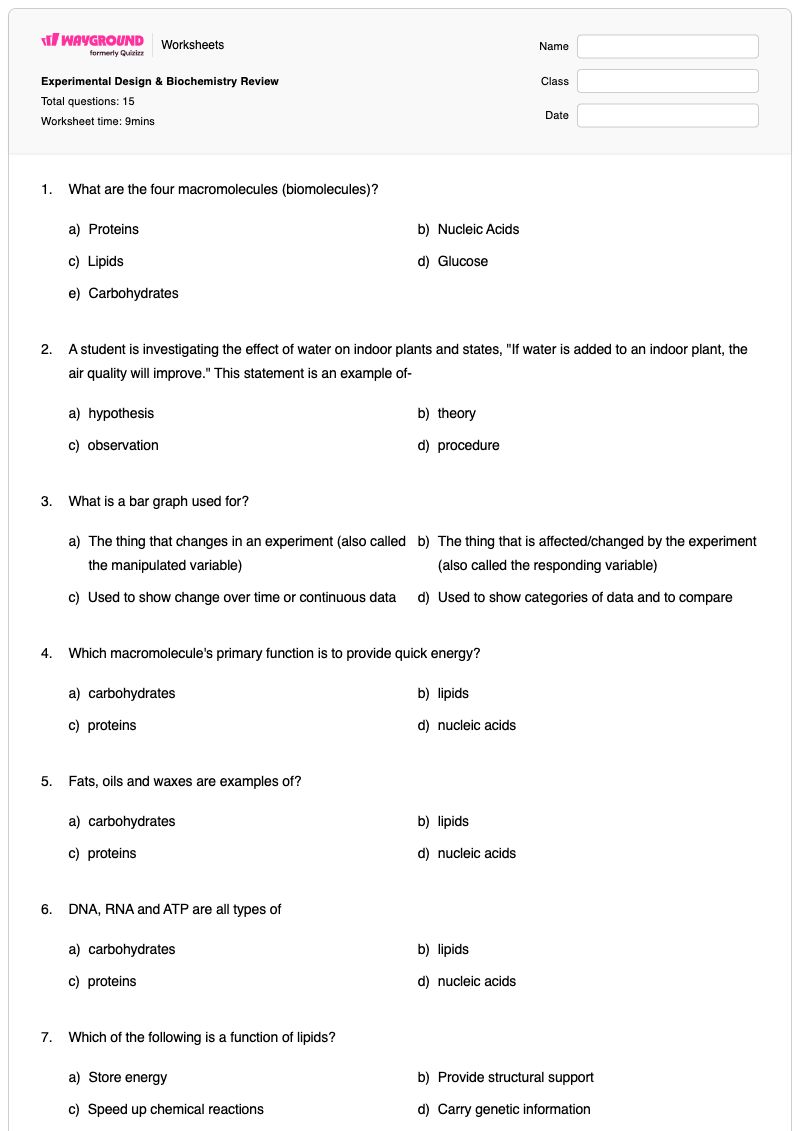
Experimental Design & Biochemistry Review

คำถามทั้งหมด: 15

ชื่อ
ระดับ
วันที่
1.

What are the four macromolecules (biomolecules)?

a)

Proteins

b)

Nucleic Acids

c)

Lipids

d)

Glucose

e)

Carbohydrates

2.

A student is investigating the effect of water on indoor plants and states, "If water is added to an indoor plant, the air quality will improve." This statement is an example of-

a)

hypothesis

b)

theory

c)

observation

d)

procedure

3.

What is a bar graph used for?

a)

The thing that changes in an experiment (also called the manipulated variable)

b)

The thing that is affected/changed by the experiment (also called the responding variable)

c)

Used to show change over time or continuous data

d)

Used to show categories of data and to compare

4.

Which macromolecule's primary function is to provide quick energy?

a)

carbohydrates

b)

lipids

c)

proteins

d)

nucleic acids

5.

Fats, oils and waxes are examples of?

a)

carbohydrates

b)

lipids

c)

proteins

d)

nucleic acids

6.

DNA, RNA and ATP are all types of

a)

carbohydrates

b)

lipids

c)

proteins

d)

nucleic acids

7.

Which of the following is a function of lipids?

a)

Store energy

b)

Provide structural support

c)

Speed up chemical reactions

d)

Carry genetic information

8.

Which of the following statements are true about water? (Select all correct answers)

a)

Water is a polar molecule

b)

Water can form strong bonds with polar molecules

c)

Water is a nonpolar molecule

d)

Water is essential for life

9.

What enzyme do mammals produce to digest lipids? (Remember enzymes end in -ase)

a)

Amylase

b)

Lactase

c)

Lactose

d)

Lipase

10.

What are the two simple sugars produced when lactase hydrolyzes lactose?

a)

Glucose and fructose

b)

Glucose and galactose

c)

Galactose and sucrose

d)

Fructose and sucrose

11.
In the reaction involving lactase, what are glucose and galactose considered as?

In the reaction involving lactase, what are glucose and galactose considered as?

a)

Products

b)

Reactants

c)

Enzymes

d)

Substrates

12.

Select all that are correct: Water is important to life because:

a)

Water allows for chemical reactions to occur in the body

b)

Water helps the body maintain a stable internal temperature

c)

Water transports molecules like oxygen for respiration

d)

Without water, cell membranes would lack structure, and without proper membrane structure, cells would be unable to keep important molecules inside the cell and harmful molecules outside the cell.

13.

______________ is a principle of biology which states that organisms and nature must maintain stable conditions to be healthy and survive.

a)

The Cell Theory

b)

The Gene Theory

c)

Heterozygous Gene Principal

d)

Homeostasis

14.

Which of the following is an example of an organism responding to a stimulus?

a)

A cat eating because it is hungry

b)

A tadpole changing into a frog

c)

A cell dividing to make two new cells

d)

A plant undergoing photosynthesis to make food

15.

Click on the reactants.

Waygroundแป้นคำตอบ

Experimental Design & Biochemistry Review

คำถามทั้งหมด: 15

1.
a)

Proteins

, b)

Nucleic Acids

, c)

Lipids

, e)

Carbohydrates

2.
a)

hypothesis

3.
d)

Used to show categories of data and to compare

4.
a)

carbohydrates

5.
b)

lipids

6.
d)

nucleic acids

7.
a)

Store energy

8.
a)

Water is a polar molecule

, b)

Water can form strong bonds with polar molecules

, d)

Water is essential for life

9.
d)

Lipase

10.
b)

Glucose and galactose

11.
a)

Products

12.
a)

Water allows for chemical reactions to occur in the body

, b)

Water helps the body maintain a stable internal temperature

, c)

Water transports molecules like oxygen for respiration

, d)

Without water, cell membranes would lack structure, and without proper membrane structure, cells would be unable to keep important molecules inside the cell and harmful molecules outside the cell.

13.
d)

Homeostasis

14.
a)

A cat eating because it is hungry

15.

คำถามที่พบบ่อย

แบบฝึกหัดทบทวนการออกแบบการทดลองและชีวเคมีครอบคลุมเนื้อหาอะไรบ้าง?

แบบฝึกหัดวิทยาศาสตร์ระดับชั้น ม.4 นี้ ประกอบด้วยคำถามแบบเลือกตอบ 11 ข้อ คำถามแบบเลือกคำตอบ 3 ข้อ และคำถามแบบระบุจุดสำคัญ 1 ข้อ เพื่อประเมินความเข้าใจเกี่ยวกับการออกแบบการทดลองและแนวคิดทางชีวเคมี นักเรียนจะต้องจำแนกโมเลกุลขนาดใหญ่ทั้งสี่ชนิด ระบุหน้าที่ของโมเลกุลเหล่านั้น ตีความความสำคัญทางชีววิทยาของน้ำ แยกแยะสมมติฐานและวัตถุประสงค์ของการเขียนกราฟ ประยุกต์ใช้คำศัพท์เกี่ยวกับเอนไซม์และปฏิกิริยา และตระหนักถึงภาวะสมดุลและการตอบสนองต่อสิ่งเร้า

ฉันจะใช้แบบฝึกหัดนี้ในการสอนการออกแบบการทดลองและชีวเคมีได้อย่างไร?

ใช้แบบฝึกหัดนี้หลังจากการสอนโดยตรงเพื่อเป็นการทบทวนอย่างเป็นระบบ: เริ่มต้นด้วยการให้นักเรียนจัดเรียงโมเลกุลขนาดใหญ่ตามตัวอย่างและหน้าที่ จากนั้นอภิปรายสมมติฐานและคำถามเกี่ยวกับกราฟแท่งก่อนที่จะไปยังคุณสมบัติของน้ำและปฏิกิริยาของเอนไซม์ ถามนักเรียนว่าทำไมกลูโคสและกาแลคโตสจึงเป็นผลิตภัณฑ์ของการไฮโดรไลซิสของแลคโตส และทำไมจึงต้องแยกสารตั้งต้นออกจากผลิตภัณฑ์ก่อนที่จะทำแบบฝึกหัดในส่วนที่เป็นจุดสำคัญ

ฉันควรสังเกตข้อผิดพลาดอะไรบ้างเมื่อนักเรียนทำแบบฝึกหัดนี้เสร็จ?

นักเรียนอาจเลือกกลูโคสเป็นหนึ่งในสี่กลุ่มของโมเลกุลขนาดใหญ่ สับสนระหว่างไลเปสกับแลคเตส หรือสลับผลิตภัณฑ์และสารตั้งต้นในปฏิกิริยาของแลคโตส สังเกตนักเรียนที่เลือกทุกข้อความที่เป็นไปได้ในคำถามเกี่ยวกับน้ำแบบเลือกตอบหลายข้อ ใช้กราฟแท่งเป็นการแสดงการเปลี่ยนแปลงอย่างต่อเนื่องตามเวลา หรือเลือกกระบวนการทางชีวภาพที่ไม่ใช่การตอบสนองต่อสิ่งเร้า ข้อสอบจุดสำคัญนี้ยังเผยให้เห็นว่านักเรียนสามารถระบุสารตั้งต้นได้หรือไม่ แทนที่จะเพียงแค่จดจำคำศัพท์เกี่ยวกับปฏิกิริยา

ฉันจะมอบหมายและตรวจงานใบงานนี้อย่างไร?

แบบฝึกหัดนี้มีให้เลือกทั้งในรูปแบบไฟล์ PDF ที่สามารถพิมพ์ได้ และแบบทดสอบดิจิทัลบน Wayground พร้อมเฉลยคำตอบครบถ้วนสำหรับทั้ง 15 ข้อ คุณสามารถตรวจงานที่ส่งในรูปแบบไฟล์พิมพ์ได้โดยการสแกนงานของนักเรียนด้วยแอป Wayground for Teachers ในขณะที่เวอร์ชันดิจิทัลรองรับการมอบหมายงานและการตรวจให้คะแนนทางออนไลน์ รูปแบบไฟล์พิมพ์ยังช่วยให้โรงเรียนลดเวลาการใช้หน้าจอได้อีกด้วย

ฉันจะปรับแบบฝึกหัดทบทวนวิชาชีวเคมีนี้ให้เหมาะสมกับนักเรียนของฉันได้อย่างไร?

ในส่วนการตั้งค่าขั้นสูงของแบบฝึกหัด คุณสามารถสร้างแบบฝึกหัดเวอร์ชันอื่นที่มีระยะห่างระหว่างตัวอักษรที่กว้างขึ้นหรือขนาดตัวอักษรที่ใหญ่ขึ้น เพื่อให้การเลือกคำตอบแบบปรนัยและแบบเลือกหลายข้อทำได้ง่ายขึ้น นอกจากนี้ คุณยังสามารถเปิดใช้งานแบบอักษรที่เหมาะสำหรับผู้ที่มีภาวะดิสเล็กเซีย หรือแปลแบบฝึกหัดเป็นภาษาอื่น รวมถึงคำถามเกี่ยวกับปฏิกิริยาของเอนไซม์และความสำคัญของน้ำได้อีกด้วย

ฉันจะหาแบบฝึกหัดแบบนี้เพิ่มเติมได้ที่ไหนบน Wayground?

Wayground นำเสนอชุดแบบฝึกหัดและโจทย์ฝึกหัดฟรีมากมายในหลากหลายวิชา พร้อมทั้งไฟล์ PDF และเฉลยคำตอบให้ดาวน์โหลด ดูแหล่งข้อมูลเพิ่มเติมได้ที่ https://wayground.com/en-us/worksheets