

Wayground
Experimental Design - Printable ศาสตร์ Worksheets ระดับ 7 - Wayground

Experimental Design

Kaitlin Kummer

สร้างโดย Kaitlin Kummer

19 คำถาม

7th ระดับชั้น

ศาสตร์

อัปเดตแล้ว ต.ค. 2569

แบบฝึกหัดการออกแบบการทดลองสำหรับนักเรียนชั้นมัธยมศึกษาปีที่ 7 ช่วยให้นักเรียนระบุและประยุกต์ใช้ส่วนประกอบหลักของการทดลองแบบควบคุม แบบฝึกหัดนี้ประกอบด้วยคำถาม 19 ข้อ—แบบเลือกตอบ 18 ข้อ และแบบเลือกหลายข้อ 1 ข้อ—นักเรียนจะได้ฝึกฝนการแยกแยะตัวแปรอิสระ ตัวแปรตาม และตัวแปรควบคุม วิเคราะห์การทดลองเฮลิคอปเตอร์กระดาษและการทดลองทางลาด และอธิบายว่าทำไมจึงควรเปลี่ยนปัจจัยเพียงตัวเดียวในแต่ละครั้ง นอกจากนี้ นักเรียนยังได้ฝึกฝนการกำหนดสมมติฐาน การรู้จักว่าเมื่อใดควรเขียนสมมติฐาน และการเลือกสมมติฐานแบบ “ถ้า...แล้ว...” ที่มีโครงสร้างเหมาะสม แบบฝึกหัดนี้จบลงด้วยคำถามเกี่ยวกับข้ออ้าง หลักฐาน และเหตุผล รวมถึงการระบุข้อมูลทางวิทยาศาสตร์ที่สนับสนุนข้ออ้าง และเหตุผลที่เชื่อมโยงหลักฐานกับข้ออ้าง แบบฝึกหัดที่พิมพ์ได้ฟรีนี้มีเฉลยคำตอบครบถ้วน และเหมาะสำหรับใช้ในการสอน การทบทวน หรือการประเมินผลวิชาวิทยาศาสตร์ชั้นมัธยมศึกษาปีที่ 7

การตั้งค่าแผ่นงาน

ขนาดตัวอักษร

S
M
L
XL
Waygroundแผ่นงาน

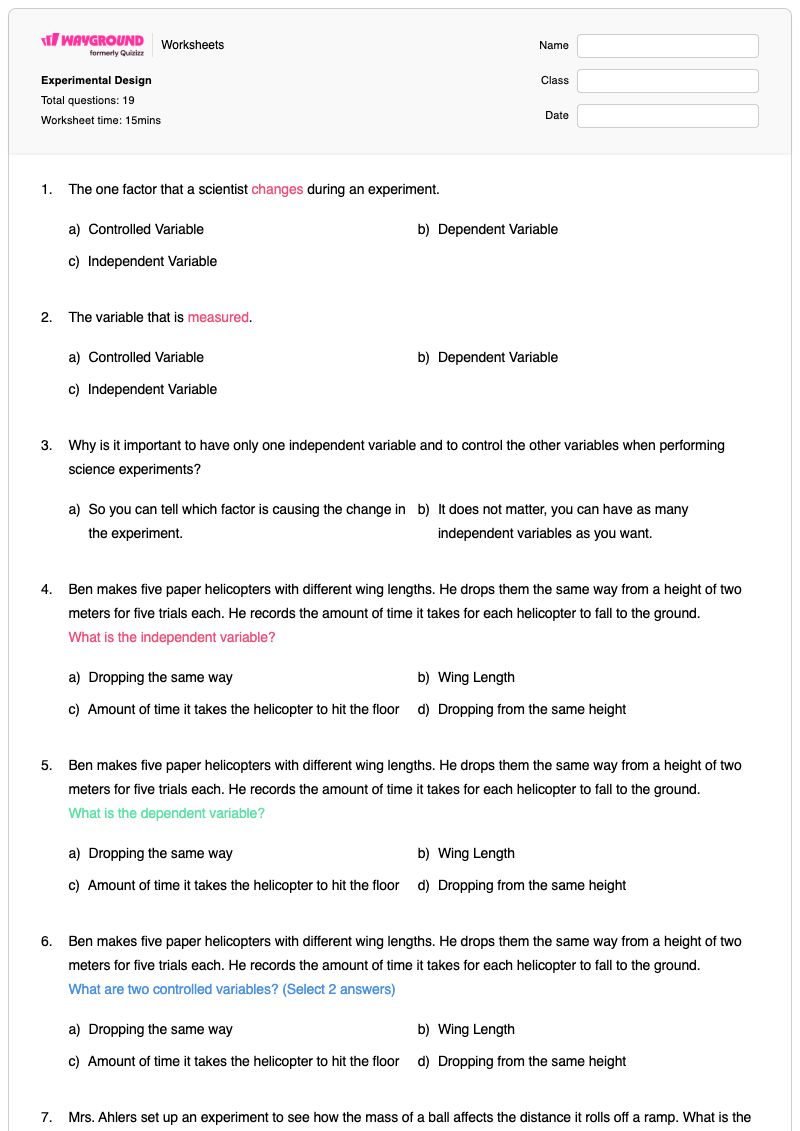
Experimental Design

คำถามทั้งหมด: 19

ชื่อ
ระดับ
วันที่
1.

The one factor that a scientist changes during an experiment.

a)

Controlled Variable

b)

Dependent Variable

c)

Independent Variable

2.

The variable that is measured.

a)

Controlled Variable

b)

Dependent Variable

c)

Independent Variable

3.

Why is it important to have only one independent variable and to control the other variables when performing science experiments?

a)

So you can tell which factor is causing the change in the experiment.

b)

It does not matter, you can have as many independent variables as you want.

4.

Ben makes five paper helicopters with different wing lengths. He drops them the same way from a height of two meters for five trials each. He records the amount of time it takes for each helicopter to fall to the ground.

What is the independent variable?

a)

Dropping the same way

b)

Wing Length

c)

Amount of time it takes the helicopter to hit the floor

d)

Dropping from the same height

5.

Ben makes five paper helicopters with different wing lengths. He drops them the same way from a height of two meters for five trials each. He records the amount of time it takes for each helicopter to fall to the ground.

What is the dependent variable?

a)

Dropping the same way

b)

Wing Length

c)

Amount of time it takes the helicopter to hit the floor

d)

Dropping from the same height

6.

Ben makes five paper helicopters with different wing lengths. He drops them the same way from a height of two meters for five trials each. He records the amount of time it takes for each helicopter to fall to the ground.

What are two controlled variables? (Select 2 answers)

a)

Dropping the same way

b)

Wing Length

c)

Amount of time it takes the helicopter to hit the floor

d)

Dropping from the same height

7.
Mrs. Ahlers set up an experiment to see how the mass of a ball affects the distance it rolls off a ramp. What is the dependent variable?
a)
Distance traveled by the ball
b)
Height of the ramp
c)
Mass of the ball
d)
Where the experiment took place.
8.

What is a hypothesis?

a)

the thing changed on purpose in the experiment

b)

an explanation about what you observed

c)

using your 5 senses to gather data

d)

an educated guess about the outcome of an experiment

9.

What two words should be in your hypothesis?

a)

I think

b)

If ...then...

c)

It will

d)

No idea

10.

When is a hypothesis written?

a)

before you decide on a question

b)

after the experiment

c)

before the experiment

d)

after the conclusion

11.

Choose the correctly written hypothesis for "What is the effect of putting Pam Cooking Spray on the bottom of a sled?"

a)

I think the sled will slide faster.

b)

If I put Pam Cooking Spray on the bottom of my sled, then I will win the race."

c)

If I put Pam Cooking Spray on the bottom of my sled, then I will slide faster.

12.
A claim is ______________________________.
a)
a kind of shellfish often used in chowder. 
b)
a fact.
c)
a statement or conclusion that answers the original question or problem
d)
a bad thing to make about something.
13.
Evidence is ___________________
a)
A statement or conclusion that answers a question
b)
Scientific data that supports the claim
c)
A justification that connects the claim to the evidence
d)
Not vital when using an argument
14.
Reasoning is __________________.
a)
A statement of conclusion that answers the original question/problem
b)
Scientific data that supports the claim
c)
A justification that connects the evidence to the claim
d)
Empirical Evidence
15.
According to the American Health Association, peanut butter is a great source of protein.
a)
Claim
b)
Evidence
16.
Air is matter. We found that the weight of the ball increases by .5lbs each time we pumped more air into it. This shows that air has weight, one of the characteristics of matter.
Which sentence is the claim?
a)
Air is matter.
b)
We found that the weight of the ball increases by .5lbs each time we pumped more air into it.
c)
This shows that air has weight, one of the characteristics of matter.
17.
Air is matter. We found that the weight of the ball increases by .5lbs each time we pumped more air into it. This shows that air has weight, one of the characteristics of matter.
Which sentence is the evidence?
a)
Air is matter.
b)
We found that the weight of the ball increases by .5lbs each time we pumped more air into it.
c)
This shows that air has weight, one of the characteristics of matter.
18.
Air is matter. We found that the weight of the ball increases by .5lbs each time we pumped more air into it. This shows that air has weight, one of the characteristics of matter.
Which sentence is the reasoning?
a)
Air is matter.
b)
We found that the weight of the ball increases by .5lbs each time we pumped more air into it
c)
This shows that air has weight, one of the characteristics of matter.
19.
"Sleepy students are more likely to be tardy, absent, inattentive in the morning and less able to learn" is an example of:
a)
Claim
b)
Reasoning
c)
Evidence
d)
None of these
Waygroundแป้นคำตอบ

Experimental Design

คำถามทั้งหมด: 19

1.
c)

Independent Variable

2.
b)

Dependent Variable

3.
a)

So you can tell which factor is causing the change in the experiment.

4.
b)

Wing Length

5.
c)

Amount of time it takes the helicopter to hit the floor

6.
d)

Dropping from the same height

, a)

Dropping the same way

7.
a) Distance traveled by the ball
8.
d)

an educated guess about the outcome of an experiment

9.
b)

If ...then...

10.
c)

before the experiment

11.
c)

If I put Pam Cooking Spray on the bottom of my sled, then I will slide faster.

12.
c) a statement or conclusion that answers the original question or problem
13.
b) Scientific data that supports the claim
14.
c) A justification that connects the evidence to the claim
15.
b) Evidence
16.
a) Air is matter.
17.
b) We found that the weight of the ball increases by .5lbs each time we pumped more air into it.
18.
c) This shows that air has weight, one of the characteristics of matter.
19.
b) Reasoning

คำถามที่พบบ่อย

แบบฟอร์มการออกแบบการทดลองครอบคลุมอะไรบ้าง?

แบบฝึกหัดวิทยาศาสตร์สำหรับนักเรียนชั้น ม.1 นี้ ประกอบด้วยคำถามแบบเลือกตอบ 18 ข้อ และคำถามแบบเลือกคำตอบหลายข้ออีก 1 ข้อ เพื่อประเมินทักษะการออกแบบการทดลอง นักเรียนจะต้องระบุตัวแปรอิสระ ตัวแปรตาม และตัวแปรควบคุม ในคำจำกัดความและสถานการณ์การทดลอง เลือกสมมติฐานที่มีโครงสร้าง “ถ้า...แล้ว...” ที่ถูกต้อง และแยกแยะความแตกต่างระหว่างข้ออ้าง หลักฐาน และเหตุผล

ฉันจะใช้แบบฝึกหัดนี้ในการสอนการออกแบบการทดลองได้อย่างไร?

แนะนำตัวแปรต่างๆ ด้วยการทดลองง่ายๆ จากนั้นให้นักเรียนนำไปใช้กับสถานการณ์เฮลิคอปเตอร์กระดาษและทางลาดในแบบฝึกหัด ก่อนที่นักเรียนจะทำแบบฝึกหัดสมมติฐาน ให้ถามพวกเขาว่าอะไรจะเปลี่ยนแปลง อะไรจะถูกวัด และเงื่อนไขใดต้องคงที่ จากนั้นให้สรุปด้วยการอภิปรายว่าหลักฐานสนับสนุนข้ออ้างอย่างไรผ่านการให้เหตุผล

ฉันควรสังเกตข้อผิดพลาดอะไรบ้างเมื่อนักเรียนทำแบบฝึกหัดนี้เสร็จ?

นักเรียนอาจสับสนระหว่างตัวแปรอิสระกับตัวแปรตาม โดยเฉพาะในแบบฝึกหัดเฮลิคอปเตอร์กระดาษ หรืออาจเลือกความยาวปีกแทนที่จะเลือกความสูงและวิธีการปล่อยเป็นตัวแปรควบคุม นอกจากนี้ ควรตรวจสอบให้แน่ใจว่านักเรียนตั้งสมมติฐานก่อนทำการทดลอง ใช้โครงสร้าง “ถ้า...แล้ว...” และไม่สับสนระหว่างข้ออ้าง หลักฐานที่สนับสนุนข้ออ้าง และเหตุผลที่เชื่อมโยงกัน

ฉันจะมอบหมายและให้คะแนนแบบฝึกหัดการออกแบบการทดลองได้อย่างไร?

แบบฝึกหัดนี้มีให้ดาวน์โหลดในรูปแบบ PDF สำหรับพิมพ์ และเป็นแบบทดสอบดิจิทัลบน Wayground พร้อมเฉลยคำตอบครบถ้วนสำหรับทั้ง 19 ข้อ คุณสามารถตรวจงานที่ส่งในรูปแบบ PDF ได้โดยการสแกนงานของนักเรียนด้วยแอป Wayground for Teachers ในขณะที่แบบทดสอบดิจิทัลสามารถมอบหมายผ่านแพลตฟอร์มได้

ฉันจะปรับแบบฝึกหัดการออกแบบการทดลองนี้ให้เหมาะสมกับนักเรียนของฉันได้อย่างไร?

ใช้การตั้งค่าขั้นสูงของแบบฝึกหัดเพื่อปรับระยะห่างระหว่างตัวอักษรหรือเพิ่มขนาดตัวอักษร เพื่อให้คำจำกัดความของตัวแปร สถานการณ์การทดลอง และตัวเลือกสมมติฐาน “ถ้า...แล้ว...” อ่านง่ายขึ้น นอกจากนี้ คุณยังสามารถใช้แบบอักษรที่เหมาะสำหรับผู้ที่มีภาวะดิสเล็กเซีย หรือแปลแบบฝึกหัดเป็นภาษาอื่นเมื่อเป็นประโยชน์สำหรับนักเรียนที่ทำงานกับคำศัพท์เกี่ยวกับการออกแบบการทดลอง

ฉันจะหาแบบฝึกหัดแบบนี้เพิ่มเติมได้ที่ไหนบน Wayground?

Wayground มีแบบฝึกหัดและโจทย์ฝึกหัดมากมายให้ดาวน์โหลดฟรีในหลากหลายวิชา พร้อมไฟล์ PDF และเฉลยคำตอบ เพื่อช่วยให้นักเรียนพัฒนาทักษะและความเข้าใจในแนวคิดสำคัญๆ ดูแหล่งข้อมูลเพิ่มเติมได้ที่ https://wayground.com/en-us/worksheets