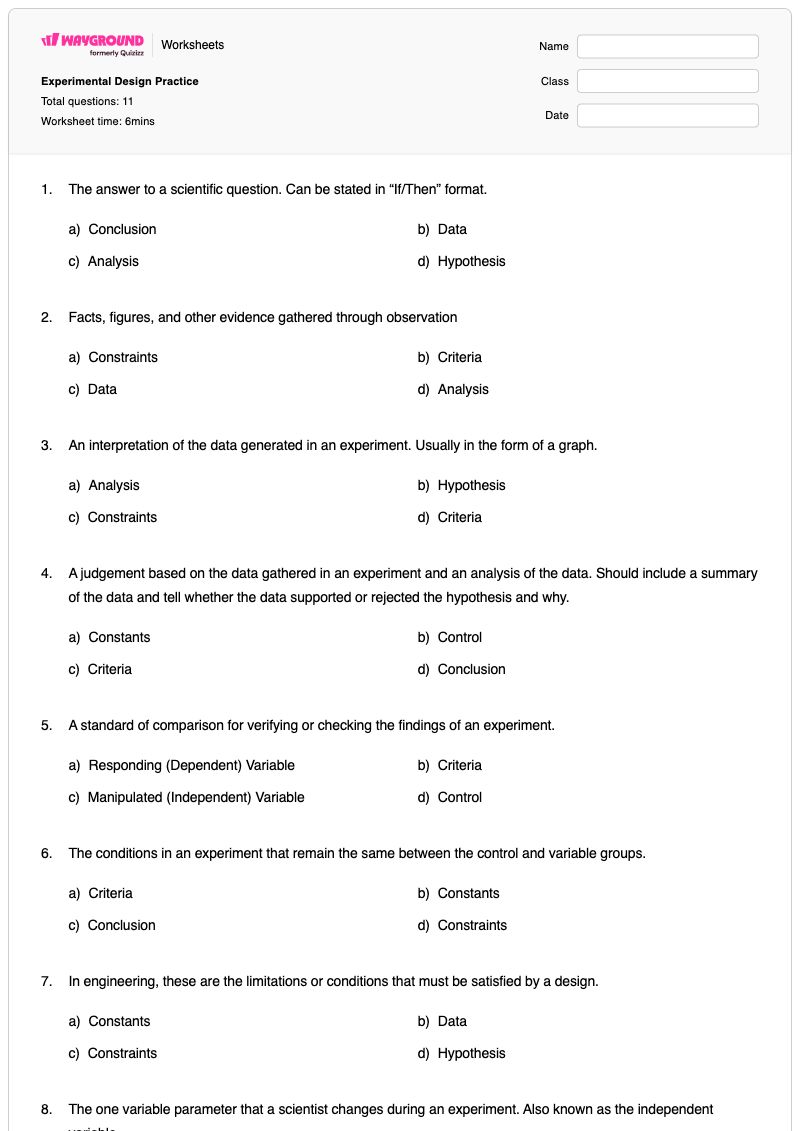
The answer to a scientific question. Can be stated in “If/Then” format.
a)
Conclusion
b)
Data
c)
Analysis
d)
Hypothesis
2.
Facts, figures, and other evidence gathered through observation
a)
Constraints
b)
Criteria
c)
Data
d)
Analysis
3.
An interpretation of the data generated in an experiment. Usually in the form of a graph.
a)
Analysis
b)
Hypothesis
c)
Constraints
d)
Criteria
4.
A judgement based on the data gathered in an experiment and an analysis of the data. Should include a summary of the data and tell whether the data supported or rejected the hypothesis and why.
a)
Constants
b)
Control
c)
Criteria
d)
Conclusion
5.
A standard of comparison for verifying or checking the findings of an experiment.
a)
Responding (Dependent) Variable
b)
Criteria
c)
Manipulated (Independent) Variable
d)
Control
6.
The conditions in an experiment that remain the same between the control and variable groups.
a)
Criteria
b)
Constants
c)
Conclusion
d)
Constraints
7.
In engineering, these are the limitations or conditions that must be satisfied by a design.
a)
Constants
b)
Data
c)
Constraints
d)
Hypothesis
8.
The one variable parameter that a scientist changes during an experiment. Also known as the independent variable.
a)
Manipulated (Independent) Variable
b)
Responding (Dependent) Variable
c)
Control
d)
Constants
9.
The variable parameter that changes as a result of changes to the manipulated, (or independent), variable in an experiment. Also called the dependent variable.
a)
Manipulated (Independent) Variable
b)
Responding (Dependent) Variable
c)
Constants
d)
Analysis
10.
In engineering, a standard or attribute of a design that can be measured. These clearly identify the requirements that must be met for a design to be successful.
a)
Constraint
b)
Constants
c)
Criteria
d)
Control
11.
In engineering, these are the limitations or conditions that must be satisfied by a design.


 แผ่นงาน