


Wayground
READING CAMP: Pyramids Passages - Printable สังคมศึกษา Worksheets 8th ระดับชั้น - Wayground

READING CAMP: Pyramids Passages

. Perez

สร้างโดย . Perez

11 คำถาม

8th ระดับชั้น

สังคมศึกษา

อัปเดตแล้ว พ.ค. 2568

แบบฝึกหัดการอ่าน: บทความเกี่ยวกับพีระมิด เป็นแบบฝึกหัดวิชาสังคมศึกษาสำหรับนักเรียนชั้น ม.2 ที่สร้างขึ้นจากบทความให้ข้อมูลเกี่ยวกับขนาด วัตถุประสงค์ การก่อสร้าง และความสำคัญทางประวัติศาสตร์ของพีระมิดอียิปต์ นักเรียนจะต้องตอบคำถามที่อิงจากเนื้อหา 11 ข้อ—แบบเลือกตอบ 1 ข้อ และแบบเลือกตอบ 10 ข้อ—ซึ่งจะถามให้ระบุรายละเอียดสนับสนุน ตีความภาพถ่าย กำหนดความหมายของคำจากบริบท อธิบายว่าประโยคหนึ่งๆ พัฒนาความคิดอย่างไร และระบุใจความสำคัญและวัตถุประสงค์ของผู้เขียน แบบฝึกหัดนี้ยังถามให้นักเรียนเชื่อมโยงหลักฐานจากบทความต่างๆ รวมถึงการเปรียบเทียบความคิดเกี่ยวกับความท้าทายทางกายภาพของการก่อสร้างพีระมิดและเทคนิคขั้นสูงที่ชาวอียิปต์โบราณอาจใช้ แบบฝึกหัดนี้สามารถพิมพ์ได้ฟรีพร้อมเฉลยคำตอบครบถ้วน ทำให้มีประโยชน์สำหรับการฝึกทักษะการอ่านเพื่อความเข้าใจ การสอนวิชาสังคมศึกษา หรือการประเมินความสามารถของนักเรียนในการวิเคราะห์บทความให้ข้อมูลโดยใช้หลักฐานเชิงประจักษ์

การตั้งค่าแผ่นงาน

ขนาดตัวอักษร

S
M
L
XL
Waygroundแผ่นงาน

READING CAMP: Pyramids Passages

คำถามทั้งหมด: 11

ชื่อ
ระดับ
วันที่
1.

Which TWO details from Passage 1 illustrate the size of the pyramids?

a)

The pyramids were built as burial chambers for kings.

b)

The largest pyramid was originally nearly 500 feet tall.

c)

The pyramids are smaller now than they were originally.

d)

The pyramids are one of the seven wonders of the ancient world.

e)

The largest pyramid is made of stones that weigh over five million tons.

2.
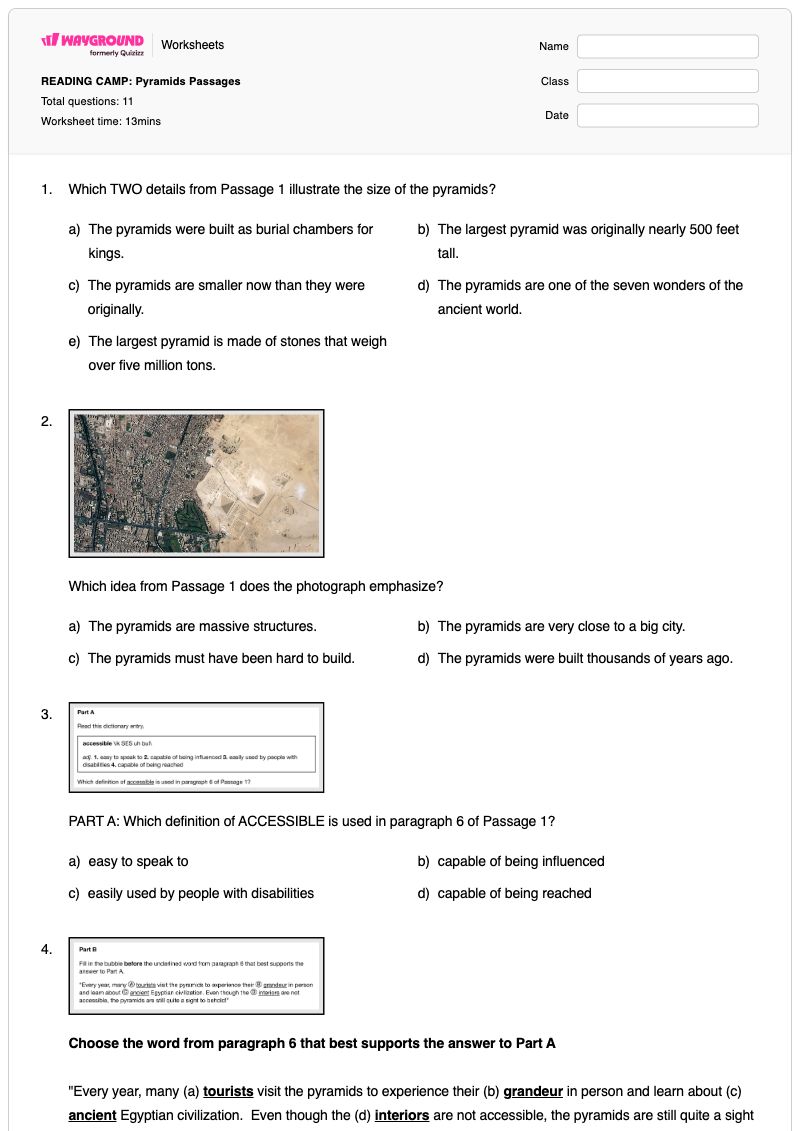
Which idea from Passage 1 does the photograph emphasize?

Which idea from Passage 1 does the photograph emphasize?

a)

The pyramids are massive structures.

b)

The pyramids are very close to a big city.

c)

The pyramids must have been hard to build.

d)

The pyramids were built thousands of years ago.

3.
PART A: Which definition of ACCESSIBLE is used in paragraph 6 of Passage 1?

PART A: Which definition of ACCESSIBLE is used in paragraph 6 of Passage 1?

a)

easy to speak to

b)

capable of being influenced

c)

easily used by people with disabilities

d)

capable of being reached

4.
Choose the word from paragraph 6 that best supports the answer to Part A "Every year, many (a) tourists visit the pyramids…

Choose the word from paragraph 6 that best supports the answer to Part A


"Every year, many (a) tourists visit the pyramids to experience their (b) grandeur in person and learn about (c) ancient Egyptian civilization.  Even though the (d) interiors are not accessible, the pyramids are still quite a sight to behold!"

a)

tourists

b)

grandeur

c)

ancient

d)

interiors

5.
Read this sentence from Passage 1. " The pyramids were built as royal burial chambers and were surrounded by funeral temples…

Read this sentence from Passage 1.


"The pyramids were built as royal burial chambers and were surrounded by funeral temples and other burial sites." (paragraph 2)


How does this sentence help develop the author's explanation of the pyramids?

a)

It tells the reason why the pyramids were built.

b)

It introduces the kings who built the pyramids.

c)

It explains why the location of the pyramids was important.

d)

It describes what the ancient Egyptians thought about death.

6.

Which of the following statements illustrates the importance of Michael Barsoum's work as described in Passage 2?

a)

Barsoum thought it would be simple to analyze the blocks

b)

Barsoum spent five years analyzing the chemistry of the stones

c)

Barsoum discovered a substance very close to natural limestone

d)

Barsoum determined the blocks were made from a type of concrete

7.

Which sentence from Passage 2 provides a reason that supports the claim that the blocks were made of molded concrete?

a)

"In addition, the pyramids are aligned almost exactly to the cardinal points of north, south, east, and west."  (paragraph 7)

b)

"Ancient Egyptians had created a material so close to natural limestone that it fooled everyone for 4,500 years." (paragraph 11)

c)

"Finally, the stones fit together too perfectly to have been chiseled by hand." (paragraph 12)

d)

"Cast stones are no lighter than natural limestone." (paragraph 13)

8.

What is the main idea of Passage 2?

a)

The pyramids are aligned to the cardinal points.

b)

The ancient Egyptians used advanced building techniques.

c)

The blocks of stone making up the pyramids are nearly identical.

d)

The builders may have moved stones up ramps to get them in place.

9.
Read this sentence from Passage 2: " Despite the idea that the stones were chiseled, there have been no chisels or other…

Read this sentence from Passage 2:


"Despite the idea that the stones were chiseled, there have been no chisels or other IMPLEMENTS found as archaeological evidence." (paragraph 12)


How does the word chisels help you determine the meaning of implements?

a)

Chisels and implements are synonyms.

b)

Implements are the products made from using chisels.

c)

Implements are one type of chisel.

d)

Chisels are items in the category of implements.

10.
Read this sentence from Passage 1: " Given their size and durability, the pyramids must have been extremely challenging to…

Read this sentence from Passage 1:


"Given their size and durability, the pyramids must have been extremely challenging to build." (paragraph 5)


Which sentence from Passage 2 shows the same idea?

a)

"As to the building blocks themselves, up until recently, it was thought that the cumbersome stone blocks were carved from natural limestone." (paragraph 9)

b)

"They were then moved by a tremendous amount of physical labor and carefully put into place." (paragraph 9)

c)

"Finally, the stones fit together too perfectly to have been chiseled by hand." (paragraph 12)

d)

"Cast stones are no lighter than natural limestone." (paragraph 13)

11.

What purpose is shared by the authors of both passages?

a)

to entertain readers with amusing stories of ancient civilizations

b)

to argue that readers should use concrete for all future building projects

c)

to teach readers about the incredible building feat of the Egyptian pyramids

d)

to tell readers about some of the people involved in analyzing the Egyptian pyramids

Waygroundแป้นคำตอบ

READING CAMP: Pyramids Passages

คำถามทั้งหมด: 11

1.
b)

The largest pyramid was originally nearly 500 feet tall.

, e)

The largest pyramid is made of stones that weigh over five million tons.

2.
a)

The pyramids are massive structures.

3.
d)

capable of being reached

4.
d)

interiors

5.
a)

It tells the reason why the pyramids were built.

6.
d)

Barsoum determined the blocks were made from a type of concrete

7.
c)

"Finally, the stones fit together too perfectly to have been chiseled by hand." (paragraph 12)

8.
b)

The ancient Egyptians used advanced building techniques.

9.
d)

Chisels are items in the category of implements.

10.
b)

"They were then moved by a tremendous amount of physical labor and carefully put into place." (paragraph 9)

11.
c)

to teach readers about the incredible building feat of the Egyptian pyramids

คำถามที่พบบ่อย

แบบฝึกหัด READING CAMP: Pyramids Passages ครอบคลุมเนื้อหาอะไรบ้าง?

แบบฝึกหัดวิชาสังคมศึกษา ชั้น ม.2 นี้ ใช้บทความให้ข้อมูลเกี่ยวกับพีระมิดอียิปต์สองบทความ เพื่อฝึกฝนทักษะการระบุรายละเอียดสนับสนุน การพิจารณาคำศัพท์จากบริบท การวิเคราะห์ใจความสำคัญและจุดประสงค์ของผู้เขียน และการเชื่อมโยงหลักฐานจากบทความต่างๆ แบบฝึกหัดประกอบด้วย 11 ข้อ แบ่งเป็นข้อเลือกตอบ 1 ข้อ และข้อเลือกตอบ 10 ข้อ ซึ่งรวมถึงคำถามเกี่ยวกับภาพถ่าย หลักฐานในระดับย่อหน้า และวิธีการที่บทความนำเสนอการสร้างพีระมิด

ฉันจะใช้แบบฝึกหัดนี้สอนนักเรียนให้วิเคราะห์ข้อความให้ข้อมูลเกี่ยวกับพีระมิดได้อย่างไร?

ให้นักเรียนจดบันทึกรายละเอียดเกี่ยวกับขนาด วัตถุประสงค์ และการเข้าถึงพีระมิดในบทความที่ 1 จากนั้นอ่านบทความที่ 2 เพื่อหาหลักฐานเกี่ยวกับวิธีการก่อสร้างและสิ่งที่ไมเคิล บาร์ซูมค้นพบ ก่อนที่นักเรียนจะตอบ ให้พวกเขาขีดเส้นใต้ประโยคที่สนับสนุนข้อสรุปแต่ละข้อ และอภิปรายว่าภาพถ่ายช่วยเสริมแนวคิดที่ว่าพีระมิดมีขนาดใหญ่โตได้อย่างไร จบด้วยการให้นักเรียนเปรียบเทียบวัตถุประสงค์ร่วมกันของทั้งสองบทความและหลักฐานที่แต่ละบทความใช้เพื่ออธิบายความสำเร็จในการสร้างสิ่งก่อสร้างนี้

ฉันควรระวังข้อผิดพลาดอะไรบ้างเมื่อนักเรียนทำแบบฝึกหัดการอ่านเรื่องพีระมิดนี้?

นักเรียนอาจเลือกรายละเอียดเพียงอย่างเดียวในคำถามแบบเลือกหลายข้อ เลือกคำจำกัดความที่คุ้นเคยของคำว่า “เข้าถึงได้” แทนที่จะใช้ย่อหน้าที่ 6 หรือระบุคำว่า “นักท่องเที่ยว” หรือ “ความยิ่งใหญ่” แทนที่จะเป็น “ภายใน” เป็นคำที่สนับสนุนความหมาย นอกจากนี้ พวกเขายังอาจสับสนระหว่างรายละเอียดสนับสนุนกับใจความสำคัญของบทความที่ 2 มองข้ามหลักฐานที่สนับสนุนเรื่องบล็อกคอนกรีตหล่อ หรือเลือกประโยคที่กล่าวถึงการสร้างพีระมิดโดยไม่แสดงให้เห็นว่าทำไมงานจึงยาก เตือนนักเรียนให้จับคู่คำตอบทุกข้อกับถ้อยคำของคำถามและหลักฐานจากบทความที่อ้างถึง

ฉันจะมอบหมายและให้คะแนนแบบฝึกหัดเรื่องทางเดินพีระมิดได้อย่างไร?

แบบฝึกหัดนี้มีให้ดาวน์โหลดในรูปแบบ PDF ที่สามารถพิมพ์ได้ และเป็นแบบทดสอบดิจิทัลบน Wayground โดยมีเฉลยคำตอบครบถ้วนสำหรับทั้ง 11 ข้อ สำหรับการส่งงานในรูปแบบพิมพ์ ครูสามารถสแกนงานของนักเรียนด้วยแอป Wayground for Teachers เพื่อใช้ในการตรวจและให้คะแนน นอกจากนี้ รูปแบบพิมพ์ยังช่วยให้โรงเรียนลดเวลาการใช้หน้าจอได้เมื่อเหมาะสม

ฉันจะปรับแบบฝึกหัดนี้ให้เหมาะสมกับนักเรียนของฉันได้อย่างไร?

สำหรับบทอ่านทั้งสองบทและคำถามเชิงประจักษ์ที่ซับซ้อน ให้ใช้การตั้งค่าขั้นสูงเพื่อปรับระยะห่างระหว่างตัวอักษรหรือเพิ่มขนาดตัวอักษรเพื่อให้ติดตามได้ง่ายขึ้น นอกจากนี้ คุณยังสามารถเปิดใช้งานแบบอักษรที่เหมาะสำหรับผู้ที่มีภาวะดิสเล็กเซีย หรือแปลแบบฝึกหัดเป็นภาษาอื่นหากจะช่วยให้เข้าถึงบทอ่านแบบพีระมิดและข้อสอบแบบเลือกตอบได้ดียิ่งขึ้น

ฉันจะหาแบบฝึกหัดแบบนี้เพิ่มเติมได้ที่ไหนบน Wayground?

Wayground มีแบบฝึกหัดและโจทย์ฝึกหัดมากมายให้ดาวน์โหลดฟรีในหลากหลายวิชา พร้อมไฟล์ PDF และเฉลยคำตอบ เพื่อช่วยเสริมสร้างทักษะและความเข้าใจในเนื้อหาสำคัญ ดูแหล่งข้อมูลเพิ่มเติมได้ที่ https://wayground.com/en-us/worksheets