

Wayground
Assessing Students with Special Needs Chapter 15 - Printable อีแอลเอ Worksheets ระดับ 6 - Wayground

Assessing Students with Special Needs Chapter 15

Heather Hall

สร้างโดย Heather Hall

22 คำถาม

6th ระดับชั้น

อีแอลเอ

อัปเดตแล้ว พ.ค. 2568

แบบฝึกหัดภาษาอังกฤษสำหรับนักเรียนชั้นประถมศึกษาปีที่ 6 นี้ ช่วยเสริมสร้างความรู้เกี่ยวกับการประเมินทักษะการเขียนสำหรับนักเรียนที่มีความต้องการพิเศษ ประกอบด้วยคำถาม 22 ข้อ—แบบเลือกตอบ 16 ข้อ และแบบเลือกตอบหลายข้อ 6 ข้อ—นักเรียนจะได้เรียนรู้เกี่ยวกับเครื่องมือประเมินการสะกดคำและการเขียน รู้จักส่วนสำคัญของการประเมินทักษะการเขียน และแยกแยะข้อความที่เหมาะสมและไม่เหมาะสมเกี่ยวกับการพัฒนาการเขียน แบบฝึกหัดนี้ยังตรวจสอบความเข้าใจเกี่ยวกับกระบวนการเขียนเรียงความ การสัมภาษณ์การเขียนเชิงคลินิก การประเมินแบบองค์รวมของตัวอย่างงานเขียน การทดสอบการสะกดคำตามเกณฑ์ และการสอนการสะกดคำที่ได้รับการสนับสนุนจากงานวิจัย แบบฝึกหัดนี้มีประโยชน์สำหรับการทบทวนคำศัพท์เกี่ยวกับการประเมิน ตรวจสอบความเข้าใจในหลักการสอน หรือเตรียมความพร้อมนักเรียนสำหรับการประเมินบทเรียน แบบฝึกหัดที่พิมพ์ได้ฟรีนี้มีเฉลยคำตอบครบถ้วนเพื่อการตรวจสอบและตรวจให้คะแนนอย่างมีประสิทธิภาพ

การตั้งค่าแผ่นงาน

ขนาดตัวอักษร

S
M
L
XL
Waygroundแผ่นงาน

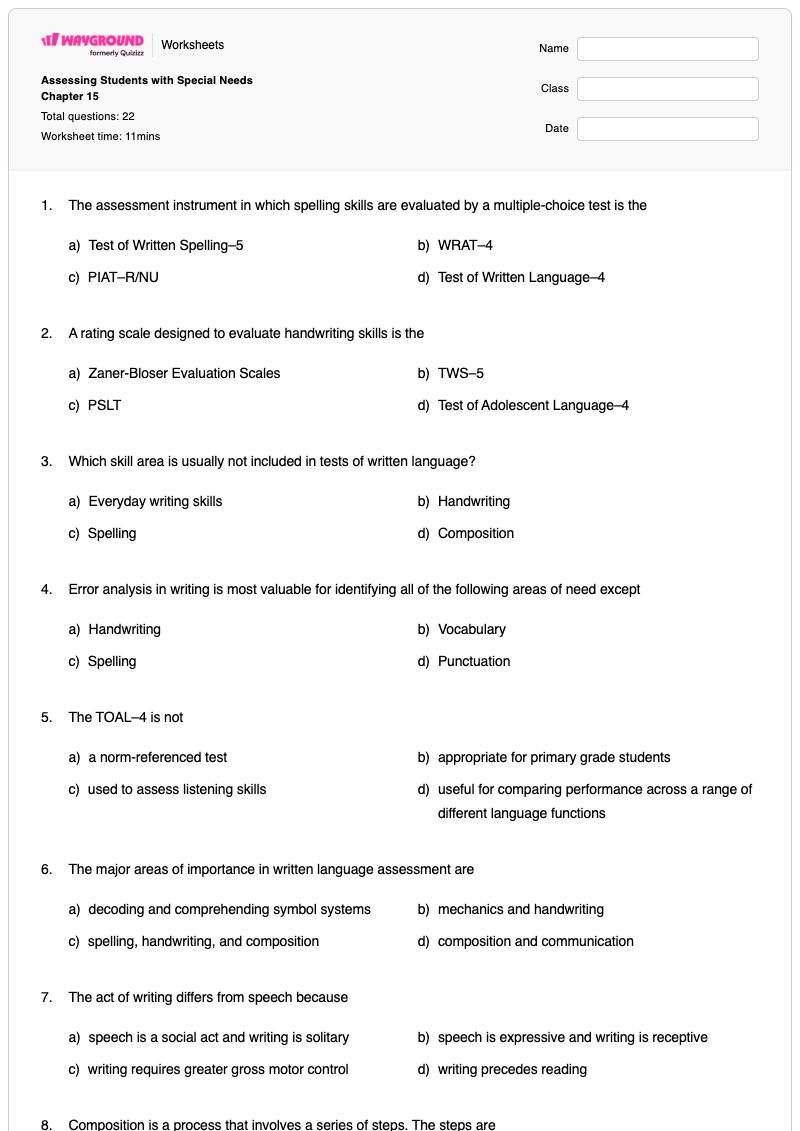
Assessing Students with Special Needs Chapter 15

คำถามทั้งหมด: 22

ชื่อ
ระดับ
วันที่
1.

The assessment instrument in which spelling skills are evaluated by a multiple-choice test is the

a)

Test of Written Spelling–5

b)

WRAT–4

c)

PIAT–R/NU

d)

Test of Written Language–4

2.

A rating scale designed to evaluate handwriting skills is the

a)

Zaner-Bloser Evaluation Scales

b)

TWS–5

c)

PSLT

d)

Test of Adolescent Language–4

3.

Which skill area is usually not included in tests of written language?

a)

Everyday writing skills

b)

Handwriting

c)

Spelling

d)

Composition

4.

Error analysis in writing is most valuable for identifying all of the following areas of need except

a)

Handwriting

b)

Vocabulary

c)

Spelling

d)

Punctuation

5.

The TOAL–4 is not

a)

a norm-referenced test

b)

appropriate for primary grade students

c)

used to assess listening skills

d)

useful for comparing performance across a range of different language functions

6.

The major areas of importance in written language assessment are

a)

decoding and comprehending symbol systems

b)

mechanics and handwriting

c)

spelling, handwriting, and composition

d)

composition and communication

7.

The act of writing differs from speech because

a)

speech is a social act and writing is solitary

b)

speech is expressive and writing is receptive

c)

writing requires greater gross motor control

d)

writing precedes reading

8.

Composition is a process that involves a series of steps. The steps are

a)

scribbling, printing, cursive writing

b)

drawing, scribbling, penmanship

c)

planning, transcribing, revising

d)

input, planning, output, debugging

9.

When evaluating a classroom program for teaching written language skills, it is important that

a)

the subskills of writing, such as spelling, vocabulary, and composition should be taught in an integrated manner, not separately.

b)

the students keep journals in which they write everyday.

c)

the subskills of writing, such as spelling, vocabulary, and compostition should be taught separately.

d)

students be exposed to a broad range of writing tasks.

10.

It is best to conduct a clinical writing interview

a)

when the student is planning his or her composition

b)

while the student is writing

c)

after the student has finished writing

d)

when the composition has been graded and returned to the student

11.

Which instructional method of spelling is not supported by research?

a)

Presentation of words in lists

b)

Use of the test-study-test method

c)

Allocation of 60 to 75 minutes per week for spelling

d)

Writing words several times each to promote retention

12.

Clinical interview questions about the composition process should include questions about

a)

the student's view of the purpose of writing and the audience

b)

the student's past successes and failures in writing

c)

the teacher's requirements for written work

d)

the ways in which the student attempts to correct decoding errors

13.

Holistic evaluation of writing samples

a)

is recommended when standardized tests are not available

b)

requires that the teacher read the student's work quickly to obtain a general impression of its quality

c)

is a process in which groups of teachers use the same rating scales and checklists to evaluate student work samples

d)

begins with correction of all student errors

14.

Teachers can devise criterion-referenced tests of spelling skills using

a)

high frequency word lists

b)

lists of spelling demons

c)

words from the spelling basal used in the classroom

d)

all of the above

15.

Which of the following statements is incorrect regarding written language?

a)

Writing imposes the roles of author and secretary on the student

b)

Written language assessment is usually limited to evaluation of spelling skills because spelling is the most important area of written expression

c)

Many students with mild disabilities experience difficulty in the area of written language

d)

Students should be instructed in the content and mechanics of written language

16.

If handwriting is an area of difficulty for a student, the teacher can allow the student

a)

to type his or her written work

b)

to tape record his or her written work

c)

dictate his or her written work

d)

all of the above

17.

Identify the phonetic spelling error

a)

writing "kat" instead of "cat"

b)

writing “lenht” for “length”

c)

writing “oh” for “house”

d)

none of the above

18.

This aspect of language is concerned with the meanings of words.

a)

Morphology

b)

Semantics

c)

Pragmatics

d)

Phonology

19.

The study of the use of language in various communication settings and contexts is

a)

Morphology

b)

Semantics

c)

Pragmatics

d)

Phonology

20.

Which aspect of language is not concerned with language form?

a)

Semantics

b)

Morphology

c)

Syntax

d)

Phonology

21.

Which is a formal measure of pragmatic competence?

a)

Basic Inventory of Natural Language

b)

Let's Talk Inventory for Children

c)

Photo Articulation Test-3rd Ed.

d)

Test of Adolescent and Adult Language–4

22.

The TOLD–4, Intermediate does not assess

a)

phonology

b)

both expressive and receptive language

c)

syntax

d)

semantics

Waygroundแป้นคำตอบ

Assessing Students with Special Needs Chapter 15

คำถามทั้งหมด: 22

1.
c)

PIAT–R/NU

2.
a)

Zaner-Bloser Evaluation Scales

3.
a)

Everyday writing skills

4.
b)

Vocabulary

5.
c)

used to assess listening skills

6.
c)

spelling, handwriting, and composition

7.
a)

speech is a social act and writing is solitary

8.
c)

planning, transcribing, revising

, d)

input, planning, output, debugging

9.
d)

students be exposed to a broad range of writing tasks.

10.
c)

after the student has finished writing

11.
d)

Writing words several times each to promote retention

12.
a)

the student's view of the purpose of writing and the audience

13.
b)

requires that the teacher read the student's work quickly to obtain a general impression of its quality

14.
d)

all of the above

15.
b)

Written language assessment is usually limited to evaluation of spelling skills because spelling is the most important area of written expression

16.
d)

all of the above

17.
a)

writing "kat" instead of "cat"

18.
b)

Semantics

19.
c)

Pragmatics

20.
a)

Semantics

21.
b)

Let's Talk Inventory for Children

22.
a)

phonology

คำถามที่พบบ่อย

แบบฝึกหัดนี้ครอบคลุมหัวข้ออะไรบ้างเกี่ยวกับการประเมินทักษะภาษาเขียน?

แบบฝึกหัดนี้ครอบคลุมถึงวิธีการที่ครูประเมินการสะกดคำ ลายมือ การเรียบเรียง และด้านอื่นๆ ของภาษาเขียนสำหรับนักเรียนที่มีความต้องการพิเศษ แบบฝึกหัดนี้มีคำถามแบบเลือกตอบ 16 ข้อ และคำถามแบบเลือกตอบหลายข้อ 6 ข้อ ซึ่งจะกระตุ้นให้นักเรียนระบุเครื่องมือในการประเมิน ตีความวิธีการประเมิน และแยกแยะหลักการที่ถูกต้องเกี่ยวกับการสอนและการประเมินการเขียน

ฉันจะใช้แบบฝึกหัดนี้ในการสอนการประเมินทักษะการเขียนได้อย่างไร?

เริ่มด้วยการอธิบายความแตกต่างระหว่างการประเมินการสะกดคำ ลายมือ และการเรียบเรียง จากนั้นอภิปรายว่าเหตุใดตัวอย่างงานเขียนจึงให้ข้อมูลที่มากกว่าคะแนนการสะกดคำเพียงอย่างเดียว หลังจากที่นักเรียนทำแบบฝึกหัดเสร็จแล้ว ให้พวกเขาอธิบายเหตุผลในการเลือกใช้การสัมภาษณ์การเขียนเชิงคลินิก การประเมินแบบองค์รวม กระบวนการเรียบเรียง และการทดสอบการสะกดคำแบบอ้างอิงเกณฑ์ โดยใช้ตัวอย่างจากงานเขียนในห้องเรียน

ฉันควรสังเกตข้อผิดพลาดอะไรบ้างเมื่อนักเรียนทำแบบฝึกหัดนี้เสร็จ?

นักเรียนอาจสับสนเกี่ยวกับจุดประสงค์ของเครื่องมือประเมินผลต่างๆ เช่น PIAT–R/NU และ Zaner-Bloser Evaluation Scales หรืออาจมองว่าการสะกดคำเป็นสิ่งสำคัญเพียงอย่างเดียวในการประเมินทักษะภาษาเขียน ในข้อสอบแบบเลือกตอบหลายข้อ ให้สังเกตนักเรียนที่เลือกเพียงตัวเลือกที่ถูกต้องเพียงข้อเดียว มองข้ามความแตกต่างระหว่างขั้นตอนการแต่งเรียงความและหลักการเขียน หรือเลือกแบบฝึกหัดการสะกดคำที่ไม่ได้รับการสนับสนุน

ฉันจะมอบหมายและให้คะแนนแบบฝึกหัดประเมินทักษะภาษาเขียนนี้ได้อย่างไร?

แบบฝึกหัดนี้มีให้ดาวน์โหลดในรูปแบบไฟล์ PDF สำหรับพิมพ์ และเป็นแบบทดสอบดิจิทัลบน Wayground พร้อมเฉลยคำตอบครบถ้วนสำหรับคำถามแบบเลือกตอบและเลือกคำตอบที่ถูกต้องทั้ง 22 ข้อ การส่งงานในรูปแบบไฟล์ PDF สามารถตรวจได้โดยการสแกนงานของนักเรียนด้วยแอป Wayground for Teachers ในขณะที่เวอร์ชันดิจิทัลรองรับการส่งงานและการตรวจให้คะแนนทางออนไลน์

ฉันจะปรับแบบฝึกหัดนี้ให้เหมาะสมกับนักเรียนของฉันได้อย่างไร?

ในการตั้งค่าขั้นสูงของแบบฝึกหัด ให้ปรับระยะห่างระหว่างตัวอักษรหรือเลือกขนาดตัวอักษรที่ใหญ่ขึ้นเพื่อให้คำศัพท์และตัวเลือกคำตอบในการประเมินอ่านง่ายขึ้น นอกจากนี้ คุณยังสามารถเปิดใช้งานแบบอักษรที่เหมาะสำหรับผู้ที่มีภาวะดิสเล็กเซีย หรือแปลแบบฝึกหัดแบบเลือกตอบและเลือกหลายข้อเป็นภาษาอื่นได้

ฉันจะหาแบบฝึกหัดแบบนี้เพิ่มเติมได้ที่ไหนบน Wayground?

Wayground นำเสนอชุดแบบฝึกหัดและโจทย์ฝึกหัดที่สามารถพิมพ์ได้ฟรีอย่างครอบคลุมในทุกวิชา รวมถึงไฟล์ PDF ที่ดาวน์โหลดได้และเฉลยคำตอบ ซึ่งช่วยเสริมสร้างทักษะและความเข้าใจในแนวคิดที่สำคัญ ดูแหล่งข้อมูลเพิ่มเติมได้ที่ https://wayground.com/en-us/worksheets