
Wayground
Motion definitions and graphs - Printable ศาสตร์ Worksheets ระดับ 11 - Wayground

Motion definitions and graphs

Logan Lloyd

สร้างโดย Logan Lloyd

20 คำถาม

11th ระดับชั้น

ศาสตร์

อัปเดตแล้ว ต.ค. 2569

แบบฝึกหัดวิทยาศาสตร์สำหรับชั้นมัธยมศึกษาปีที่ 4 ชุดนี้ ช่วยเสริมสร้างทักษะพื้นฐานในการอธิบายและวิเคราะห์การเคลื่อนที่ นักเรียนจะได้เรียนรู้การแยกแยะระยะทางจากการกระจัด การระบุปริมาณสเกลาร์และเวกเตอร์ และการแยกแยะความเร็ว อัตราเร็ว และความเร่ง นอกจากนี้ พวกเขายังสามารถตีความกราฟตำแหน่ง ความเร็ว และระยะทางเทียบกับเวลา โดยเชื่อมโยงความชัน ทิศทาง ความเร็ว ความเร่ง และการเปลี่ยนแปลงของการเคลื่อนที่เข้ากับสิ่งที่กราฟแสดง แบบฝึกหัด 20 ข้อนี้ ประกอบด้วยคำถามแบบเลือกตอบ 18 ข้อ และคำถามแบบเลือกคำตอบ 2 ข้อ นักเรียนจะได้คำนวณระยะทางรวม การกระจัด และความเร็วเฉลี่ย ระบุความเร็วและความเร่ง ณ ขณะใดขณะหนึ่ง และใช้หลักฐานจากกราฟเพื่อพิจารณาว่าวัตถุนั้นอยู่นิ่ง เคลื่อนที่ด้วยความเร็วคงที่ กำลังเร่งความเร็ว กำลังชะลอความเร็ว หรือเปลี่ยนทิศทาง แบบฝึกหัดนี้ออกแบบมาสำหรับใช้ในการสอนวิทยาศาสตร์ชั้นมัธยมศึกษาปีที่ 4 และมีเฉลยให้สำหรับทบทวน ฝึกฝนด้วยตนเอง หรือประเมินผล

การตั้งค่าแผ่นงาน

ขนาดตัวอักษร

S
M
L
XL
Waygroundแผ่นงาน

Motion definitions and graphs

คำถามทั้งหมด: 20

ชื่อ
ระดับ
วันที่
1.
Scott drives a Jeep 12 km east, then 4 km north, then finally 3 km west. He traveled a total distance of:
a)
5 km
b)
10 km
c)
13 km
d)
19 km
2.

A ping-pong ball rolls forward 6 meters, and bounces backward 3 meters. It traveled a total displacement of:

a)
9 meters
b)
6 meters
c)
3 meters
d)
0 meters
3.

The slope of a velocity-time graph represents __________.

a)

acceleration

b)

displacement

c)

speed

d)

distance

4.
This position vs. time graph shows an object...

This position vs. time graph shows an object...

a)

not moving

b)

moving with constant velocity

c)

moving with changing velocity

5.

Which of these position vs. time graphs shows an object changing direction?

a)
Which of these position vs. time graphs shows an object changing direction?
b)
Which of these position vs. time graphs shows an object changing direction?
c)
Which of these position vs. time graphs shows an object changing direction?
d)
Which of these position vs. time graphs shows an object changing direction?
6.

Which of these velocity vs. time graphs shows an object changing direction?

a)
Which of these velocity vs. time graphs shows an object changing direction?
b)
Which of these velocity vs. time graphs shows an object changing direction?
c)
Which of these velocity vs. time graphs shows an object changing direction?
d)
Which of these velocity vs. time graphs shows an object changing direction?
7.
Select the two correct statements that describe the object's motion.

Select the two correct statements that describe the object's motion.

a)

The object is moving in the positive direction.

b)

The object is moving in the negative direction.

c)

The object is moving at a constant speed.

d)

The object is speeding up.

e)

The object is slowing down.

8.
Select the two correct statements that describe the object's motion.

Select the two correct statements that describe the object's motion.

a)

The object is moving in the positive direction.

b)

The object is moving in the negative direction.

c)

The object is moving at a constant speed.

d)

The object is speeding up.

e)

The object is slowing down.

9.
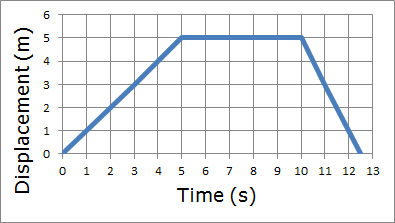
According to the graph what is the distance traveled over the whole trip?

According to the graph what is the distance traveled over the whole trip?

a)

12.5 m

b)
10 m
c)
0 m
d)
5 m
10.
The speedometer on your car tells you
a)
average velocity
b)
instantaneous velocity
c)
average speed
d)
instantaneous speed
11.
The rate at which velocity changes is called 
a)
motion
b)
average speed
c)
instantaneous speed
d)
acceleration
12.
What is happening between 3 seconds and 4 seconds?
a)
The object is moving in a negative direction.
b)
The object is returning to its starting position.
c)
The object is slowing to a stop.
d)
The object is changing direction.
13.
A value with magnitude and direction
a)
Scalar
b)
Speed
c)
Velocity
d)
Vector
14.
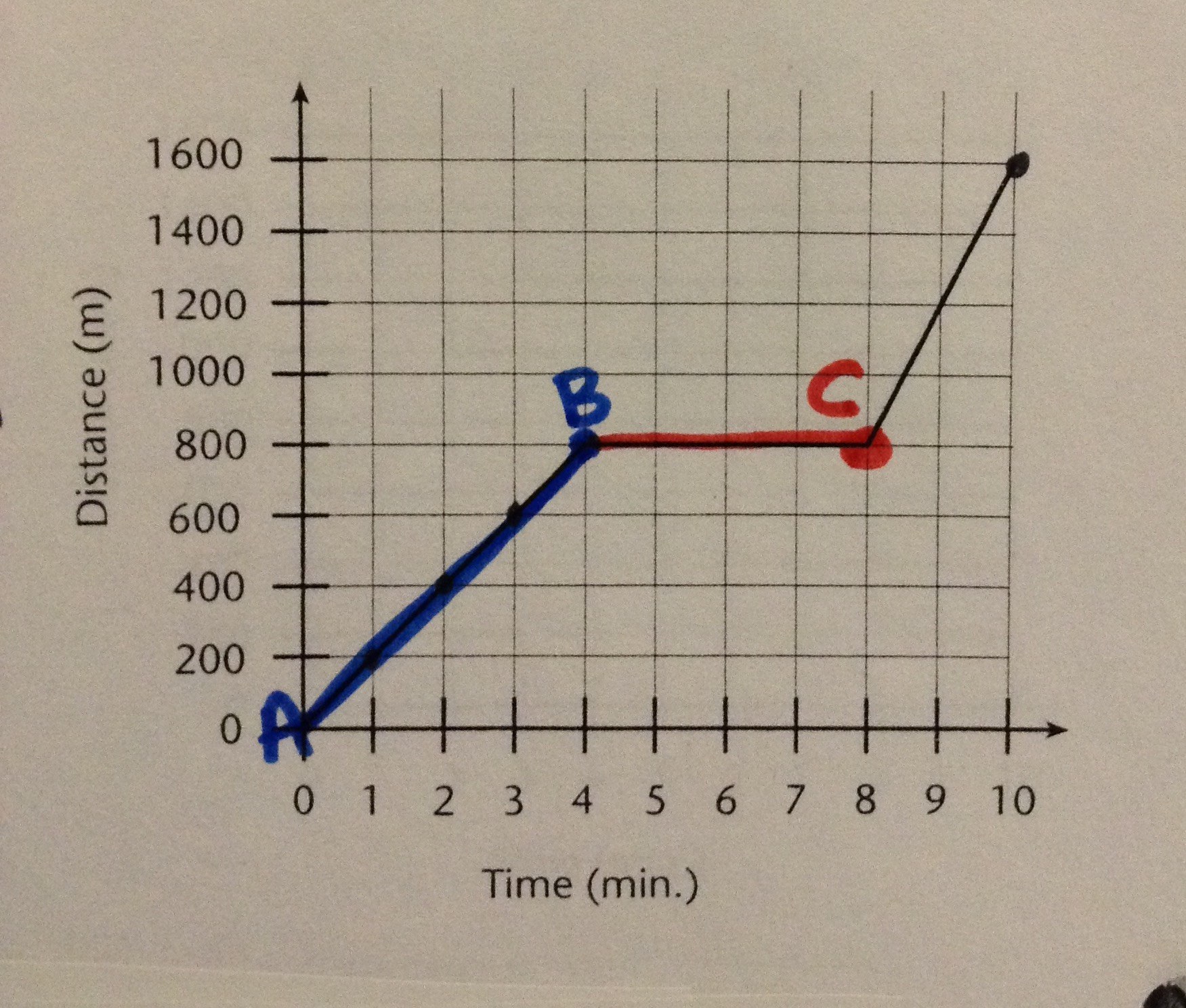
The graph shows Ashley riding her bike to Maria's house. What was her average speed for the ENTIRE trip?
 The graph shows Ashley riding her bike to Maria's house. 
What was her average speed for the ENTIRE trip?
a)
1600 m/min
b)
200 m/min
c)
160 m/min
15.
On a distance vs. time graph, the steeper the slope _____
a)
the slower the speed
b)
the faster the speed
c)
less acceleration
d)
greater acceleration
16.
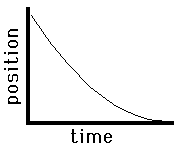
Describe the motion
Describe the motion
a)
Slow to fast;   Negative direction
b)
Fast to slow;   Negative direction
c)
Fast to slow;   Positive direction
d)
Slow to fast;   Positive direction
17.
How would you find the average speed from 0 - 40 seconds?

How would you find the average speed from 0 - 40 seconds?

a)

10/40 = 0.25 m/s

b)

40/10 = 4 m/s

c)

slope = 10/20 = 0.5 m/s

d)

slope = 0/20 = 0 m/s

18.
How would you find the average velocity from 40-100 seconds?

How would you find the average velocity from 40-100 seconds?

a)

-10/60 = -0.167 m/s

b)

10/60 = 0.167 m/s

c)

0/60 = 0 m/s

d)

-40/60 = -0.67 m/s

19.
In the motion diagram shown, when would the acceleration be considered negative? (Assume right is the positive direction)

In the motion diagram shown, when would the acceleration be considered negative? (Assume right is the positive direction)

a)

never

b)

at A only

c)

at B only

d)

at A and B

20.
For a ball thrown straight up in the air, which of the following statements is TRUE? (assume up is the positive direction)

For a ball thrown straight up in the air, which of the following statements is TRUE? (assume up is the positive direction)

a)

The velocity is positive the whole time the ball is in the air.

b)

The acceleration is only negative on the way down.

c)

The velocity and acceleration are both positive on the way up.

d)

The velocity and acceleration are both negative on the way down.

Waygroundแป้นคำตอบ

Motion definitions and graphs

คำถามทั้งหมด: 20

1.
d) 19 km
2.
c) 3 meters
3.
a)

acceleration

4.
b)

moving with constant velocity

5.
d)
6.
d)
7.
a)

The object is moving in the positive direction.

, c)

The object is moving at a constant speed.

8.
b)

The object is moving in the negative direction.

, e)

The object is slowing down.

9.
b) 10 m
10.
d) instantaneous speed
11.
d) acceleration
12.
c) The object is slowing to a stop.
13.
d) Vector
14.
c) 160 m/min
15.
b) the faster the speed
16.
b) Fast to slow;   Negative direction
17.
a)

10/40 = 0.25 m/s

18.
a)

-10/60 = -0.167 m/s

19.
b)

at A only

20.
d)

The velocity and acceleration are both negative on the way down.

คำถามที่พบบ่อย

แบบฝึกหัดเรื่องคำจำกัดความและกราฟการเคลื่อนที่ครอบคลุมหัวข้ออะไรบ้าง?

แบบฝึกหัดวิทยาศาสตร์สำหรับนักเรียนชั้นมัธยมศึกษาปีที่ 4 (เกรด 11) นี้ ประกอบด้วยคำถามแบบเลือกตอบ 18 ข้อ และคำถามแบบเลือกคำตอบ 2 ข้อ เพื่อประเมินความเข้าใจเกี่ยวกับนิยามของการเคลื่อนที่ ระยะทางและการกระจัด ปริมาณสเกลาร์และเวกเตอร์ และความเร็ว อัตราเร็ว และความเร่ง นอกจากนี้ นักเรียนยังต้องอ่านกราฟแสดงความสัมพันธ์ระหว่างตำแหน่ง ความเร็ว และระยะทางกับเวลา เพื่อหาความชัน ทิศทาง ระยะทางรวม ความเร็วเฉลี่ย และพิจารณาว่าวัตถุนั้นกำลังเร่งความเร็ว ลดความเร็ว หรือเปลี่ยนทิศทาง

ฉันจะใช้แบบฝึกหัดนี้ในการสอนเรื่องคำจำกัดความและกราฟการเคลื่อนที่ได้อย่างไร?

เริ่มแบบฝึกหัดโดยทบทวนความสัมพันธ์ระหว่างระยะทางกับการกระจัด และปริมาณสเกลาร์กับปริมาณเวกเตอร์ จากนั้นเชื่อมโยงกราฟแต่ละประเภทเข้ากับข้อมูลการเคลื่อนที่ที่ได้จากความชันหรือรูปร่างของกราฟ ให้นักเรียนอธิบายหลักฐานที่อยู่เบื้องหลังคำตอบที่ได้จากกราฟ เช่น ทำไมความชันของกราฟตำแหน่งเทียบกับเวลาจึงบ่งชี้ถึงความเร็วคงที่ หรือทำไมความชันของกราฟความเร็วเทียบกับเวลาจึงบ่งชี้ถึงความเร่ง ใช้คำถามแบบเลือกหลายข้อเป็นหัวข้อในการอภิปราย เพื่อให้นักเรียนอธิบายเหตุผลของทั้งข้อความเกี่ยวกับทิศทางและการเปลี่ยนแปลงของความเร็ว

ฉันควรระวังข้อผิดพลาดอะไรบ้างเมื่อนักเรียนทำแบบฝึกหัดเรื่องการเคลื่อนที่นี้?

นักเรียนอาจบวกความยาวของเส้นทางเมื่อคำถามถามถึงการกระจัด หรืออาจคิดว่าการกระจัดคือระยะทางที่เดินทางไป นอกจากนี้ พวกเขาอาจสับสนระหว่างความชันของกราฟตำแหน่ง-เวลา กับความเร่ง แม้ว่าแบบฝึกหัดจะใช้ความชันของกราฟความเร็ว-เวลาสำหรับความเร่ง และความชันของกราฟระยะทาง-เวลาสำหรับความเร็วที่มากขึ้นก็ตาม โปรดระวังข้อผิดพลาดเรื่องเครื่องหมายเมื่อระบุทิศทางบวกหรือลบ และการเลือกคำตอบที่ถูกต้องเพียงข้อเดียวในข้อคำถามเกี่ยวกับการเคลื่อนที่แบบเลือกหลายข้อ

ฉันจะมอบหมายและให้คะแนนแบบฝึกหัดเรื่องคำจำกัดความและกราฟการเคลื่อนที่นี้ได้อย่างไร?

แบบฝึกหัดนี้มีให้เลือกทั้งในรูปแบบไฟล์ PDF ที่สามารถพิมพ์ได้ และแบบทดสอบดิจิทัลบน Wayground โดยมีเฉลยคำตอบครบถ้วนสำหรับคำถามทั้ง 20 ข้อ สำหรับการส่งงานแบบพิมพ์ คุณสามารถตรวจงานของนักเรียนได้โดยการสแกนด้วยแอป Wayground for Teachers นอกจากนี้ ตัวเลือก PDF ยังสามารถใช้สนับสนุนการเรียนการสอนในสภาพแวดล้อมที่ลดเวลาการใช้หน้าจอได้อีกด้วย

ฉันจะปรับแบบฝึกหัดกราฟการเคลื่อนที่นี้ให้เหมาะสมกับนักเรียนของฉันได้อย่างไร?

ใช้การตั้งค่าขั้นสูงของแบบฝึกหัดเพื่อปรับระยะห่างระหว่างตัวอักษร หรือเลือกขนาดตัวอักษรที่ใหญ่ขึ้น เพื่อให้คำถามเกี่ยวกับกราฟและตัวเลือกคำตอบอ่านง่ายขึ้น นอกจากนี้ คุณยังสามารถเปิดใช้งานแบบอักษรที่เหมาะสำหรับผู้ที่มีภาวะดิสเล็กเซีย หรือแปลแบบฝึกหัดเป็นภาษาอื่นในขณะที่นักเรียนกำลังทำแบบฝึกหัดเกี่ยวกับคำศัพท์เกี่ยวกับการเคลื่อนไหว คำถามเกี่ยวกับกราฟ และข้อความแบบเลือกหลายข้อได้

ฉันจะหาแบบฝึกหัดฟรีแบบนี้เพิ่มเติมได้ที่ไหนบน Wayground?

Wayground นำเสนอชุดแบบฝึกหัดและโจทย์ฝึกหัดฟรีที่ครอบคลุมทุกวิชา พร้อมไฟล์ PDF และเฉลยคำตอบ เพื่อช่วยให้นักเรียนเชี่ยวชาญทักษะและแนวคิดที่สำคัญ ดูแบบฝึกหัดเพิ่มเติมได้ที่ https://wayground.com/en-us/worksheets