
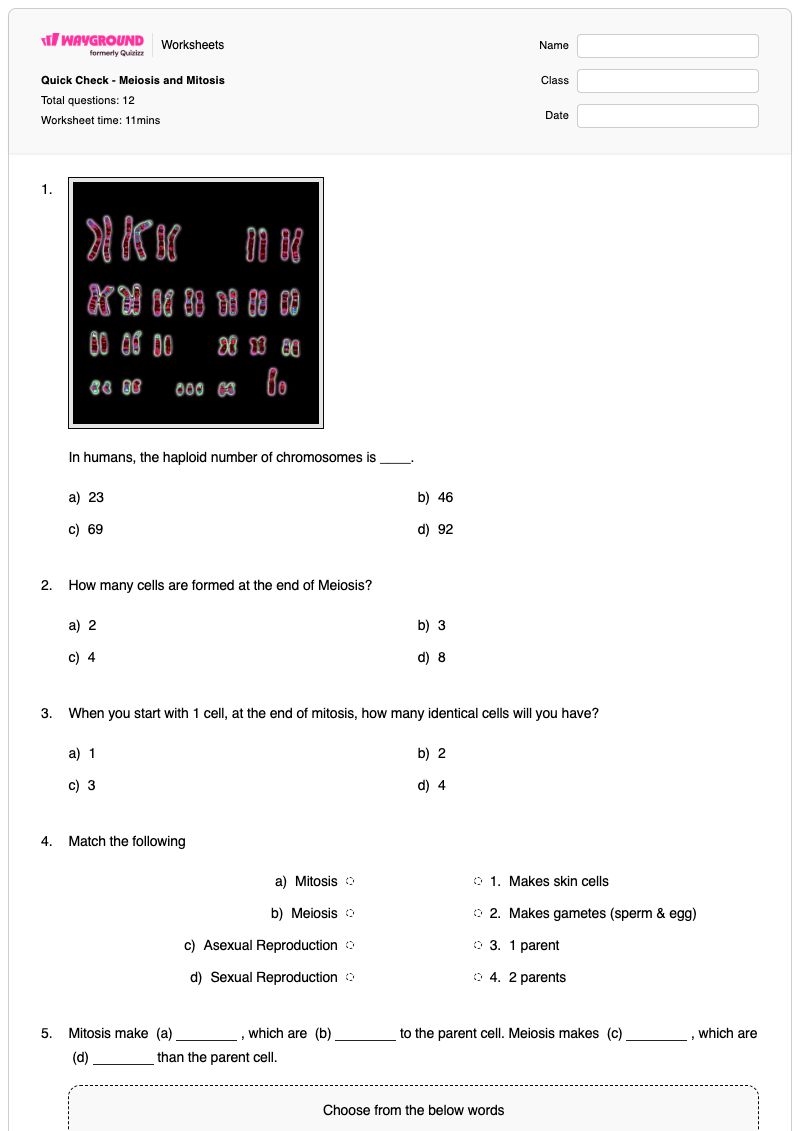

In humans, the haploid number of chromosomes is ____.
a)
23
b)
46
c)
69
d)
92
2.
How many cells are formed at the end of Meiosis?
a)
2
b)
3
c)
4
d)
8
3.
When you start with 1 cell, at the end of mitosis, how many identical cells will you have?
a)
1
b)
2
c)
3
d)
4
4.
Match the following
Mitosis
Makes skin cells
Meiosis
Makes gametes (sperm & egg)
Asexual Reproduction
1 parent
Sexual Reproduction
2 parents
5.
Mitosis make (a) , which are (b) to the parent cell. Meiosis makes (c) , which are (d) than the parent cell.
เลือกจากคำด้านล่าง
2 daughter cells
identical
4 daughter cells
different
6.
In complex organisms mitosis is used for (a) . Cells made by mitosis will be (b) to the parent cell. This similar to (c) If a parent cell has 16 chromosomes the daughter cells will have (d)
เลือกจากคำด้านล่าง
growth & repair or tissues
identical
asexual reproduction
16 chromosomes.
8 chromosomes
making gametes
different
sexual reproduction
7.
This image shows chromosomes during Meiosis. Which of the following correctly describes the process shown?
a)
separating of sister chromatids
b)
condensing and separating of genes
c)
mutationin which the DNA content of the gene is altered
d)
crossing over or recombination in which genes are exchanged between chromosomes
8.
What is an advantage of sexual reproduction?
a)
Allows genetic variation
b)
Only needs one parent
c)
Happens very quickly
d)
Offspring are exact copies of parent
9.
The part of the cell that contains chromosomes and genes is the:
a)
Mitochondria
b)
Nucleus
c)
Chloroplast
d)
Ribosomes
10.
Which organelle is DNA usually found in?
a)
cell membrane
b)
vacuole
c)
chloroplast
d)
nucleus
11.
Bundled up, organized DNA is called a
a)
gene
b)
trait
c)
chromosome
d)
nucleotide
12.
The 2 exact copies of DNA in a chromosome are called ________.
a)
chromatids
b)
genes
c)
mutations
d)
pathogens
แป้นคำตอบ
Quick Check - Meiosis and Mitosis
คำถามทั้งหมด: 12
1.
a)
23
2.
c)
4
3.
b) 2
4.
Mitosis
-
Makes skin cells
,
Meiosis
-
Makes gametes (sperm & egg)
,
Asexual Reproduction
-
1 parent
,
Sexual Reproduction
-
2 parents
5.
2 daughter cells, identical, 4 daughter cells, different
6.
growth & repair or tissues, identical, asexual reproduction, 16 chromosomes.
7.
d)
crossing over or recombination in which genes are exchanged between chromosomes