

Wayground
Transformations. Sequence of Transformations. - Printable คณิตศาสตร์ Worksheets 10th ระดับชั้น - Wayground

Transformations. Sequence of Transformations.

Pablo Unday

สร้างโดย Pablo Unday

18 คำถาม

10th ระดับชั้น

คณิตศาสตร์

อัปเดตแล้ว ต.ค. 2569

แบบฝึกหัดเรื่องการแปลงรูปทรงเรขาคณิต: ลำดับของการแปลงรูปทรงเรขาคณิต เป็นแบบฝึกหัดคณิตศาสตร์สำหรับนักเรียนชั้นมัธยมศึกษาปีที่ 4 ที่พัฒนาความสามารถของนักเรียนในการระบุและอธิบายการแปลงรูปทรงเรขาคณิตเดี่ยวและการแปลงรูปทรงเรขาคณิตแบบเรียงลำดับ แบบฝึกหัดนี้มีคำถามแบบเลือกตอบ 18 ข้อ นักเรียนจะได้วิเคราะห์รูปทรงและจุดพิกัดเพื่อแยกแยะความแตกต่างระหว่างการเลื่อน การสะท้อนข้ามแกน x และ y การหมุน 90° และ 180° และลำดับการแปลงรูปทรงเรขาคณิต เช่น การเลื่อนตามด้วยการสะท้อนหรือการหมุน แบบฝึกหัดนี้ยังถามนักเรียนให้หาภาพของจุดหลังจากการหมุน 180° ใช้การสะท้อนหลังจากการหมุน และตระหนักถึงวิธีการที่ลำดับของการแปลงรูปทรงเรขาคณิตเปลี่ยนรูปทรงหนึ่งไปเป็นอีกรูปทรงหนึ่ง แบบฝึกหัดนี้มีประโยชน์สำหรับการฝึกฝนแบบมีผู้แนะนำ การทบทวนด้วยตนเอง หรือการตรวจสอบความเข้าใจของนักเรียนเกี่ยวกับลำดับการแปลงรูปทรงเรขาคณิตและกฎพิกัด นี่คือแบบฝึกหัดที่พิมพ์ได้ฟรีพร้อมเฉลยคำตอบครบถ้วน ออกแบบมาสำหรับการสอนคณิตศาสตร์ชั้นมัธยมศึกษาปีที่ 4

การตั้งค่าแผ่นงาน

ขนาดตัวอักษร

S
M
L
XL
Waygroundแผ่นงาน

Transformations. Sequence of Transformations.

คำถามทั้งหมด: 18

ชื่อ
ระดับ
วันที่
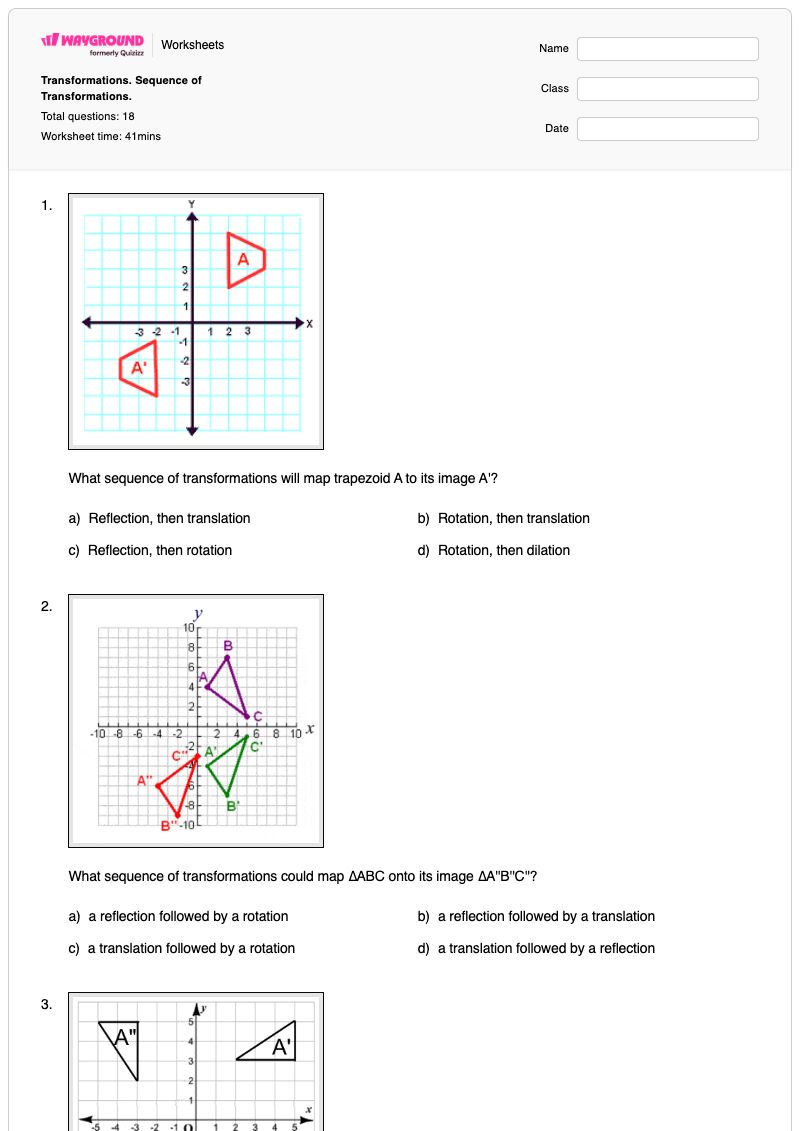
1.
What sequence of transformations will map trapezoid A to its image A'?

What sequence of transformations will map trapezoid A to its image A'?

a)

Reflection, then translation

b)

Rotation, then translation

c)

Reflection, then rotation

d)

Rotation, then dilation

2.
What sequence of transformations could map ∆ABC onto its image ∆A''B''C''?

What sequence of transformations could map ∆ABC onto its image ∆A''B''C''?

a)

a reflection followed by a rotation

b)

a reflection followed by a translation

c)

a translation followed by a rotation

d)

a translation followed by a reflection

3.
Which of the following describes the sequence of transformations shown?

Which of the following describes the sequence of transformations shown?

a)

Reflect across the x-axis and then rotate 90 degrees clockwise around the origin

b)

Rotate 90 degrees clockwise around the origin and then translate down.

c)

Reflect across the x-axis and then reflect across the y-axis.

d)

Translate up and then rotate 90 degrees counterclockwise about the origin.

4.
Which transformation is shown?

Which transformation is shown?

a)

Translation

b)

Reflection over the x-axis

c)

Reflection over the y-axis

d)

180o rotation

5.
Which transformation is shown?

Which transformation is shown?

a)

Translation

b)

Reflection over the x-axis

c)

Reflection over the y-axis

d)

90o counterclockwise rotation

6.
Which transformation is shown?

Which transformation is shown?

a)

Translation

b)

Reflection over the x-axis

c)

Reflection over the y-axis

d)

180o rotation

7.
Describe a sequence of transformations that maps figure A onto figure B.
Describe a sequence of transformations that maps figure A onto figure B.
a)
A translation 4 units right followed by a reflection across the x-axis
b)
A reflection across the x-axis followed by a reflection across the y-axis
c)
A reflection across the y-axis followed by a translation 6 units down
d)
A 90° counter-clockwise rotation about the Origin followed by a reflection across the y-axis
8.
Identify the sequences of transformations from the green image to the red image to the blue image.

Identify the sequences of transformations from the green image to the red image to the blue image.

a)

rotation then translation

b)

translation then rotation

c)

translation then reflection

d)

rotation then reflection

9.
What is the sequence of transformations?
a)
Reflect over the y-axis then reflect over the x-axis
b)
Reflect over the x-axis then reflect over the y-axis
c)
Translate 4 units then rotate 90˚ counter-clockwise about the origin
d)
Rotate 90˚ counter-clockwise about the origin then reflect over the x
10.
What combinaton of transformations is shown?

What combinaton of transformations is shown?

a)

Rotation, then translation

b)

Translation, then reflection

c)

Rotation, then reflection

d)

Translation, then rotation

11.
What combination of transformations is shown?

What combination of transformations is shown?

a)

Reflection, then rotation

b)

Translation, then rotation

c)

Translation, then reflection

d)

Reflection, then translation

12.
What are the final coordinates of B after a rotation of 180 degrees counterclockwise and a reflection over the y-axis

What are the final coordinates of B after a rotation of 180 degrees counterclockwise and a reflection over the y-axis

a)

(-3, -4)

b)

(3, 4)

c)

(-4, 3)

d)

(4, -3)

13.
Rotate the point (-3,-4) around the origin 180 degrees. State the image of the point.
a)
(-4,-3)
b)
(-4,3)
c)
(4,-3)
d)
(3,4)
14.
If you were to rotate ABCD 180° about the origin, what would the coordinate of A' be?
If you were to rotate ABCD 180°  about the origin, what would the coordinate of A' be?
a)
(-5, 5)
b)
(-3, -5)
c)
(-5, 3)
d)
(-3, 3)
15.
Which of the following describes the sequence of transformations shown?

Which of the following describes the sequence of transformations shown?

a)

Reflect across the x-axis and then rotate 90 degrees clockwise around the origin

b)

Rotate 90 degrees clockwise around the origin and then translate down.

c)

Reflect across the x-axis and then reflect across the y-axis.

d)

Translate up and then rotate 90 degrees counterclockwise about the origin.

16.
What sequence of transformations will map trapezoid A to its image A'?

What sequence of transformations will map trapezoid A to its image A'?

a)

Reflection, then translation

b)

Rotation, then translation

c)

Reflection, then rotation

d)

Rotation, then dilation

17.
If the red triangle is rotated 180 degrees, then reflected over the line y=2, what is the resulting image?

If the red triangle is rotated 180 degrees, then reflected over the line y=2, what is the resulting image?

a)

Green Triangle

b)

Blue Triangle

c)

Orange Triangle

d)

Red Triangle

18.
Describe a sequence of transformations that maps Triangle ABC onto Triangle A"B"C".
Describe a sequence of transformations that maps 
Triangle ABC onto Triangle A"B"C".
a)
A 180° rotation about the Origin followed by a reflection across the y-axis
b)
A reflection across the y-axis followed by a reflection across the x-axis and another reflection across the y-axis
c)
A translation 8 units right and 6 units down followed by a reflection across the y-axis
d)
A reflection across the x-axis followed by a translation 2 units to the left
Waygroundแป้นคำตอบ

Transformations. Sequence of Transformations.

คำถามทั้งหมด: 18

1.
a)

Reflection, then translation

2.
b)

a reflection followed by a translation

3.
d)

Translate up and then rotate 90 degrees counterclockwise about the origin.

4.
d)

180o rotation

5.
a)

Translation

6.
c)

Reflection over the y-axis

7.
b) A reflection across the x-axis followed by a reflection across the y-axis
8.
c)

translation then reflection

9.
a) Reflect over the y-axis then reflect over the x-axis
10.
c)

Rotation, then reflection

11.
c)

Translation, then reflection

12.
a)

(-3, -4)

13.
d) (3,4)
14.
b) (-3, -5)
15.
d)

Translate up and then rotate 90 degrees counterclockwise about the origin.

16.
a)

Reflection, then translation

17.
c)

Orange Triangle

18.
c) A translation 8 units right and 6 units down followed by a reflection across the y-axis

คำถามที่พบบ่อย

แบบฝึกหัดลำดับการแปลงนี้ครอบคลุมเรื่องอะไรบ้าง?

แบบฝึกหัดสำหรับนักเรียนชั้นมัธยมศึกษาปีที่ 4 นี้ ประกอบด้วยคำถามแบบเลือกตอบ 18 ข้อ เพื่อประเมินว่านักเรียนสามารถระบุการเลื่อน การสะท้อน และการหมุน และกำหนดลำดับการใช้การแปลงรูปทรงเรขาคณิตได้อย่างไร นักเรียนจะต้องตีความแผนภาพ อธิบายความสัมพันธ์ระหว่างรูปทรง และคำนวณพิกัดภาพหลังจากดำเนินการต่างๆ เช่น การหมุน 180° แล้วสะท้อนผ่านแกน y

ฉันจะใช้แบบฝึกหัดนี้สอนลำดับการแปลงรูปทรงเรขาคณิตได้อย่างไร?

เริ่มแบบฝึกหัดโดยทบทวนว่าการเลื่อน การสะท้อนตามแกน x และ y และการหมุนรอบจุดกำเนิด เปลี่ยนแปลงรูปทรงหรือจุดอย่างไร จากนั้นให้นักเรียนอธิบายขั้นตอนแรกและขั้นตอนที่สองในคำถามที่ใช้แผนภาพประกอบที่เลือกไว้ ก่อนที่จะเลือกคำตอบ โดยเน้นว่าการเปลี่ยนลำดับสามารถเปลี่ยนภาพสุดท้ายได้ หลังจากนั้นให้ใช้คำถามเกี่ยวกับพิกัดเพื่อเชื่อมโยงการแปลงรูปทรงกับการใช้กฎพิกัด

ฉันควรระวังข้อผิดพลาดอะไรบ้างเมื่อนักเรียนทำแบบฝึกหัดเรื่องการแปลงรูปทรงนี้?

สังเกตนักเรียนที่ระบุการแปลงที่ถูกต้อง แต่สลับลำดับ เช่น เลือกการหมุนก่อนแล้วค่อยการเลื่อน แทนที่จะเลือกการเลื่อนก่อนแล้วค่อยการหมุน นักเรียนอาจสับสนระหว่างการสะท้อนข้ามแกน x กับการสะท้อนข้ามแกน y หรือใช้กฎการหมุน 180° อย่างไม่ถูกต้อง แบบฝึกหัดเรื่องพิกัดจะช่วยตรวจสอบได้อย่างชัดเจน เพราะการหมุน 180° รอบจุดกำเนิดจะเปลี่ยนเครื่องหมายของพิกัดทั้งสองข้าง

ฉันจะมอบหมายและให้คะแนนแบบฝึกหัดเรื่องการแปลงรูปทรงนี้ได้อย่างไร?

คุณสามารถมอบหมายแบบฝึกหัดนี้เป็นไฟล์ PDF ที่พิมพ์ได้ หรือเป็นแบบทดสอบดิจิทัลบน Wayground แบบฝึกหัดนี้มีเฉลยคำตอบครบถ้วน และสามารถตรวจงานของนักเรียนที่พิมพ์ออกมาได้โดยการสแกนด้วยแอป Wayground for Teachers รูปแบบที่พิมพ์ได้ยังช่วยสนับสนุนโรงเรียนที่ต้องการลดเวลาการใช้หน้าจอได้อีกด้วย

ฉันจะปรับแบบฝึกหัดเรื่องการแปลงรูปทรงนี้ให้เหมาะสมกับนักเรียนของฉันได้อย่างไร?

ใช้การตั้งค่าขั้นสูงของแบบฝึกหัดเพื่อปรับระยะห่างระหว่างตัวอักษรหรือเพิ่มขนาดตัวอักษร เพื่อให้คำอธิบายการแปลงแบบเลือกตอบและตัวเลือกพิกัดอ่านง่ายขึ้น นอกจากนี้ คุณยังสามารถใช้แบบอักษรที่เหมาะสำหรับผู้ที่มีภาวะดิสเล็กเซีย หรือแปลแบบฝึกหัดเป็นภาษาอื่นได้ เมื่อการเปลี่ยนแปลงเหล่านั้นช่วยให้เข้าถึงแผนภาพและคำถามเกี่ยวกับพิกัดได้ง่ายขึ้น

ฉันจะหาแบบฝึกหัดแบบนี้เพิ่มเติมได้ที่ไหนบน Wayground?

Wayground นำเสนอชุดแบบฝึกหัดและโจทย์ฝึกหัดที่สามารถพิมพ์ได้ฟรีอย่างครอบคลุมในทุกวิชา รวมถึงไฟล์ PDF ที่ดาวน์โหลดได้และเฉลยคำตอบ เพื่อช่วยให้นักเรียนเชี่ยวชาญทักษะและแนวคิดที่สำคัญ ดูแหล่งข้อมูลเพิ่มเติมได้ที่ https://wayground.com/en-us/worksheets