

Wayground
Great Depression - Printable สังคมศึกษา Worksheets ระดับ 11 - Wayground

Great Depression

Kristen Christensen

สร้างโดย Kristen Christensen

16 คำถาม

11th ระดับชั้น

สังคมศึกษา

อัปเดตแล้ว มิ.ย. 2569

แบบฝึกหัดเรื่องภาวะเศรษฐกิจตกต่ำครั้งใหญ่ (Great Depression) สำหรับนักเรียนชั้นมัธยมศึกษาปีที่ 6 ช่วยให้นักเรียนได้ศึกษาถึงสาเหตุ เหตุการณ์สำคัญ และผลกระทบโดยตรงของภาวะเศรษฐกิจตกต่ำครั้งใหญ่ แบบฝึกหัดนี้ประกอบด้วย 16 ข้อ—15 ​​ข้อเป็นแบบเลือกตอบ และ 1 ข้อเป็นการเลือกคำตอบที่ถูกต้อง—เพื่อให้นักเรียนได้เชื่อมโยงเหตุการณ์ต่างๆ เช่น การล่มสลายของตลาดหุ้นในปี 1929 ความต้องการของผู้บริโภคที่ลดลง การแห่ถอนเงินจากธนาคาร การให้สินเชื่อมากเกินไป การกระจายรายได้ที่ไม่เท่าเทียมกัน ความผิดพลาดของธนาคารกลางสหรัฐ และภาษีศุลกากรที่ลดการค้าโลก เข้ากับวิกฤตเศรษฐกิจในวงกว้าง แบบฝึกหัดนี้ยังตรวจสอบความเข้าใจของนักเรียนเกี่ยวกับสมัยการดำรงตำแหน่งประธานาธิบดีของเฮอร์เบิร์ต ฮูเวอร์ รวมถึงแนวทางการบริหารที่ไม่แทรกแซงมากนัก เงินกู้เพื่อธุรกิจของบรรษัทการเงินเพื่อการฟื้นฟู (Reconstruction Finance Corporation) กองทัพโบนัส (Bonus Army) ชุมชนฮูเวอร์วิลล์ (Hoovervilles) และผลกระทบของการล้มเหลวของธนาคารต่อประชาชนทั่วไป แบบฝึกหัดนี้สามารถพิมพ์ได้ฟรี พร้อมเฉลยคำตอบครบถ้วน เหมาะสำหรับการเรียนการสอนแบบมีผู้แนะนำ การทบทวนด้วยตนเอง หรือการประเมินความสามารถของนักเรียนในการระบุความสัมพันธ์ระหว่างสาเหตุทางประวัติศาสตร์ การตอบสนองของรัฐบาล และผลที่ตามมา

การตั้งค่าแผ่นงาน

ขนาดตัวอักษร

S
M
L
XL
Waygroundแผ่นงาน

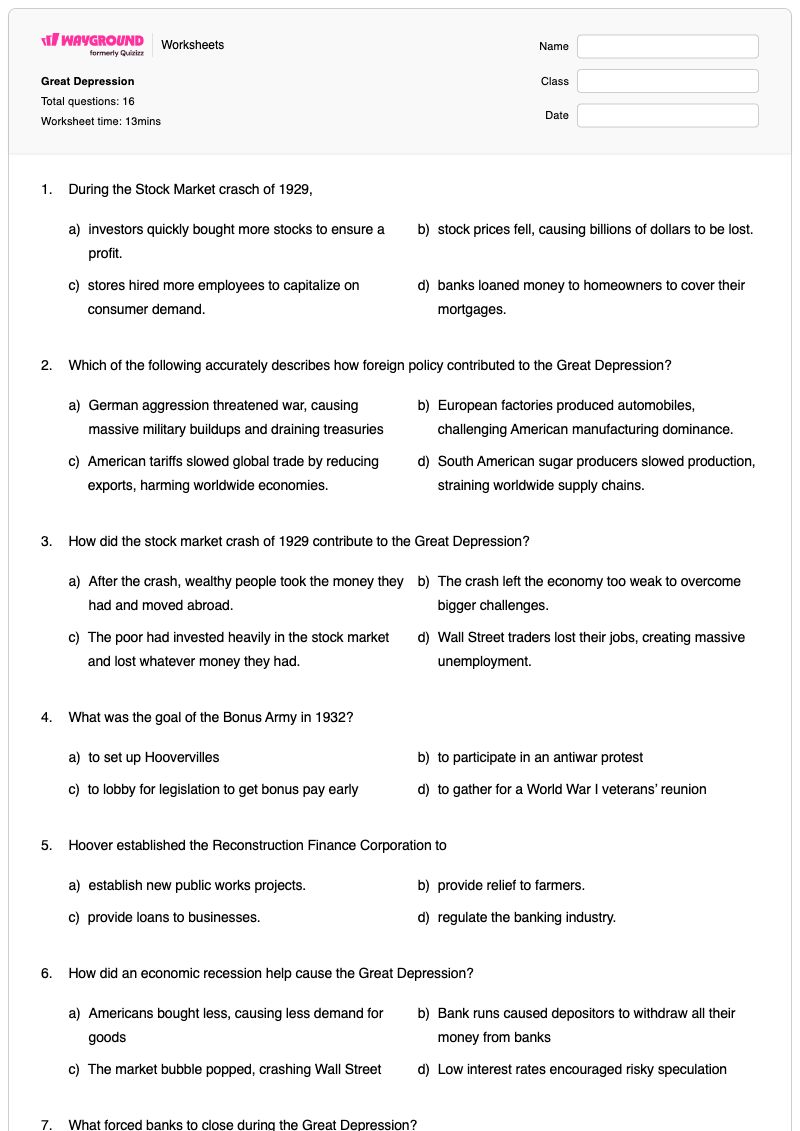
Great Depression

คำถามทั้งหมด: 16

ชื่อ
ระดับ
วันที่
1.

During the Stock Market crasch of 1929,

a)

investors quickly bought more stocks to ensure a profit.

b)

stock prices fell, causing billions of dollars to be lost.

c)

stores hired more employees to capitalize on consumer demand.

d)

banks loaned money to homeowners to cover their mortgages.

2.

Which of the following accurately describes how foreign policy contributed to the Great Depression?

a)

German aggression threatened war, causing massive military buildups and draining treasuries

b)

European factories produced automobiles, challenging American manufacturing dominance.

c)

American tariffs slowed global trade by reducing exports, harming worldwide economies.

d)

South American sugar producers slowed production, straining worldwide supply chains.

3.

How did the stock market crash of 1929 contribute to the Great Depression?

a)

After the crash, wealthy people took the money they had and moved abroad.

b)

The crash left the economy too weak to overcome bigger challenges.

c)

The poor had invested heavily in the stock market and lost whatever money they had.

d)

Wall Street traders lost their jobs, creating massive unemployment.

4.

What was the goal of the Bonus Army in 1932?

a)

to set up Hoovervilles

b)

to participate in an antiwar protest

c)

to lobby for legislation to get bonus pay early

d)

to gather for a World War I veterans’ reunion

5.

Hoover established the Reconstruction Finance Corporation to

a)

establish new public works projects.

b)

provide relief to farmers.

c)

provide loans to businesses.

d)

regulate the banking industry.

6.

How did an economic recession help cause the Great Depression?

a)

Americans bought less, causing less demand for goods

b)

Bank runs caused depositors to withdraw all their money from banks

c)

The market bubble popped, crashing Wall Street

d)

Low interest rates encouraged risky speculation

7.

What forced banks to close during the Great Depression?

a)

Huge amounts of inflation

b)

War in Europe

c)

Investors unable to pay loans and bank runs

d)

Not enough people invested in the Stock Market

8.

Why did the stock market collapse in 1929?

a)

Only wealthy Americans invested in the stock market

b)

Investors inflated prices, and then sold shares very cheap, losing money

c)

Investors refused to invest in the stock market

d)

Investors bought shares cheap, and then sold stocks at a high price

9.

Which TWO answers best describe President Herbert Hoover's presidency during the Great Depression?

a)

A very hands-on government

b)

Mostly hands-off government

c)

Largely unable to better economic conditions

d)

Created many New Deal programs

10.

Who was president when the stock market crashed?

a)

Theodore Roosevelt

b)

Woodrow Wilson

c)

Herbert Hoover

d)

Franklin Delano Roosevelt

11.

Who would lose money/their savings if the banks failed in the 1920s/30s?

a)

Speculators

b)

Big Business

c)

Everyone

d)

The working class

12.

Which of the following is NOT one of the "Root Causes" of the Great Depression?

a)

Uneven distribution of income

b)

Credit and excessive debt

c)

Mistakes by the Federal Reserves (National Banks)

d)

WWI

13.

What was one of the biggest reasons why the American economy boomed in the 1920s?

a)

mass production led to goods being made faster and an increase in supply

b)

the arrest of criminals who wouldn't stop killing people

c)

the banning of alcohol

d)

giving women the right to vote

14.
People who could no longer afford their homes were forced to live in cardboard shacks that they built in public parks. What were these shacks called?
a)
Shantyshacks
b)
Town Homes
c)
Tenement Housing
d)
Hoovervilles
15.
After the Stock Market Crash, many people lost their life savings because _______________.
a)
banks closed
b)
banks gave away their money
c)
they couldn't remember where they put it
d)
someone stole it
16.
Which of the following is a term for buying something now and paying for it later?
a)
Credit 
b)
Debit
c)
Speculation 
d)
Investment 
Waygroundแป้นคำตอบ

Great Depression

คำถามทั้งหมด: 16

1.
b)

stock prices fell, causing billions of dollars to be lost.

2.
c)

American tariffs slowed global trade by reducing exports, harming worldwide economies.

3.
b)

The crash left the economy too weak to overcome bigger challenges.

4.
c)

to lobby for legislation to get bonus pay early

5.
c)

provide loans to businesses.

6.
a)

Americans bought less, causing less demand for goods

7.
c)

Investors unable to pay loans and bank runs

8.
b)

Investors inflated prices, and then sold shares very cheap, losing money

9.
b)

Mostly hands-off government

, c)

Largely unable to better economic conditions

10.
c)

Herbert Hoover

11.
c)

Everyone

12.
d)

WWI

13.
a)

mass production led to goods being made faster and an increase in supply

14.
d) Hoovervilles
15.
a) banks closed
16.
a) Credit 

คำถามที่พบบ่อย

แบบฝึกหัดเกี่ยวกับภาวะเศรษฐกิจตกต่ำครั้งใหญ่ฉบับนี้ครอบคลุมหัวข้ออะไรบ้าง?

แบบฝึกหัดวิชาสังคมศึกษา ชั้นมัธยมศึกษาปีที่ 4 นี้ ประกอบด้วยคำถามแบบเลือกตอบ 15 ข้อ และคำถามแบบเลือกคำตอบ 1 ข้อ เพื่อประเมินว่านักเรียนเชื่อมโยงเหตุการณ์ต่างๆ เช่น วิกฤตตลาดหุ้นปี 1929 ความต้องการของผู้บริโภคที่ลดลง การแห่ถอนเงินจากธนาคาร สินเชื่อที่มากเกินไป ภาษีศุลกากร และปัจจัยอื่นๆ เข้ากับภาวะเศรษฐกิจตกต่ำครั้งใหญ่ได้อย่างไร นอกจากนี้ยังตรวจสอบความเข้าใจเกี่ยวกับการตอบสนองและประสบการณ์ในยุคของประธานาธิบดีฮูเวอร์ รวมถึงกองทัพโบนัส บรรษัทการเงินเพื่อการฟื้นฟู ชุมชนฮูเวอร์วิลล์ และผลกระทบของการล้มเหลวของธนาคารต่อเงินออมของประชาชน

ฉันจะใช้แบบฝึกหัดนี้ในการสอนเกี่ยวกับสาเหตุของภาวะเศรษฐกิจตกต่ำครั้งใหญ่ได้อย่างไร?

ใช้คำถามเหล่านี้หลังจากที่นักเรียนสร้างห่วงโซ่เหตุและผลจากความเจริญเติบโตทางเศรษฐกิจและการผลิตจำนวนมากในทศวรรษ 1920 ไปสู่การเก็งกำไร วิกฤตเศรษฐกิจปี 1929 ความต้องการที่ลดลง การล้มเหลวของธนาคาร และการว่างงาน หยุดที่หัวข้อเกี่ยวกับภาษีศุลกากรและภาวะเศรษฐกิจถดถอยเพื่อให้นักเรียนอธิบายว่าปัญหาเศรษฐกิจภายในประเทศและการค้าโลกที่ลดลงส่งผลกระทบซึ่งกันและกันอย่างไร ปิดท้ายด้วยคำถามเกี่ยวกับวิกฤตการณ์ฮูเวอร์ เพื่อให้นักเรียนแยกแยะสาเหตุของวิกฤตการณ์ออกจากมาตรการรับมือของรัฐบาลกลาง

ฉันควรระวังข้อผิดพลาดอะไรบ้างเมื่อนักเรียนทำแบบฝึกหัดเกี่ยวกับภาวะเศรษฐกิจตกต่ำครั้งใหญ่?

นักเรียนอาจมองว่าวิกฤตตลาดหุ้นเป็นสาเหตุเดียวของภาวะเศรษฐกิจตกต่ำ แทนที่จะตระหนักว่ามันทำให้เศรษฐกิจที่ได้รับผลกระทบจากปัญหาต่างๆ เช่น หนี้สิน การกระจายรายได้ที่ไม่เท่าเทียมกัน และอุปสงค์ที่ลดลงนั้นอ่อนแอลงไปอีก พวกเขายังอาจสับสนระหว่างแนวทางที่ไม่แทรกแซงมากนักของฮูเวอร์กับโครงการนิวดีล หรือเลือกสงครามโลกครั้งที่หนึ่งเป็นสาเหตุหลัก ทั้งๆ ที่แบบฝึกหัดระบุว่าเป็นข้อยกเว้น ในข้อที่เลือกได้หลายข้อ ให้เตือนนักเรียนว่าต้องเลือกคำอธิบายที่ถูกต้องทั้งสองข้อเกี่ยวกับสมัยการดำรงตำแหน่งประธานาธิบดีของฮูเวอร์

ฉันจะมอบหมายและให้คะแนนแบบฝึกหัดเรื่องภาวะเศรษฐกิจตกต่ำครั้งใหญ่ (Great Depression) นี้ได้อย่างไร?

คุณสามารถส่งแบบฝึกหัดเป็นไฟล์ PDF ที่พิมพ์ได้ หรือเป็นแบบทดสอบดิจิทัลบน Wayground ก็ได้ เฉลยคำตอบที่สมบูรณ์ช่วยให้ตรวจข้อสอบแบบปรนัย 15 ข้อ และข้อสอบแบบเลือกหลายคำตอบได้อย่างรวดเร็ว และสามารถตรวจงานที่ส่งในรูปแบบไฟล์พิมพ์ได้โดยการสแกนงานของนักเรียนด้วยแอป Wayground for Teachers รูปแบบไฟล์พิมพ์ยังช่วยสนับสนุนโรงเรียนที่ต้องการลดเวลาการใช้หน้าจอได้อีกด้วย

ฉันจะปรับแบบฝึกหัดเรื่องภาวะเศรษฐกิจตกต่ำครั้งใหญ่ให้เหมาะสมกับนักเรียนของฉันได้อย่างไร?

ในการตั้งค่าขั้นสูงของแบบฝึกหัด ให้ปรับระยะห่างระหว่างตัวอักษรหรือเลือกขนาดตัวอักษรที่ใหญ่ขึ้น เพื่อให้แบบฝึกหัดที่มี 16 ข้อนี้ใช้งานง่ายขึ้น โดยเฉพาะอย่างยิ่งสำหรับนักเรียนที่ต้องเปรียบเทียบตัวเลือกคำตอบในข้อสอบแบบปรนัย นอกจากนี้ คุณยังสามารถเปิดใช้งานแบบอักษรที่เหมาะสำหรับผู้ที่มีภาวะดิสเล็กเซีย หรือแปลแบบฝึกหัดเป็นภาษาอื่นโดยยังคงรักษาเนื้อหาคำถามเกี่ยวกับวิกฤตเศรษฐกิจ การล้มเหลวของธนาคาร นโยบายของฮูเวอร์ และชุมชนฮูเวอร์วิลล์เอาไว้ได้

ฉันจะหาแบบฝึกหัดแบบนี้เพิ่มเติมได้ที่ไหนบน Wayground?

Wayground มีแบบฝึกหัดและโจทย์ฝึกหัดมากมายให้ดาวน์โหลดฟรีในหลากหลายวิชา พร้อมไฟล์ PDF และเฉลยคำตอบ เพื่อช่วยให้นักเรียนพัฒนาทักษะและความเข้าใจในแนวคิดสำคัญๆ ดูแหล่งข้อมูลเพิ่มเติมได้ที่ https://wayground.com/en-us/worksheets